
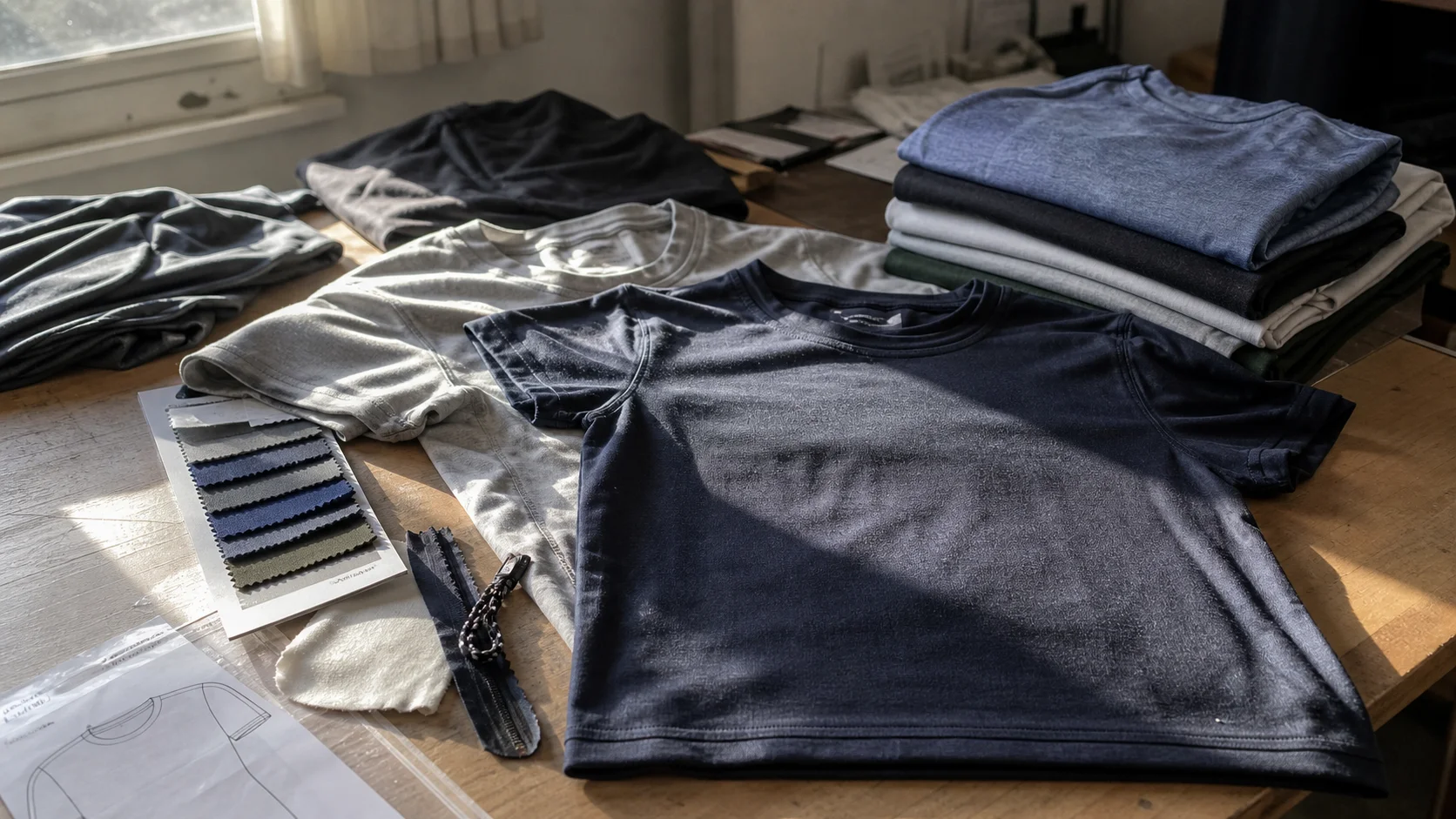
A focused outline for gym brands evaluating OEM activewear sets with size grading, covering fit specs, grading rules, tech packs, sampling, and production details that directly affect launch quality and scale.
OEM Activewear Sets With Size Grading for Gym Brands - Fabrikn production reference
OEM activewear sets with size grading for gym brands sit in a useful middle ground between fully custom performance development and simple logo placement on stock garments. For most private label buyers, that balance matters. It gives a brand more control over fit, fabric, silhouette, branding, and packaging than a blank program, while avoiding the cost and delay of building every detail from zero.
In practical sourcing terms, an OEM activewear set usually means a coordinated top-and-bottom program produced to a brand’s specification. That may include sports bras with leggings, cropped tops with shorts, fitted jackets with leggings, or men’s training tees with joggers. The supplier develops the product against an approved tech pack, pattern, graded size chart, fabric standard, trim list, and labeling requirement.
For gym brands, the key issue is not only appearance. It is repeatable fit across sizes under stretch, movement, and wash. Activewear can look fine on a sample in one size and still fail commercially once it is graded into a full run. That is where size grading becomes a buying priority rather than a technical afterthought.
Brands evaluating private label production should treat grading as part of product engineering. A set that performs well in size S but twists, sheers, compresses too aggressively, or rides down in XL and above will create returns quickly. That is especially true in women’s seamless-look leggings, high-compression bras, and squat-proof fabric programs.
If you are building a collection under the Private Label Apparel category, it helps to review the broader production scope a supplier can handle through services such as development, sourcing, sampling, and bulk manufacturing. A general overview is available at https://fabrikn.com/services/.
Size grading is the process of increasing or decreasing a base pattern into a full size range while preserving the intended fit, balance, and function of the garment. In fashion basics, grading errors may show up as minor visual issues. In activewear, grading errors often become wear issues.
A gym brand sells motion-driven garments. Customers bend, squat, run, stretch, and sweat in them. That creates more pressure on seam placement, rise depth, waistband tension, bust support, armhole shape, and fabric recovery. A pattern grade that is mathematically simple but physically unrealistic can distort the entire fit.
Here is the purchasing reality: many startups spend most of their attention on color, logo placement, and fabric handfeel, then approve a sample in one size. That is not enough. The grade rules between sizes can decide whether the set works commercially.
Good grading helps with:
Poor grading tends to create predictable problems:
For gym brands selling online, grading also affects size-chart trust. A clean product page cannot fix a poor production grade. When customers reorder, they expect the same fit block and same tolerance behavior. That repeatability is one of the strongest long-term advantages an OEM manufacturing setup can offer.
An OEM activewear set can be simple or fairly technical. The more fitted and performance-oriented the product is, the more precise the specification needs to be.
Common set combinations include:
A standard OEM specification package often includes:
Buyers should avoid vague briefs such as “same as sample but better fit.” That language creates room for interpretation, and interpretation usually creates inconsistency. Activewear production works better when the set is specified by measurable standards.
Purchasing judgment: if your set relies on compression, contour seams, or high waist shaping, ask for a graded measurement chart before bulk approval. Waiting until finished production to assess fit risk is expensive.
Most activewear programs start from a base size, often S or M for women and M or L for men, depending on target market standards. From that point, the factory pattern team or a brand’s technical designer applies grade rules to key points of measurement.
Those points may include:
The important point is that all measurements should not increase at the same rate. Activewear needs proportional grading, not blunt enlargement. A sports bra, for example, may need different grade logic for cup area, strap length, and underband elastic than a simple knit tank. Leggings may require careful control of waistband circumference versus hip expansion, especially in compressive nylon-spandex constructions.
Some gym brands choose straight-size ranges such as XS-XL. Others require extended sizing such as XXS-3XL or 4XL. Extended sizing is possible, but it should not be treated as a simple extension of the same grade rule. In many cases, fit quality improves when brands review plus-size grading separately and adjust rise depth, panel shapes, waistband construction, and support zones accordingly.
That is a commercial decision as much as a technical one. Poor extended sizing can damage brand credibility faster than offering a smaller but better-developed range. A narrower range with solid fit is often a better launch strategy than a wide range built on weak grading logic.
Buyers sourcing OEM activewear sets should expect several sample stages rather than a single sample round.
For performance-sensitive products, skipping the size set stage is risky. A single fit sample does not reveal how the product behaves across the size range. A bra that sits flat in size S may cut into the armhole in XL. A legging that looks opaque in M may become too sheer in XXL if the fabric weight and recovery are marginal.
Fabric drives much of the grading outcome in activewear. Two garments with identical measurements can fit very differently if the stretch, modulus, recovery, and fabric weight are different.
Common OEM activewear fabrics include:
Typical specification points buyers should request include:
Trim choices matter too. Waistband elastic quality, bra cup shape, underband plushness, zipper gauge, thread type, and needle selection all affect the finished set. If a factory uses a weaker elastic or changes thread tension in production, the same grade can feel tighter, looser, or less stable.
Flatlock seams, coverstitching, bonded edges, and seamless-look finishes each carry different cost and risk profiles. Flatlock can improve comfort but requires good tension control. Bonded details can look premium but may fail after washing if adhesive performance is not validated. Removable bra cups are commercially common, though they often create customer complaints unless pocket sizing and insertion quality are managed well.
Purchasing judgment: do not review grading separately from fabric. A size chart approved in one fabric may need adjustment if the factory substitutes another knit with different stretch and rebound.
For private label gym brands, the cleanest development process begins with a clear product brief and realistic commercial priorities. Most sourcing problems start when the design target, budget level, and performance expectation do not match.
A practical process usually looks like this:
Small brands often underestimate how important comment discipline is. Fit comments should be written clearly, with measurable corrections where possible. Terms like “slightly tighter” or “make more flattering” are not strong enough. Better comments identify the exact issue: reduce waistband height by 1.5 cm, add back rise depth, increase armhole coverage, or lower front neckline by a defined amount.
When reviewing suppliers for this process, it is worth checking whether they can support not just cut-and-sew production but also development, sourcing coordination, and sample management. That broader overview is usually more useful than looking at unit price alone. For company background, buyers can review https://fabrikn.com/about-us/.
MOQ, lead time, and cost vary depending on fabric sourcing, customization level, number of colorways, and whether the product uses stock or custom components.
Typical MOQ ranges in OEM activewear are often:
Those numbers are not fixed rules. They shift based on supplier setup, fabric mill requirements, and how many sizes are spread across the order. A 300-piece MOQ across eight sizes is a very different production equation from 300 pieces across four sizes.
Lead times also depend heavily on the development stage already completed. As a rough planning guide:
Stage Typical Timing Main Dependencies Proto or first fit sample 7-21 days Pattern readiness, available fabric, trim sourcing Revised fit sample 7-14 days Comment clarity, sample queue, pattern changes Size set sample 10-21 days Grade rule setup, fabric availability Bulk production 30-75 days Fabric lead time, order volume, color approvals, line capacityBrands should build margin for delays around dyeing, lab dip approvals, logo transfers, and imported trims. If the activewear set uses custom silicone logos, branded elastic, molded cups, or special packaging, the calendar extends quickly.
The main cost tradeoff is straightforward. Lower MOQ flexibility usually comes with a higher unit price. Greater customization usually increases both development time and production risk. Stock fabric can reduce lead time, but it limits color control and long-term repeatability. Custom fabric improves brand consistency, though it often raises MOQ and planning pressure.
That is why early-stage gym brands often perform best with a focused launch: fewer styles, tighter color selection, and strong fit work on core sets. Broad assortments can wait until the sizing block proves itself in sales.
Inspection in activewear should go beyond simple visual review. Stretch garments can pass a flat-table check and still fail in wear.
Common quality risks include:
From a buying standpoint, graded measurement control deserves close attention. A factory may hit average size tolerances in one size and still drift significantly in others. Size set inspection or pre-production measurement review helps catch this earlier.
It also makes sense to align tolerance expectations in writing. Activewear often cannot be controlled like rigid woven garments because stretch affects measurement method. Buyers should define how garments are measured, whether relaxed or under light tension, and what tolerance is acceptable for each point of measure.
For bulk orders, in-line and final random inspections are useful, but they work best when the product standard is already well documented. Inspection cannot rescue an unclear specification. It can only verify against one.
Choosing an OEM supplier for activewear sets should come down to technical control, communication quality, and commercial fit. Price matters, but it is rarely the only useful filter.
Buyers should ask practical questions such as:
A good supplier is not necessarily the one saying yes to everything fastest. It is often the one that flags technical conflicts early. If your requested fabric is too light for squat-proof leggings, or your grade spread is too aggressive for the chosen style, a useful manufacturing partner should say so.
That kind of caution saves money. Overpromising in development is one of the most common sourcing problems in private label activewear.
Brands that are ready to discuss specifications, sampling, and production planning can use a direct inquiry channel at https://fabrikn.com/contact-us/.
OEM activewear sets with size grading for gym brands are not just a design purchase. They are a fit-engineering purchase. The strongest private label programs are built on controlled grading, suitable performance fabric, disciplined sampling, and realistic MOQ planning.
If the goal is long-term repeat business, treat size grading as a core commercial asset. Approve the set across sizes, not just on a model sample. Match the grade to the fabric. Define measurement methods clearly. Keep the first launch focused enough that fit issues can be solved properly.
That approach is less flashy than rushing new color drops, but it tends to produce the result that matters most in this category: lower returns, better customer trust, and a stronger base for repeat production.
Get a free quote from Fabrikn — your trusted B2B clothing manufacturer with 10+ years of experience. MOQ as low as 200 pieces.
Get a Free Quote →OEM in activewear manufacturing generally refers to products made to a brand’s specification rather than sold as ready-made blanks. The brand typically controls design, measurements, grading, fabric direction, trims, labeling, and packaging to varying degrees.
Size grading is important because activewear must perform under movement and stretch. A set that fits well in one size can fail in other sizes if grading is weak, leading to returns, poor reviews, and inconsistent customer confidence.
Typical MOQs often start around 150-300 pieces per style per color for simpler programs and can move to 300-500 pieces or more for custom developments. The exact level depends on fabric source, trims, color count, and production complexity.
Yes, especially for leggings, sports bras, compression tops, and any style where fit consistency matters across sizes. Size set samples help identify grading problems before bulk production starts.
There is no single best fabric for every brand. Nylon-spandex blends are commonly selected for smooth compression and a premium handfeel, while polyester-spandex can work well for print programs and cost control. The right choice depends on fit target, opacity requirement, price point, and end use.
Sampling can take several rounds over a few weeks, while bulk production often runs roughly 30-75 days after approvals. The timeline depends on fabric lead time, trim development, color approval, order quantity, and factory capacity.