
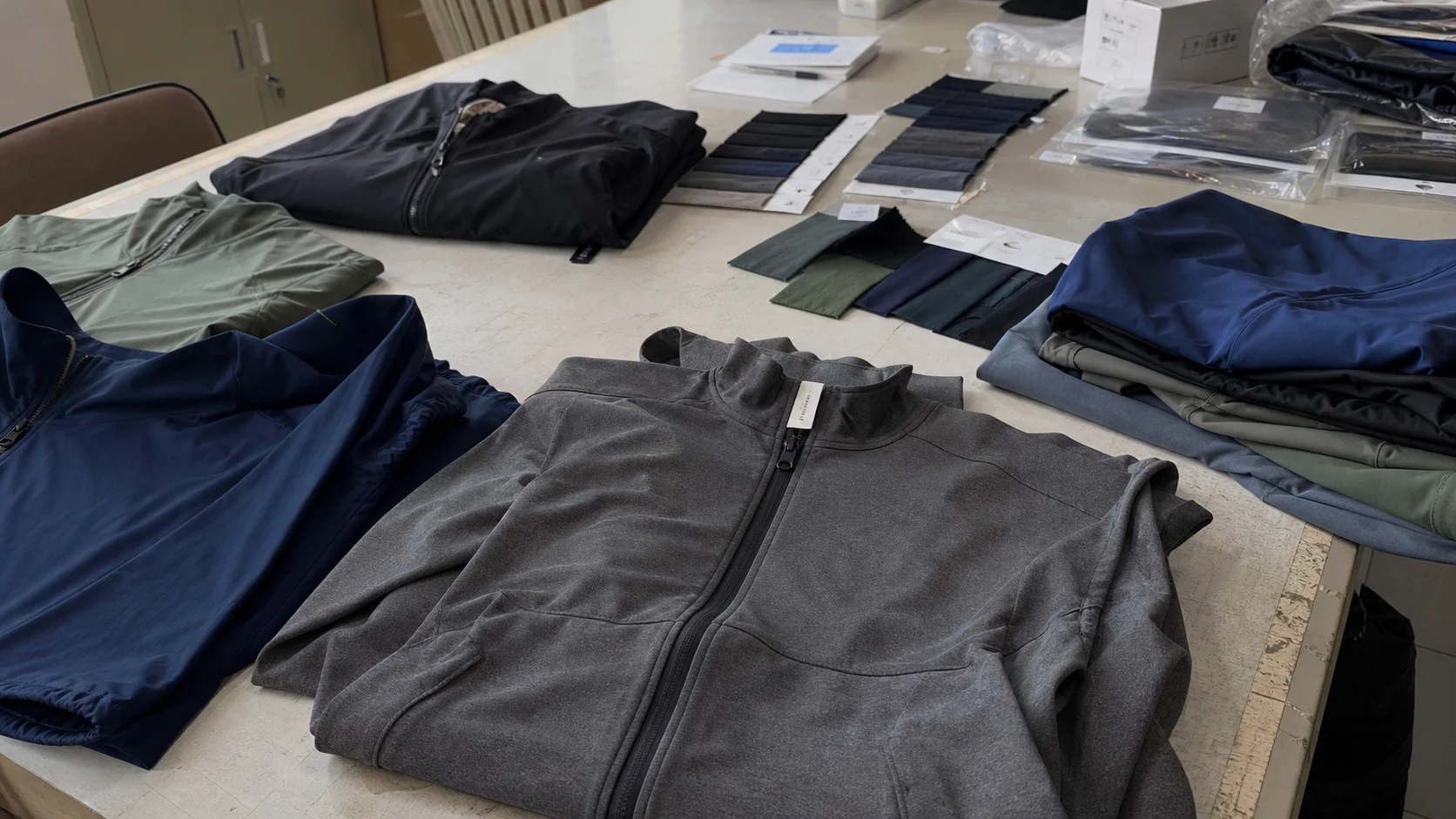
A focused outline for buyers evaluating OEM chef coats with size grading for foodservice apparel programs, covering fit consistency, grading specs, fabric performance, branding methods, and production controls specific to chef coat development.
OEM Chef Coats With Size Grading: Buyer Criteria - Fabrikn production reference
For foodservice apparel programs, chef coats are not just uniform pieces. They sit at the center of brand presentation, daily comfort, laundering performance, and workforce practicality. When buyers source OEM chef coats with size grading, the main goal is not simply to make a jacket in several sizes. The real objective is to build a repeatable size architecture that works across a broad employee base without causing excessive returns, replacement requests, or line-level complaints.
That distinction matters. A supplier can offer standard sizes from XS to 5XL and still fail on grading if the chest grows too fast between sizes, sleeve lengths do not stay proportional, or shoulder balance shifts enough to affect movement. In foodservice operations, those fit errors show up quickly. Kitchen teams bend, lift, reach, turn, and work near heat for long shifts. A chef coat that looks acceptable on a static sample form can become restrictive in actual use.
Buyers managing restaurant groups, hospitality brands, contract catering, institutional dining, and culinary schools usually need more than a generic stock pattern. They need an OEM development process that connects fit intent, size grading logic, fabric behavior, and production consistency. That is where supplier evaluation becomes more technical.
Good size grading reduces hidden cost. It improves wearer acceptance, helps procurement standardize reorders, and supports long-term brand consistency. Weak grading tends to create a different result: too many exceptions, ad hoc alterations, and a uniform program that looks orderly on paper but performs poorly in deployment.
In this category, OEM generally means the buyer controls the product concept and brand direction while the manufacturer develops and produces the garment to specification. That can include custom pattern blocks, proprietary fit standards, specific pocket layouts, fabric weights, embroidery placement, label requirements, and graded size sets tailored to the end-user program.
For chef coats, OEM work often includes:
This model gives buyers more control than off-the-shelf sourcing, but it also increases responsibility. If the tech pack, graded measurement chart, sample comments, and tolerance standards are weak, the production outcome will be weak as well. OEM can solve fit and branding issues very effectively, but only when the development process is disciplined.
Buyers that are still defining their uniform program often start by reviewing a supplier’s development support and pattern capability through a service overview. That step is useful because it clarifies whether the supplier is mainly a trading source for stock garments or whether it can actually manage custom apparel engineering.
When comparing OEM suppliers for foodservice apparel programs, buyers should judge more than price per unit. The more practical approach is to review the program against performance criteria that affect reorder stability and field satisfaction.
The first question is whether the supplier can build from an approved base size and grade out logically. A reliable supplier should be comfortable working from a measurement spec sheet with points of measure such as chest, waist, sweep, shoulder width, back length, sleeve length, bicep, cuff opening, collar stand, and armhole.
If the factory only offers pre-existing market fit without pattern adjustment, the buyer may end up forcing a stock body into a custom program. That is rarely ideal for multi-location foodservice use.
Many foodservice programs need broader size coverage than fashion outerwear. Common requirements include XXS through 5XL, with some programs extending farther. Women’s and men’s separate fits may also be required, even when the initial brief calls for unisex. Buyers should confirm early whether the supplier can grade across the full size curve without distorting proportions.
Chef coats must handle heat, repeated washing, staining risk, and active movement. Fabric choices often include poly-cotton twill, cotton-rich twill, cotton-poly blends with mechanical stretch, and lighter-weight panels for breathability. The best choice depends on the laundering model and brand image.
A lighter fabric may improve comfort, but it can also reduce opacity or shorten wear life if the construction is too light for commercial kitchens. A heavier fabric may project structure, though it can feel hot in high-temperature back-of-house settings. Buyers need a supplier that discusses these tradeoffs directly.
Chef coats are simple only at a distance. In production, collar roll, front overlap, placket alignment, topstitch consistency, sleeve setting, and snap placement all affect the finished look. When size grading changes garment dimensions, those details need to remain balanced across the entire run.
A uniform program is rarely a one-time order. New hires, staff turnover, replacement demand, and program expansion mean reorders matter almost as much as the first bulk run. Buyers should ask whether the supplier can retain patterns, approved grading rules, trim references, fabric standards, and shade continuity records for repeat production.
In chef coat sourcing, material and build details should be specified with more precision than many buyers initially expect. A vague fabric note such as “poly cotton” leaves too much room for interpretation.
For industrial or repeated commercial laundering, buyers should ask for shrinkage expectations, colorfastness performance, pilling resistance, seam stability, and dimensional recovery after wash. White chef coats look straightforward, but whiteness retention and stain-release behavior still affect replacement cost.
Each trim decision has a tradeoff. Knotted buttons can communicate traditional culinary styling but may complicate replacement management. Snaps are practical and fast in use, but snap pull-out risk needs testing if the base fabric is light. Hidden plackets offer a cleaner appearance, though they increase construction complexity and can expose front alignment issues if the pattern is not balanced.
Size grading is the heart of this buying topic. A chef coat that fits well in medium but fails in XL and 3XL is not a successful uniform product. Buyers should treat grading review as a technical approval stage, not as a routine paperwork step.
Most OEM development begins with one base sample, often medium or large depending on the target market. That sample should be reviewed on a live fit model or equivalent fit form aligned with the intended user profile. Key checkpoints include chest ease, shoulder comfort, front overlap security, arm mobility, sleeve length, collar comfort, and overall garment balance.
After the base fit is approved, the supplier applies grade increments to each point of measure. Those grade rules should not be assumed. Buyers should request a graded measurement chart and confirm that changes between sizes remain sensible for the intended workforce. Typical chest grading increments may differ from sleeve or body length increments, and plus-size grading often needs separate logic rather than simple linear extension.
This is where many programs go wrong. A supplier may grade uniformly without considering mobility, body shape distribution, or front coverage in larger sizes. The result is a coat that technically measures bigger but does not fit better.
For larger programs, size-set sampling is worth the extra time and cost. A size set usually includes several graded samples across the range, such as S, L, 2XL, and 4XL. That review helps buyers catch proportion issues before production. It is one of the best ways to reduce post-launch fit complaints.
If budget is tight, buyers can still request at least one smaller and one larger confirmation sample after base-size approval. That is not as thorough as a full size set, but it is more reliable than approving grading by spreadsheet alone.
Some brands initially request a unisex coat to simplify ordering. In practice, separate men’s and women’s fit blocks may produce better adoption, especially for front-of-house culinary concepts, visible open-kitchen teams, or hospitality groups with appearance-sensitive uniform standards. A unisex fit can lower SKU complexity, but it often sacrifices precision. Buyers need to decide whether simpler inventory or better wearer satisfaction matters more.
OEM chef coat sourcing should move through structured approvals. Skipping sample gates often leads to expensive bulk corrections.
Each stage should be linked to a formal comment sheet. Buyers should avoid verbal approvals where possible. Written approvals help protect the program when production teams, merchandisers, or procurement contacts change mid-development.
Lead times are heavily influenced by the number of sample rounds. A straightforward chef coat based on a proven block may move faster. A new pattern with broad size grading, special trims, and embroidery placements will take longer. The most common delay is not factory inefficiency. It is incomplete feedback or repeated concept changes after fit approval.
MOQ for OEM chef coats varies depending on fabric customization, trim sourcing, number of colorways, and how many sizes are included in the run. Buyers should be cautious of blanket MOQ claims because the real threshold usually changes by component.
Those numbers are directional rather than universal. The practical issue is not just total quantity. It is how that quantity is split across sizes. If a buyer orders a broad range with very low units in the edge sizes, production balancing and packing accuracy become more sensitive.
Typical bulk lead times for chef coats can fall in the range of 45 to 90 days after final approval, but this depends heavily on sourcing complexity. Buyers should treat any unusually short promise with caution unless the supplier is clearly using stock fabric, stock trims, and a previously approved block.
If you are still comparing supply-chain support options, it helps to review how a manufacturer handles development and bulk coordination through pages such as about us and capability information. Those pages will not replace a technical review, but they can help screen whether the supplier is positioned for OEM program management rather than one-off trading.
Chef coats carry a manageable risk profile, but there are recurring failure points that buyers should monitor. Most quality issues are not dramatic defects. They are consistency problems that accumulate across size ranges and reorder cycles.
Pre-production inspection should confirm fabric hand feel, color, trims, label details, and workmanship against the approved sample. During production, inline inspection is useful for catching repeat sewing issues early, especially with collars, fronts, and pockets. Final random inspection should include measurement checks across multiple sizes, not only the base size.
That last point is important. Some suppliers present acceptable measurements on central sizes while edge sizes receive less scrutiny. For graded uniform programs, inspection plans should reflect the actual risk. If 3XL to 5XL make up a meaningful share of the order, those sizes need to be actively measured and visually reviewed.
Purchasing judgment: if a supplier is strong on cost but weak on graded measurement control, the apparent savings may disappear through replacements, staff dissatisfaction, and reorder instability.
Foodservice uniform buyers often need chef coats to support a wider branded apparel program. That means the garment must work not only as a stand-alone item, but as part of a managed system.
Compliance expectations also vary. Depending on market and buyer policy, a supplier may be asked to support fabric testing, restricted-substance declarations, labeling compliance, and social compliance documentation. Buyers should define those requirements at the RFQ stage rather than after sampling. Late compliance requests often slow production or trigger avoidable material changes.
For enterprise or multi-site programs, order management becomes nearly as important as garment design. A supplier that can manufacture a good sample but cannot maintain documentation, SKU clarity, and reorder discipline may still be the wrong fit.
The strongest OEM supplier for chef coats with size grading is not automatically the one with the lowest unit cost. Buyers should weigh capability against program complexity.
Buyers should also pay attention to communication quality. Clear replies on grading logic, sample comments, tolerance expectations, and MOQ structure usually signal a more controlled OEM process. Vague replies tend to mean the technical work is not fully owned.
When you are ready to move from research into supplier discussions, a direct inquiry through contact us is often the fastest way to compare development feasibility, target quantities, and program requirements.
OEM chef coats with size grading for foodservice apparel programs should be evaluated as a systems purchase, not just a garment purchase. The visible product is a chef coat, but the real buying decision covers fit engineering, material performance, production control, and reorder stability.
A practical sourcing approach starts with a clear tech pack, a realistic size range, and an honest discussion about laundering conditions, wearer mobility, and branding priorities. From there, the supplier should prove capability through fit sampling, graded measurement review, and disciplined pre-production approvals.
The strongest programs usually balance three factors well: fit consistency across sizes, durable fabric and trim performance, and a supply partner that can maintain documentation for repeat orders. If one of those factors is weak, the uniform program often becomes more expensive than it first appears.
For buyers in Outerwear & Jackets sourcing, chef coats may look straightforward compared with more complex protective garments. In reality, size grading is where many programs succeed or fail. Buyers that take grading seriously at the sourcing stage are usually the ones that end up with more stable costs, better staff acceptance, and fewer corrective orders later.
Get a free quote from Fabrikn — your trusted B2B clothing manufacturer with 10+ years of experience. MOQ as low as 200 pieces.
Get a Free Quote →For basic custom programs using available fabrics, MOQ often starts around 300 to 500 pieces per style and color. For more customized builds with special trims, broader size sets, or custom fabric development, MOQ may move closer to 800 to 1,500 pieces. The actual threshold depends on fabric, trims, decoration, and how the size ratio is distributed.
Because foodservice teams need comfort and movement across long shifts, a chef coat must fit consistently in every approved size. Poor grading leads to restriction, poor appearance, and higher replacement rates. A good base-size sample does not guarantee good fit in larger or smaller sizes unless the grade rules are properly engineered.
Yes, especially for larger programs or wide size ranges. Size-set samples help confirm that proportions remain correct outside the base size. They cost more time and money during development, but they often reduce far more expensive fit issues in bulk orders.
There is no single best fabric for every program. Poly-cotton twill is common because it balances durability, care performance, and cost. Cotton-rich fabrics can feel more premium, while stretch blends can improve mobility. The right choice depends on laundering method, heat exposure, desired appearance, and budget.
After final sample and specification approval, bulk lead times often range from 45 to 90 days. Development can take longer if the buyer requests multiple sample rounds, size-set approvals, custom fabrics, embroidery revisions, or special packaging requirements.
Common issues include inconsistent measurements across sizes, collar and placket imbalance, snap misalignment, embroidery puckering, shrinkage after wash, and fabric shade variation in reorders. These risks are manageable when the supplier controls specs, sampling, and inspection carefully.
Sometimes, but not always. Unisex sizing can simplify inventory, yet it may not deliver the best fit across all wearers. Programs with stronger image requirements or a wide employee size profile often benefit from separate men’s and women’s blocks or at least a more refined inclusive fit strategy.