
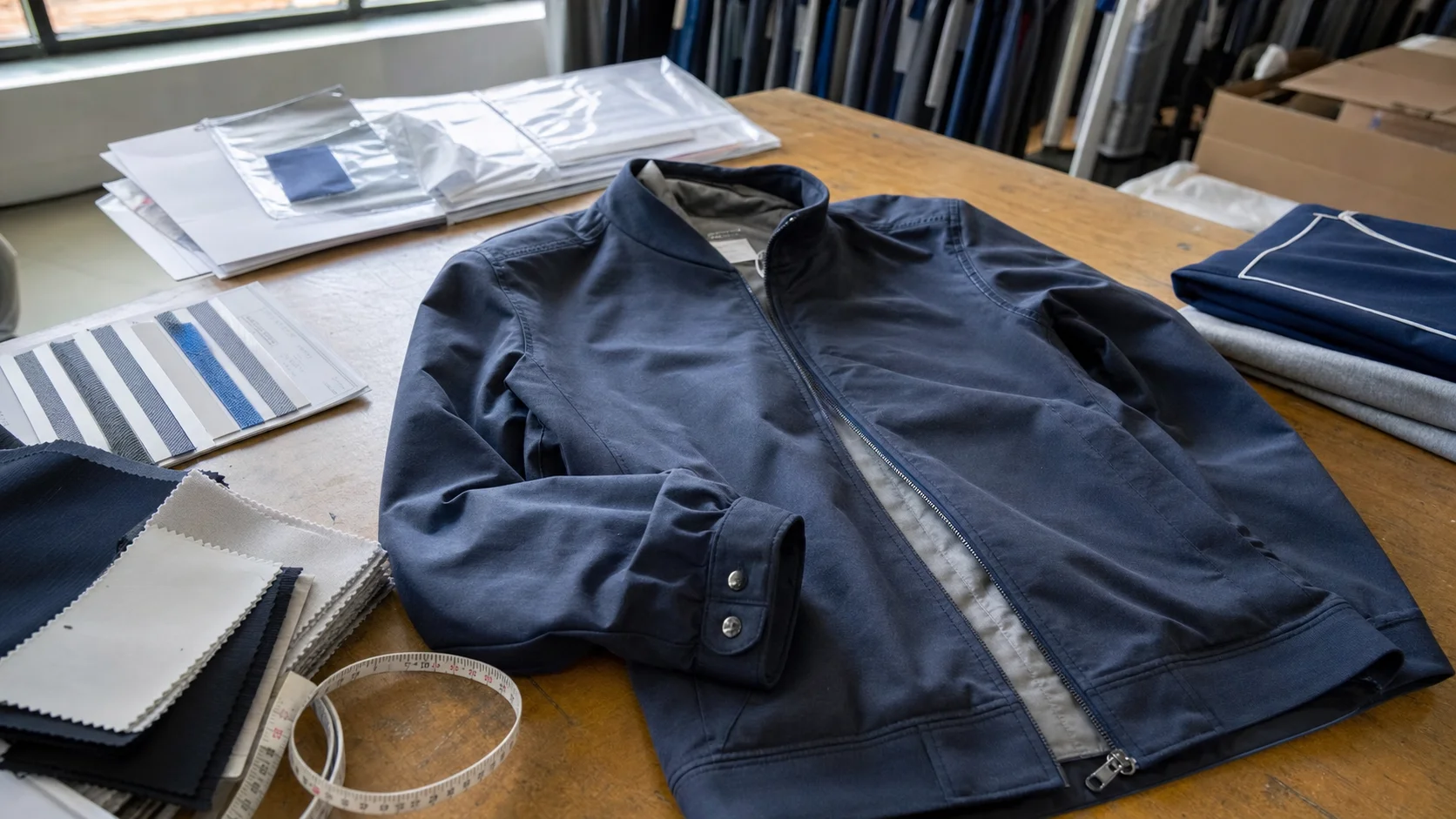
A focused outline for procurement teams managing OEM jacket orders for schools, covering safety, labeling, documentation, testing, and approval workflows...
OEM Jackets Compliance Support for School Buyers - Fabrikn production reference
School procurement teams do not buy jackets the same way a retail brand does. The brief is broader, the risk is higher, and the paperwork matters as much as the garment. When an OEM jacket program is going into a school, compliance support has to cover child safety, labeling, restricted substances, size consistency, purchase order control, and delivery timing across a school calendar that does not forgive delays.
This is where sourcing discipline matters. A jacket that looks acceptable on a sample table can still fail a school buyer’s requirements because the fabric weight drifts, the trims are wrong, the labeling is incomplete, or the factory cannot document the material chain. Procurement departments need a supplier that can handle garment development and compliance with the same level of care. That includes clear spec sheets, realistic MOQ expectations, sample approval steps, and inspection checkpoints that catch problems before they become a warehouse dispute.
School buyers usually need more than a garment. They need uniformity across sizes, repeatability across seasons, and documentation that can survive audit questions from internal stakeholders. A school jacket may be used for field trips, outdoor sports, winter wear, or student uniform programs. Each use case changes the compliance profile slightly, but the procurement logic stays the same: reduce risk, keep the process traceable, and make sure the final product can be reordered without surprises.
OEM programs are attractive because they let the buyer control the spec. That is useful when a district wants specific fabric performance, school branding, color matching, or a fixed fit block. The tradeoff is that the buyer must define the details well. The more complete the technical package, the less room there is for factory interpretation. That usually means lower rework risk and cleaner approvals, though it can also raise development time at the front end.
For school procurement departments, the strongest suppliers are not the ones that promise everything. They are the ones that can explain what they need from the buyer, what can be standardized, and what will need sample approval before bulk production starts. That is the difference between a controlled order and a late-season rescue job.
Compliance requirements vary by region, but school programs tend to center on a few recurring issues. The first is fiber content and labeling accuracy. Buyers should expect the supplier to label the garment correctly, with clear composition information, care instructions, country of origin, and size marking where required. Labels are a small detail until they become a receiving problem or a student complaint.
The second issue is restricted substances. Dyes, coatings, waterproof membranes, prints, and trims all need attention. A jacket for children or teenagers may need testing for harmful chemicals, colorfastness, and trim safety. If a school buyer has internal safety standards, those should be written into the purchase order or tech pack rather than assumed.
The third issue is physical safety. Zippers, drawcords, detachable parts, and sharp trim edges can create compliance risks. Younger age groups usually require stricter attention to cord lengths, toggle design, and small parts. A procurement department should not treat these as manufacturing details only. They are product risks that can affect acceptance.
For school programs, compliance is not a single certificate. It is a chain of controls that starts with the spec and ends with final inspection documents.
Documentation matters as much as the garment itself. Buyers should request test reports, material declarations, label proofs, carton markings, and pre-shipment inspection records where applicable. A supplier that can provide these without drama is easier to manage across repeat orders.
OEM jacket sourcing becomes easier when procurement teams focus on the specs that affect compliance, durability, and cost. The fabric shell is usually the first decision. Common school jacket options include polyester woven, polyester-cotton blends, softshell constructions, fleece-backed fabric, and insulated outerwear with quilting or padding. Each option has different cost and lead-time implications. Polyester woven styles tend to be more economical and stable in repeat production. Softshell and waterproof garments bring more performance value, but they also raise testing and trim complexity.
Fabric weight should be stated clearly. A school buyer might specify shell fabric in GSM or oz/yd, lining fabric by composition and weight, and insulation by fill weight or thickness. If the supplier is allowed to choose freely, the result may still look fine but wear differently across sizes or batches. That is a common source of dissatisfaction in uniform programs.
Trim detail also deserves attention. Zippers should be specified by type and grade, such as nylon coil, molded plastic, or metal, along with puller style and length. Snaps, Velcro, elastic, rib knit, cord locks, and reflective tape should all be written into the tech pack if they affect cost or safety. A school jacket with reflective detailing may need the reflective placement defined rather than left to the factory’s layout preference.
Fit block is another control point. School buyers usually benefit from a consistent size range and a clear grading spec. If the jacket is intended for young children, teens, or mixed-age groups, sample fitting should include the largest likely body shape within each size band. A garment that passes on one sample size can still fail at scale if grading is too aggressive or sleeve length is inconsistent.
Spec Area What to Define Common Risk if Omitted Shell fabric Fiber content, weave/knit, GSM, finish Inconsistent hand feel or performance Lining Composition, weight, color, breathability Heat retention or wear discomfort Trims Zippers, snaps, cords, reflective tape Safety issues or mismatch in bulk Labels Care, fiber content, origin, size Receiving rejection or relabeling cost Packaging Polybag type, carton marks, size breakdown Warehouse confusion and count errorsMOQ is one of the first practical questions school buyers need answered. For OEM jackets, typical MOQs often start around 300 to 500 pieces per color or style for simpler constructions, and can move to 800 to 1,500 pieces or more when the design includes custom fabric development, special waterproofing, or multiple trims. Smaller orders are possible with some suppliers, but unit cost usually rises because setup, cutting, and trim purchasing overhead are spread over fewer units.
School procurement departments need to decide whether the goal is lowest unit cost, lower inventory risk, or better spec control. Those goals do not always align. A larger MOQ may reduce the price per piece and improve material efficiency, yet it increases exposure if enrollment forecasts change. A smaller MOQ protects the budget against overbuying, but it often forces compromises on price and sometimes on fabric choice or decoration complexity.
Lead time is also tied to approval speed. A basic jacket with stock fabric might move from tech pack approval to shipment in 30 to 45 days if the supplier already has trims and fabric available. A custom outerwear style with new lab dips, sourced trims, waterproof testing, and branded labeling can easily take 60 to 90 days, sometimes longer. The real schedule depends on sample revisions, lab testing, and how quickly the buyer signs off each stage.
Procurement teams should budget for hidden timing costs. If the first sample is not approved, the whole chain moves. If the school wants a color match against an existing uniform shade, lab dip approval can add days or weeks. If special testing is required, the test slot itself can become the bottleneck. Good suppliers flag these dependencies early rather than promising a date they cannot defend.
There is also a cost tradeoff between standardization and customization. Keeping to one fabric shell, one zipper type, and a limited color set usually lowers cost and reduces approval risk. Expanding into multiple school colors, custom piping, embroidery, printed names, or removable liners raises complexity quickly. The most economical program is often the one with the fewest moving parts.
School jacket programs should follow a disciplined sample approval process. A flat sketch or catalog image is not enough. The buyer should issue a tech pack that includes measurements, construction notes, artwork placement, labeling instructions, and any compliance thresholds that matter. If there is a preferred benchmark garment, that should be measured and annotated rather than described casually.
A sensible approval sequence usually starts with a development sample or prototype. This checks shape, stitch direction, trim placement, and the basic look of the jacket. The next step may be a size set sample, especially if the order covers a wide age range. Color approval should happen separately if matching is important, because the visual acceptance of the garment can be distorted when the buyer is judging fit at the same time.
Before bulk production, the supplier should submit a pre-production sample or sealed approval sample, depending on the buyer’s process. This is the point where fabric, lining, trims, labels, and packaging should match the intended bulk order. If the buyer skips this step or treats it lightly, later disputes become harder to resolve. A sample that is not properly signed off is not protection. It is just another reference point.
One practical rule is to hold bulk launch until three things are clear: the sample is approved, the test results are acceptable, and the packing method matches the receiving team’s needs. Schools often receive on a fixed schedule and may not have time for unpacking confusion at the dock.
Inspection risk is usually less about dramatic failure and more about small inconsistencies that multiply across a large order. Measurement drift is common. Sleeves can come out short, body length can vary, and a school may reject an entire size range if the tolerance window is not respected. Outerwear is especially sensitive because layering expectations are different from basic knitwear.
Color inconsistency is another issue. A jacket program that uses multiple sizes, batches, or repeat orders can show shade variation if fabric lots are not controlled. School buyers should ask whether the supplier plans to cut all material from one lot or whether multiple dye lots will be used. That detail matters when the school needs a consistent appearance across a class year or winter season.
Trim failure also deserves attention. Zippers can snag, elastic can lose recovery, reflective tape can lift, and embroidery can distort light fabric panels. Schools generally want durable garments that hold up through repeated use and laundry cycles. That makes wash testing and abrasion testing worthwhile where applicable.
Packaging mistakes are easy to miss until the cartons arrive. Mixed sizes, missing labels, or incomplete carton marks create warehouse delays. For schools, that can turn a well-made garment into an operational headache. Inspection should include carton count, size ratio, label presence, and a check against the packing list, not just garment appearance.
A jacket order can pass a visual check and still fail in receiving if the cartons, labels, or size breakdown are wrong.
When a procurement department evaluates an OEM jacket supplier, the first question should be whether the supplier understands school buying behavior. That means they should be able to work from fixed budgets, seasonal deadlines, size runs, and compliance paperwork without requiring constant explanation. Suppliers with good process discipline usually ask better questions up front.
Look for clear answers on material sourcing, sample path, compliance testing support, and inspection procedure. A strong supplier should explain whether they source fabric internally, whether they can arrange third-party testing, and which parts of the bill of materials are fixed versus negotiable. Transparency here is worth more than a low quote that later expands through revision charges or material substitutions.
Procurement teams should also pay attention to communication quality. If a supplier cannot respond clearly on spec questions, they are unlikely to manage order changes cleanly. Delayed replies during sampling usually predict more delay during bulk production. That is not a reason to reject every slower supplier, but it is a reason to price in risk honestly.
For a broad overview of capability, it helps to review the supplier’s service structure and company profile before sending a request for quotation. Fabrikn’s services page and about us page are a useful starting point for that type of review. When a buyer is ready to discuss a school program in detail, the contact us page is the right place to begin the conversation.
School procurement departments usually get the best outcome when they run jacket sourcing in a controlled sequence. Start with the use case. Is the jacket for winter uniform wear, sports travel, staff use, or general student outerwear? That answer changes the compliance burden and the cost target. A water-resistant softshell for older students is a different sourcing exercise from a lined everyday jacket for primary school use.
Next, define the technical package in writing. Include size range, fabric composition, target GSM, trim list, label requirements, decoration method, and packaging instructions. If embroidery or print is required, define artwork files and placement dimensions early. This avoids the common problem where the factory interprets the logo location differently than the buyer expected.
Then establish the approval gate. A buyer should know in advance which sample stage is the final sign-off point and what testing evidence is needed before bulk launch. This keeps the process from drifting. In school buying, drift is expensive because it collides with term dates and delivery windows.
Finally, decide how much variation the program can tolerate. A well-run school jacket order usually benefits from simplified colorways, one or two fabric options, and standardized trims across the program. That approach reduces MOQ pressure, lowers inspection risk, and improves repeatability. Custom features should be used where they add real value, not just because they are available.
For most school buyers, the best OEM jacket program is the one that balances compliance, cost, and delivery certainty without overcomplicating the spec. The cheapest quote is not the strongest buy if it comes with weak traceability or a loose approval process. A supplier that can keep the order disciplined is usually the better commercial choice, even when the unit price is not the lowest on paper.
Get a free quote from Fabrikn — your trusted B2B clothing manufacturer with 10+ years of experience. MOQ as low as 200 pieces.
Get a Free Quote →It means supplier support for the documentation, testing, labeling, and product controls needed to make a school jacket suitable for purchase and receiving. That can include material declarations, label approval, test reports, size verification, and inspection records.
Typical MOQs often start around 300 to 500 pieces per style or color for simpler jackets. More complex outerwear, special fabrics, or custom trims can push MOQs higher, sometimes into the 800 to 1,500 piece range.
Lead times depend on sample approval speed, fabric availability, trim sourcing, and testing requirements. Stock-based styles may take around 30 to 45 days after approval. Custom jackets with new materials or additional testing can take 60 to 90 days or more.
Label accuracy, restricted substance control, trim safety, colorfastness, sizing consistency, and packaging accuracy are the most common issues. Requirements vary by region and age group, so the buyer should confirm the standard before the order is placed.
They should confirm the approved sample, lab or test results if needed, fabric and trim specifications, size breakdown, labeling artwork, carton markings, and packing method. Missing any one of these can lead to receiving problems later.
It can be, if artwork placement, stitch density, or ink application is not controlled. Decoration can affect comfort, durability, and appearance after washing. The buyer should approve artwork size, placement, and production method before bulk starts.
School jacket sourcing is not about chasing the lowest quote. It is about buying a repeatable product with enough compliance support to survive procurement review, warehouse receiving, and student wear. That is the standard that saves time later.