
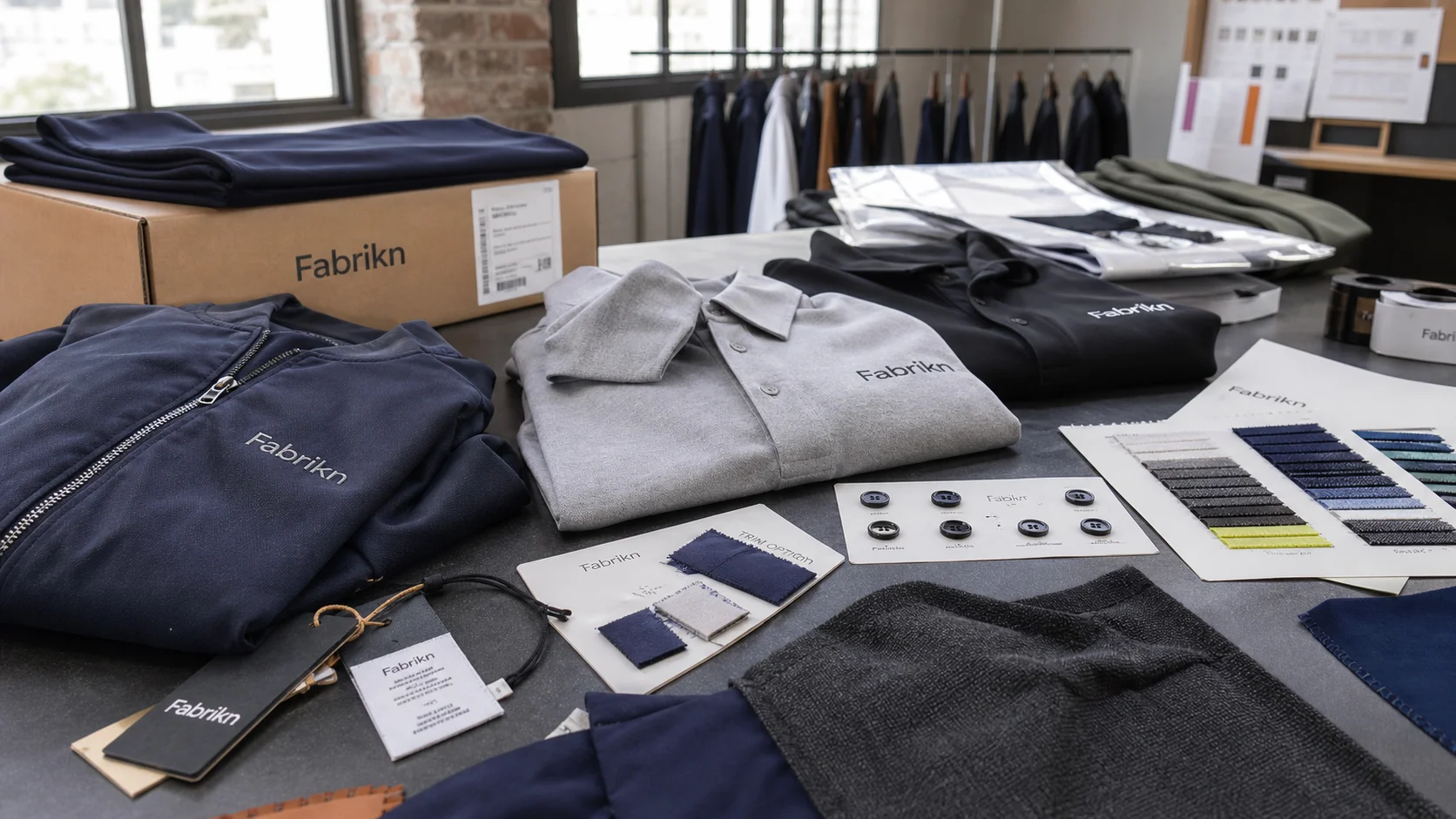
A focused outline for planning OEM tracksuits with heat transfer decoration for fitness franchise uniform rollouts, covering fit consistency, branding...
OEM Tracksuits With Heat Transfer for Franchise Rollouts - Fabrikn production reference
Franchise uniform programs are judged on consistency, repeatability, and cost control. For fitness brands, OEM tracksuits with heat transfer branding sit in a practical middle ground: they can look sharp, scale across multiple locations, and keep decoration costs lower than embroidery or multi-step appliqué work. The catch is that heat transfer only performs well when the base fabric, adhesive, and application method are specified with some discipline. A weak setup can lift at the seam, crack after laundering, or look uneven across a large rollout.
For sourcing teams, the real question is not whether heat transfer works. It is whether the decoration method fits the franchise timeline, the wash standard, and the brand’s need for visual consistency. Sustainable Fashion buyers also have to weigh material choices, durability, repairability, and the waste created by remakes. A good OEM program reduces overproduction, shortens sampling loops, and avoids decoration methods that force higher rejects.
Fitness franchise uniforms need to look uniform in the literal sense. Staff in different stores should wear garments that present the same logo size, the same placement, and the same color tone. OEM tracksuits are well suited to that requirement because the cut, fabric weight, trims, and branding can all be standardized before production starts.
Heat transfer is especially useful when the franchise wants clean branding on a performance garment. It supports small logos, large chest marks, sleeve hits, back identifiers, and role-based personalization without adding much sewing time. That matters when a rollout includes front desk staff, trainers, and regional managers, each with slightly different branding needs.
There is a tradeoff. Heat transfer is usually faster and lighter than embroidery, but it is less forgiving if the substrate is wrong. A stretchy knit, a coated fabric, or a low-quality finish can make the decoration unstable. Buyers should treat the decoration method as part of the garment architecture, not as a last-minute add-on.
Franchise programs usually fail at the details: logo placement shifts, fabric lots vary too widely, or a “sample approved” garment is not matched during mass production. A tight technical brief prevents most of that drift.
For buyers building a structured sourcing program, a supplier that offers product development, garment manufacturing, and decoration coordination under one roof is easier to manage. The process is usually cleaner when the vendor can handle pattern work, material sourcing, heat transfer application, and final packing. Fabrikn’s service pages are a useful reference point for that type of workflow: see services, about us, and contact us.
Heat transfer covers several decoration methods, and buyers should not treat them all the same. The most common options are PU film transfer, vinyl-style transfer, screen-printed transfer, and reflective transfer. Some are chosen for appearance. Some are chosen for wash resistance. Some are selected for special visibility or brand impact.
On tracksuits, heat transfer is often applied to the chest, back yoke, thigh, or sleeve. Placement matters because stretch zones and abrasion zones behave differently. A logo sitting over a high-flex area, like a shoulder seam or elbow bend, needs a more elastic transfer formulation than a static chest mark.
The best practice is to confirm the exact transfer type before sampling. Ask for the carrier film, adhesive system, and wash standard. A vague request for “heat transfer logo” is too loose for a franchise rollout. It leaves room for substitutions that may look similar in a photo but perform differently after laundering.
Buyers also need to decide whether the graphic is meant to be permanent or replaceable. If the rollout is seasonal, transfer branding can simplify small refreshes. If the brand identity is long-term and high-traffic, the decoration needs a higher wash rating and a more conservative application spec.
Tracksuits for fitness franchises are usually made in polyester knit, polyester-spandex blends, recycled polyester blends, or brushed performance fleece. The right choice depends on climate, price target, and the amount of stretch needed for staff mobility. A lightweight tricot can keep cost down. A heavier interlock or fleece can feel more premium but adds weight and drying time.
For heat transfer, fabric surface is critical. Smooth, stable knit surfaces accept transfers more predictably than textured or highly brushed surfaces. If the garment is too soft or too stretchy, the adhesive bond may weaken at stress points. If the fabric has a high spandex content, the transfer needs to move with it rather than sit on top of it rigidly.
Useful spec points to lock before quoting:
Trim quality is not a side issue. Franchise buyers often focus on the visible logo and overlook zippers, cord ends, elastic recovery, and inside labeling. Those details are where consistency problems show up first. A weak zipper pull or inconsistent drawcord color can make a program look underdeveloped even when the branding itself is clean.
Recycled polyester is attractive for sustainable fashion programs, but it should be evaluated with the same discipline as virgin polyester. Ask for recycled content verification, dye lot control, pilling performance, and transfer compatibility. Some recycled fabrics accept heat transfer well. Others show more surface variation, which can affect appearance across multiple production batches.
MOQ for OEM tracksuits varies widely by supplier, fabric availability, and decoration complexity. For franchise rollout programs, a practical range is often 100 to 300 sets per colorway for a development order, with larger production MOQs commonly starting around 300 to 500 sets or more. Some factories can go lower, but the unit price usually rises quickly, and decoration setup costs can be harder to absorb.
Sampling should be treated as a gate, not a formality. A typical approval process includes:
Heat transfer adds its own checkpoints. Buyers should confirm the transfer under actual wash and stretch conditions, not just visual inspection. A logo that looks crisp on a flat sample can still fail when the garment is bent, packed, or laundered repeatedly.
Lead time depends on a stack of variables, not a single number. Fabric sourcing, lab dip approval, transfer production, sample revisions, and packaging all affect timing. A straightforward program might move from sample approval to bulk delivery in 30 to 50 days if fabric is stocked and the artwork is final. Custom fabric, specialty transfer film, or multiple revision rounds can push that much longer.
Franchise buyers should leave time for color confirmation. Black, navy, charcoal, and deep green are often used in fitness uniforms because they photograph well and hide wear better, but those colors still need lot control. A slightly different black between tops and bottoms is obvious in a uniform rollout, especially under bright indoor lighting.
Sustainable Fashion in franchise uniforms is less about slogans and more about waste reduction and durable purchasing choices. The most practical gains often come from avoiding excessive sample rounds, ordering accurate quantities, and choosing materials that last through repeated laundering. A tracksuit that survives more wear cycles is usually the lower-impact option, even before any marketing claims are made.
Heat transfer can support sustainability when it reduces decoration waste and enables simpler customization. It can also create waste if low-quality transfers fail and require rework. Buyers should look for suppliers who can control decoration temperature, pressure, and dwell time consistently. That reduces rejects and avoids over-ordering for replacements.
Material choice matters too. Recycled polyester can improve the story, but it should come with proof and performance validation. Buyers should also pay attention to pack-out efficiency. Compact folding, reduced polybag use, and right-sized cartons can lower logistics waste, though those choices have to be balanced against moisture protection and retail presentation.
There is no value in choosing a more “sustainable” finish if the garment degrades after a short service life. A premium tracksuit that lasts longer and keeps its appearance often performs better in both operational and environmental terms than a cheaper item that gets replaced early.
Heat transfer can fail in predictable ways, and most of them are avoidable with better specs. Cracking, edge lift, color shift, and uneven gloss are common issues. On stretch garments, the most serious risk is bond failure at movement points. On dark fabrics, gloss mismatch can make logos look misaligned even when the placement is technically correct.
Some of the most common sourcing mistakes include:
Inspection risk rises when the order is split across sizes and colors. Small logos can appear centered on one size and drift on another if grading and application templates are not controlled. Buyers should ask for size-run checks, not only a single golden sample.
Garment packing can create another failure point. If freshly transferred pieces are packed too early, the graphics may block, scuff, or pick up dust. A disciplined factory will allow curing and cooling time before folding. That should be written into the production method, not assumed.
A clean sample does not prove a clean bulk order. The real control point is whether the factory can repeat the same decoration under production speed, across full size runs, and without changing film or adhesive on the fly.
Franchise buyers should issue a brief that is precise enough for quoting and production control. A useful tech pack for OEM tracksuits with heat transfer should cover both garment construction and decoration standards. That reduces back-and-forth and helps suppliers quote the real cost, not a placeholder estimate.
Spec Area What to Define Why It Matters Fabric Composition, gsm, knit type, finish, recycled content Affects hand feel, stretch, print adhesion, and cost Decoration Transfer type, size, placement, color, wash rating Controls durability and visual consistency Fit Size chart, grading, intended wearer use Affects comfort and return rate Trims Zipper grade, elastic spec, drawcord, labels Supports brand quality and wear life Packing Fold method, polybag, carton pack ratio, labeling Reduces damage and simplifies distribution Testing Wash tests, colorfastness, pilling, seam strength Reduces field failures after rolloutFor franchise programs, it is sensible to request a pre-production sample that matches the intended bulk fabric, bulk trim, and final decoration settings. That is the closest practical check before mass production. When possible, ask the supplier to produce a small pilot quantity and test it through a store-level wash cycle before approving the full rollout.
Pricing should be reviewed in context. A lower unit price can become expensive if the factory is weak on packing, if logo rework is required, or if late-stage changes slow the release schedule. On a multi-location rollout, schedule risk often costs more than the decoration premium.
Supplier selection for franchise apparel should focus on process control, not only catalog appearance. A good OEM partner can explain how they handle fabric sourcing, transfer application, sample revisions, and final QC. A weak supplier tends to answer in general terms and offers little detail on tolerances or testing.
Ask direct questions about decoration capability. Can they handle stretch fabrics without lifting at the edges? Do they test under laundering conditions? Can they keep the transfer consistent across multiple size ranges? Can they show how they separate approved samples from bulk production?
It is also worth checking whether the supplier can support both the initial rollout and the replenishment cycle. Franchise orders often start with a launch batch and then move into steady reorder flow. The second phase is where many programs expose weaknesses. If the original fabric is no longer available or the transfer supplier has changed, the uniform line can drift.
A practical supplier will also push back when the specification is unrealistic. That is a positive signal. If a buyer asks for very detailed artwork on a highly stretchy fabric, the supplier should flag the durability risk and suggest simplification. A vendor that agrees to everything without qualification is often creating a future problem.
OEM tracksuits with heat transfer are a strong fit for fitness franchise uniform rollouts when the buyer wants controlled branding, manageable costs, and a fast production path. The method works best on stable fabrics, with clear artwork, disciplined sample approval, and a supplier that understands repeat production. It is not the best choice for every garment, but it is often the right choice when visual consistency and rollout speed matter more than decorative complexity.
The strongest programs are built around clear specifications: fabric weight, logo placement, transfer type, wash expectations, and packing method. Those details are where quality is won or lost. For buyers working within Sustainable Fashion targets, the best outcome is a uniform that lasts, is replenished cleanly, and avoids waste from preventable defects. That is the standard worth setting before the first sample is cut.
Get a free quote from Fabrikn — your trusted B2B clothing manufacturer with 10+ years of experience. MOQ as low as 200 pieces.
Get a Free Quote →Heat transfer gives a clean finish, lower decoration thickness, and faster application than embroidery in many cases. It is useful for franchise rollouts that need consistent branding across multiple locations.
Many OEM suppliers quote development runs around 100 to 300 sets, with production MOQs often starting around 300 to 500 sets or more depending on fabric, color, and decoration complexity. Lower MOQs are possible, but the price usually rises.
A normal process includes a proto sample, a decoration strike-off, a size set sample if needed, and a pre-production sample. Large franchise programs may add a pilot order before bulk approval.
Smooth polyester knits and stable polyester blends usually perform well. High-stretch fabrics, heavily brushed surfaces, and coated materials need more testing because the bond can weaken under movement or laundering.
The biggest risk is inconsistency across size runs, color lots, and production batches. Logo placement drift, transfer lifting, and fabric shade variation are the issues that most often show up after bulk production starts.
Yes, when it reduces decoration waste, supports durable garments, and limits rework. Sustainable sourcing depends more on longevity, correct order quantities, and verified material choices than on decoration alone.