
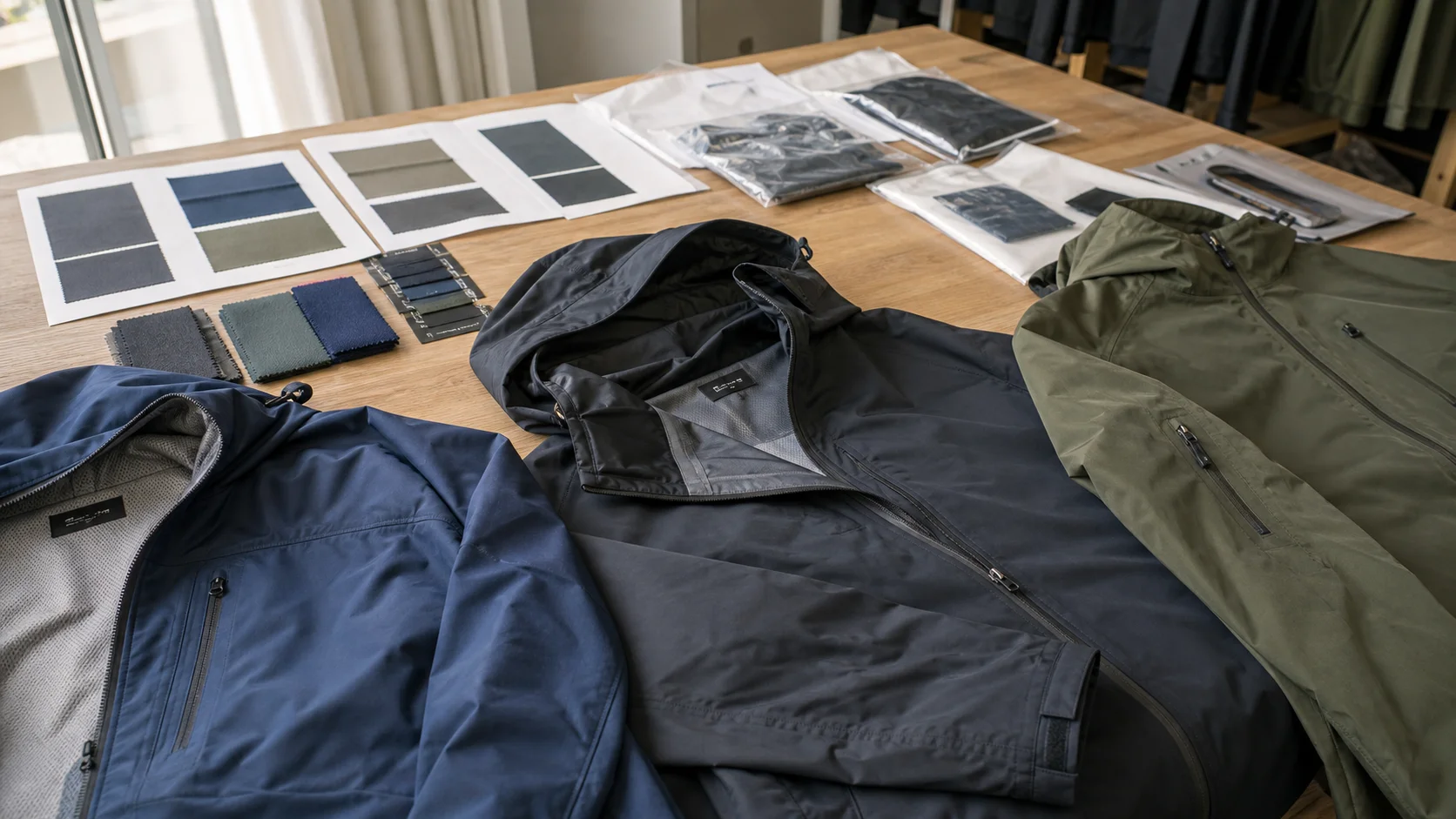
A product-specific outline for sourcing OEM training jackets with a focus on seam strength testing, failure points, test methods, and QA decisions gym...
OEM Training Jackets: Seam Strength Testing - Fabrikn production reference
For gym brands sourcing OEM training jackets, seam strength testing is not a technical sidebar. It is one of the main checks that decides whether a jacket can survive repeated wear, stretch, laundering, and abrasion in real training use. A jacket may pass a visual fit review and still fail at the seams once it is pulled over layers, packed in a gym bag, or washed after a few high-sweat sessions. That is where seam construction, thread choice, stitch density, fabric stability, and testing discipline all matter.
Training jackets sit in a difficult category. They are expected to look clean enough for team presentation, move like activewear, and last like workwear in daily use. For sourcing teams, the right question is rarely “Does it look good in the sample room?” The better question is “What happens to the seams when the jacket is worn hard, washed often, and produced at scale?”
Seam strength is the structural backbone of a training jacket. In activewear and teamwear, seams are exposed to repeated motion at the shoulders, underarms, side panels, cuffs, hems, and pocket openings. A failure in any of these areas quickly turns into a product return, a review complaint, or a wholesale claim. For gym brands, that risk is expensive because the issue often appears after the order has been shipped and the first wear cycle has already started.
Training jackets also face a wider range of stress than casual outerwear. They are worn during warm-ups, in transit, in layered outfits, and sometimes in environments where the garment is stretched more than intended. If the fabric has recovery issues or the seams are under-engineered, the product can distort even before it tears. That is why seam strength testing should be reviewed alongside fit, fabric performance, and wash durability, not after them.
Brands that source on private label or OEM programs usually want consistency across size runs and reorder cycles. A jacket that passes one lab sample and then shifts in bulk production is not a minor variation. It is a sourcing problem. The point of seam testing is to reduce that risk before production locks in.
Seam strength testing measures how much force a sewn seam can tolerate before it breaks, opens, or distorts beyond acceptable limits. In practical buying terms, it tells you whether the construction can support the jacket’s intended use. For a gym brand, the important question is not only the numeric result. It is whether the result reflects the garment’s intended stress points and the fabric system being used.
Common methods include straight-pull seam tests, seam slippage checks, and related tensile assessments depending on the product and lab standard. Some buyers use general garment strength requirements, while others ask for methods aligned with their market or retail compliance program. The exact standard should be stated in the tech pack or testing request so the supplier and lab are measuring the same target.
In a training jacket, seam strength should be reviewed together with seam appearance after stress. A seam that technically holds but puckers, tunnels, or shifts after pulling may still be unacceptable if it affects the fit line or weakens the garment over time. That is especially important on lighter woven shells, brushed tricot, stretch knit panels, and bonded or hybrid constructions.
The sourcing mistake is to treat seam strength as a single pass or fail number. In jacket development, it is a construction problem, a fabric problem, and a production control problem at the same time.
Most seam failures in training jackets start in predictable places. The first is the shoulder and armhole area, where the garment sees repeated lift and rotational stress. The second is the side seam, especially when the jacket includes stretch panels, mesh inserts, or contrast fabrics with different elongation behavior. Pocket openings are another weak point, particularly when the pocket bag fabric is lighter than the shell or the reinforcement stitching is too sparse.
Hems and cuffs deserve close review as well. If the stitch balance is poor or the needle choice damages the fabric, edge seams can fail through fraying, seam grin, or pop-out. Full-zip jackets add another risk at the zipper tape attachment and the top stop area. For OEM production, these weak points are rarely random. They usually come from a mismatch between fabric weight, stitch class, and intended use.
Panel-mixed jackets can be especially tricky. A woven body with knit sleeves, or a polyester shell combined with elastane-rich side panels, will not behave the same under stress. When fabrics stretch differently, the seam line becomes the first place to show strain. That means seam allowance, stitch type, and thread elasticity all need to be selected with the full garment system in mind.
Fabric selection drives seam performance more than many buyers expect. A dense woven polyester shell can hold seams well, but it may not flex comfortably for training use unless the pattern has enough ease or the panel layout supports movement. A stretch knit can feel better on body, but it may require more careful seam engineering to avoid breakage or seam slippage. Brushed fabrics, laminated fabrics, and water-resistant coatings add another layer of complexity because they can change needle penetration and seam behavior.
Thread is not a minor spec. Polyester thread is common for training jackets because it offers good strength and better resistance to abrasion and laundering than weaker alternatives. In some cases, textured or core-spun options are used where stretch recovery matters. Needle size, stitch density, and stitch type must match the fabric. Too dense, and the seam can perforate the material. Too loose, and the seam loses integrity under pull.
Trims matter too. Zippers, snaps, elastic tapes, drawcords, and labels can all affect seam performance directly or indirectly. A heavy zipper tape stitched into a light shell can create stress concentration. A weak elastic binding can distort an otherwise sound seam. Even heat transfer labels can create localized stiffness that changes how the garment loads during wear.
For sourcing teams, the safest approach is to define the fabric and trim specs clearly before sampling begins. That should include composition, weight, yarn type, finish, stretch behavior, and any coatings or lamination. If the jacket is intended for teamwear or high-frequency gym use, ask for all relevant components to be listed in the tech pack rather than assumed during development.
A useful testing process starts before bulk production, during sample development. The first sample should confirm pattern logic, seam placement, and the intended fabric stack. A salesman sample or proto sample can help with look and proportion, but it should not be treated as proof of production readiness. The fit sample should then verify mobility and seam placement under body movement. After that, the pre-production sample should be used for lab-oriented review and final approval.
Seam strength testing is most useful when paired with a measured construction review. Buyers should ask which seams will be tested, how the specimens are cut, and whether the test reflects the actual jacket construction. A lab result on a plain seam may not tell you enough if the production garment uses topstitching, binding, or a different seam class in the final build.
For gym brands, a practical acceptance workflow often looks like this:
That sequence sounds basic, but it is where many problems are prevented. If a supplier changes thread, needle, or subcontracted finishing after sample approval, seam performance can move outside the tested range. A disciplined approval trail reduces that exposure.
OEM training jacket MOQs vary by factory capability, fabric availability, and decoration method. A typical range for many suppliers is roughly 300 to 1,000 pieces per color or style, with some programs requiring higher volumes for custom fabric development or special trims. Lower MOQs can be possible for stock fabric programs, but buyers should expect tradeoffs in customization depth, price, and lead-time control.
Sampling usually takes more than one round when seam strength is part of the approval standard. A proto sample can take one to three weeks depending on material sourcing. Fit and revised samples may each add another one to two weeks. If the factory needs to rework seam construction, switch thread, or re-spec a zipper tape, the timeline can stretch further. Lab testing time should also be added. Buyers who skip this time in planning often end up compressing bulk production and inspection windows, which raises risk.
Lead time depends heavily on fabric booking, trim sourcing, and the number of revisions required during sample approval. Custom-dyed fabric, bonded panels, and special performance finishes can slow things down. If the program requires testing across multiple colorways, keep in mind that one approved color does not guarantee identical seam behavior in every dye lot. The safest purchasing practice is to reserve enough schedule for at least one correction round before bulk commit.
Bulk inspection should not stop at visual defects. Seam issues often show up as inconsistency rather than obvious failure. One unit may have a slightly tighter stitch, another may have skipped stitches at a curve, and a third may have thread tension imbalance that only becomes obvious after washing. Those are the early signs of a broader process problem.
Inspection points should include seam alignment, stitch density, seam allowance width, bar-tack strength, puckering, thread trimming, and any signs of needle damage. If the jacket includes bonded sections or taped seams, inspect for lift, delamination, and edge fray. A garment may look acceptable on the rack and still fail under repeat flex if the seam finish is weak.
Buyers should also pay attention to size grading. A seam that passes on a medium sample may behave differently in XXL or XS if the pattern scaling changes load distribution. That is one reason a single sample result should never be treated as the whole story for a full size run.
The most useful inspection question is simple: does this seam still look and behave the same after stress, wash, and size grading? If the answer is unclear, the order is not ready for confidence.
Not every seam needs the same level of reinforcement, but buyers should be careful about where they reduce cost. Saving on decorative topstitching may be reasonable if the seam is structurally sound. Saving on thread quality, needle control, or stitch engineering is usually a false economy. Those decisions can create returns that cost more than the original margin gained.
For gym brands, it is usually worth spending more on high-stress zones such as shoulders, armholes, pocket openings, zipper attachments, and hem joins. It is also worth paying for a better pre-production testing cycle when a jacket uses multiple fabrics or a new finishing method. Those are the kinds of styles where issues hide in plain sight until wear testing or bulk inspection begins.
Cost savings are safer in less critical areas such as label formatting, packaging simplification, or stock-colored trims, provided the product brief still meets brand expectations. A sharp sourcing team knows that the cheapest-looking decision is not always the cheapest outcome. Seam failure is a returns problem, a reputation problem, and a restock problem.
The best OEM supplier relationship is specific and documented. The tech pack should state the seam type, stitch class, thread spec, fabric weight, trim details, testing standard, and approval steps. If the supplier also offers development support, that can be useful, but the buyer still needs clear written targets. “Good seam strength” is not a spec.
It helps to ask the supplier how they control sewing consistency across production lines, whether they conduct in-line checks on seam tension and stitch density, and how they handle material substitutions if a trim or fabric is unavailable. That is especially relevant in activewear and teamwear, where styles are often reordered and buyers expect repeatability.
Brands looking for a structured sourcing partner can review the broader development and manufacturing scope on Fabrikn services, learn more about the company background on About Fabrikn, or start a project discussion through Contact Fabrikn. Those pages are useful starting points when the brief includes OEM training jackets, custom specs, and production testing requirements.
Get a free quote from Fabrikn — your trusted B2B clothing manufacturer with 10+ years of experience. MOQ as low as 200 pieces.
Get a Free Quote →It is a lab or controlled production test that measures how much force a sewn seam can take before it breaks, opens, or deforms beyond acceptable limits. For training jackets, it helps confirm that the garment can handle active wear, washing, and repeated movement.
Shoulders, armholes, side seams, pocket openings, hems, cuffs, and zipper attachments are the main risk points. Mixed-material styles can also fail where stretch fabrics meet woven panels.
A common range is about 300 to 1,000 pieces per style or color, though this changes by fabric, trim, and factory capability. Stock fabric and simpler trims can sometimes support lower MOQs.
At least two is common for a serious OEM program: a first sample to confirm structure and a revised or pre-production sample to confirm the final build. Complex fabrics or seam revisions can add more rounds.
No. It confirms one point in the development process. Bulk quality still depends on cutting accuracy, sewing control, thread consistency, fabric lot stability, and final inspection discipline.
State the fabric composition, weight, seam type, stitch class, thread type, trim details, testing standard, approval steps, and any wash or performance requirements. Clear specs reduce disputes and rework later in production.
For gym brands sourcing OEM training jackets, seam strength testing is not extra caution. It is part of basic product control. A jacket that fits well but fails at the seams will cost more than a careful program ever would.