
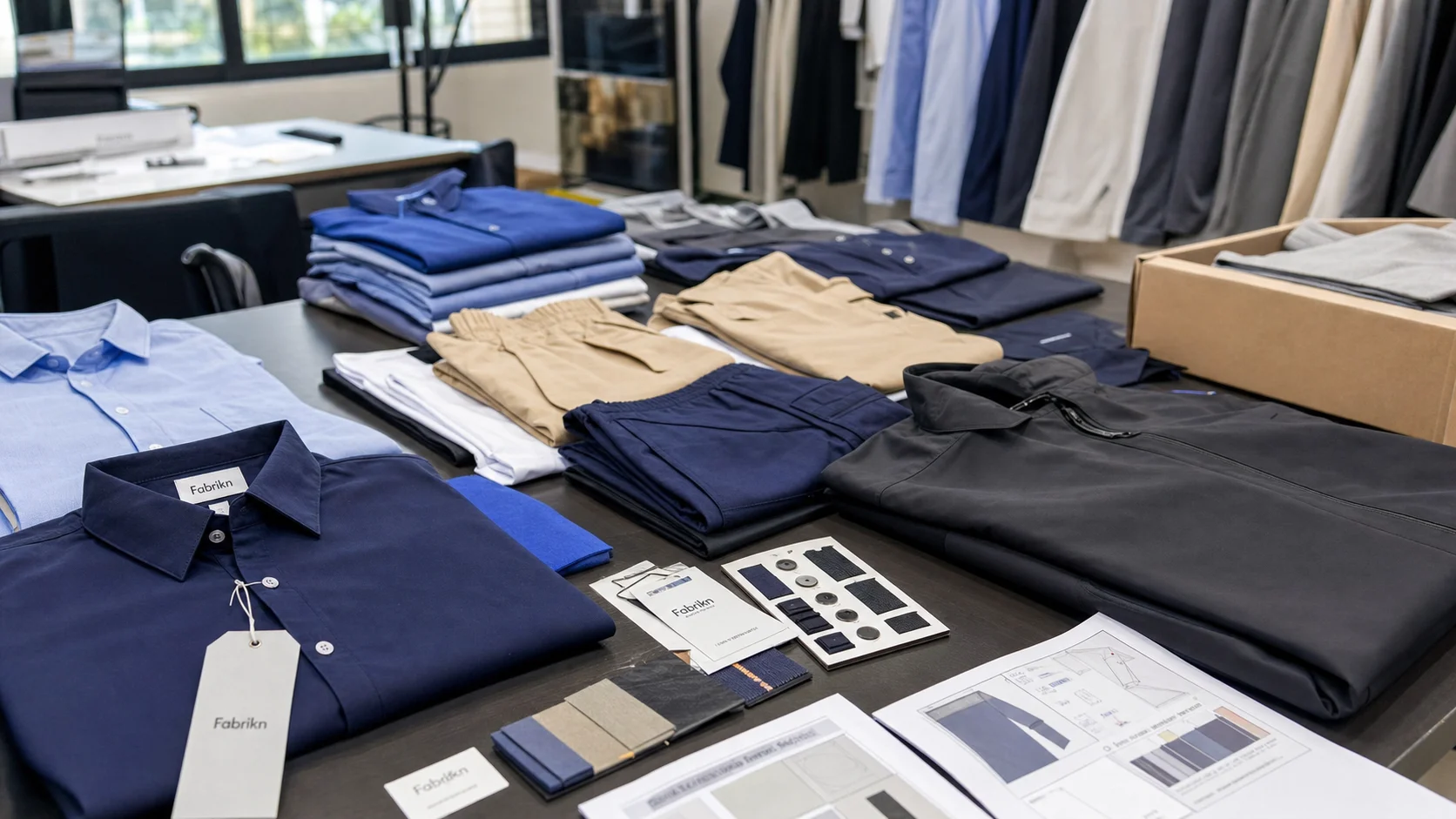
A buyer-focused outline for pricing OEM uniform screen printing for cleaning service chains, covering cost drivers, decoration setup, garment choices,...
OEM Uniforms Screen Printing Pricing for Buyers - Fabrikn production reference
Cleaning service chains buy uniforms differently from one-location operators. A chain has to think about repeat orders, regional rollout timing, consistent color control, durability after frequent washing, and the cost of decorating every size run without wasting stock. That is where OEM uniforms screen printing pricing becomes a practical sourcing topic, not just a print shop question.
For cleaning service chains, screen printing is often used on T-shirts, polos, work tees, sweatshirts, aprons, and lightweight outerwear when the goal is visible branding at a controlled cost. The price is shaped by garment type, print location, ink system, artwork complexity, order quantity, and how much approval and inspection work sits between sampling and bulk production. Buyers who understand those drivers usually get more predictable landed costs and fewer surprises during rollout.
Screen printing pricing is usually quoted on a per-piece basis, but the real pricing structure is built from several parts. For OEM uniforms, the factory or decorator may quote the blank garment, printing charges, setup or screen fees, color matching, packaging, and freight separately. Some suppliers bundle those costs. Others break them out to make the quote look lower at first glance. Buyers should compare landed cost, not just print price.
The main variables are straightforward, but they add up quickly:
For cleaning service chains, the real budgeting issue is not one shirt. It is the full program. A uniform plan may need staff tees, supervisor polos, seasonal jackets, and replacement stock for turnover. Pricing should be reviewed by role, not only by style.
Most OEM screen printing quotes for uniforms follow a pattern: garment cost plus print cost plus fixed setup. The setup component matters most on smaller runs. Once order quantities climb, the print cost becomes the more visible part. Buyers often ask for a per-piece rate, but that only works if the supplier has already factored in all setup and prep work.
In practical terms, a basic short-sleeve cotton tee with one-color screen print usually sits at the lower end of the market. Add a second print location, switch to a performance fabric, or ask for tighter color matching, and the price climbs. Polo shirts for service crews generally cost more than tees because the base garment is more expensive and the print surface can be less forgiving.
Below is a rough buying view, not a universal factory quote. Actual pricing varies by country of origin, fiber content, garment weight, brand requirement, and freight method.
Item Type Typical Decoration Common Pricing Pressure Buyer Note Basic cotton tee 1-color chest print Lowest base cost Best for high-volume staff issue Performance tee 1-2 color print Fabric compatibility and ink adhesion Better for hot climates and mobile crews Polo shirt Left-chest logo Higher garment cost Looks more polished for client-facing roles Sweatshirt Front or back print Larger ink laydown and setup Seasonal replacement planning matters Apron or overshirt Chest logo or name lockup Special fabric handling Useful for detail crews and supervisorsThere is a tradeoff in every direction. The cheapest garment can produce more replacement cost if it fades, pills, or shrinks after repeated laundering. A better uniform fabric may cost more up front, but it can reduce reorders and improve how the brand looks in the field.
MOQ is one of the first numbers buyers should pin down. For OEM uniforms with screen printing, typical minimums often start around 100 to 300 pieces per design, though some suppliers will go lower at a higher unit price. Larger factories may prefer 500 pieces or more for efficient production. The exact MOQ depends on the fabric, the print count, the number of sizes, and whether the garment is stock-supported or custom-made.
Cleaning service chains rarely need one uniform per employee. They need enough inventory to cover onboarding, damage replacement, size swaps, and regional expansion. That means a practical order plan usually includes:
Order quantity affects more than unit price. It changes screen setup efficiency, print line scheduling, and whether a supplier can hold color consistency across repeated runs. A chain that reorders every few weeks can get trapped in inconsistency if the supplier does not retain approved art, ink formulas, and garment references carefully.
For buyers comparing options, it is worth asking whether the supplier can support repeat production from archived specs. That matters when multiple branches need the same branding six months later. It also reduces the risk of subtle logo drift.
Sampling is where many uniform programs are won or lost. Screen printing on uniforms is not just about the artwork landing in the right place. It is also about how the print behaves on the chosen fabric after wash testing, whether the logo stays legible on darker garments, and whether the bulk piece matches the approved sample closely enough for field use.
A cautious sample flow usually includes these steps:
For cleaning service chains, the sample should be judged in a real work context. A logo that looks acceptable on a desk can be too small to read in the field. A print that looks sharp on the first day may soften after repeated commercial laundry cycles. The right approval standard is not showroom appearance. It is service durability.
Buyers should not approve a uniform program on artwork alone. The blank garment, print method, and wash performance need to be approved together, or the first bulk shipment can miss the mark in ways that are expensive to correct.
Fabric choice has a direct effect on screen printing pricing because not every textile behaves the same way. Cotton is generally easier for screen printing. Polyester and blended performance fabrics can require special inks, lower curing temperatures, and tighter process control. That raises risk and often raises price.
Common spec decisions that influence cost include:
Cleaning service chains often need garments that survive high wash frequency, exposure to chemicals, and heavy movement. That makes cheap fabric a false economy in many cases. A low-cost tee that fades or distorts after a short run of laundering can create a bigger total cost than a better-made blank.
Screen print ink choice matters too. Standard plastisol is common on cotton and many blends. Water-based inks can feel softer, but they may not be the best choice for every garment or every wash requirement. High-opacity ink may be necessary on dark garments. Stretch inks can help on fabrics that move more. Each choice affects both cost and process control.
Lead time depends on more than decoration speed. Buyers should think in layers: artwork approval, blank garment availability, sampling, print setup, bulk production, inspection, and freight. Any one of those steps can become the bottleneck.
A typical lead time for OEM uniforms with screen printing can range from a few weeks to longer, depending on the level of customization. Stock blanks with simple decoration move faster. Custom fabrics, special trims, and multiple approval rounds take more time. If a chain is rolling out a new branch network, the risk is usually not print time alone. It is delay at the approval stage or shortage of a preferred size curve.
Three things tend to slow projects down:
Buyers should also ask whether the supplier has a stable reordering process. The first order may be manageable. The second or third order often exposes weak file control, lost print references, or inconsistent blank sourcing. A chain needs repeatability more than novelty.
For service uniforms, a slightly longer lead time is often worth it if it means stronger spec control. Rushing production on a critical rollout can create more problems than it solves.
Inspection risk is easy to underestimate because the logo may look fine on a single piece, while the bulk order still contains defects. The common failure points are familiar: misaligned prints, inconsistent ink density, smudging, missed placements, garment shade variation, size tolerance problems, and damage from curing or packing.
For cleaning service chains, the most costly defects are usually functional rather than cosmetic. A shirt that fits poorly, shrinks too much, or loses legibility after washing can undermine uniform consistency across a branch. That can also affect staff acceptance. Crew members are more likely to wear a garment correctly if it fits well and feels durable.
Useful inspection checks include:
A buyer should also decide whether final inspection should happen at the factory, through a third party, or both. For routine replenishment of simple styles, internal QC may be enough if the supplier has a reliable track record. For a new program or a large rollout, a more formal inspection step is usually justified.
Do not ignore packaging. Mixed sizes, wrong branch labels, or missing cartons can create real operating cost even when the garments themselves are acceptable.
The right pricing strategy depends on how the chain uses uniforms. A front-desk or supervisor garment should usually aim for a cleaner presentation and a more stable fabric. Crew issue items should favor durability, wash resistance, and easy replacement. There is no reason to overbuild every SKU in the program.
For a typical cleaning service chain, the most sensible split is often this:
That approach keeps screen printing costs under control while preserving a professional look. It also makes reordering simpler. Fewer artwork variations mean fewer chances for error.
A buyer should also compare screen printing against other decoration methods. Screen printing is usually strong on cost for volume runs and simple logos. Embroidery may look sharper on certain garments, but it can cost more and may not be ideal for lightweight tees. Heat transfer can be useful for small runs or variable names, though durability and wash behavior should be checked carefully. The cheapest decoration method is not always the cheapest program.
For supplier evaluation and broader sourcing support, see fabrikn.com/services/, and use fabrikn.com/contact-us/ when you are ready to request a quote or sample discussion. Company background and sourcing approach are usually easier to assess through fabrikn.com/about-us/ before moving into production.
Before placing an OEM uniform screen printing order, buyers should lock down the following points in writing:
That checklist protects the buyer from a common problem: a quote that looks competitive but leaves too many details open. In uniform programs, unresolved details usually become cost later, not savings.
OEM uniforms screen printing pricing for cleaning service chains is best managed as a program, not a one-off print order. The base garment, decoration complexity, MOQ, and approval flow all affect the final number. A chain that defines its specs early and limits unnecessary variation usually gets better pricing and fewer production headaches.
The most reliable buying move is to price the full life of the uniform: sample development, bulk production, inspection, freight, and replacement. That gives a truer answer than comparing unit print cost alone. Cheap quotes are easy to find. Consistent, repeatable uniforms that survive the job are harder to source and worth more when the rollouts start scaling.
Get a free quote from Fabrikn — your trusted B2B clothing manufacturer with 10+ years of experience. MOQ as low as 200 pieces.
Get a Free Quote →Typical MOQs often start around 100 to 300 pieces per style and design, though some suppliers can go lower at a higher unit cost. Larger runs usually improve pricing and reduce setup cost per piece.
Because the garment has to survive repeated washing, movement, and daily wear. If the blank fabric shrinks, fades, or distorts, the print cost becomes a secondary issue.
Basic cotton tees are usually the most cost-effective. Polos and performance fabrics cost more but can be better suited to client-facing roles or hotter work environments.
At minimum, buyers should approve the artwork placement, garment spec, print sample, and wash performance. Pre-production sign-off should happen only after those checks are complete.
Misaligned prints, color inconsistency, shrinkage, poor wash resistance, wrong size packing, and damage during curing or shipping are the most common issues.
It depends on the garment and use case. Screen printing is often better for volume tees and simple logos. Embroidery can work well on polos and outerwear, but it usually costs more and is not always the best fit for light fabrics.