
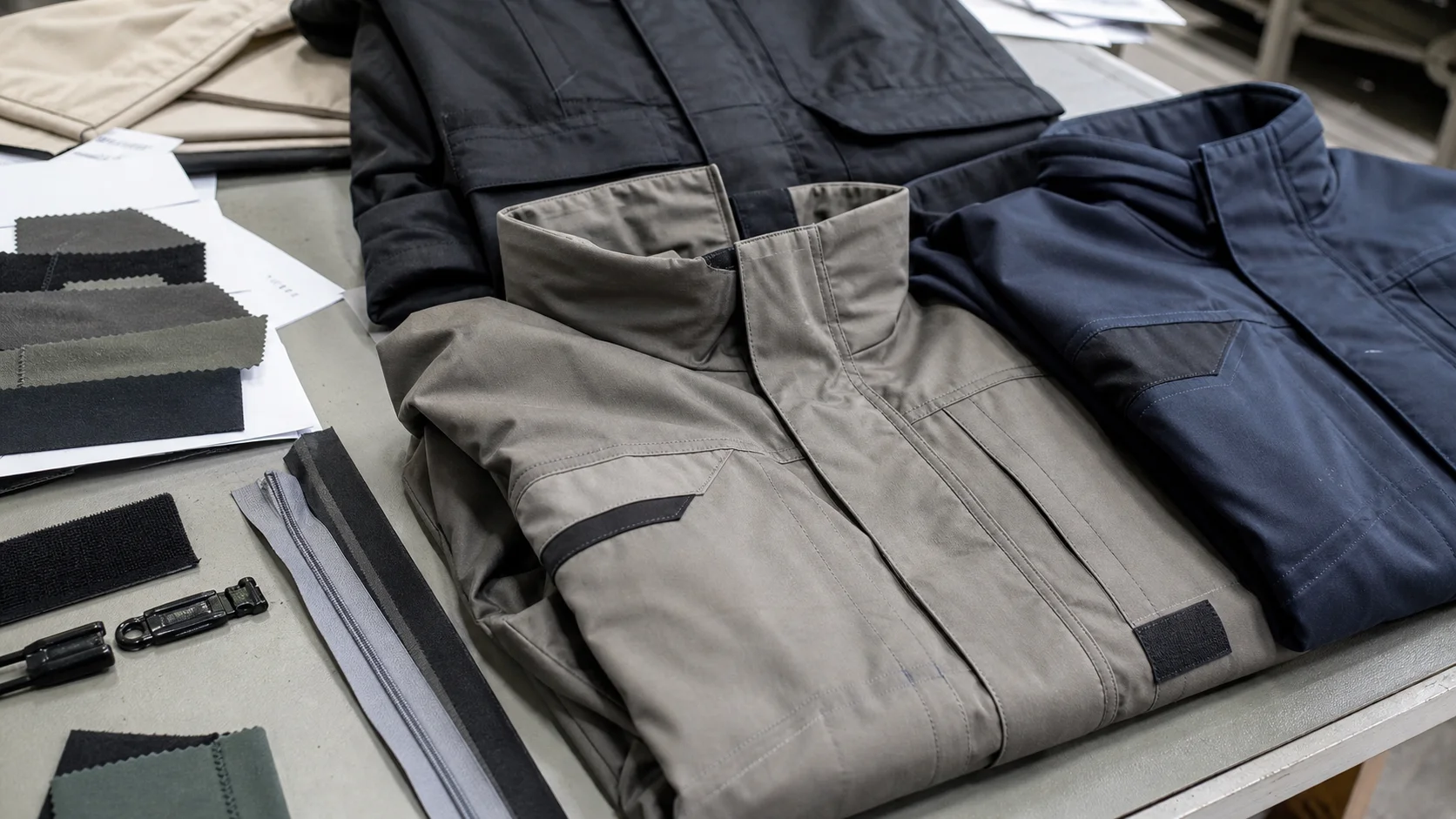
A product-specific SEO outline for buyers sourcing OEM workwear coats, with a focus on trim packages, logistics supervisor uniform requirements, and production details that affect fit, durability, and compliance.
OEM Workwear Coats Trim Sourcing for Buyers - Fabrikn production reference
Trim sourcing is often where workwear programs become either stable and repeatable or expensive and inconsistent. In logistics supervisor uniforms, the coat itself gets most of the attention at the start of development, but trim decisions usually determine how the garment performs in day-to-day use. Zippers, snaps, reflective tapes, drawcords, hook-and-loop closures, labels, patches, cuff components, and reinforcement details all affect durability, appearance, safety, and replenishment planning.
For buyers sourcing an OEM workwear coat trim package, the question is not simply where to buy trims at the lowest quote. The better question is whether the supplier can control specification consistency across production runs, color continuity, safety requirements, and lead-time risk. That is especially important for logistics supervisor uniforms, where garments need to look professional, hold up under frequent wear, and support practical jobsite movement across warehouse, yard, dock, and transport environments.
In the Activewear & Teamwear category, workwear coats for supervisors sit in a specific position. They need a cleaner visual standard than basic industrial outerwear, but they still have to function as equipment. That changes the trim sourcing strategy. Buyers often need stronger branding control, more reliable shade matching, and more disciplined documentation than in a simple promotional jacket order.
A capable sourcing partner should help manage trim compatibility with shell fabrics, insulation, seam construction, wash expectations, and logo execution. If you are evaluating manufacturing support for development or bulk production, a practical starting point is to review available OEM capabilities and process support through pages such as /services/ and discuss commercial details through /contact-us/.
Logistics supervisors are typically moving between operational zones and office-facing responsibilities. Their uniforms often need to project authority while still working in active environments. That balance puts real pressure on trim selection.
A decorative zipper with poor tape strength may fail early in a cold-weather coat. A reflective trim with the wrong stitch application may tunnel or peel after repeated washing. A low-grade snap finish may corrode if garments are used in wet loading areas. None of these issues are dramatic during proto sampling, yet they become costly in bulk.
Buyers should treat trims as functional components with measurable specifications rather than accessory items. The main purchasing objective is to build a trim package that fits the end-use profile:
That is why experienced OEM suppliers usually request more than artwork and a size breakdown. They should ask about use conditions, wash method, expected life cycle, closure preference, branding method, and whether the uniform program requires continuity for future top-up orders. If a supplier does not press for those details, the buying risk rises.
Zippers are usually the highest-risk trim in workwear coats because they combine mechanical stress, repeated use, and visual importance. For logistics supervisor outerwear, common options include nylon coil zippers, molded plastic zippers, and metal-look front zippers where aesthetics matter more than heavy-duty industrial use.
For many buyers, a medium-to-heavy nylon coil or molded zipper offers the best balance of cost and reliability. Metal zippers can look premium, but they add weight and may not be the most practical choice for cold-weather uniforms if corrosion or stiffness is a concern. Buyers should confirm:
Front plackets with snaps or hook-and-loop can add weather protection, but they also introduce alignment risk. If the placket is poorly set, the coat front will twist, gap, or look uneven. That is a trim-and-construction issue, not only a sewing issue.
Not every logistics supervisor coat needs full high-visibility certification, but many programs still require reflective details for low-light movement around loading bays, truck yards, or early-morning shifts. Reflective tape selection should be matched to the actual compliance target. A non-certified decorative reflective trim should not be treated as a substitute for certified visibility components where safety standards apply.
Buyers should specify:
Sew-on reflective tape is often more stable for rugged outerwear, though it can add stiffness. Heat-transfer reflective trims can provide a cleaner appearance, but adhesion performance depends heavily on shell fabric surface, coating, and wash conditions.
Supervisor uniforms often need clearer visual hierarchy than standard teamwear. That can include woven main labels, printed care labels, size pip labels, rubber badges, embroidered patches, rank tabs, or chest name solutions. The tradeoff is straightforward: more branding trims create better identity control, but they also increase development complexity and replenishment risk.
For long-running programs, buyers usually benefit from keeping branding trim formats standardized across styles. If every coat uses a different badge backing, patch size, or label fold, repeat ordering becomes slower and more error-prone. A disciplined OEM supplier should recommend rationalization where possible.
These are smaller trims, but they often drive complaint rates. Snap strength that is too high can damage placket fabric during removal. Hook-and-loop that is too aggressive can catch knit cuffs or inner linings. Drawcord stoppers can crack in cold conditions if the resin grade is weak. Elastic cords may lose recovery if heat aging is not considered.
For workwear coats, practical buyers will request specification details such as:
Not all trim sourcing is visible. Seam tape, binding tape, pocketing reinforcement, hanger loops, shoulder epaulettes, cuff ribs, and internal storm-cuff components all matter. In coated or insulated supervisor coats, these details influence comfort and wear life. Buyers who focus only on the visible trims often miss the components that fail first in use.
A trim sourcing supplier for OEM workwear coats should be evaluated as part of the full manufacturing system, not as a standalone trader. The real issue is whether the supplier can convert trim specifications into repeatable production outcomes.
There are a few practical checkpoints worth using during supplier selection:
One useful buying test is to ask how the supplier handles a discontinued zipper slider finish or a reflective tape delay during bulk production. A strong supplier should discuss substitution approval rules, risk timing, and how the trim change would be documented. A weak supplier often answers only with price or availability.
Buyers comparing vendors may also want to review company background and sourcing orientation through pages such as /about-us/. That does not replace technical due diligence, but it helps frame whether the partner is structured for OEM development support rather than simple resale.
Trim problems usually start in development when approvals are rushed. A reliable OEM workwear coat program should move through a controlled sequence rather than skipping directly from tech pack to bulk.
For logistics supervisor uniforms, the pre-production stage is where buyers should pay close attention. A coat may fit correctly but still be commercially wrong if zipper pullers feel too lightweight, reflective placement looks uneven, badge stitching puckers the shell, or snaps are misaligned. Those are not minor details. They affect field acceptance and repeat order confidence.
Buyers should ask for a trim card that includes actual production-intended components, not only swatches or supplier names. Each trim should be tied to a code, size, color, finish, and placement reference. When repeat orders begin six or twelve months later, that record becomes essential.
Practical sourcing judgment: a sealed sample without a sealed trim list is incomplete approval. Many repeat-order mistakes happen because garment appearance was approved visually, but the component standard was never documented in enough detail.
MOQ and lead time in trim sourcing can reshape the whole coat program. Buyers often focus on garment MOQ, but custom trims may set the real commercial threshold.
Typical MOQ ranges vary by item and customization level:
These ranges are not fixed rules. They shift with supplier base, trim complexity, branding requirements, and whether stock alternatives are acceptable. Still, they are useful for budgeting and negotiation.
Lead times are equally variable. Stock trims may be ready quickly, while custom molded, dyed, printed, or plated trims can extend development by several weeks. Buyers should separate lead time into distinct buckets:
For workwear coats, a practical planning assumption is that custom trims can become the critical path if approvals are delayed or if special finishes are involved. That is one reason many experienced buyers simplify trim architecture in year one, then upgrade selectively after the program is stable.
Trim quality failures usually look small at first. In bulk, they can cause claims, delayed shipment, or poor wearer adoption. Buyers sourcing logistics supervisor coats should watch for the following risk areas.
Black is not always the same black. Navy is even more difficult across mixed materials. Zipper tape, woven labels, hook-and-loop, webbing, and shell fabric may all drift in shade. If a uniform program is image-sensitive, buyers should define color standards early and ask whether components can be matched to Pantone reference, physical swatch, or in-house standard. Exact matching across different substrates is not always realistic, so the better goal is acceptable tolerance backed by approval.
Slider breakage, snap pull-out, reflective peeling, and weak stopper locking are common failure types. These issues often trace back to under-specified trims or poor compatibility between trim and garment construction. A strong inspection plan should include incoming checks for appearance, count, dimensions, finish, and basic function before trims are released to the line.
Even when coats are not heavily laundered, trims still face wear cycles, weather shifts, friction, and storage pressure. Hook-and-loop contamination, badge edge lifting, coating cracks on logos, and reflective surface wear can all show up faster than expected. Sample approval should include realistic handling expectations, not just tabletop inspection.
This is one of the biggest sourcing concerns in OEM programs. If a specified trim becomes unavailable, some factories or intermediaries may propose a substitute late in the process. A substitute can be acceptable, but only if it is formally reviewed for performance, color, dimensions, and visual impact. Silent substitution is where uniform programs lose consistency.
Direct purchasing view: if a trim is business-critical, ask for pre-booking or reserve stock options before bulk starts. That may increase commitment, but it can protect delivery dates on recurring programs.
Supervisor coats often sit between safety garment logic and corporate identity logic. Buyers need both sides under control. A trim package should support any applicable safety requirement without compromising brand appearance or replenishment practicality.
If visibility or protective standards apply, the supplier should be clear about which trim component carries the requirement and how it is documented. Buyers should not assume that a reflective-looking trim is compliant, or that all closures perform equally under cold, wet, or high-use conditions.
On the branding side, the smartest approach is usually controlled restraint. Too many custom trims can lock the buyer into higher MOQs, longer lead times, and more complicated stock management. For many logistics supervisor uniform programs, the strongest structure is:
This approach keeps the visual hierarchy clear while controlling complexity. It also makes it easier to scale across depots, regions, or seasonal replenishment cycles.
Before confirming an OEM workwear coat order, buyers should be able to answer the following questions:
If the answer to several of these questions is no, the sourcing program is not fully controlled yet. In practice, trim discipline is one of the clearest signs of whether an OEM supplier is ready for serious uniform business or only for opportunistic production.
OEM workwear coats for logistics supervisor uniforms demand more from trim sourcing than many buyers first expect. The garment may look straightforward, yet closures, visibility details, badges, labels, cords, and reinforcement components all shape the coat’s performance in the field. The right sourcing decision is rarely the cheapest trim offer. It is the trim package that can be documented, tested, approved, repeated, and delivered without avoidable surprises.
For buyers in Activewear & Teamwear, the strongest sourcing strategy is to combine technical trim specification, disciplined sample approval, realistic MOQ planning, and clear substitution control. That creates a more stable outerwear program and reduces quality disputes later. If you are reviewing OEM support for workwear or team uniform development, it makes sense to start with manufacturing scope at /services/ and open a sourcing discussion through /contact-us/.
Get a free quote from Fabrikn — your trusted B2B clothing manufacturer with 10+ years of experience. MOQ as low as 200 pieces.
Get a Free Quote →The highest-priority trims are usually front zippers, snaps, hook-and-loop closures, reflective details, labels, badges, and cuff or drawcord components. These have the biggest impact on durability, user comfort, visual consistency, and repeat-order control.
Typical MOQs often range from 500 pieces for some badges or patches to 1,000 to 5,000 pieces for labels, custom pullers, or branded hardware. Exact levels depend on the trim type, tooling requirements, supplier policy, and whether the component is stock-based or fully custom.
A sealed trim card records the approved production components used for the garment. It helps prevent confusion in bulk production and is especially valuable for repeat orders, where visual memory alone is not enough to maintain consistency.
Buyers can reduce risk by defining detailed trim specifications, approving pre-production samples with production-intended trims, confirming compliance status where relevant, controlling substitutions in writing, and checking which trims carry long lead times or high MOQ exposure.
Not always. Stock trims reduce lead time and MOQ pressure, which is useful for launch orders. Custom trims improve branding and program control in some cases. The right choice depends on order volume, delivery timing, brand requirements, and whether the uniform program needs long-term repeatability.