
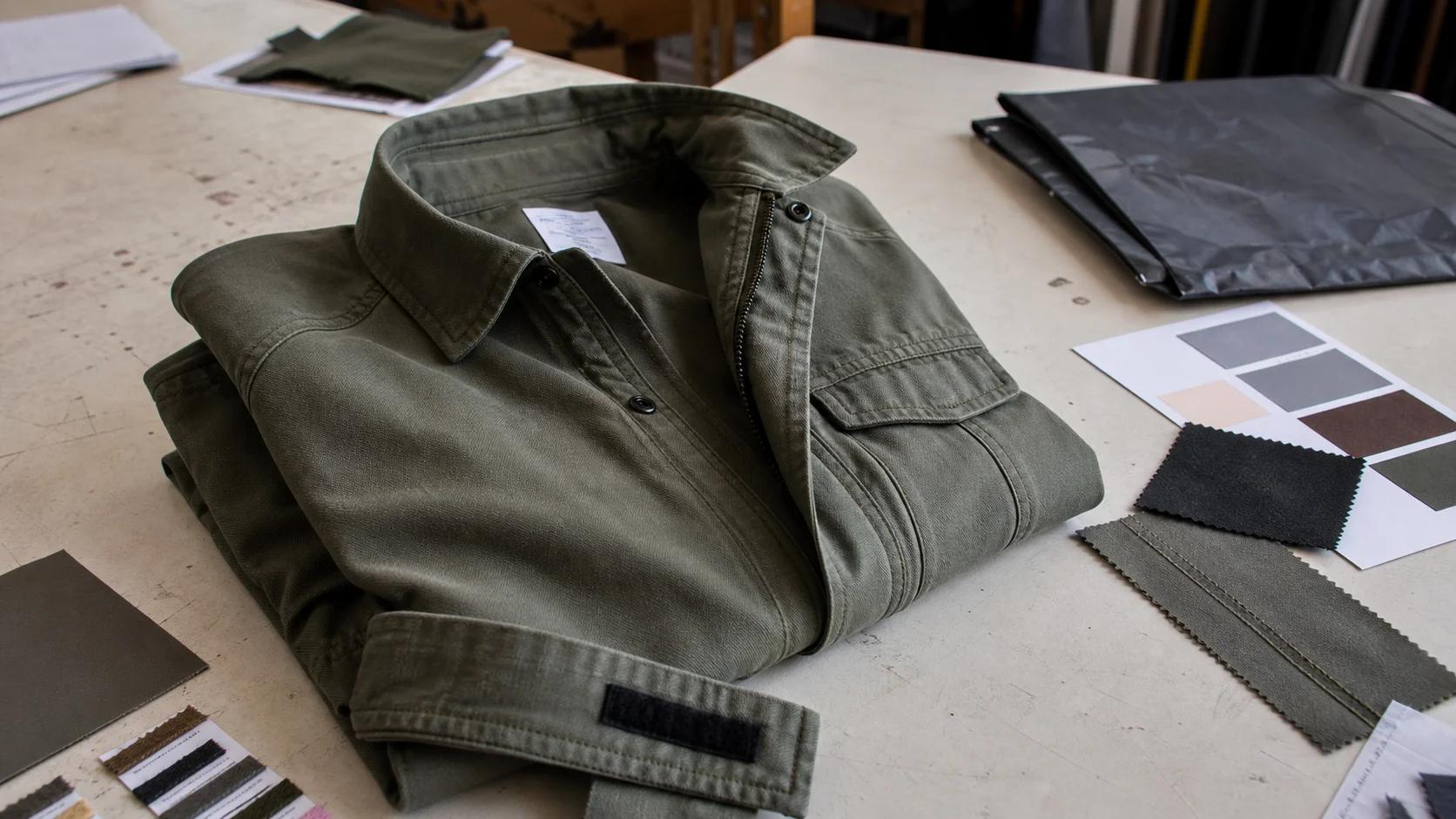
A 2500-word SEO outline for security contractors auditing organic cotton work jacket colorfastness before field deployment, wash cycles, branding, and...
Organic Cotton Work Jacket Colorfastness Audit - Sustainable Fashion manufacturing guide
An organic cotton work jacket colorfastness audit is not a cosmetic exercise. For security contractors, jacket color is part of the service presentation, contract compliance, and daily identification system. A black, navy, charcoal, khaki, or dark green jacket that fades unevenly after a few weeks can make a uniform program look poorly managed. A jacket that transfers dye onto shirts, vehicle seats, radio straps, reflective tape, or duty belts can create complaints and replacement costs that were not priced into the tender.
Security uniforms face harder use than ordinary lifestyle apparel. Guards may work outdoor gates, construction sites, logistics yards, hospitals, schools, commercial buildings, parking facilities, and event venues. Jackets are exposed to rain, sweat, abrasion from equipment, repeated laundering, sun, and sometimes disinfectant or spot-cleaning chemicals. Organic cotton adds another layer of sourcing complexity because buyers often want lower-impact fibers without losing uniform-grade durability.
The practical question is simple: can the jacket keep an acceptable shade and avoid staining other materials through the contract period? A proper audit answers that question before bulk production, not after a warehouse receives thousands of units.
For security contractors, the best organic cotton work jacket is not the softest sample in the showroom. It is the jacket that keeps a controlled shade, passes agreed test limits, fits the duty environment, and can be replenished without visible color drift.
Colorfastness problems are especially expensive in B2B uniform programs because replacement is rarely one garment at a time. If the first batch fades and a second batch arrives in a slightly different shade, mixed teams can look mismatched. This is why a colorfastness audit should be treated as part of the product specification, not as an optional quality check.
A useful audit covers the full color risk chain: fiber, yarn, fabric construction, dyeing, finishing, trims, sample approval, bulk production, laundering instructions, and final inspection. Looking only at a finished jacket test report is too narrow. Many shade and staining failures begin much earlier, especially when organic cotton fabric is reactive dyed in dark colors or garment dyed after sewing.
The audit should first separate sustainability claims from performance claims. Organic cotton certification supports fiber sourcing, but it does not automatically guarantee colorfastness. A buyer should request clear documentation for the organic cotton content, applicable certification scope, fabric mill declarations, and transaction documents where relevant. This is especially important if the program is promoted under Sustainable Fashion or responsible procurement policies.
For work jackets, common fabric choices include organic cotton twill, canvas, ripstop, sateen, or cotton-rich blends with recycled polyester. A 100% organic cotton shell may be attractive for sustainability messaging and comfort, but it can be less dimensionally stable and slower drying than a blended option. A cotton-rich blend can improve durability and drying performance, but the buyer must check whether the blend still meets internal sustainability targets.
The audit must define the approved color standard. This can be a physical fabric swatch, Pantone reference, brand standard, or master lab dip. Physical standards are usually more reliable than digital references because screens do not represent dyed cotton accurately. The buyer should define shade tolerance using a grey scale rating, spectrophotometer delta values, or both.
Security contractor jackets often use dark navy, black, tactical grey, forest green, or khaki. Dark shades create higher colorfastness risk because more dye is used. Black organic cotton jackets are particularly sensitive to crocking, edge fading, and shade variation between lots. Khaki and beige shades may show less dye transfer, but they reveal stains and soil more quickly.
A jacket for indoor reception security does not need the same performance profile as a jacket for outdoor perimeter guards. The audit should document expected wearing conditions, laundering frequency, weather exposure, and contact with equipment. If guards wear body cameras, radios, access cards, reflective harnesses, or high-friction belts, abrasion and crocking risk increases.
Buyers should not approve a colorfastness requirement in isolation. The audit needs to match the jacket to the working environment. A dark organic cotton jacket for rainy outdoor shifts needs stricter wet rubbing and water spotting checks than a light indoor layer. A jacket worn under reflective vests needs attention to dye transfer onto light-colored reflective trims.
A colorfastness audit is only useful if the product specification is stable. If the factory changes fabric weight, dyehouse, finishing route, zipper tape, lining, or pocket binding after sample approval, the original test results may no longer apply. Buyers should lock critical specifications before bulk ordering.
Common organic cotton work jacket shells may range from about 220 gsm to 380 gsm, depending on season and duty use. A lighter 220-260 gsm twill can work for indoor or mild-weather roles. A 280-340 gsm canvas or twill is more suitable for general outdoor security work. Heavier fabrics can improve perceived durability, but they may increase drying time and make shade control more difficult if dye penetration is uneven.
Reactive dyeing is commonly used for cotton because it can produce strong shades with better wash performance than many low-grade alternatives. Pigment dyeing can create a softer, casual look, but it usually carries higher rubbing and fading risk. Garment dyeing can produce a worn-in appearance, but it is not usually the first choice for strict uniform consistency across multiple deliveries.
For security contractors, the safer purchasing route is generally piece-dyed fabric with a controlled lab dip and bulk shade approval. Garment dyeing may be acceptable for a casual sustainable fashion jacket, but it is harder to defend when a client expects a consistent uniform appearance across sites.
Trims can create their own colorfastness issues. Zipper tapes, snap tapes, rib cuffs, pocketing, labels, drawcords, hook-and-loop tabs, and reflective trims may bleed, stain, or shade-shift differently from the shell fabric. A buyer should not assume all trims are colorfast just because the shell fabric passes.
Component Colorfastness Risk Audit Check Organic cotton shell Fading, crocking, shade variation Wash, rubbing, perspiration, light, water spotting Zipper tape Bleeding onto shell or lining Wash and wet rubbing checks Rib cuffs or collar Different shade aging than body fabric Shade match before and after wash Reflective trim Staining from dark shell dye Wet contact and laundering assessment Printed logo Cracking, fading, dye interaction Wash durability and rubbing tests Embroidery thread Thread bleeding or contrast distortion Colorfastness to wash and perspirationIf the jacket includes logo embroidery or printed security identification, the audit should include decorated samples. A blank jacket test is not enough. Heat transfer films, screen prints, and embroidery threads can react differently during washing and rubbing, especially on dark organic cotton grounds.
Testing should be selected according to the sales market and contract requirements. Buyers may use ISO, AATCC, or other recognized standards depending on the destination. The important point is not to list every possible test. The important point is to choose tests that match actual use and define pass ratings before production starts.
Wash fastness checks whether the jacket changes shade or stains adjacent fabrics during laundering. This is essential for security contractors because jackets may be washed weekly or more often during active deployment. Dark cotton jackets can lose depth after repeated washing, particularly if the dyeing and soaping process is weak.
A common purchasing expectation is a grey scale rating around 4 or better for color change and staining, though this depends on the buyer's standard and garment type. For dark shades, some buyers accept slightly lower results if the performance is disclosed and consistent. That is a commercial decision, but it should not be discovered after bulk delivery.
Rubbing fastness is one of the most important tests for dark organic cotton work jackets. Dry rubbing checks dye transfer when the jacket rubs against equipment or other clothing. Wet rubbing checks dye transfer under moisture, rain, or perspiration. Wet rubbing is often where dark cotton fabrics struggle.
Security jackets are exposed to high-contact points: cuffs, elbows, pocket edges, side seams, collar, shoulder areas, and waist zones where belts or radios sit. Buyers should request dry and wet rubbing tests on the shell fabric and, where possible, evaluate high-friction garment areas after a wash cycle.
Perspiration testing matters even for outerwear because collars, cuffs, underarms, and inner facings may contact skin or damp shirts. Guards working long shifts may wear jackets in variable temperatures. Acid and alkaline perspiration tests help assess whether dye will bleed, stain linings, or change shade.
Outdoor security jackets need water-related testing. Rain can expose weak dye fixation, create streaking, or cause dye transfer onto lighter garments. Water spotting is a practical risk for dark cotton jackets with certain finishes. If a jacket is promoted as water-resistant, the buyer should check both water repellency and color behavior after wet exposure.
Light fastness is relevant for outdoor posts, parking security, events, and construction site access control. Sunlight can shift navy toward purple, black toward brown or grey, and green toward dull olive. Organic cotton itself does not solve light fading. The dye selection, shade depth, and finishing process are the controlling factors.
Not every contract needs an extreme lightfastness requirement. A guard jacket used mainly at night or indoors can be specified differently from a day-shift outdoor jacket. Still, the buyer should avoid weak lightfastness on repeat uniform programs because different issue dates may age differently and create team mismatch.
Many security contractors do not intentionally bleach jackets, but accidental exposure is common in facilities that use disinfectants, cleaning sprays, or industrial chemicals. A cotton jacket may show permanent discoloration from chlorine or peroxide products. The audit should at least review care label wording and warn the contractor if the selected fabric is vulnerable to common cleaning agents.
The sample approval process should be structured, documented, and slow enough to catch color problems before the purchase order becomes expensive. Rushing color approval is one of the most common causes of uniform inconsistency.
The technical package should include fiber content, fabric weight, construction, color standard, trim colors, decoration method, care label, testing requirements, packing method, and inspection criteria. If the buyer wants the jacket to support a sustainable fashion or responsible procurement story, certification and traceability documents should be listed in the same package.
Lab dips allow the buyer to approve the target shade before bulk fabric dyeing. For work jackets, at least two or three lab dip options are commonly submitted. The buyer should review them under a controlled light source, not only under office lighting. If possible, shade should be checked against other uniform items such as trousers, shirts, caps, or vests.
A dark navy jacket that looks acceptable alone may clash badly with existing navy trousers. A black jacket may look deep in one fabric but brownish next to synthetic trim. This is why the audit should compare the full uniform system, not only the jacket shell.
The first sample may use available fabric, especially if the goal is to check pattern, fit, pocket placement, and construction. Buyers should avoid using this sample for final color judgment unless it is made from approved production fabric. Fit approval and color approval are related, but they are not the same checkpoint.
The pre-production sample should use correct fabric, correct dye, correct trims, correct labels, and correct decoration. This is the sample that should be tested, measured, washed, and visually assessed. For security contractor jackets, this stage should include checks on badge placement, radio loop durability, pocket access, and compatibility with other duty gear.
Bulk fabric should not be cut until colorfastness tests and shade approvals are complete. If the program schedule forces cutting before test results return, the buyer carries avoidable risk. A practical compromise is to approve a pilot lot first, then release full bulk after test confirmation.
Bulk fabric rolls should be inspected for shade bands, side-to-side variation, end-to-end variation, and lot mismatch. If several dye lots are used, each lot should be identified and controlled. Jackets for the same site or team should not be mixed randomly from different lots if visible shade variation exists.
MOQ depends on fabric, dyeing route, customization, trim sourcing, and supplier capability. Buyers should treat MOQ claims carefully because a low MOQ may mean compromises in fabric availability, shade control, or unit cost. A higher MOQ may allow better control of custom organic cotton fabric, but it ties up more inventory.
Program Type Typical MOQ Range Best Use Case Main Risk Stock fabric with custom logo 100-300 pieces Small security teams or pilot orders Limited shade control and fabric continuity Custom dyed organic cotton fabric 300-800 pieces Contractor uniforms with defined brand shade Higher testing and dye lot management requirement Fully custom work jacket program 800-2,000+ pieces Multi-site security contracts and replenishment planning Longer lead time and inventory exposure Organic cotton blend with special finish 500-1,500+ pieces Outdoor duty jackets needing water resistance or durability Finish may affect shade and rubbing fastnessThese ranges are typical sourcing reference points, not fixed rules. Some suppliers can support smaller runs if fabric is already available. Others require higher minimums because organic cotton fabric, custom dyeing, or certified material handling has batch constraints.
A realistic timeline for an organic cotton work jacket program may range from 8 to 16 weeks after final specification approval. Faster production is possible with stock fabric and simple decoration. Custom dyed fabric, lab testing, special trims, and repeated sample corrections can extend the schedule.
Buyers working to a security contract start date should build in approval buffers. A jacket that misses deployment is not simply late apparel. It can disrupt onboarding, site launch, and compliance with client uniform requirements.
For buyers developing a sustainable uniform program, Fabrikn's services page is a useful starting point for understanding apparel sourcing and production support. Early supplier alignment usually costs less than correcting shade problems after finished goods arrive.
Colorfastness audits should connect lab testing with production inspection. A test report does not catch every visual or commercial problem. Inspectors need clear criteria for shade, staining, trims, and packaging.
Shade variation can appear between sizes, bundles, or production dates. Jackets cut from different fabric rolls may look acceptable individually but mismatched when hung together. This is a major risk for security contractors because teams are seen side by side.
Inspection should compare finished jackets under consistent lighting. The inspector should pull samples from different cartons, sizes, and production lots. If shade bands are visible, the supplier should segregate affected units rather than mix them into the shipment.
Dark cotton jackets packed tightly while slightly damp or insufficiently cured can transfer dye onto labels, linings, contrast trims, or lighter garments. Polybags can trap moisture and increase risk. If jackets are packed with printed inserts or tissue, the buyer should confirm no staining occurs.
A jacket may pass one wash test but show edge abrasion or seam fading after repeated laundering. High-stress zones include cuffs, collar edges, elbows, pocket flaps, zipper plackets, and hem seams. Buyers should request washed sample evaluation before bulk approval, especially for dark colors.
Security jackets often carry company logos, site identifiers, or role markings. Decoration can fail even when the fabric is acceptable. Heat transfers may peel or discolor. Screen prints may crack. Embroidery thread may bleed or distort the fabric. The audit should test decorated samples through the intended laundering process.
Care labels must match the tested garment. If the jacket passes at cold wash but the label allows warm wash or tumble drying, field results may be worse than the audit suggests. Contractors should also train staff not to use bleach or harsh stain removers unless the garment has been tested for that exposure.
A supplier scorecard helps buyers compare options beyond unit price. Organic cotton work jackets involve sustainability documentation, color discipline, and uniform practicality. The cheapest quote may be acceptable for a one-off promotional jacket, but it can be weak for a security contractor program that needs repeat consistency.
Audit Area Strong Supplier Evidence Buyer Judgment Organic cotton documentation Clear certification scope and material records Essential if sustainability claims are customer-facing Color development Lab dips, shade bands, controlled light review Critical for repeat uniform programs Testing discipline Pre-agreed ISO or AATCC test methods and pass ratings Should be confirmed before bulk cutting Trim control Approved zipper, rib, lining, thread, and logo materials Important for dark shell jackets with contrast details Bulk inspection Roll shade checks, inline inspection, final AQL inspection Needed for multi-site orders Replenishment ability Fabric continuity plan and shade standard retention High value for long-term security contractsA practical scorecard should also include communication speed and correction discipline. If a supplier cannot explain why a lab dip failed or how a bulk shade will be controlled, the buyer should not expect better answers after the order is late.
Sustainable sourcing does not remove the need for hard purchasing choices. Organic cotton work jackets sit at the intersection of uniform function, brand presentation, price, and environmental positioning. Buyers need to decide which risks are acceptable and which are not.
A 100% organic cotton jacket gives a cleaner sustainability message and can be comfortable for wearers. It may also appeal to clients that prefer natural fibers. The tradeoff is that cotton can absorb moisture, take longer to dry, shrink if not controlled, and show abrasion fading in dark shades.
An organic cotton and recycled polyester blend can improve drying time, dimensional stability, and sometimes durability. The tradeoff is a more complex sustainability claim and a different hand feel. For outdoor security teams, a blend may be the more practical choice if the contract values durability and weather performance over a pure-fiber message.
Black and dark navy remain popular for security uniforms because they look professional and hide dirt. They also carry higher colorfastness risk, especially wet rubbing and edge fading. Mid-grey, khaki, and olive can reduce some dye transfer risk, but they may show stains or fail to match existing uniform standards.
For high-volume contracts, the safest decision is to test the intended shade, not a similar shade. A navy test result does not prove that black will perform equally. A pigment-dyed sample does not represent a reactive-dyed bulk fabric.
Buyers often prefer a soft sample because it feels premium. Excessive softening, enzyme washing, or garment washing can reduce the crisp appearance expected in security uniforms and may accelerate faded edges. A firmer fabric may look more uniform and structured but feel less comfortable at first wear.
The purchasing decision should reflect wearer reality. If guards wear the jacket for long shifts, comfort matters. If the jacket is mainly an outer uniform layer for client-facing posts, structure and shade retention may deserve more weight.
Low MOQ production can help a contractor test a new jacket without heavy inventory. The tradeoff is weaker control over fabric continuity. If the supplier uses stock organic cotton fabric, the next order may come from a different lot, mill, or finish.
For long contracts, buyers should ask whether the supplier can reserve greige fabric, hold the approved shade standard, and reproduce the dye lot within tolerance. Replenishment planning is often more important than saving a small amount on the first order.
The following checklist gives buyers a practical structure for an organic cotton work jacket colorfastness audit. It can be adapted to security contractors, facility management firms, event security providers, and other uniformed service businesses.
Buyers who need help structuring a production brief or aligning specifications can review Fabrikn's about us page to understand the company's apparel sourcing focus. For program-specific support, the contact us page is the practical route for discussing requirements, timelines, and documentation expectations.
An organic cotton work jacket colorfastness audit for security contractors should be treated as a commercial risk control tool. It protects the contractor from shade mismatch, dye transfer, customer complaints, and avoidable replenishment problems. It also protects the sustainability story behind the garment. A jacket cannot credibly support a responsible sourcing message if it must be replaced early because the color fails.
The strongest buying approach is disciplined and specific: lock the fabric, approve the shade, test the correct sample, inspect the bulk, and plan replenishment before the first order ships. Organic cotton can work well in security contractor jackets, but it needs clear specifications and realistic expectations. The best result is not just a jacket that looks good in the first sample meeting. It is a uniform garment that keeps its appearance through real shifts, real washing, and real field conditions.
Get a free quote from Fabrikn — your trusted B2B clothing manufacturer with 10+ years of experience. MOQ as low as 200 pieces.
Get a Free Quote →It is a structured review of how well the jacket keeps its color and avoids dye transfer during washing, rubbing, perspiration, water exposure, light exposure, and field use. For security contractors, it should include fabric, trims, decoration, care labels, and bulk shade control.
No. Organic cotton refers mainly to how the fiber is grown and certified. Colorfastness depends on dye selection, dyeing quality, washing-off, finishing, fabric construction, and care conditions.
Wet and dry rubbing tests are especially important for dark security jackets because guards wear equipment that creates friction. Wash fastness, perspiration fastness, and light fastness are also important depending on the working environment.
Typical MOQs may range from 100-300 pieces for stock fabric programs, 300-800 pieces for custom dyed organic cotton fabric, and 800-2,000+ pieces for fully custom jacket programs. Exact MOQ depends on supplier capacity, fabric availability, trims, and certification requirements.
A realistic lead time is often 8-16 weeks after the specification is confirmed. Stock fabric orders can be faster, while custom dyeing, testing, special trims, and sample revisions can extend the timeline.
Buyers should test the decorated jacket when logos, reflective trim, embroidery, or heat transfers are part of the final product. Decoration can affect washing, rubbing, and staining performance.
Many uniform buyers target around grey scale 4 or better for color change and staining, though requirements depend on the market, test method, shade, and end use. The pass rating should be agreed before bulk production.
Dark shades use more dye and are more likely to show crocking, edge fading, and shade variation. Black, navy, and deep green jackets need stricter control during lab dip approval, dyeing, washing-off, and inspection.
Yes. Finishes can change shade, hand feel, rubbing performance, and laundering behavior. A jacket with water-repellent treatment should be tested after the finish is applied, not before.
They should retain an approved fabric swatch, approved pre-production sample, test reports, trim records, care label standard, and bulk shade references. These records help reduce mismatch when replenishment orders are placed.