
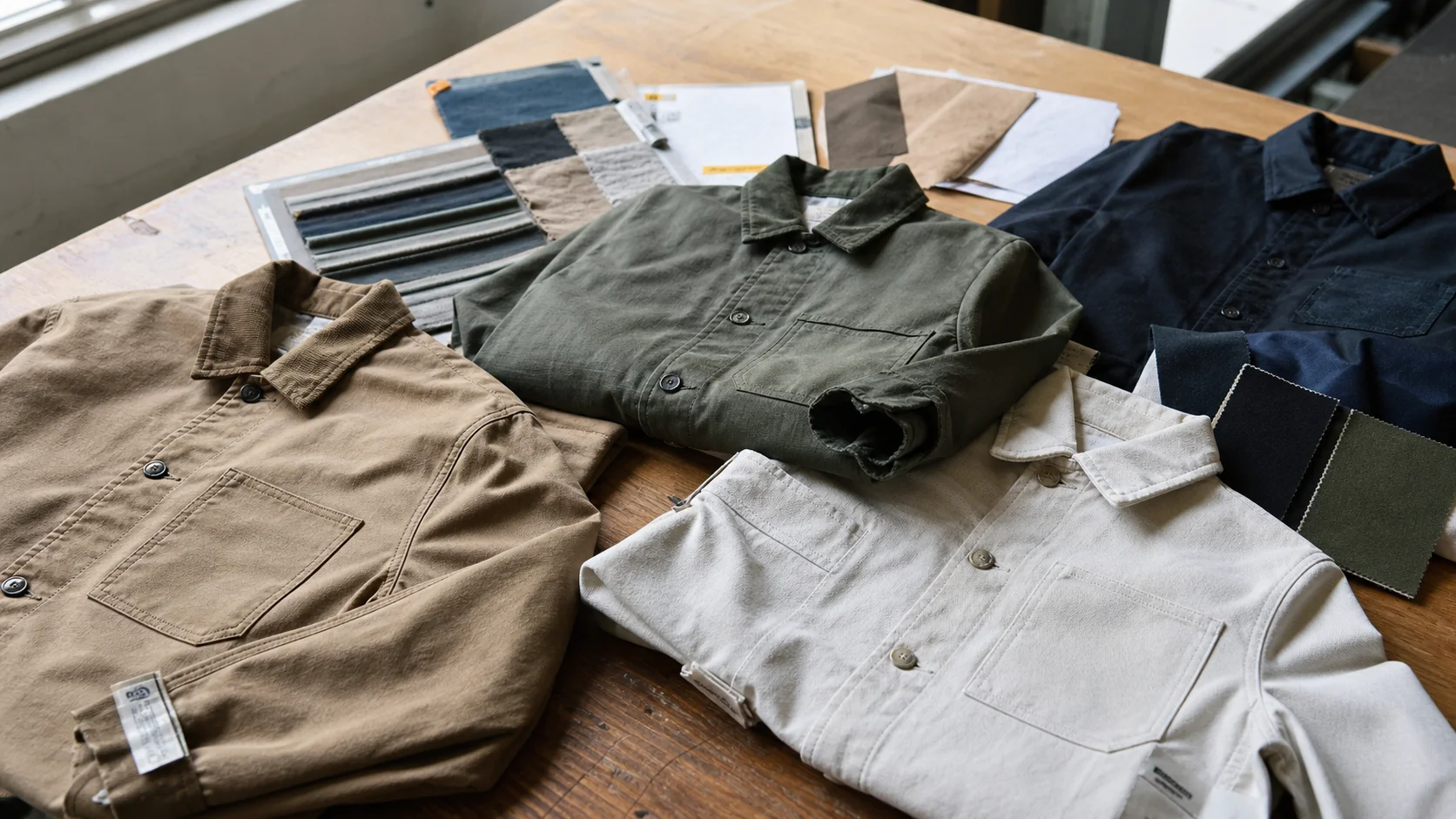
A product-specific scorecard for gym program buyers evaluating organic cotton work jacket suppliers, from fabric proof and trims to decoration readiness,...
Organic Cotton Work Jacket Supplier Scorecard - Sustainable Fashion manufacturing guide
An organic cotton work jacket can be a strong uniform, retail, or member-loyalty product for gym programs. It has a more structured profile than a hoodie, more perceived value than a tee, and better year-round usefulness than a seasonal outerwear piece. For gym buyers managing staff apparel, trainer uniforms, branded merchandise, or member drops, the jacket needs to look good after repeated wear, hold embroidery or patches cleanly, and support the sustainability message without creating sourcing risk.
The challenge is that “organic cotton work jacket” is not a single standardized product. One supplier may quote a lightweight twill overshirt and call it a work jacket. Another may quote a lined chore jacket with reinforced pockets, heavier fabric, and a longer production calendar. A third may offer a fashion jacket that looks right in photos but fails on seam strength, shrinkage, or color consistency after gym-floor use.
A supplier scorecard gives gym program buyers a practical way to compare options. It moves the conversation away from the lowest unit price and toward measurable buying criteria: fabric quality, organic certification support, sample accuracy, trim durability, production reliability, inspection readiness, and reorder suitability.
For gym programs, the best supplier is not always the cheapest supplier. The best supplier is usually the one that can repeat the approved jacket consistently, explain fabric and trim choices clearly, and keep the sustainability claim defensible.
This article provides a sourcing-focused scorecard for evaluating organic cotton work jacket suppliers. It is written for buyers who need to make decisions across apparel quality, brand presentation, sustainability, cost, and operational timing. The goal is not to create a perfect academic framework. The goal is to help buyers ask better questions before they approve samples, pay deposits, or commit to launch dates.
A good scorecard should be simple enough to use during supplier comparison but detailed enough to reveal weak spots. For an organic cotton work jacket program, the scorecard should cover five major areas: product capability, sustainability verification, development discipline, production reliability, and commercial fit.
Gym buyers should weight these areas based on the program type. A staff uniform jacket needs durability, size consistency, reorder continuity, and wash performance. A limited retail drop may prioritize silhouette, packaging, branding, and speed to market. A premium membership gift should focus on perceived value, comfort, and documentation behind the organic cotton claim.
Scorecard Category Recommended Weight What It Measures Buyer Risk If Weak Fabric and Construction Capability 25% Organic cotton fabric suitability, jacket pattern quality, stitching, trims, reinforcement Poor fit, shrinkage, weak seams, low perceived value Sustainability Verification 20% Organic cotton documentation, transaction certificates where applicable, labeling control Unsupported sustainability claims and compliance concerns Sampling and Development Discipline 20% Tech pack handling, proto sample accuracy, fit corrections, pre-production sample control Delayed approvals and production mismatches Production and Quality Control 20% MOQ flexibility, lead-time reliability, inline inspection, final AQL readiness Late deliveries, inconsistent sizing, rejected goods Commercial Fit 15% Pricing transparency, reorder terms, communication, packaging, export support Budget overruns and difficult repeat programsA supplier that scores well across all five areas is a stronger long-term partner than one that only offers a sharp initial quote. This is especially true for gym programs that plan seasonal drops, staff uniforms, franchise apparel, or recurring member merchandise.
Gym apparel is not the same as general lifestyle merchandise. Even when a work jacket is not worn during training, it still lives in a high-movement environment. Trainers lift equipment, move through changing rooms, commute between locations, and wear branded outer layers over tees, tanks, or sweatshirts. Members buying the jacket expect a piece that feels premium but still relates to the active culture of the gym.
That means the jacket needs practical function. Pocket placement should not interfere with arm movement. Shoulder and back width should allow layering. Fabric should feel substantial without becoming stiff. Cuffs should survive frequent use. If the jacket is washed at home, shrinkage should be managed. If it is intended as staff apparel, size grading must work across different body types.
Gym program buyers should score suppliers against the intended use case rather than a generic product description. A retail-focused jacket can tolerate more fashion detailing and a narrower fit. A trainer uniform should have more room through the shoulders, more durable pocket construction, and a clear reorder path. A corporate wellness program jacket may need broader size coverage, conservative branding, and reliable packaging for multi-location distribution.
These questions affect every sourcing decision. A supplier may be acceptable for a one-off promotional jacket but unsuitable for a branded uniform program with repeat orders and documentation requirements.
The fabric decision is the foundation of the jacket. For organic cotton work jackets, common fabric options include organic cotton twill, organic cotton canvas, organic cotton duck, brushed cotton, and blended fabrics that include a small percentage of elastane or recycled fiber. Pure organic cotton is often preferred for a clean sustainability story, but it can have limitations in stretch recovery, wrinkle resistance, and abrasion performance depending on fabric weight and finish.
For gym program buyers, typical fabric weights may range from 240 gsm to 380 gsm for unlined work jackets. Lighter weights around 240 to 280 gsm can work for overshirt-style jackets or indoor staff layers. Midweight fabrics around 300 to 340 gsm often give a better workwear handfeel without making the garment too heavy. Heavier canvas or duck fabrics above 350 gsm can look premium but may increase sewing complexity, cost, shipping weight, and break-in time.
Fabric specification should not stop at “organic cotton twill.” A proper supplier should be able to discuss yarn count or construction, weight tolerance, shrinkage expectations, colorfastness targets, finishing method, and whether the fabric is piece-dyed or garment-dyed. For branded gym apparel, shade control matters. Black, charcoal, ecru, olive, navy, and stone are common work jacket colors, but dark shades can show crocking risk and light shades can expose uneven dyeing or stains.
Trim choices deserve the same attention. Buttons, snaps, zippers, labels, drawcords, thread, and patches can weaken the sustainability story if they are poorly selected or undocumented. Recycled polyester thread may be available, but not every supplier can source it consistently. Organic cotton labels are possible, but woven labels often use polyester. Metal snaps and buttons can look stronger than plastic options, yet they need pull testing and corrosion control.
Buyers should be cautious with claims around “fully sustainable trims.” Some trims may be lower-impact but not certified organic. The scorecard should reward suppliers who describe trims accurately rather than using vague claims.
Organic cotton sourcing requires documentation discipline. A gym brand may not need a complex certification strategy for every product, but if it markets the jacket as organic cotton, the supplier should be able to support the claim with credible paperwork. The exact documentation depends on the certification route, supply chain structure, and labeling language.
Common references in organic cotton sourcing include GOTS and OCS. GOTS covers organic fiber and processing criteria across parts of the supply chain, while OCS focuses on verifying the presence and amount of organic material in a finished product. Buyers should avoid assuming that a supplier’s general certificate automatically covers the specific fabric, mill, dyeing process, and order. Transaction certificates or scope certificates may be relevant depending on the claim and sales market.
The scorecard should not simply ask, “Are you certified?” It should ask what certification applies to the product, which entity holds the certificate, whether the certification covers the process being quoted, and what documents can be provided before production and after shipment. A supplier that gives clear answers may be more valuable than a supplier that uses sustainability language broadly but cannot provide order-level support.
Documentation Item Why It Matters Buyer Note Scope certificate Shows certified activities and product categories for a supply chain participant Check validity dates and whether the certificate covers relevant processes Transaction certificate Supports certified organic material movement for a specific transaction May be needed for stronger organic product claims Fabric composition report Confirms fiber content and blend structure Useful when organic cotton is blended with other fibers Dyeing and finishing declaration Clarifies chemical processing and finishing route Important for brands making broader sustainability statements Care label review Reduces risk of incorrect washing instructions or fiber claims Approve before bulk label productionGym buyers should also review claim wording. “Made with organic cotton” may be safer than “100% certified organic jacket” if trims, labels, and processing are not covered in the way the buyer assumes. Legal and compliance review may be appropriate for consumer-facing sustainability language, especially for larger programs.
For buyers building a formal sourcing workflow, a manufacturing partner with structured development and documentation support can reduce confusion. Fabrikn’s apparel manufacturing services page is a useful internal reference for understanding how product development, sourcing, and production support can be organized before a buyer starts supplier outreach.
The sampling process is where many jacket programs either become controlled or start drifting. Organic cotton work jackets have more moving parts than basic knitwear. A small change in fabric weight, shoulder slope, pocket angle, wash treatment, or button placement can alter the final product. Gym buyers should use the scorecard to reward suppliers who run a disciplined sample process and penalize suppliers who rush from sketch to bulk production without proper approval gates.
A typical development path may include reference review, fabric sourcing, proto sample, fit sample, sales sample or photo sample, pre-production sample, size set, and bulk production approval. Not every program needs every sample stage. A low-MOQ repeat of an existing supplier block may move faster. A new custom jacket with organic fabric, custom trims, and embroidery should not skip important checkpoints.
Buyers should expect sample timelines to vary. A proto sample using available fabric may take one to three weeks after complete instructions are provided. A custom organic cotton fabric, custom-dyed shade, or special trim package can add several weeks. If the supplier is waiting for lab dips, fabric testing, embroidery artwork, or buyer comments, the calendar extends.
Clear sample comments are essential. Comments should be measurable, not emotional. “Make it more premium” is not a useful correction. “Increase body length by 2 cm, reduce sleeve length by 1.5 cm, deepen lower pockets by 2 cm, change topstitching to 30 tex thread, and submit revised lab dip for olive shade” is actionable.
A supplier that treats sampling as a controlled approval process should score higher than one that relies on verbal agreement and loose photos. The more customized the jacket, the more valuable written approvals become.
MOQ is one of the biggest decision points for gym program buyers. Organic cotton work jackets usually have higher minimums than basic tees because woven jackets require more pattern work, cutting control, sewing time, trims, and fabric planning. MOQ also depends on whether the buyer uses stock fabric, custom-dyed fabric, custom trims, private label packaging, or an existing jacket block.
Typical MOQ ranges can vary widely. For a simple work jacket using available organic cotton fabric and standard trims, a supplier may accept around 100 to 300 pieces per color, especially for a development-friendly program. For custom-dyed organic cotton fabric, MOQ may move closer to 300 to 800 pieces per color. For fully custom fabric weaving, special finishing, or complex trim packages, minimums can exceed 1,000 pieces depending on the mill and production setup.
Low MOQ is attractive, but it is not always the best commercial choice. A very low quantity may increase unit cost, reduce fabric choices, limit color options, and make the supplier less willing to invest time in fit correction. A higher MOQ can unlock better pricing, stronger fabric sourcing, and more consistent production, but it raises inventory risk for the buyer.
Program Type Typical MOQ Range Best Fit Main Tradeoff Stock-fabric branded jacket 100 to 300 pieces Small gym groups, staff programs, test drops Limited fabric and color flexibility Custom color organic cotton jacket 300 to 800 pieces Retail drops and stronger brand identity programs Longer lead time and higher inventory exposure Fully custom jacket with special trims 500 to 1,500 pieces Multi-location gym chains and premium campaigns Higher development cost and more approval checkpoints Repeat production from approved style Often lower than first custom run if fabric is available Uniform replenishment and seasonal reorders Fabric continuity must be checked earlyPricing should be reviewed beyond unit cost. Buyers should request a clear breakdown of fabric, trims, decoration, labels, packaging, sampling, testing, freight terms, and payment schedule. A cheap quote that excludes testing, packaging, or custom labels may not remain cheap after the program is fully specified.
Gym buyers should also consider sell-through. A jacket has a higher retail price than a tee or cap, but it also ties up more cash. If the program is untested, a conservative first buy may be sensible even at a higher unit cost. If the jacket is for staff across many locations, stronger MOQ planning can reduce reorder gaps and shade differences.
Lead time for organic cotton work jackets depends on fabric availability, certification documentation, trim sourcing, sample approval speed, production capacity, decoration complexity, inspection timing, and shipping method. Buyers should not accept a generic “six weeks” answer unless the supplier defines when the clock starts and what assumptions are included.
For stock fabric and standard trims, production after pre-production sample approval may take roughly four to eight weeks, depending on quantity and factory loading. Custom-dyed organic cotton fabric can add two to six weeks before cutting. Custom woven fabric may add longer, especially if the mill has minimum batch requirements. Decoration can also affect timing. Embroidery on heavy cotton panels may be straightforward, while appliqué patches, garment dyeing, or wash treatments require more testing and scheduling.
A practical timeline for a new custom organic cotton work jacket may run 10 to 16 weeks from complete brief to shipment, and longer if fabric is custom-developed or approvals are slow. A repeat order using approved fabric and trims may be shorter, but buyers should still confirm fabric stock and trim availability before promising launch dates.
Lead-time discipline is especially important for gym programs tied to openings, challenges, seasonal campaigns, anniversaries, or membership drives. A jacket delivered two weeks late can miss the commercial moment. Buyers should build a buffer and avoid approving production based only on photos if fit, color, and trims have not been physically checked.
Work jackets have more inspection risk than simple tops because they involve woven fabric behavior, multiple panels, functional closures, pocket symmetry, topstitching, and heavier seam operations. Organic cotton does not automatically make the garment fragile, but some organic cotton fabrics may have slubs, shade variation, or shrinkage behavior that needs controlled handling.
Inspection should start before final inspection. Bulk fabric should be checked for color, defects, handfeel, weight, and shrinkage. Trims should be checked before they enter sewing. Decoration should be tested before full application. Inline inspections can catch pocket placement, panel mismatch, seam puckering, skipped stitches, and incorrect labels before the entire order is complete.
AQL inspection is often used for final quality review, but buyers should not rely only on final inspection. If the supplier cuts bulk fabric before shrinkage testing or starts full embroidery before a decoration approval, the problem may be expensive to correct. The scorecard should reward suppliers that show preventive control, not just final sorting.
Inspection Point What to Check Recommended Buyer Action Bulk fabric arrival Weight, shade, defects, shrinkage, handfeel Request fabric report or photos plus swatch approval when possible Trim arrival Button strength, snap function, label content, color match Approve trim card before mass sewing Decoration trial Embroidery tension, patch placement, print adhesion Approve physical strike-off or production test panel Inline production Measurements, stitching, pocket symmetry, seam quality Use inline photos or third-party inspection for larger orders Final inspection AQL defects, packing, labeling, carton marks, quantity Inspect before balance payment or shipment release where terms allowFor gym buyers without internal technical teams, supplier selection should favor partners who can communicate these controls clearly. If the supplier cannot explain how shrinkage, shade, and closures will be checked, the buyer carries more risk.
The following scorecard can be used during supplier shortlisting. Buyers can score each supplier from 1 to 5 in each category, multiply by the weighting, and compare total performance. A score of 1 means weak or unclear capability. A score of 3 means acceptable but not exceptional. A score of 5 means strong, documented, and suitable for a controlled program.
Category Weight Score 1 Score 3 Score 5 Organic cotton fabric capability 15% Vague fabric descriptions and limited fabric data Can source basic organic cotton fabric with some specs Provides weight, construction, shrinkage, colorfastness, and testing options Work jacket construction 10% Mostly basic shirts or light outerwear experience Can make simple chore or utility jackets Understands woven jacket fit, reinforcement, closures, and finishing Sustainability documentation 20% Uses unsupported sustainability language Provides general certificates but limited order-level clarity Explains relevant certificates, transaction documents, and claim limits Sampling process 15% Relies on photos and unclear approvals Offers standard samples with basic corrections Controls proto, fit, trim, decoration, PP sample, and size set steps MOQ and pricing fit 10% MOQ or pricing is unclear MOQ is workable but pricing lacks detail Provides clear MOQ tiers, cost drivers, and reorder terms Lead-time reliability 10% Gives broad promises without assumptions Provides basic production timing after approval Separates fabric, sample, production, inspection, and shipping timelines Quality control readiness 15% No clear inspection plan Final inspection available on request Uses fabric checks, trim checks, inline review, and final AQL inspection Communication and program fit 5% Slow, unclear, or reactive communication Acceptable response and basic follow-up Clear technical communication and organized approval trackingBuyers should not over-focus on the total score alone. A supplier with a high total but weak sustainability documentation may be unsuitable if the jacket will be marketed around organic cotton. A supplier with excellent documentation but limited jacket construction experience may be a risk for fit and durability. The scorecard is a decision tool, not a substitute for judgment.
The right supplier depends on the business goal. For a boutique gym testing its first organic cotton jacket, a lower MOQ supplier using available fabric may be the practical choice. The buyer accepts fewer color and trim options in exchange for lower inventory risk. For a multi-location gym group building a repeatable uniform program, a higher MOQ and more structured supplier may be worth the extra planning. The buyer gains consistency, documentation, and better reorder control.
For a retail merchandise drop, product feel and brand presentation matter heavily. The jacket must sit well on the rack, photograph cleanly, and justify its price. In that case, fabric handfeel, garment wash, pocket design, and branding details deserve more weight. For staff apparel, the buyer should give stronger weight to seam strength, mobility, size range, reorder reliability, and wash testing.
The biggest tradeoff is usually between flexibility and control. A flexible low-MOQ supplier may help launch quickly, but the buyer may face limited documentation, less fabric choice, and higher unit cost. A structured supplier may require stronger commitments, longer development, and higher MOQ, but the final jacket is usually easier to repeat and defend.
Buyers should also watch for quotation traps. A supplier may quote a low price using conventional cotton, unverified organic fabric, lighter weight fabric, cheaper buttons, or no wash testing. Another may quote a stronger garment but appear expensive because it includes documentation support, better fabric, custom labels, and more realistic production handling. The buyer should normalize quotes before comparing.
A strong request for quotation should include style images, target fabric weight, organic cotton requirement, colorways, estimated quantity by color and size, decoration method, label requirements, packaging preference, target delivery window, inspection expectations, and shipping terms. If the buyer does not have a complete tech pack, it may be worth developing one before contacting multiple suppliers. Fabrikn’s about us page provides background on a manufacturing-oriented approach that may help buyers understand the value of structured apparel development before production.
A scorecard is most useful when buyers apply it at the right stages. It should be used before sampling, after sample review, and before bulk approval. A supplier that looks strong during email quotation may perform differently during sample correction. A supplier that provides a good proto sample may still need to prove documentation and production readiness.
Start with suppliers that can clearly discuss woven jackets and organic cotton. Ask for fabric options, MOQ ranges, sample costs, lead-time assumptions, and documentation capability. Do not request a final price before the product is defined well enough. Early pricing should be treated as directional.
Review how each supplier answers technical questions. Strong suppliers will ask clarifying questions about fit, fabric, wash, trims, decoration, and packaging. Weak suppliers may rush to a price without confirming the details that affect quality and compliance.
Score the supplier again after the proto or fit sample. Check whether the supplier followed the tech pack, corrected comments accurately, submitted fabric and trim details, and communicated limitations honestly. A sample that is close to perfect on the first round is helpful, but responsiveness to corrections is often more revealing.
Before bulk production, approve the pre-production sample, size specifications, color standard, trim card, label artwork, decoration placement, packaging method, and inspection plan. This is the point where verbal flexibility should end. The supplier should know exactly what must be reproduced.
After shipment, keep records of approved samples, fabric specs, trims, size grading, inspection reports, and customer feedback. If the jacket sells well or works as uniform, these records reduce reorder friction. Reorders should still confirm fabric lot, shade, trim availability, and any certification documents needed for the new production.
Buyers who need help defining the jacket before supplier engagement can use Fabrikn’s contact page to start a more structured conversation around development, sourcing, and production planning.
Some supplier weaknesses are visible early. Buyers should not ignore them because the first quote looks attractive. A supplier that cannot define fabric weight, refuses to provide trim details, or avoids documentation questions may create larger problems later.
Not every red flag means the supplier is unusable. Some small suppliers are capable but less polished in documentation. The buyer’s job is to decide whether the weakness is manageable. For an internal team jacket with modest claims, the risk may be acceptable. For a consumer-facing sustainable fashion product, weak documentation is a serious issue.
For gym program buyers, an organic cotton work jacket supplier should be evaluated as both a product partner and a documentation partner. The garment must be durable, comfortable, and brand-appropriate. The organic cotton claim must also be supportable. A supplier that fails either side can damage the program.
The most balanced buying approach is to shortlist three to five suppliers, request comparable fabric and MOQ information, run one or two serious sample developments, and choose the supplier that performs best against the scorecard after physical review. Buyers should avoid awarding production based only on the lowest quote or the most polished catalog image.
A good organic cotton work jacket can become a signature piece for a gym program. It can sit between sustainable fashion and practical uniform apparel. It can support staff identity, retail revenue, and member engagement. The scorecard helps buyers protect that opportunity by turning subjective supplier claims into measurable sourcing decisions.
Direct purchasing judgment: choose the supplier that can repeat the approved jacket, verify the organic cotton route, and manage inspection risk. If a supplier cannot do those three things, a lower price is not enough compensation.
Get a free quote from Fabrikn — your trusted B2B clothing manufacturer with 10+ years of experience. MOQ as low as 200 pieces.
Get a Free Quote →An organic cotton work jacket supplier scorecard is a structured evaluation tool used to compare suppliers across fabric quality, sustainability documentation, sampling process, MOQ, lead time, construction capability, and inspection readiness. It helps gym program buyers make sourcing decisions based on measurable criteria rather than price alone.
Typical MOQs may range from 100 to 300 pieces when using available organic cotton fabric and standard trims. Custom-dyed fabric often moves MOQ closer to 300 to 800 pieces per color. Fully custom fabric, special trims, or larger private-label programs can require 500 to 1,500 pieces or more, depending on the supplier and mill requirements.
For stock fabric and standard trims, production after final sample approval may take around four to eight weeks. A new custom organic cotton work jacket program can take roughly 10 to 16 weeks from complete brief to shipment when sampling, fabric sourcing, approvals, production, inspection, and logistics are included. Custom weaving, garment dyeing, or delayed approvals can extend the timeline.
Many gym programs fit well in the 300 to 340 gsm range for an unlined organic cotton twill or canvas jacket. Lighter 240 to 280 gsm fabrics can work for overshirt-style layers, while heavier 350 gsm and above can look premium but may feel stiff, cost more, and increase shipping weight. The best choice depends on whether the jacket is for staff uniform, retail sale, or member gifting.
Buyers should request relevant scope certificates, transaction certificates where applicable, fabric composition details, dyeing and finishing declarations, and care label confirmation. The supplier should explain which documents apply to the quoted product and which claims are supportable. Buyers should be cautious with broad sustainability language that is not backed by order-level documentation.
Not automatically. A low price may reflect lighter fabric, weaker trims, limited testing, unclear organic cotton documentation, or fewer quality controls. The better choice is usually the supplier that balances price with repeatable construction, clear documentation, realistic lead times, and inspection readiness.
Common risks include shrinkage, shade variation, seam puckering, weak button or snap attachment, uneven pocket placement, embroidery distortion, incorrect labels, and measurement variation across sizes. These risks should be addressed through fabric checks, trim approval, decoration testing, inline inspection, and final AQL inspection.
Yes, if the jacket is designed for movement, layering, repeated wear, and easy care. Gym uniforms should prioritize shoulder mobility, durable seams, functional pockets, wash performance, broad size coverage, and reorder consistency. A fashion-focused jacket may need adjustments before it works well as staff apparel.