
A distributor-focused outline for evaluating organic cotton work jacket trims, from zipper tapes and snaps to labels, reinforcement patches, and compliance...
Organic Cotton Work Jacket Trim Sourcing Review - Sustainable Fashion manufacturing guide
Organic cotton work jackets sit in a demanding corner of sustainable fashion. Distributor buyers are not only sourcing a garment with visible eco credentials; they are sourcing a durable outerwear product that has to survive warehouse work, field use, retail handling, repeated washing, and price comparison against conventional workwear.
The fabric gets most of the attention, but trim sourcing often decides whether the jacket feels commercially ready. Buttons, zippers, snaps, thread, labels, pocketing, interlining, drawcords, reinforcement tape, and packaging all affect cost, durability, compliance, and the credibility of the “organic” positioning.
This organic cotton work jacket trim sourcing review is written for distributor buyers comparing suppliers, preparing tech packs, or reviewing factory quotations. The focus is practical: what trims matter, what specifications to ask for, where sustainable claims can become weak, and how to reduce production risk before bulk order placement.
Organic cotton work jackets are usually judged first by the shell fabric: canvas, duck, twill, ripstop, or brushed cotton. That makes sense. The shell controls hand feel, abrasion resistance, shrinkage behavior, and much of the garment’s sustainability story.
Trims are where many sourcing mistakes appear later. A jacket may use certified organic cotton fabric, yet carry a conventional polyester label, a low-grade zipper, weak snap fasteners, non-recycled poly sewing thread, plastic packaging, or inconsistent metal finishes. For a distributor selling into retailers, uniform programs, trades, or sustainability-led channels, those details can become objections during buyer review.
Trim selection also affects repeat orders. A failed zipper or rusting snap is more visible to the end user than a minor fabric specification change. Workwear customers are less forgiving because the product is expected to perform. Sustainable positioning does not excuse poor durability.
For distributor buyers, the practical goal is not to make every trim organic. The goal is to make every trim appropriate, traceable where possible, durable in use, and consistent with the jacket’s sustainability claim.
This is especially important when jackets are sold as part of a broader sustainable apparel range. If the brand message says “organic cotton workwear,” trim inconsistencies should not undermine the claim. Buyers should separate core sustainability requirements from nice-to-have upgrades before requesting quotations.
Distributor buyers typically need a balance between margin, availability, repeatability, and compliance. A boutique brand may accept long development cycles for unusual natural trims. A distributor usually needs a trim package that can be scaled, reordered, and explained clearly to customers.
The best sourcing decisions start with the sales channel. A jacket for promotional uniforms has different trim priorities than a jacket for premium sustainable retail. A jacket for light warehouse work has different stress points than one intended for outdoor trades.
A practical trim strategy begins with a clear tier. For example, an entry sustainable work jacket may use organic cotton shell fabric, recycled polyester sewing thread, standard durable metal snaps, and recycled paper hangtags. A premium version may add corozo buttons, recycled metal hardware, organic cotton labels, and compostable or recycled poly packaging.
Trying to maximize every sustainable option at once can create price, testing, and lead-time pressure. Distributor buyers should decide which features are visible and valuable enough to support the final selling price.
Work jacket trims should be reviewed as a system. One weak component can cause the garment to fail inspection or disappoint the customer. The following areas deserve particular attention during development and quotation.
Zippers are often used on center fronts, chest pockets, inside pockets, or detachable linings. For organic cotton work jackets, zipper choice affects both appearance and performance.
For distributor buyers, the safest choice is usually a reputable zipper quality with clear size, tape composition, slider type, puller shape, and finish stated in the bill of materials. Generic “metal zipper” descriptions are too vague for consistent production.
Work jackets may use shank buttons, tack buttons, four-part snaps, or hidden snap plackets. Metal buttons and snaps are common because they look durable and suit canvas or duck fabrics.
Key issues include pull strength, rust resistance, finish rubbing, sharp edges, and compatibility with fabric thickness. Organic cotton canvas can be heavy, and garment washing can change thickness and hand feel. Snap settings should be tested after washing, not only on raw fabric.
Corozo buttons can support a more natural trim story, but they are not always the best option for heavy-duty work jackets. They may suit overshirts, chore jackets, and lifestyle workwear better than utility jackets exposed to hard abrasion.
Sewing thread is easy to overlook because it is not usually promoted on product pages. It still matters. Weak thread can cause seam failure, and mismatched thread can make a jacket look inconsistent.
Common choices include cotton thread, polyester thread, recycled polyester thread, or cotton-wrapped polyester thread. For work jackets, 100% cotton thread may support a natural story but can be weaker and more shrink-sensitive than polyester. Recycled polyester thread is often the practical compromise for durability and sustainability messaging.
Buyers should specify thread count, color, composition, and whether contrast stitching is required. Contrast stitching increases the visibility of sewing defects, so factories need clear tolerance expectations.
Labels include main labels, size labels, care labels, origin labels, organic certification references, brand patches, and hangtags. Sustainable work jackets often use organic cotton woven labels, recycled polyester labels, printed cotton labels, recycled paper hangtags, or kraft paper branding.
Care labels must remain legible after washing. Printed cotton labels can look appealing but may fade if ink quality is poor. Woven labels tend to be durable, although they are commonly polyester unless specified otherwise.
Distributor buyers should also be careful with certification language. If the garment uses certified organic cotton fabric but trims are not certified, label wording should avoid implying that the entire jacket and all components are certified organic unless documentation supports that claim.
Pocket bags and internal reinforcements affect comfort and durability. Organic cotton pocketing can align with the garment story, but recycled polyester or poly-cotton pocketing may perform better in high-abrasion areas.
Binding tape around seams, collar stands, or inner facings can be made from cotton, organic cotton, recycled polyester, or conventional polyester. Reinforcement tape at stress points should be selected for strength first, then sustainability.
A jacket that tears at the pocket corner because the reinforcement was chosen only for its eco appeal is not sustainable in practical terms. Longevity is part of responsible sourcing.
Some work jackets use collar interlining, cuff support, placket reinforcement, or quilted lining. If the product is promoted as organic cotton, buyers should still check whether interlining includes fusible polyester, nonwoven materials, or chemical adhesives.
There is nothing automatically wrong with these materials if they are disclosed and safe. The issue is alignment with the product claim. For premium sustainable ranges, buyers may request recycled content interlining or reduce fusible use where design allows.
Packaging is not technically part of the jacket, but it is part of the sourcing review. Polybags, size stickers, silica gel, hangers, tissue paper, carton liners, and hangtags can all affect sustainability scoring.
Common options include recycled-content polybags, biodegradable bags, paper bands, FSC-certified hangtags, soy-based printing inks, and reduced packaging formats. Each has tradeoffs. Biodegradable bags may require specific disposal conditions, while recycled polybags may be easier to manage in existing logistics.
Sustainable trim sourcing is rarely a simple replacement exercise. A natural trim may perform poorly. A recycled synthetic trim may be more durable. A certified trim may have a high MOQ that does not suit the distributor’s launch quantity.
Trim Component Sustainable Option Main Advantage Tradeoff to Review Sewing thread Recycled polyester thread Durable and easier to source than many natural alternatives Still synthetic; certification documentation should be checked Buttons Corozo, recycled metal, recycled plastic Supports lower-impact material story Performance and color consistency vary by material Zipper tape Recycled polyester tape Useful sustainability upgrade with limited design disruption May have longer lead time or higher MOQ Labels Organic cotton, recycled polyester, recycled paper Visible to buyers and easy to communicate Printed labels need wash durability testing Packaging Recycled polybag, paper band, FSC paper hangtag Supports sustainability message beyond garment Must still protect product during shippingDistributor buyers should not assume that natural always means better. A metal snap that lasts five years may be a better choice than a low-strength natural button that fails quickly. Recycled polyester thread may be more responsible than virgin polyester thread while still meeting workwear performance needs.
The strongest commercial position is usually a mixed trim strategy: organic cotton shell, durable functional hardware, recycled or responsibly sourced trims where feasible, and clear documentation for customer-facing claims.
A strong bill of materials prevents many sourcing disputes. Vague trim descriptions leave too much room for substitution. Buyers should request complete specifications before salesman sample approval and again before bulk production.
For support with structured apparel development, buyers can review the sourcing and production support outlined on Fabrikn’s services page. A clear development process is especially useful when multiple trims, certifications, and wash requirements are involved.
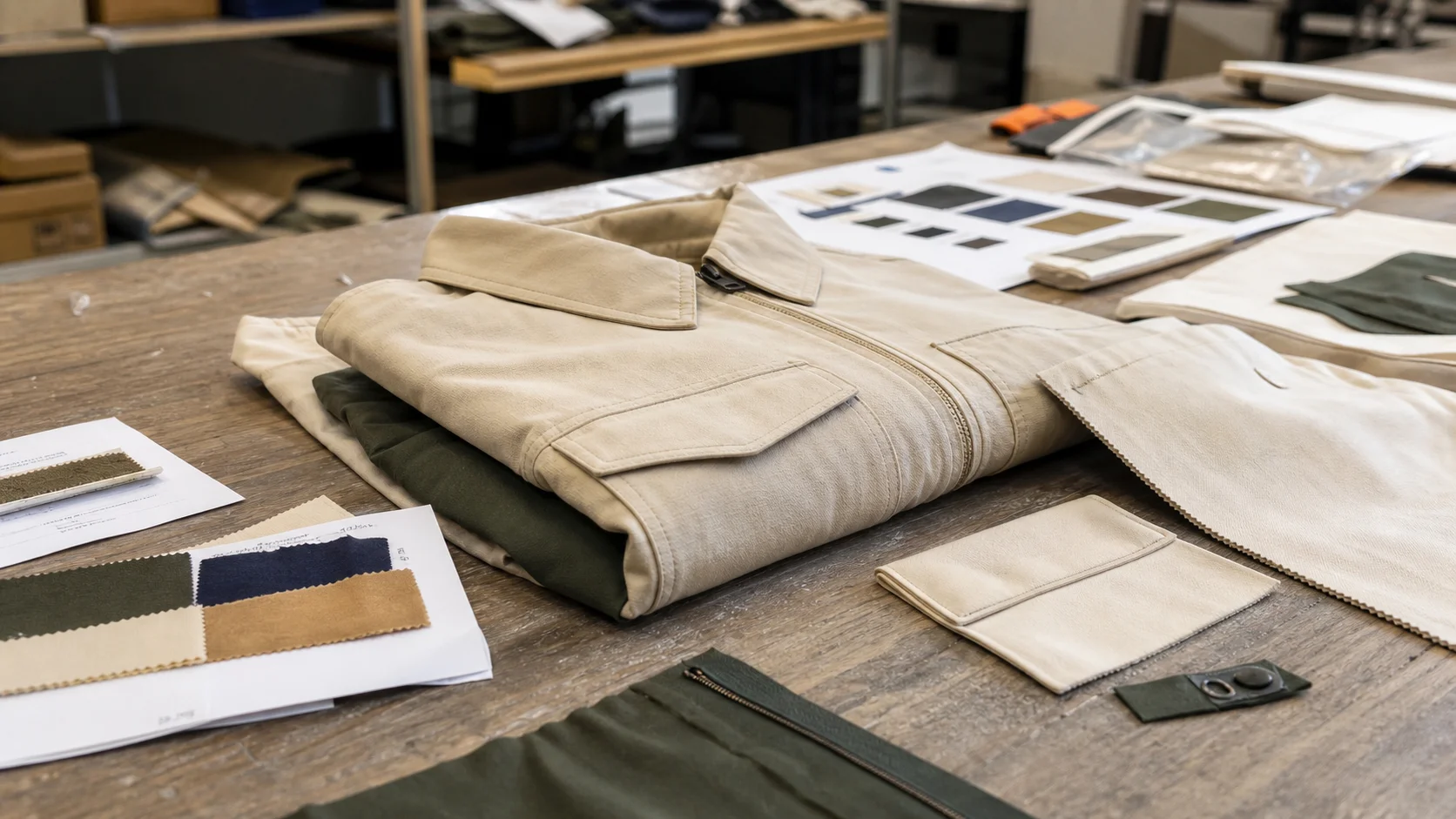
Trim cards should be physical where possible. Digital images are useful for early alignment, but they do not show weight, edge quality, slider smoothness, snap action, label softness, or metal finish accurately.
Trim MOQ can control whether a distributor’s project is commercially viable. Organic cotton work jackets are often ordered in moderate quantities, especially for new ranges or test programs. The jacket factory may accept a garment MOQ, but trim suppliers may create hidden volume barriers.
These ranges are typical planning references, not guaranteed quotes. MOQs vary by supplier, market, material, customization level, and season. Buyers should ask whether unused trims can be held for repeat orders, returned, or applied to other styles.
Trim lead times are affected by raw material availability, dyeing, plating, logo tooling, certification documentation, and lab testing. Standard trims may be ready in one to two weeks. Custom trims can take three to six weeks, and longer if molds or special certification checks are required.
The most common sourcing mistake is approving the fabric while trims remain undecided. This creates a production bottleneck after cutting plans are ready. Jacket factories need trims before sewing can move smoothly, and missing snaps or late zippers can hold the entire order.
A practical production calendar should include trim approval, trim production, inbound trim inspection, pre-production sample, bulk cutting, sewing, finishing, final inspection, and shipping. The calendar should not assume that all trims arrive together.
Sample approval is where trim choices become real. A trim that looks suitable on a card may feel wrong on a finished jacket. The jacket’s fabric weight, wash treatment, pocket construction, and seam bulk all influence trim performance.
Pre-production sample approval should be treated as a production gate. If the snap pull strength is poor, the zipper tape color is off, or the care label wording is wrong, bulk should not proceed until the issue is corrected.
Distributor buyers should also request a wash-tested sample when the jacket is garment-washed, enzyme-washed, softened, or dyed. Metal trims can change appearance after washing, and natural labels may shrink or twist.
Trim costs can look small line by line, but they add up quickly on a work jacket. A center-front metal zipper, multiple pocket zippers, tack buttons, snaps, branded patch, woven labels, hangtag, spare button, and upgraded packaging can materially affect FOB cost.
Distributor buyers should ask for trim cost transparency at least by category. A supplier may not disclose every sub-supplier price, but they should explain what is driving cost: custom mold, special plating, recycled content, certification, low MOQ surcharge, or imported origin.
The right question is not simply “Can this be cheaper?” A better question is “Which trim upgrades help sell the jacket, and which ones are invisible cost?”
For many distributor programs, visible and explainable upgrades are easier to justify. Recycled packaging, organic cotton labels, and durable metal hardware may support sales conversations. A costly hidden interlining upgrade may be less valuable unless the customer has strict material requirements.
Buyers planning a broader sustainable apparel range can also review company background and sourcing orientation at Fabrikn’s about page to understand how development and production support may align with long-term programs.
Trim inspection should happen before and after sewing. Once incorrect trims are attached, rework becomes expensive and may damage the garment. Work jackets use heavier fabrics, so removing snaps, rivets, or tack buttons can leave permanent holes.
Buyers should define acceptable quality limits with the supplier, but trim-specific checks should be explicit. A general final inspection may catch obvious defects, yet miss pull strength, corrosion, or wash durability unless these tests are requested.
Testing requirements should match the product’s target market and price point. Over-testing can make a small order uneconomical. Under-testing can create claims, returns, and customer dissatisfaction. The buyer’s job is to set the right risk level.
A good supplier can explain trim options without pushing every upgrade. Distributor buyers should look for clear answers, not just attractive sample photos.
Buyers should also ask suppliers to separate confirmed facts from proposed options. “Can be certified” is not the same as “certification is available for this order.” “Recycled look” is not the same as verified recycled content.
When a distributor is preparing a new workwear program or comparing development routes, a direct discussion can prevent specification drift. Buyers can use Fabrikn’s contact page to start a more specific sourcing conversation.
For distributor buyers, the best trim package is usually not the most expensive one. It is the package that protects the jacket’s durability, supports the sustainability claim, and stays repeatable across orders.
Worth paying for: durable zippers, reliable snaps or buttons, recycled polyester thread where strength is needed, accurate care and certification labeling, and packaging that matches the customer’s sustainability expectations. These choices reduce complaints and improve the product story.
Worth reviewing carefully: custom logo hardware, unusual natural buttons, specialty patches, and compostable packaging. These can be useful for premium positioning, but they may raise MOQ and lead time. If the distributor is testing a new product, these trims may be better introduced after demand is proven.
Not worth accepting: vague trim descriptions, unsupported sustainability claims, weak hardware, care labels that do not match the garment, and late substitution without approval. These are avoidable risks.
The practical sourcing recommendation is to build a trim hierarchy. Lock functional trims first: zippers, snaps, buttons, thread, reinforcement, pocketing, and interlining. Then refine visible branding trims: labels, patches, hangtags, and packaging. Finally, review documentation and claim language so the product can be sold confidently.
Organic cotton work jackets can be strong sustainable fashion products when they are sourced with workwear discipline. The trims need to serve the garment, not just decorate it. Distributor buyers who control the bill of materials, sample approval, MOQ exposure, and inspection plan will have a much better chance of delivering a jacket that sells well and holds up in use.
Get a free quote from Fabrikn — your trusted B2B clothing manufacturer with 10+ years of experience. MOQ as low as 200 pieces.
Get a Free Quote →The most important trims are zippers, snaps or buttons, sewing thread, pocketing, labels, reinforcement tape, and packaging. For work jackets, functional trims should be prioritized before decorative branding trims because they directly affect durability and returns.
Not usually. Organic cotton can be used for shell fabric, some labels, pocketing, or tape, but hardware, zippers, thread, and interlining often require other materials for durability. A credible product claim should state what is organic and avoid implying that every component is organic unless documentation supports it.
Typical MOQs vary widely. Standard buttons, snaps, and zippers may start around 500 to 5,000 pieces depending on the supplier. Custom branded hardware can require 5,000 to 20,000 pieces or more. Labels and hangtags often start around 500 to 5,000 pieces. Buyers should confirm trim MOQ separately from garment MOQ.
Yes, recycled polyester thread is often a practical choice for work jackets because it offers better strength and lower shrinkage risk than many natural thread options. It also supports a sustainability upgrade compared with virgin polyester, provided the recycled content claim is documented.
It depends on the jacket’s use and positioning. Metal buttons and snaps usually suit rugged workwear and heavy fabrics. Natural buttons such as corozo can support a premium sustainable look but should be tested for cracking, wash durability, and strength. Function should come before the material story.
Common failures include weak snap attachment, rough zipper operation, incorrect label wording, poor color matching, rusting hardware, loose patches, thread breakage, and packaging errors. These problems are easier to prevent when trim specifications and pre-production samples are approved before bulk sewing.
Claims should be specific and supported. If only the shell fabric is certified organic cotton, the label should not suggest the entire jacket is fully organic unless all applicable components and certification rules allow that claim. Buyers should review certification documents and care label wording before production.
Use proven functional trims, limit unnecessary customization, and choose visible sustainability upgrades that customers understand. A balanced first order may include organic cotton shell fabric, durable metal hardware, recycled polyester thread, recycled paper hangtags, and recycled-content packaging. More complex custom trims can be added once demand is clearer.