
A fitness club buyer-focused review outline for evaluating organic cotton work jackets after repeated washing, covering shrinkage, colorfastness, fit...
For fitness club buyers evaluating branded outerwear, an organic cotton work jacket wash test is more than a fabric check. It is a practical way to measure whether a garment can survive regular laundering, retain shape, keep branding legible, and still look acceptable after repeated club use. In the sustainable fashion category, buyers also need to balance environmental claims with performance expectations. That means reviewing shrinkage, color change, seam stability, print durability, and hand feel after wash cycles before committing to bulk production.
This review focuses on what matters most for fitness club buyers sourcing organic cotton work jackets: how to assess wash results, which specifications should be confirmed early, where failures usually appear, and how to reduce risk before a purchase order is placed. If you are comparing suppliers, it also helps to see whether the factory can support a structured sampling process and testing plan. For broader sourcing support, you can review Fabrikn services, learn more on the about us page, or reach out through the contact page.
Organic Cotton Work Jacket Wash Test for Buyers - Fabrikn production reference
Fitness clubs often buy jackets for staff uniforms, member retail, event wear, or seasonal layering. These jackets are worn in mixed conditions, then washed on a repeating schedule. That creates a harder test than a one-time promotional garment. A jacket may look good on day one and still fail after three or five washes if the fabric finishes poorly, the stitching is weak, or the print system is not compatible with the base cloth.
Organic cotton sounds simple, yet the final performance depends on yarn quality, knitting or weaving density, dye method, finishing chemistry, and garment construction. Buyers should not assume that “organic” automatically means durable or wash stable. It only means the cotton supply meets organic production criteria. The real purchasing question is whether the garment remains fit for purpose after laundering.
A sustainable fabric claim is only useful if the garment still performs in use. For club buyers, wash stability is part of quality, not a side note.
For fitness environments, there are three practical priorities:
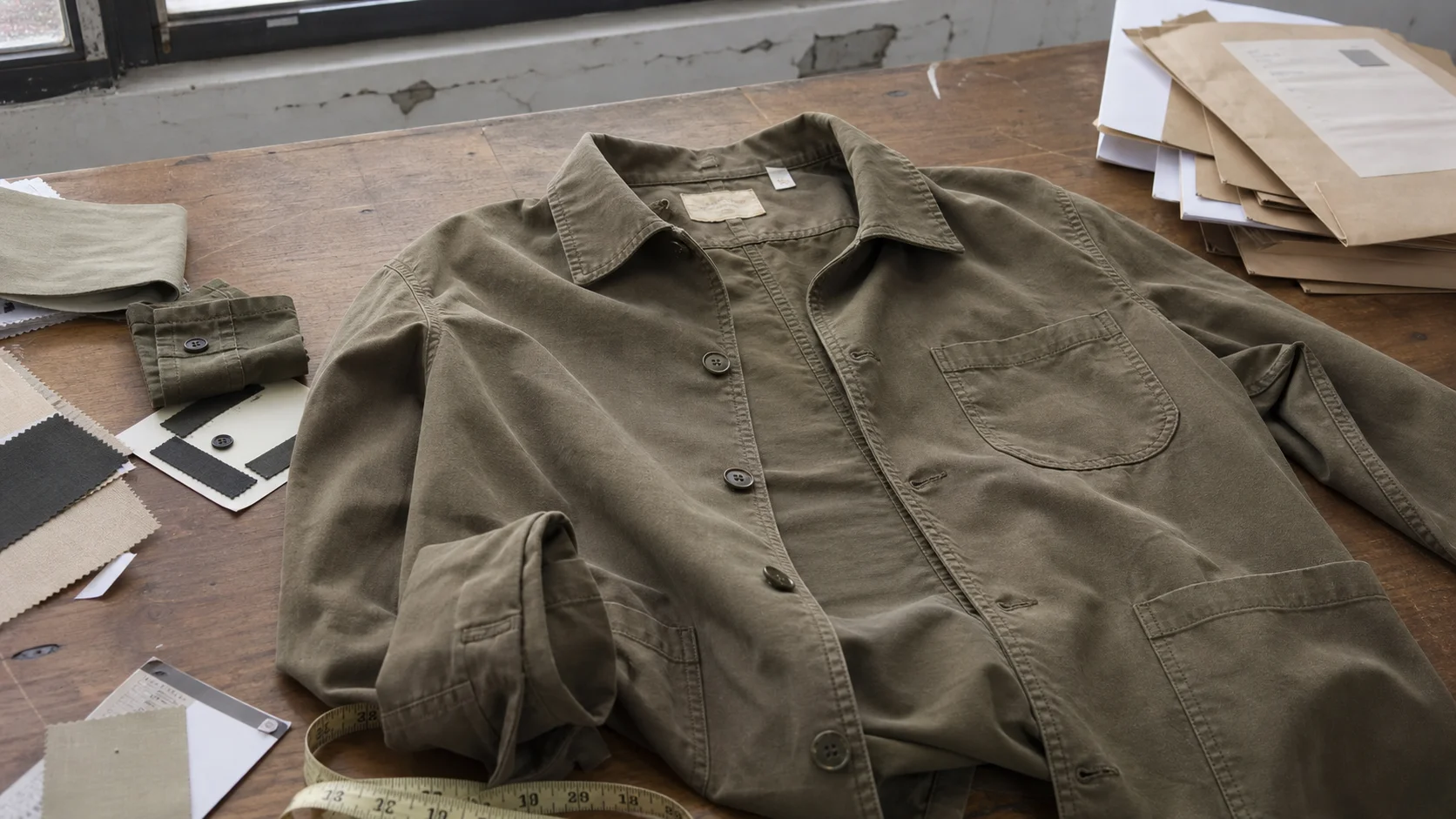
An organic cotton work jacket in this context is usually a casual utility layer made from woven cotton, cotton twill, brushed cotton, or heavyweight organic cotton canvas. It may have patch pockets, metal buttons, zip closures, reinforcement stitching, and branding placements for embroidery or print. For fitness clubs, the design is often more functional than fashion-led, but the jacket still needs to look polished enough for front-of-house or retail-facing staff.
Buyers should confirm whether the jacket is made from 100% organic cotton or a blend. Blends may improve recovery or reduce wrinkling, but they can complicate sustainability positioning. If recycled content or elastane is included, the wash test should also confirm whether the fabric twists, bags out, or changes surface texture after laundering.
Common weight ranges for this type of garment are often in the medium-to-heavy band, such as 220 gsm to 350 gsm for woven work jackets, though the exact target depends on season, region, and intended use. Heavier fabrics usually wear better, yet they can feel too warm for active club staff or indoor retail environments. Lighter constructions may be more comfortable but can show seam stress and fading more quickly.
Before placing an order, buyers should ask direct questions about the wash test method and the acceptance standard. A supplier may say a jacket “passed washing,” but that phrase is too vague to support a purchase decision.
A good supplier should be able to discuss test conditions in a structured way. Buyers should be cautious if the answer is limited to visual approval only. A garment that survives one gentle wash may still fail when club staff wash it weekly or when retail customers follow warmer machine settings.
The sample stage is where most costly wash problems can be prevented. A sensible approval flow usually includes a proto sample, a fit sample, a sales or pre-production sample, and then a final size set or gold seal sample. If branding is applied, the sample should include the exact logo method intended for production.
For organic cotton work jackets, buyers should not approve based on appearance alone. The sample needs to be washed before final sign-off. If possible, request at least one pre-production sample washed under the intended care conditions. That should reveal most major issues early enough to revise fabric, construction, or care instructions.
Typical checks during sample approval include:
If the factory cannot supply a clear approval trail, buyers should treat that as a sourcing risk. Quality issues are easier to correct on one sample than on 2,000 units.
MOQ levels for organic cotton work jackets vary by factory, fabric availability, decoration method, and whether stock fabric is being used. A practical range for custom production is often around 300 to 1,000 pieces per color or style, though some suppliers may accept lower quantities with a price premium. Larger factories may prefer higher thresholds, especially if special dyeing, custom trims, or proprietary labels are involved.
Lead time usually depends on four main factors:
For organic cotton garments, organic certification documents and material traceability may add time to the front end. If the jacket uses custom finishes or heavier washed effects, the bulk timeline can extend further. Buyers should build a buffer rather than promising launch dates before sample approval is complete.
Wash-test results are only meaningful if the product specification is fixed. When multiple details change between sample and bulk, the wash result from the sample may no longer apply. Buyers should lock down the following points early:
Spec area What to confirm Why it matters in wash testing Fabric composition 100% organic cotton or blend, with exact fiber percentages Different fiber mixes shrink and age differently Fabric weight GSM target and tolerance Heavier cloth may handle washing better, but can feel too warm Weave or knit type Twill, canvas, brushed woven, or similar structure Structure affects shrinkage, texture, and distortion Dye method Garment dyed, piece dyed, or yarn dyed Colorfastness risk varies by dye process Trims Metal or resin buttons, zipper quality, thread type, labels Trims can fail even when the base fabric survives Construction Stitch density, seam type, reinforcement points Weak seams may open after laundering and wear Decoration Embroidery, print, woven patch, heat transfer Decoration often shows the first visible wash failureThread choice is often overlooked. A cotton jacket may be sewn with polyester thread for strength, which is common and practical. The buyer should still confirm thread quality because poor thread can produce seam popping, fuzzy appearance, or uneven shrink behavior after washing.
Most wash-test failures fall into a few predictable categories. The problem is usually not mysterious; it is a sign that the construction or process was under-specified.
Some shrinkage is normal in cotton, but excessive shrinkage causes sleeve length loss, tightness across the chest, or a distorted hem. If a jacket shrinks unevenly, the garment may twist after washing. Buyers should define acceptable tolerances before testing begins, rather than arguing over results later.
Color loss is a major concern for branded clubwear because staff uniforms need to stay consistent. A wash test should evaluate whether the color fades, patches out, or develops lighter stress areas at seams, cuffs, and elbows. Dark shades often carry higher risk than light neutrals.
Labels can curl, lose print clarity, or detach at the edges. Buttons may loosen, and zipper tape can distort if the fabric shrinks around it. Buyers should check the garment inside and out after laundering, not just the front view.
If the jacket includes a logo, decoration must survive the chosen care cycle. Heat transfers may crack sooner than embroidery. Embroidery can pucker if the base fabric shrinks more than the stitch backing can handle. For fitness club buyers, this matters because logos are often the most visible brand element.
Organic cotton can still pill or become harsh after washing depending on fiber length and finishing quality. A jacket that feels acceptable out of the box may become less comfortable after several wash cycles. That affects employee adoption and member retail satisfaction.
A simple pass-fail decision is often not enough. Fitness club buyers benefit from a scoring sheet that ranks the jacket across practical categories. This approach makes supplier comparison easier and keeps the decision tied to use case rather than sales claims.
Category Suggested scoring focus Buyer concern Fit after wash Does it still match size chart? Staff comfort and consistent presentation Appearance Color, shape, surface finish Retail value and uniform quality Branding Logo clarity and placement Customer-facing image Durability Seam and trim integrity Replacement cost and reorder risk Care practicality Can it be washed easily without special handling? Real-world club operationsIn a fitness club setting, a jacket that needs delicate care may be less practical even if it looks premium. Buyers should weigh appearance against maintenance burden. A sustainable garment that is difficult to clean can become a poor purchase in operational terms.
Testing should not stop at the sample stage. Bulk inspection is still needed because production lots can drift. Fabric rolls may vary, dye lots may differ slightly, and sewing quality may fluctuate across lines or shifts.
Inspection and test risks to watch include:
For higher-value orders, buyers may request third-party lab testing for shrinkage, colorfastness, pilling, and seam strength. This adds cost and time, yet it can prevent larger losses. It is especially useful when the jacket will be sold to customers rather than used internally by staff.
Buyers should also confirm care labeling. If the wash instructions are unrealistic, the jacket may fail in the market even if the garment itself is acceptable. Clear care content helps reduce complaints and protects the brand.
A good sourcing decision is rarely based on a single result. It is based on the balance of performance, cost, and production reliability. For fitness club buyers, the right choice depends on how visible the jacket will be, how often it will be washed, and whether the garment sits in a premium or utility price band.
Approve the style when the wash test shows stable size retention, acceptable color behavior, sound seam performance, and decoration that remains intact. Revise the spec when the jacket is close to target but needs better thread, stronger stabilization, improved pre-shrink treatment, or a different logo method. Reject the style when shrinkage is excessive, the color fails visibly, or trims and seams start breaking down too early.
In sustainable fashion sourcing, the lowest-impact garment is not the one with the best claim sheet. It is the one that stays usable for as long as the buyer actually needs it.
For brands and clubs trying to combine sustainability with operational reliability, the most practical route is usually a controlled organic cotton specification, a washed approval sample, and a clear production inspection plan. That is the point where environmental positioning becomes commercially credible.
If you are planning a sustainable apparel program and need a structured sourcing path, you can start with the services overview, then review the company background on the about us page, or use the contact form to discuss product development questions.
Get a free quote from Fabrikn — your trusted B2B clothing manufacturer with 10+ years of experience. MOQ as low as 200 pieces.
Get a Free Quote →The main purpose is to check whether the jacket keeps its size, shape, color, and branding after laundering. For fitness club buyers, this matters because uniforms and retail pieces usually need regular washing.
That depends on the end use, but a practical review often includes at least one or more simulated wash cycles on pre-production samples. Buyers of uniforms or retail items may ask for additional cycles to spot early shrinkage or decoration failure.
Many factories work in the range of 300 to 1,000 pieces per style or color, though this changes with fabric, trim complexity, and decoration method. Lower quantities are sometimes possible, but the unit price may increase.
Both can fail, but branding often shows visible problems first. Prints may crack, embroidery may pucker, and labels can curl or detach. Fabric failures usually show up as shrinkage, twisting, fading, or pilling.
It depends on the use case. 100% organic cotton is cleaner from a material-claim standpoint, while a blend may improve recovery or reduce wrinkling. Buyers should decide based on durability, comfort, and sustainability positioning.
Not always, but cotton is naturally more shrink-prone than some synthetics. Proper pre-shrinking, fabric finishing, and construction control can reduce the risk, which is why wash testing is important before bulk purchase.
Buyers should ask for the final spec sheet, sample approval process, wash test details, care label wording, and confirmation of trims and decoration methods. That helps reduce surprises during production.