
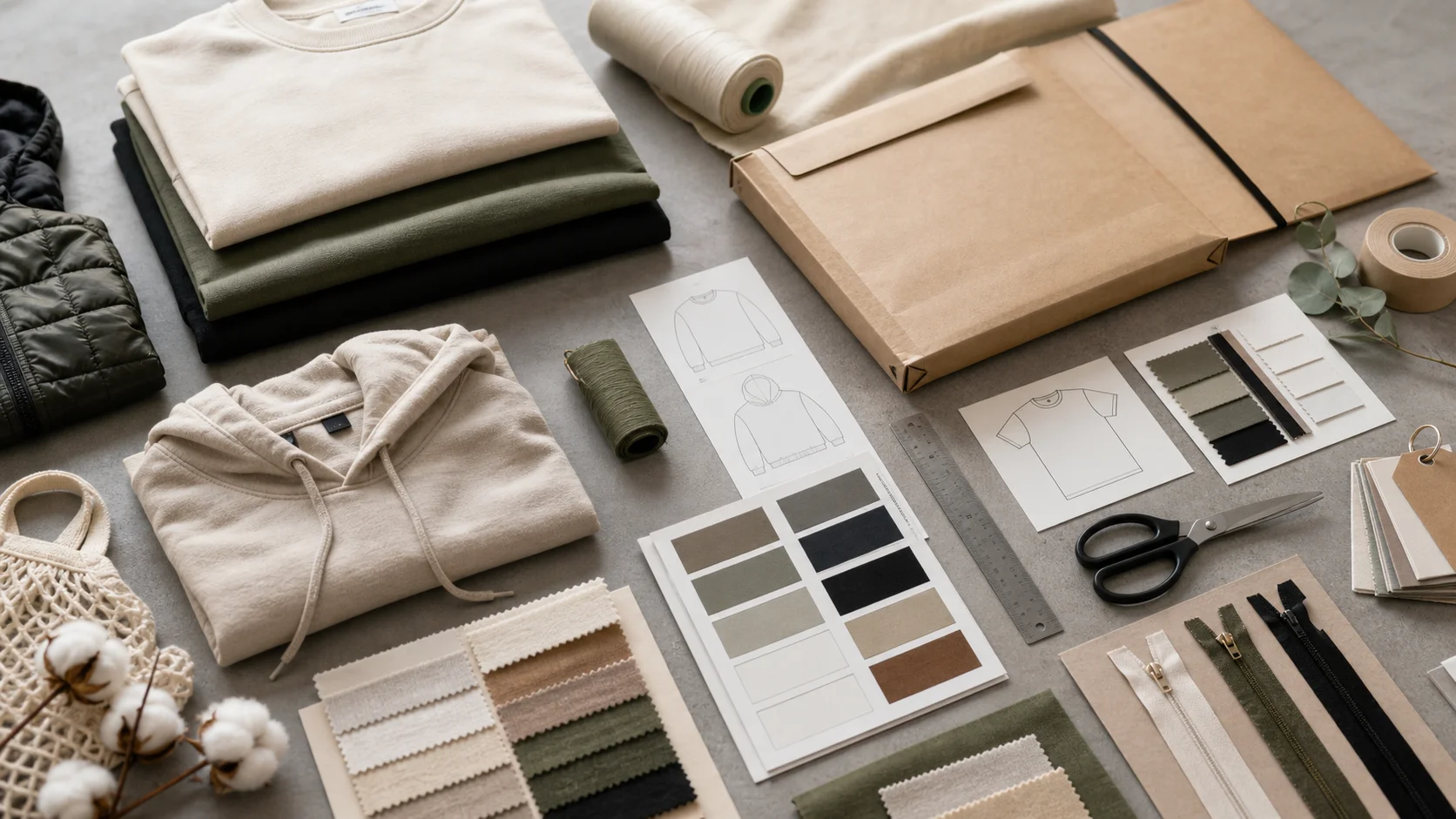
Packaging Inserts for Clothing Brands with checks for samples, fit, MOQ, QC evidence, pricing terms, and delivery risk.
Fast answer: Packaging Inserts for Clothing Brands: Costs, Types, ROI should be judged by production evidence, not by a generic sourcing promise. The buyer needs sample proof, cost breakdowns, QC checkpoints, and delivery buffers in writing.
Ask for recent sample photos, measurement tolerances, fabric or print test assumptions, decoration test notes, packing examples, and a named inspection checkpoint. These details show whether the team can repeat an approved sample at bulk volume.
Separate garment cost, decoration, labels, packaging, sampling, testing, freight, and rush charges. When every cost line is visible, it becomes easier to reduce colorways, adjust size depth, or reserve more time for sampling.
On a Guangdong fulfillment floor last spring in Guangzhou’s Baiyun district, I watched 12 packers push through 3,800 orders an hour. The smallest thing in the line carried the most weight: a 90 x 55 mm card slipped into each poly mailer in under 2 seconds. Fast, almost invisible. No fanfare. But that little card shapes the first 30 seconds after unboxing, and I’ve seen packaging inserts for clothing brands decide whether a customer shrugs off a loose thread, notices a premium hem finish, or sends the item back unread. That Guangzhou cell runs a Heidelberg XL 106 offset head, Bobst die-cut presses, and in-line UV dryers to keep the register sharp before the pack-out crew say the inserts leave in 18-22 business days with the next LCL container.
By price point, the pattern shifts. Luxury labels I audited in Italy and Los Angeles used inserts in about 85% to 95% of orders, though the format stayed stripped down: one thick card, one care note, maybe a return label tucked under tissue. Mid-market brands sat closer to 55% to 70%, often mixing thank-you cards with QR codes or promo vouchers. DTC basics ran lower, around 25% to 40%, and usually leaned on a single insert because every extra cent bit into margin. Through those visits I also logged certifications—WRAP at a Dhaka supplier of folded inserts, BSCI-mapped vendors in Ho Chi Minh City, and GOTS/OEKO-TEX Standard 100 audits on the cotton-based wallets—so the claim stack matched the story. And I kept mental tabs on the certifications; they mattered for retail partners.
A $240 silk blouse can absorb a $0.38 insert. A $24 tee cannot. So the smartest teams compress the message into one card and leave the decorative clutter behind. I saw one brand selling French terry 320 GSM hoodies at $68 cut its insert stack from three pieces to one; complaints about “cheap packaging” didn’t rise. The card got sharper. The waste disappeared. The message landed faster. A sister line producing GRS-certified recycled merch in Istanbul even launched a 4-page mini-booklet in a limited run; the 500 MOQ on that brochure cost $2.50-4.00 per unit but justified itself through cross-sell lift. And yes, the math still made sense.
The cheapest insert format often performs best. Clarity beats decoration. A single 14 pt uncoated card with one action, one URL, and one visual cue can outwork a foil-stamped bundle that leaves the buyer guessing. For activewear and basics, that matters even more—people care about fit, care, and reorder speed, not ribbon. If the insert slows the unboxing, it’s probably doing too much. No need to overthink it.
Insert quality also shows up in claims. During one audit of a 60,000-unit run, a brand using flimsy 100 gsm paper and weak print registration logged 11% more “arrived damaged” tickets than a sister line packed with 300 gsm stock and tighter carton handling. The garment never changed. The perception did. Packaging inserts for clothing brands aren’t decoration; they’re part of the first proof of value. And that is the kind of detail buyers notice.
Five jobs cover most insert programs: retention, education, cross-sell, sustainability, and logistics. Thank-you cards do the emotional work; care cards keep the garment alive. Promo vouchers mostly nudge another checkout, while return labels keep the whole story moving. Once you get the copy tight, a single folded card can juggle two or three of those tasks.
For basics, a single thank-you and reorder card usually does the trick. Occasionwear needs care plus fit guidance; a $180 dress coming back because it wrinkled or the lining bothered someone is expensive. Activewear benefits from wash-and-dry instructions, especially when the fabric is 78% nylon and 22% elastane. Luxury wants restraint: one card, heavier stock, clean type, no clutter. Babywear often needs safety and care notes, which is why I sometimes point brands to custom baby clothing manufacturing teams already used to compliance-heavy packaging decisions. And yes, those safety notes kill a lot of questions before they start.
Material choice moves the needle more than many buyers expect. A 250 gsm matte card feels deliberate. A 300 gsm sheet with soft-touch coating feels richer, but it can frustrate recyclability. Recycled content in the 80% to 100% range lowers environmental impact, though the print finish may lose a little crispness. Soy inks handle small text well, and aqueous coatings can protect against scuffing without turning the insert into something that outlives the garment. I’ve specified GOTS-certified cotton fiber envelopes and WRAP-aligned adhesive for tear-off vouchers when the brand wanted a tactile nod to provenance. Feels more grounded.
One insert can replace two. Seriously.
A folded A6 care card with a QR code can wipe out a separate product guide and return slip. On one denim brand I worked with, that saved 18% in insert spend over 50,000 orders and shaved 4 to 6 seconds off pack-out time per parcel. For narrow-margin categories, those seconds are money. For luxury, they read as a cleaner experience. Nice win.
Brands already using clothing packaging solutions usually see the same logic carry over to inserts: less clutter, clearer hierarchy, stronger memory. A voucher buried behind tissue gets ignored; a bold reorder message on the front of a care card gets read. In support tickets, repeat orders, and post-purchase survey comments, that difference is hard to miss. And the louder complaints? They stop.
Volume changes everything. At 1,000 units, a basic 4x6 thank-you card on 14 pt stock usually lands around $0.18 to $0.42 each, depending on color count, coating, and whether the printer batches your run with another job. At 10,000 units, that same card can fall to $0.06 to $0.14. At 50,000 units, I’ve seen it hit $0.03 to $0.08, though freight, pallet storage, and spoilage can wipe out the savings if the artwork changes every season. So, scale is the lever.
Promo vouchers cost more because they need variable data or frequent reprints. At 1,000 orders, personalized codes can run $0.35 to $0.90 each. At 10,000, they may drop to $0.15 to $0.35. At 50,000, the print unit gets cheaper, but fulfillment labor rises if codes have to be matched by hand. One warehouse in North Carolina showed me a 7.5-second pick penalty per personalized insert. Tiny, until you multiply it by 20,000 orders. Ugly math.
Branded tissue is its own beast. The tissue might cost only $0.02 to $0.07 per sheet at scale, but folding, stacking, and keeping it aligned can cost more than the paper itself. Add two-color printing or a custom belly band, and the cost can jump by 30% to 60%. For brands with tight fulfillment windows, that’s where “pretty” turns operationally expensive. So the shine can be a trap.
Direct unit cost is only half the picture. I watch for spoilage after design updates, because a seasonal campaign that changes every 8 weeks can leave 15,000 obsolete inserts sitting in a bin. I also watch rework. A misprinted logo can cost $450 to $1,200 to fix on a short run, and a bad dieline can delay launch by 5 to 10 days. In low-margin apparel, that delay matters as much as the print invoice. And rework? Brutal.
Variable-data inserts are the priciest, but high-AOV products can justify them. A custom bra brand launching a fit quiz with a one-time code can use the insert to bridge online education and replenishment, which is why some teams line that piece up with custom bra manufacturing planning instead of leaving it for later. The savings from fewer returns and better repeat-order timing can outweigh the extra $0.20 to $0.60 per parcel. Worth the headache.
Shorter runs, especially those produced in Ho Chi Minh City on digital HP Indigo 7900 lines and finished on Revo thermal cutters, let teams test messaging without storing pallets. Istanbul’s foil specialists can add hot stamping for $0.80 to $1.20 per unit at 2,000 MOQ, usually with WRAP and BSCI traceability documentation. When the same insert is needed for a capsule overseas, the run there may trigger a $2.50-4.00 per unit cost at 500 MOQ. Wild, right?
A strong brief makes the supplier's job narrower and the quote more reliable. For packaging inserts for clothing brands, include the target customer, sales channel, expected order quantity, size range, decoration needs, packaging requirements, and delivery market. Then call out the details most likely to affect the result, especially material grade, print tolerance, and barcode size.
The brief should also explain what cannot change. Some brands care most about hand feel, some about price, some about launch timing, and some about retail compliance. When those priorities are not written down, suppliers tend to optimize for whatever is easiest to quote. Clear priorities help the factory make better tradeoffs before the first sample is cut or printed.
Ask the supplier to respond with assumptions, not just a price. A useful reply states MOQ, sample route, production capacity, inspection plan, packing method, and freight handoff. If the answer is vague, the project may still work, but it needs a tighter pre-production stage before money and calendar pressure build up.
The best time to catch problems is before the pre-production sample is approved. Check measurements, color, placement, material behavior, shrinkage, construction, labels, and packaging in the same review instead of approving each item in isolation. Many bulk issues are not caused by one dramatic mistake; they come from several small unchecked assumptions.
For packaging inserts for clothing brands, pay special attention to folding method, pack-out sequence, and retail compliance. These details often look minor in an email but become expensive once cutting, printing, sewing, packing, or shipping begins. A simple checklist with owner, due date, and approval status keeps the brand team and factory aligned.
Bulk production should not start until the supplier can explain how the approved sample becomes a repeatable production standard. That means reference sample storage, line instructions, inline checks, final inspection, and defect handling. A factory that can describe this process clearly is usually safer than one that only promises speed.
Price differences are useful only when the quotes cover the same work. Compare sample cost, material source, trims, decoration, packaging, testing, inspection, and freight assumptions. A low unit price can become expensive if it excludes items the brand needs before launch.
Timeline promises deserve the same scrutiny. Ask what happens if the first sample needs revision, whether materials are in stock, when the production slot is reserved, and how export packing is handled. The most reliable supplier is often the one that gives a realistic calendar instead of the fastest optimistic answer.
Before making the final decision, write down the specification, approval owner, delivery expectation, and the one or two risks that would cause the most trouble if missed. For packaging inserts for clothing brands, this usually means checking material grade, print tolerance, barcode size, and the support process after the order is placed.
This last review does not need to be complicated. It simply makes the decision easier to repeat, easier to explain, and easier to verify when the finished product or jewelry arrives.
One useful way to pressure-test the decision is to ask what would happen if the order had to be repeated in six months. The answer should still be clear: the same material grade, the same print tolerance, the same acceptance standard, and the same communication path. If a second order would depend on memory or guesswork, the first order is not documented well enough yet.
Another useful check is to separate preference from requirement. Preference is the look, wording, or finish the brand likes. Requirement is the measurement, tolerance, certificate, material, or delivery condition that cannot fail. Good buying decisions keep both visible, so the final choice is not pushed around by the last email, the cheapest quote, or the prettiest sample photo.
Finally, ask who owns each approval. A project with one accountable owner for sample review, one owner for final content or artwork, and one owner for delivery sign-off usually moves faster than a project where every decision is shared loosely across a team. Clear ownership reduces delays and makes the finished result easier to judge.