
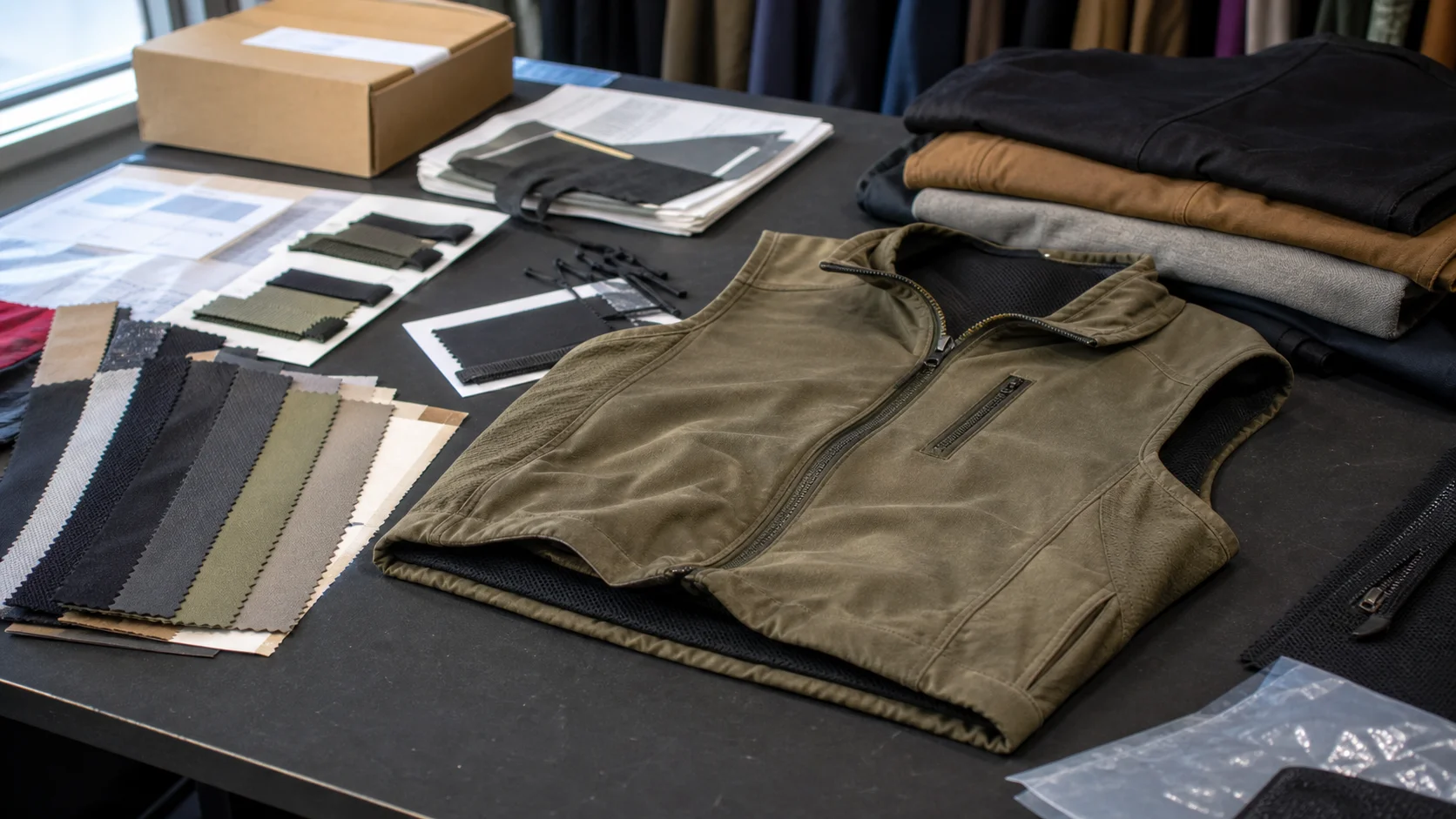
A product-specific SEO outline for restaurant group buyers auditing performance vest reorder risks, factory variables, and production artifacts before...
Performance Vest Reorder Risk Review for Buyers - Activewear & Teamwear manufacturing guide
Performance vest reorders look simple on paper. The restaurant group already approved the design, the teams already wear it, and the purchasing department usually wants the same item again with minimal discussion. In practice, reorders carry a different kind of risk from first-time production. The first order proves the concept. The reorder tests whether the factory, fabric mill, trim suppliers, decoration process, and buyer specifications are controlled well enough to repeat it.
For restaurant groups, this matters because uniform inconsistency is visible. A black softshell vest that shifts slightly toward charcoal may not sound serious in a spreadsheet, but it stands out when one store has the original batch and another store receives the reorder. A logo placed 15 mm lower than the approved sample can make front-of-house staff look uneven. A zipper that feels cheaper than the previous run can create complaints from managers who remember the original issue.
The risk is higher when the vest is used across multiple restaurant concepts, regions, or employee roles. Host teams, managers, bar staff, runners, catering staff, and outdoor service teams may all need slightly different wear performance. If the reorder is rushed, the buyer may approve “same as last order” without verifying whether the same fabric lot, zipper model, elastic binding, lining, puller, print method, or embroidery backing is still available.
A proper performance vest factory reorder risk review helps buyers prevent these issues before purchase orders are issued. It is not only a quality control exercise. It is a sourcing discipline that protects brand presentation, employee comfort, store rollout timing, and inventory budget.
Direct purchasing judgment: treat every reorder as a controlled repeat order, not an automatic copy. The item may look unchanged, but the supply chain behind it may have shifted.
The biggest reorder mistake is assuming the factory can reproduce the first production exactly because it has the old tech pack. That may be true when the original materials are reserved, the pattern is digitally controlled, and the vendor has a reliable production history. It is less reliable when the first order used open-market fabric, generic trims, or decoration settings that were never recorded in detail.
Restaurant group buyers should review reorder risk across five areas: material continuity, pattern and fit, decoration repeatability, factory capacity, and shipment timing. Each area can create a different commercial problem.
Performance vest fabrics often include polyester stretch woven, bonded fleece, softshell, quilted polyfill, ripstop, or double-knit structures. Mills may discontinue colors, alter finishes, change yarn denier, or move coating and lamination processes. Even when the composition is listed as “100% polyester,” hand feel, weight, stretch recovery, pilling resistance, and water repellency can vary sharply.
Buyers should not accept a vague confirmation such as “same fabric available” without a new fabric swatch or a retained cutting from the original bulk lot. The practical question is whether the reorder will look and perform the same when employees wear it next to older inventory.
Performance vests are fit-sensitive because they are often layered over shirts, polos, or chef jackets. Restaurant staff need arm mobility, clean front closure, and enough torso length for active service. A small pattern drift can create real wear issues: tight armholes, gaping chest, short back length, or a hem that rides up when staff bend or reach.
Buyers should confirm whether the factory still has the approved graded pattern, size set comments, and measurement tolerances from the original order. A reorder made from a recreated pattern is not the same risk profile as a reorder made from locked production files.
Restaurant group branding is often the most visible part of a vest. Embroidery, heat transfer, woven patches, silicone badges, reflective prints, and screen prints all require controlled placement and color matching. A reorder can fail if the logo thread shade changes, the embroidery density puckers the fabric, or the heat transfer adhesive reacts differently to a coated shell fabric.
If the vest uses a left chest logo and an upper back mark, buyers should require placement measurements from fixed garment points, not only photos. For example, left chest embroidery may be specified as a certain distance from center front zipper and shoulder seam. Photos help, but measurements prevent arguments.
Factories shift production lines depending on seasonal demand. The same vendor may place a reorder on a different line from the first order. That can affect seam consistency, zipper setting, quilting alignment, binding tension, and pressing quality. This does not mean the factory is unsuitable. It means buyers should ask whether the same production process, machinery, and quality benchmarks are being used.
Restaurant groups that need consistent replenishment may benefit from a supplier with repeat-order systems and clear pre-production controls. For buyers comparing support models, Fabrikn’s services page is a useful reference point for structured apparel sourcing and production support.
A late reorder can force restaurant groups to mix old and new uniform programs, delay openings, or issue temporary substitutes. Performance vests may be seasonal, especially for patio dining, outdoor queue management, delivery handoff, or catering teams. A spring vest delivered in late summer has limited value.
Lead time must be reviewed from fabric booking to final delivery, not only sewing time. Buyers should factor in lab dips, strike-offs, pre-production samples, bulk fabric approval, decoration approval, inline inspection, final inspection, packing, export clearance, and domestic distribution.
A reorder risk review should start with a clean specification file. Many restaurant groups inherit uniform specifications from earlier vendors, marketing teams, or franchise operators. These files often include a style photo and logo art but miss the technical details needed for repeat production.
For a performance vest, the buyer should lock down the shell fabric, lining, insulation if used, pocketing, zipper, puller, binding, thread, labels, packaging, and decoration method. The more the vest functions as outerwear, the more important fabric and trim control becomes.
Typical shell fabrics include polyester mechanical stretch woven, nylon-polyester blends, softshell bonded fleece, polyester spandex, and lightweight ripstop. A useful specification should include fiber content, fabric weight, construction, finish, color standard, stretch direction, water-repellent treatment if applicable, and performance requirements.
For restaurant use, stain resistance, abrasion resistance, colorfastness, and wash durability matter more than extreme outdoor performance. A vest that looks technical but cannot survive repeated laundering or daily service friction is not a good buy.
Some restaurant groups prefer lightweight unlined vests for indoor managers. Others need fleece-backed softshell or lightly padded vests for outdoor staff. Lining specifications should include material, weight, color, anti-static requirements, and whether it must slide easily over uniforms.
Insulated vests add complexity. Polyfill weight, quilting pattern, fill migration, bulk, and compressibility all affect fit and appearance. If the original order used 80 gsm polyfill and the reorder substitutes 100 gsm, the vest may feel warmer but fit tighter. That tradeoff should be approved intentionally, not discovered after delivery.
Zippers are a common reorder failure point. Buyers should record zipper brand or performance grade where relevant, teeth type, tape color, gauge, slider finish, puller design, and top/bottom construction. Generic zipper substitutions can reduce cost, but they also create higher risk of snagging, uneven closure, poor durability, or color mismatch.
For restaurant groups, zipper feel affects perceived uniform quality. Managers notice when a reorder zipper is stiff or noisy. Staff notice if pocket zippers fail after a few weeks. If cost must be reduced, it is often safer to simplify packaging than to downgrade the front zipper.
Armhole binding can make or break vest comfort. Too tight, and it restricts movement. Too loose, and it looks wavy. Elastic hem details should be checked carefully because restaurant staff often move quickly and bend frequently. Pocket depth is another practical issue. Managers may carry phones, pens, order notes, keys, or small service tools.
A reorder review should compare pocket opening size, pocket bag depth, bartack placement, and seam reinforcement against the original approved sample. These details are small, but they create daily-use complaints when missed.
Performance vest decoration must balance brand clarity with garment function. Embroidery is durable and premium, but it can pucker lightweight stretch fabrics. Heat transfer can look clean, but it depends on correct temperature, pressure, dwell time, and compatibility with fabric coatings. Woven patches add dimension but may feel stiff on lightweight vests.
Buyers should specify logo size, color standard, placement, backing, thread or transfer material, and wash durability expectations. For multi-location restaurant groups, keep a master decoration standard so each reorder does not rely on a new interpretation of the logo file.
Specification Area Reorder Risk Buyer Control Point Shell fabric Color, hand feel, stretch, weight, finish may vary Approve swatch against retained bulk cutting and color standard Zipper Slider quality, tape shade, closure smoothness may change Lock zipper gauge, tape color, slider type, and puller design Logo decoration Placement, thread shade, transfer adhesion may drift Approve strike-off and measure placement from fixed garment points Pattern Armhole, chest, length, and layering fit may shift Use approved graded pattern and compare size set measurements Packing Store allocation errors may disrupt rollout Confirm size ratio, carton marking, location packing, and barcode needsMinimum order quantity is one of the first commercial constraints in a performance vest reorder. Typical MOQ ranges vary by factory setup, fabric availability, decoration method, and whether the buyer is using stock materials or custom-developed fabric.
As a cautious planning benchmark, buyers may see MOQs around 300 to 500 pieces for simpler stock-fabric vest programs, 500 to 1,000 pieces for custom color or softshell fabric orders, and 1,000 to 3,000 pieces or more when custom-dyed fabric, specialized trims, or mill-level development is required. These are not fixed rules. A factory may accept lower quantities at a higher unit price, especially for a repeat customer, but low MOQ often limits customization and can increase material substitution risk.
Restaurant groups should separate total order quantity from practical production quantity. A 600-piece reorder across eight sizes, three logo versions, and two location groups may create small cuts per SKU. Small SKU quantities make cutting efficiency worse and increase the chance of allocation mistakes.
Performance vest size curves should be based on actual issue history, not only standard retail assumptions. Restaurant teams may need broader size coverage than fashion activewear because uniforms must fit all employees. A size curve that underbuys 2XL, 3XL, or smaller sizes can create employee dissatisfaction and emergency reorder costs.
Buyers should review past distribution, unused stock, employee turnover, new store openings, and seasonal staffing. If the group is expanding, the reorder should include buffer stock for onboarding. If the vest is part of a manager-only program, the size curve may be more stable but still needs regional review.
Restaurant groups sometimes operate multiple concepts under one parent company. The vest style may be shared, while logo decoration changes by brand. This approach can improve fabric MOQ efficiency, but it creates decoration and packing complexity.
The tradeoff is straightforward. Combining volumes under one vest body can reduce unit cost and improve fabric consistency. Splitting into many logo versions can increase setup time, inspection burden, and risk of mixed cartons. Buyers should decide whether the savings justify the operational complexity.
A small buffer is often cheaper than a panic reorder. For stable uniform programs, buyers may plan an extra 3% to 8% depending on turnover, loss rates, size uncertainty, and new store timing. Higher buffers tie up inventory and cash, so they should be based on real consumption data.
If the factory MOQ is high and annual usage is predictable, a scheduled replenishment plan may be better than large irregular orders. Buyers can also ask suppliers whether greige fabric, trim inventory, or approved logo materials can be reserved, but those arrangements should be documented with clear liability for unused materials.
A reorder should not skip sampling entirely unless the supplier is producing from the same materials, same patterns, same decoration files, and same factory-controlled approvals with retained reference samples. Even then, buyers should request confirmation photos and material evidence before bulk cutting.
The right sample process depends on risk level. A low-risk reorder may need a material swatch, logo strike-off, and pre-production sample. A higher-risk reorder may need fit samples, size set samples, wash testing, and a pilot run.
The buyer should send the latest approved tech pack, not rely on factory archives. The file should include measurement specs, tolerance, grading, construction details, fabric and trim descriptions, logo files, placement details, label requirements, packing method, and carton allocation instructions.
If the previous order had production comments, those comments should be integrated into the current document. A common problem is that the buyer approved changes by email during the first order, but the tech pack was never updated. The reorder then follows the older file and repeats problems that were already corrected.
Buyers should compare new swatches against retained samples under consistent lighting. Black, navy, charcoal, olive, and burgundy are especially sensitive in restaurant uniform programs because slight shade variation becomes visible across teams.
If the fabric is custom dyed, request lab dips before bulk. If it is stock fabric, ask whether the factory can source enough from the same lot. If not, request shade band approval and decide whether mixed lots are acceptable. In most customer-facing restaurant roles, visible shade bands are not acceptable across the same location issue.
For embroidery, the strike-off should confirm thread color, stitch density, backing, edge clarity, and puckering control. For heat transfer, it should confirm color, finish, adhesion, stretch behavior, and wash resistance. The strike-off should be tested on the actual vest fabric or a confirmed matching bulk fabric, not an unrelated base cloth.
Buyers should keep one approved strike-off as a reference. Photos are useful for communication, but physical or properly cataloged retained samples are better for dispute prevention.
The pre-production sample should use actual or confirmed bulk materials. It should be measured against the approved spec and reviewed for fit, logo placement, construction, seam appearance, zipper function, pocket usability, labeling, and packing presentation.
Restaurant group buyers should include operational reviewers when needed. A purchasing manager may focus on cost and delivery, while an operations manager may catch practical problems such as pocket depth, collar comfort, or whether the vest layers cleanly over the approved shirt.
A full size set is ideal for larger orders or changed patterns. If time is tight, buyers should at least review base size plus critical sizes such as XS, XL, and 3XL where grading issues often appear. Skipping size review can lead to fit complaints that are expensive to solve after distribution.
Before bulk production, the factory should hold a pre-production review covering material status, cutting instructions, construction details, decoration placement, measurement tolerances, inspection checkpoints, packing, and shipment timing. Buyers should request written confirmation of key points, especially any approved deviations.
Performance vest reorder lead times depend on material availability, decoration complexity, order size, factory capacity, and shipping mode. A simple reorder using available fabric may move faster than a first order. A custom-color softshell reorder can take nearly as long as a new program if fabric must be dyed or bonded again.
As cautious planning ranges, buyers may allow 2 to 4 weeks for sampling and approvals, 4 to 8 weeks for bulk production after approvals, and extra time for freight, customs, and domestic distribution. Custom fabric, special trims, complex embroidery, or peak-season capacity can extend timelines. Air freight can rescue a late delivery, but it can erase the savings of offshore production.
Restaurant groups should work backward from the date the vest must be in employees’ hands, not the date it leaves the factory. Store-level distribution can take longer than expected when cartons need to be split by location, size, role, or franchise group.
Stage Typical Timing Range Main Risk Spec reconfirmation 2 to 7 days Old files, missing comments, unclear approvals Fabric and trim confirmation 1 to 3 weeks Discontinued material, shade variance, trim substitution Sample approval 2 to 4 weeks Fit drift, logo placement issues, delayed feedback Bulk production 4 to 8 weeks Factory capacity, decoration bottlenecks, rework Inspection and shipping 1 to 6 weeks Failed inspection, carton errors, freight delaysVest orders often cluster before cooler weather, outdoor dining seasons, new store openings, and corporate refreshes. Factories may be busier during these windows. If the restaurant group waits until operations requests inventory, the sourcing team may have limited leverage on price, production slot, and material choice.
A smarter approach is to forecast vest usage quarterly. Buyers should review last year’s issue volume, planned openings, employee headcount, franchise orders, and remaining inventory. This allows the factory to plan material and production capacity before the program becomes urgent.
Many reorder delays come from buyer-side approvals. Lab dips sit with marketing. Logo strike-offs wait for brand review. Pre-production samples are passed between purchasing, operations, and executives. Factories can hold capacity only for a limited time, so slow approval can push the order behind other production.
Buyers should assign one decision owner and set approval deadlines. If multiple departments need input, their comments should be consolidated before sending to the factory. Conflicting feedback causes sample loops and weakens accountability.
Inspection should be planned before production starts. Waiting until final inspection to define quality expectations gives buyers fewer options. The goal is not to find defects after the factory has packed everything. The goal is to prevent defects during material receipt, cutting, sewing, decoration, and packing.
The factory should check bulk fabric for shade, width, weight, defects, coating consistency, and shrinkage where relevant. For softshell or bonded fabrics, delamination risk should be taken seriously. For stretch fabrics, recovery and skew can affect garment shape.
Trims should be checked against approved samples. Zipper tape shade, puller finish, label content, elastic tension, drawcords, snaps, and packaging materials can all drift between orders.
Inline inspection catches issues while they can still be corrected. For performance vests, inspectors should review seam allowance, zipper alignment, armhole shape, pocket placement, logo position, bartacks, hem shape, quilting alignment if applicable, and measurement control.
A common risk is that the first pieces look acceptable but quality drifts as production speed increases. Inline checks should include different operators, sizes, and time points during production.
Final inspection should confirm appearance, measurements, workmanship, decoration, labeling, packing, carton marks, quantities, and size breakdown. Buyers can use standard AQL methods, but inspection criteria should be adapted to the uniform program. A minor cosmetic issue hidden inside a pocket may not matter. A visible logo placement error on the chest matters a lot.
Restaurant group buyers should define critical, major, and minor defects before inspection. Critical defects may include sharp objects, mold, wrong logo, wrong brand label, unsafe trims, or severe measurement failures. Major defects may include visible stains, broken zippers, twisted seams, significant shade mismatch, poor embroidery, or incorrect size labeling. Minor defects may include small thread ends or slight internal finishing issues within tolerance.
Vests should be measured at key points: chest, bottom opening, front length, back length, shoulder width, armhole, collar height, pocket placement, and logo placement. Tolerances must be realistic. Overly tight tolerances can create unnecessary inspection failure, while loose tolerances can allow poor fit.
For many vest programs, a tolerance around plus or minus 1 cm for smaller points and 1.5 to 2 cm for larger body measurements may be practical, depending on construction and fabric. Stretch fabric and padded construction need careful judgment. Buyers should align tolerance with garment type and factory capability.
Uniform reorders often fail at packing, even when the garments are acceptable. Restaurant groups may require packing by location, department, size ratio, employee kit, or franchise account. A carton with mixed logo versions or incorrect size labels creates store-level confusion and extra labor.
Buyers should provide a packing matrix and carton marking instructions. If barcodes, polybag warnings, hangtags, or distribution labels are needed, they must be included in the purchase order and checked during final inspection.
Reorders often trigger cost pressure. Finance wants the same or lower unit price, while factories face higher fabric, labor, freight, or currency costs. The buyer’s job is not simply to reject increases. The job is to understand which cost changes protect the program and which substitutions create unacceptable risk.
Packaging simplification is often a safer cost-reduction lever than material downgrades. If the vest does not need individual hangtags, tissue, or premium bags, removing them may save cost without affecting wear performance. Shipping consolidation can also help if timing allows.
Buyers may also consider reducing low-volume logo versions, standardizing zipper pullers, or using a common lining color across concepts. These changes can make production cleaner without harming the employee experience.
Fabric substitution should be reviewed carefully. A similar-looking softshell may have weaker stretch recovery, poorer water resistance, or lower abrasion performance. A cheaper zipper can increase complaints and returns. A lower-density embroidery may look less premium. A lighter polyfill may reduce warmth for outdoor staff.
Cost reductions that affect the visible brand, fit, durability, or daily comfort should be approved only after sample review. If the reorder is for customer-facing staff, visual consistency should carry more weight than small unit-price savings.
Buyers should reject undocumented substitutions, unapproved logo changes, unknown fabric lots mixed across cartons, and production without a pre-production sample when material or factory conditions have changed. These shortcuts may save days but can create expensive rework, emergency freight, or unusable inventory.
Direct purchasing judgment: if the vest is part of a brand standard, do not trade visible consistency for a small unit-cost reduction. The savings rarely survive store-level complaints.
A reorder review becomes more effective when buyers ask practical questions before confirming the purchase order. The answers reveal whether the supplier is controlling the repeat order or treating it as a fresh approximation.
The answers should be documented in the purchase file. If the supplier cannot confirm key points, the buyer should raise the risk level and require additional samples or inspection.
Consider a restaurant group reordering black softshell vests for managers and outdoor host staff. The original vest used a bonded polyester stretch shell, brushed fleece back, reverse coil zipper, left chest embroidery, two zip pockets, and a stand collar. The reorder quantity is 1,200 pieces across XS to 4XL with three logo versions.
The purchasing team may think the job is simple because the style already exists. A risk review would identify several issues. The fabric mill may have a new black lot with a slightly different face sheen. The embroidery thread may need to match both the old logo standard and the new marketing guideline. The 3XL and 4XL sizes may need higher inventory because outdoor host roles have higher turnover. The three logo versions may require separate packing by concept. The front zipper must be checked because a cheaper substitute would be very visible.
A controlled reorder plan would request fabric swatches, zipper confirmation, logo strike-offs for all three brands, one pre-production sample in the base size, key-size measurement checks, and a packing matrix. The buyer would also ask for inline photos and final inspection based on agreed criteria.
This process may add several days at the front end, but it reduces the chance of receiving 1,200 pieces that do not match existing uniforms. For restaurant groups, that is usually a good trade.
Not every reorder should stay with the existing factory. Buyers should consider rebidding when the factory cannot reproduce the approved item, repeatedly misses delivery, resists sample documentation, changes materials without approval, or cannot support the restaurant group’s growth.
Rebidding has its own risks. A new factory may offer better pricing but will need to recreate the fit, construction, and decoration standards. There may be new sample costs, longer development time, and more internal review. If the current vest is performing well and the supplier can support repeat quality, switching only for a small price reduction may be unwise.
A rebid makes more sense when the restaurant group is redesigning the uniform program, expanding volume significantly, adding new categories, or consolidating suppliers. In that case, buyers should prepare a complete sample set and technical file before inviting quotes. Supplier comparisons based only on photos and composition are too shallow for performance teamwear.
Companies reviewing broader apparel sourcing support can learn more about the background and positioning of the sourcing partner through Fabrikn’s about page. For a specific performance vest or teamwear reorder discussion, buyers can use the contact page to start a more structured review.
A checklist helps purchasing teams avoid assumptions. It also gives operations, marketing, and suppliers a shared reference. The following checklist is suitable for most performance vest factory reorder reviews for restaurant groups.
A performance vest reorder for a restaurant group is not just a repeat garment order. It is a brand consistency project, an employee comfort project, and an operational timing project. The risks are manageable, but only when buyers review the details before bulk production.
The most important rule is simple: do not let “same as last time” replace documentation. The factory should prove material continuity, pattern control, decoration repeatability, production readiness, and packing accuracy. If anything has changed, the buyer should know what changed, why it changed, and how it will be approved.
Restaurant groups should be especially cautious with visible brand elements, black and dark color matching, zipper quality, armhole comfort, size curve planning, and location packing. These are the areas most likely to create complaints after delivery.
A well-run reorder may not feel dramatic. It is mostly disciplined confirmation: swatches, samples, measurements, approvals, inspections, and calendar control. That discipline is exactly what keeps a uniform program looking consistent across stores.
Get a free quote from Fabrikn — your trusted B2B clothing manufacturer with 10+ years of experience. MOQ as low as 200 pieces.
Get a Free Quote →The biggest risk is assuming the reorder will match the previous production without reconfirming materials, trims, logo decoration, pattern files, and packing instructions. Fabric shade, zipper quality, logo placement, and fit can all drift between orders.
Typical MOQ ranges may start around 300 to 500 pieces for simpler stock-fabric programs, 500 to 1,000 pieces for custom color or softshell programs, and 1,000 to 3,000 pieces or more for mill-level custom fabric or complex trims. Actual MOQ depends on the factory, fabric source, decoration, and SKU breakdown.
Yes, in most cases. At minimum, buyers should review fabric swatches, trim confirmation, logo strike-offs, and a pre-production sample. If the fabric, pattern, factory line, or decoration method has changed, a fuller sample approval process is safer.
A cautious planning range is 2 to 4 weeks for sampling and approvals, followed by 4 to 8 weeks for bulk production after approval. Freight, customs, and domestic distribution add more time. Custom fabric, peak-season capacity, or delayed approvals can extend the schedule.
Key inspection points include fabric shade, measurements, zipper function, armhole shape, pocket construction, logo placement, embroidery or transfer quality, seam strength, labeling, carton marks, and size allocation. Packing accuracy is especially important for multi-location restaurant groups.
Sometimes, but not automatically. A new factory may reduce unit price but increase sampling time, fit risk, and consistency risk. Switching makes more sense when the current supplier cannot control quality, delivery, documentation, or future scale.
Safer cost levers include simplifying packaging, consolidating shipments, reducing low-volume logo versions, standardizing trims, and improving order planning. Buyers should be cautious about downgrading fabric, zippers, or decoration because those changes affect daily wear and visible brand quality.
The file should include the latest tech pack, approved sample comments, fabric and trim approvals, logo strike-offs, measurement specs, size breakdown, purchase order, packing matrix, inspection criteria, and any approved substitutions. This record protects both the buyer and the supplier.