
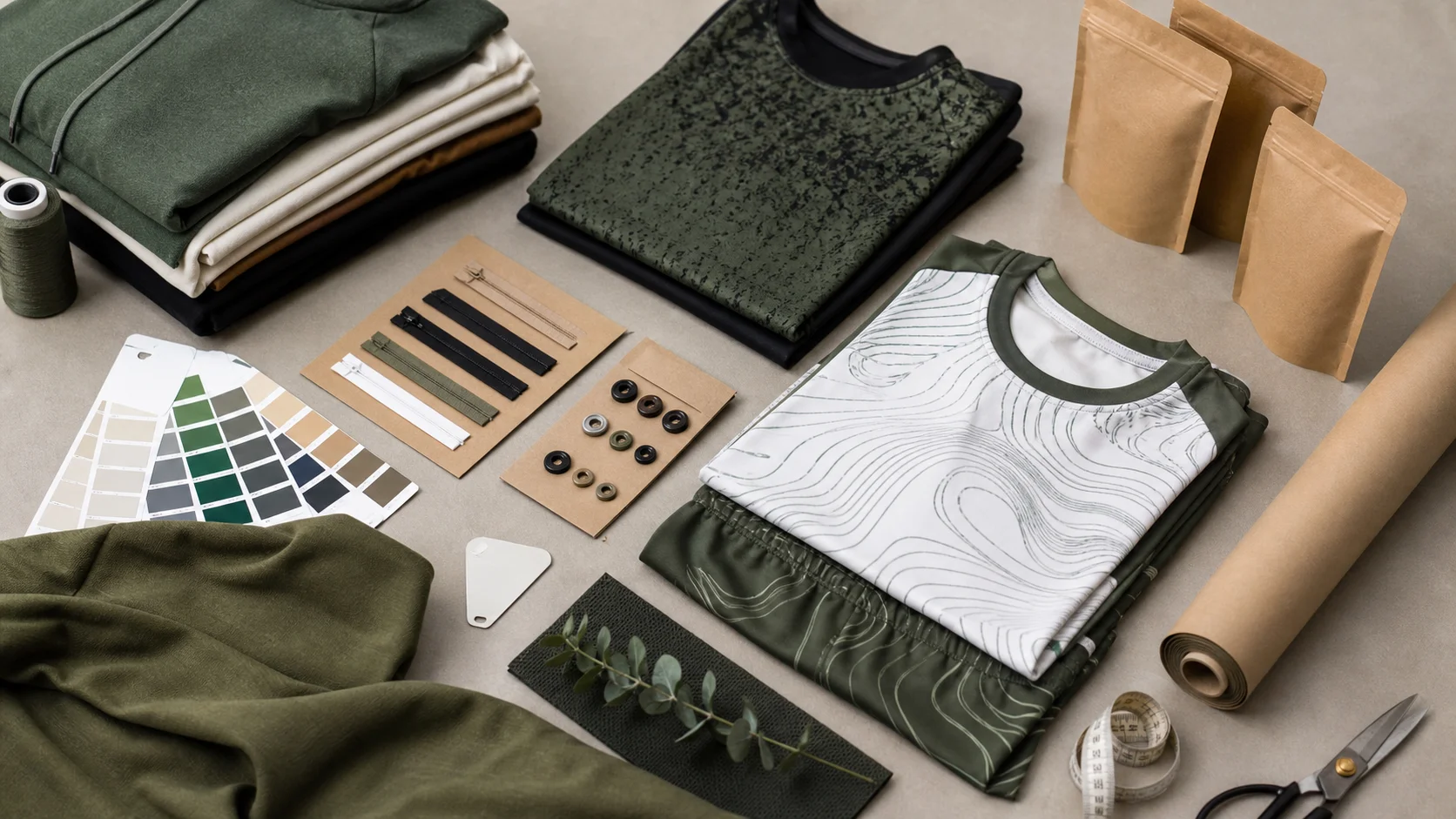
piqué polo shirt factory china with checks for samples, fit, MOQ, QC evidence, pricing terms, and delivery risk.
Fast answer: piqué polo shirt factory china: Costs, Quality, MOQs should be judged by production evidence, not by a generic sourcing promise. The buyer needs sample proof, cost breakdowns, QC checkpoints, and delivery buffers in writing.
Ask for recent sample photos, measurement tolerances, fabric or print test assumptions, decoration test notes, packing examples, and a named inspection checkpoint. These details show whether the team can repeat an approved sample at bulk volume.
Separate garment cost, decoration, labels, packaging, sampling, testing, freight, and rush charges. When every cost line is visible, it becomes easier to reduce colorways, adjust size depth, or reserve more time for sampling.
China still ships roughly a third of global textile and apparel exports, and that matters because polos are won or lost on details most buyers only notice after the first shipment goes wrong. In a piqué polo shirt factory China teams often overlook, the hourly wage may be higher, but the batch quality is tighter, the sampling cycle shorter, and the rework bill much smaller. That's why many brands still choose China for knitwear. Worth the extra few cents? Usually.
After 200+ factory visits in eight countries, the same pattern kept showing up. China wins on knitted fabric access, dyeing capacity, collar development, and the speed of moving from lab dip to bulk. Approve a cotton-piqué shade card in 3-4 days in one province, receive a corrected pre-production sample in another 5-7 days. That pace matters when a retail calendar is measured in weeks, not quarters. No other region matches that rhythm.
Vietnam can be strong on assembly, especially for simpler programs, but many factories still rely on imported yarn or fabric for premium polo lines. Bangladesh often offers lower sewing costs, yet the gap narrows once you add testing, approvals, and the extra 10-15 days that can disappear into fabric booking. India brings excellent cotton expertise and attractive raw material access, but consistency across lots can be uneven when a program needs 20,000 pieces in 4 sizes and 6 colors. China remains the supplier that can usually manage the messy middle: fiber, knit, dye, trim, sewing, and packing under one roof or within a 30-kilometer radius. No one else quite matches that mix.
According to source name, China remains a central node in global merchandise trade, and that scale shows up in knitwear. Factory visits confirm what the customs data suggests. Higher labor cost does not automatically mean higher finished cost. A line making 12,000 polos a day with 2.0% defect rates can beat a cheaper competitor running 25,000 pieces with 6.5% rejects, especially once freight, delay penalties, and replacement shipments enter the picture. It feels counterintuitive until you count the rejects.
The tension is simple. Buyers compare unit price, but the market pays landed cost. I've watched brands celebrate a $4.20 FOB quote, then absorb $0.35 in rework, $0.18 in extra inspection, and a two-week shipment hold that kills a seasonal drop. And the piqué polo shirt factory China buyers choose can look expensive on paper and still be cheaper by the time goods clear customs.
Piqué is not just a texture. It is a knit structure with raised ribs and recessed channels, usually built to hold shape better than a plain jersey. For a buyer, the first check is weight. Most retail polos land in the 180-220 GSM range, while promotional programs drop closer to 160-175 GSM. I have handled premium styles in 230 GSM cotton-piqué that felt structured at first touch and still recovered after repeated wash tests. Feels like quality.
Fabric choice matters more than many sourcing teams admit. Combed cotton gives a cleaner hand. Cotton-poly blends can cut shrinkage and improve color retention. Mercerization adds sheen and can raise dye uptake, which matters when you want deep navy or saturated red without a chalky cast. Enzyme washing softens the surface without the abrasive damage stone wash can create. In one Guangdong mill, I saw a 200 GSM mercerized polo hold its collar shape after 10 home-wash cycles, while a cheaper 170 GSM version twisted at the side seam after just 4.
A serious factory will track stitch density, collar structure, placket alignment, and shrinkage control with numbers, not adjectives. Look for a collar that sits flat with balanced rib tension, a placket with evenly spaced buttons, and side slits that are bartacked cleanly. A premium program may specify 12-14 stitches per inch on visible seams, while a budget uniform order might accept 9-10. That gap shows up in wash durability and in how the shirt hangs on the body after 8 hours of wear. Small details, big difference.
Colorfastness and pilling tests separate respectable mills from factories that only look polished in the showroom. Ask for AATCC or ISO-based test data, not just verbal assurance. According to source name, standardized colorfastness and dimensional stability testing exists for a reason: repeat orders need repeatable outcomes. Premium retail suppliers tend to document these tests; high-volume uniform suppliers often optimize for speed and cost, with less tolerance for cosmetic perfection but more discipline around bulk consistency.
If you want broader development support beyond a single style, private label clothing services can help align fabric, trims, labeling, and packaging before production begins. A polo is never just a polo. Knit structure, finish, fit, and risk all ride in the same carton. Think of it that way.
Factory price tiers are real, but they are not as simple as cheap, mid, and premium. The budget tier usually works with 300-500 piece MOQ, sample fees around $20-$40, and unit prices that can start near $3.10-$4.50 for basic 180 GSM cotton-poly polos. These factories often run lean on development staff and expect the buyer to arrive with a complete tech pack, clear size spec, and limited revision cycles. Bring patience.
The mid-market tier is where many brands should begin. MOQ often sits between 500 and 1,500 pieces, sample fees range from $30-$80, and bulk prices for a 200 GSM combed-cotton polo may land around $4.80-$7.50 depending on trim complexity. These factories usually have better inline QC, a more mature pattern room, and enough production planning to handle embroidery or small print placements without derailing the schedule. More margin for tweaks.
The premium tier can ask for 1,000-3,000 pieces per color, sample fees of $60-$150, and prices from $7.80 to $12.00 or more for mercerized cotton, enzyme wash, or branded packaging. Turnaround can still be efficient, often 3-5 weeks for sampling and 30-45 days for bulk if fabric is ready. The value is not luxury décor. It is process control.
Here’s what most people miss: the cheapest factory can become the most expensive after rework, delay, and shipment holds. I have seen a $4.05 quote turn into a $5.60 landed cost once 7% of the run needed collar correction, the inspector failed 2 cartons for shade variation, and the brand paid air freight to save a missed launch window. A more disciplined factory with a $4.80 quote shipped on time, passed a 2.5 AQL pre-shipment inspection, and cost less in the end.
When I audit a factory, I ignore the polished reception area. I ask to see cutting accuracy, panel matching, shade sorting, and how often they stop the line when a fault appears. A nice showroom can hide a weak workflow. Process control is what matters. If a factory can show stable measurements across 10 garments, documented rework logs, and a clear trace from yarn lot to packed carton, it has capability. If it only shows a rack of samples, keep walking.
Quality starts before the first stitch. Incoming yarn inspection checks count, twist, contamination, and shade variation. Knitting follows, then fabric relaxation, dyeing, washing, cutting, sewing, finishing, measurement, and packing. Each stage can create a defect that becomes expensive later. A 1.5 cm collar misalignment caught at sewing costs minutes. The same flaw found at packing can cost a full carton hold. Been there—inspires a checklist.
The most common failures in polo production are predictable. Collar shape goes uneven. Plackets skew after washing. Shade variation appears between body and collar panels. Puckering shows at the shoulder and button placket. Shrinkage exceeds spec, especially when the fabric relaxes poorly before cutting. I have also seen side slits stitched at slightly different depths, which ruins symmetry in retail hanging displays. None of this is rare. It is routine when a factory skips checks or rushes orders. Pay attention.
AQL sampling should not be an afterthought. For many apparel programs, buyers treat it as the final box to tick and then wonder why issues slip through. A decent plan sets tolerance levels up front, chooses the sample size that matches order volume, and gives the line time to understand the results. Without that, you're flying blind.
A strong brief makes the supplier's job narrower and the quote more reliable. For piqué polo shirt factory china, include the target customer, sales channel, expected order quantity, size range, decoration needs, packaging requirements, and delivery market. Then call out the details most likely to affect the result, especially MOQ, line capacity, and pattern control.
The brief should also explain what cannot change. Some brands care most about hand feel, some about price, some about launch timing, and some about retail compliance. When those priorities are not written down, suppliers tend to optimize for whatever is easiest to quote. Clear priorities help the factory make better tradeoffs before the first sample is cut or printed.
Ask the supplier to respond with assumptions, not just a price. A useful reply states MOQ, sample route, production capacity, inspection plan, packing method, and freight handoff. If the answer is vague, the project may still work, but it needs a tighter pre-production stage before money and calendar pressure build up.
The best time to catch problems is before the pre-production sample is approved. Check measurements, color, placement, material behavior, shrinkage, construction, labels, and packaging in the same review instead of approving each item in isolation. Many bulk issues are not caused by one dramatic mistake; they come from several small unchecked assumptions.
For piqué polo shirt factory china, pay special attention to QC checkpoint, export packing, and communication rhythm. These details often look minor in an email but become expensive once cutting, printing, sewing, packing, or shipping begins. A simple checklist with owner, due date, and approval status keeps the brand team and factory aligned.
Bulk production should not start until the supplier can explain how the approved sample becomes a repeatable production standard. That means reference sample storage, line instructions, inline checks, final inspection, and defect handling. A factory that can describe this process clearly is usually safer than one that only promises speed.
Price differences are useful only when the quotes cover the same work. Compare sample cost, material source, trims, decoration, packaging, testing, inspection, and freight assumptions. A low unit price can become expensive if it excludes items the brand needs before launch.
Timeline promises deserve the same scrutiny. Ask what happens if the first sample needs revision, whether materials are in stock, when the production slot is reserved, and how export packing is handled. The most reliable supplier is often the one that gives a realistic calendar instead of the fastest optimistic answer.
Before making the final decision, write down the specification, approval owner, delivery expectation, and the one or two risks that would cause the most trouble if missed. For piqué polo shirt factory china, this usually means checking MOQ, line capacity, pattern control, and the support process after the order is placed.
This last review does not need to be complicated. It simply makes the decision easier to repeat, easier to explain, and easier to verify when the finished product or jewelry arrives.
One useful way to pressure-test the decision is to ask what would happen if the order had to be repeated in six months. The answer should still be clear: the same MOQ, the same line capacity, the same acceptance standard, and the same communication path. If a second order would depend on memory or guesswork, the first order is not documented well enough yet.
Another useful check is to separate preference from requirement. Preference is the look, wording, or finish the brand likes. Requirement is the measurement, tolerance, certificate, material, or delivery condition that cannot fail. Good buying decisions keep both visible, so the final choice is not pushed around by the last email, the cheapest quote, or the prettiest sample photo.
Finally, ask who owns each approval. A project with one accountable owner for sample review, one owner for final content or artwork, and one owner for delivery sign-off usually moves faster than a project where every decision is shared loosely across a team. Clear ownership reduces delays and makes the finished result easier to judge.