
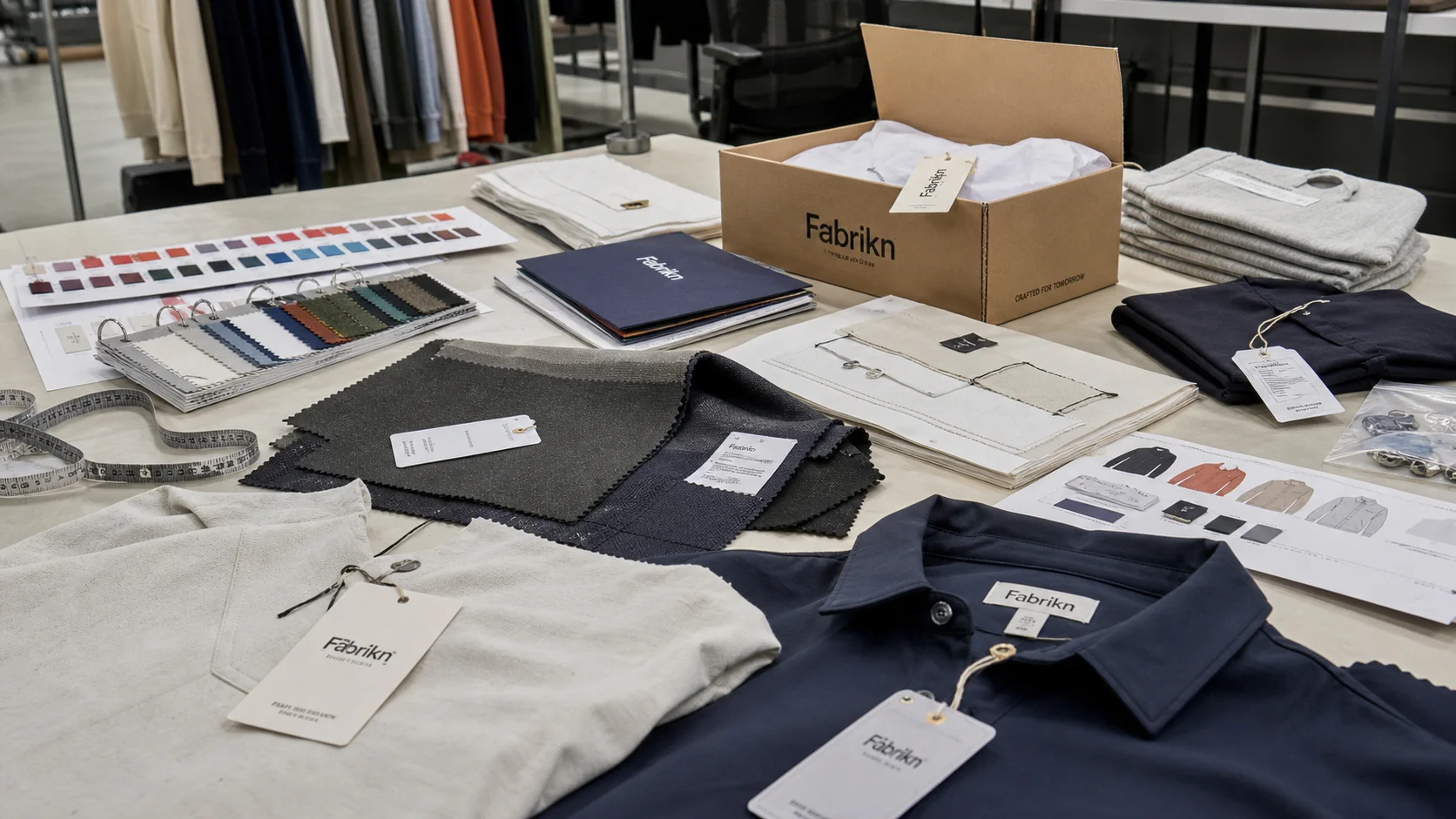
Piqué Polo Shirt Manufacturer China with checks for samples, fit, MOQ, QC evidence, pricing terms, and delivery risk.
Fast answer: Piqué Polo Shirt Manufacturer China: Costs, Quality, Lead Times should be judged by production evidence, not by a generic sourcing promise. The buyer needs sample proof, cost breakdowns, QC checkpoints, and delivery buffers in writing.
Ask for recent sample photos, measurement tolerances, fabric or print test assumptions, decoration test notes, packing examples, and a named inspection checkpoint. These details show whether the team can repeat an approved sample at bulk volume.
Separate garment cost, decoration, labels, packaging, sampling, testing, freight, and rush charges. When every cost line is visible, it becomes easier to reduce colorways, adjust size depth, or reserve more time for sampling.
I’ve watched more polo programs go sideways on the wash test than on the sales pitch. A shirt can look crisp on a hanger and still come back with collar curl, shrinkage, or a handfeel that turns customers off after two wears. That’s why a piqué polo shirt manufacturer china search still matters to private label buyers who need the bulk order to behave like the sample. I have seen factories where the so-called wash lab is a bucket with a timer, yet the buyer swears it passed because the report had a stamp.
Across 200+ factory visits in eight countries, China kept winning private label work for one simple reason: knitting, dyeing, finishing, trims, and packing can be handled at scale without sending the order on a tour of four different vendors. In Zhejiang, a coastal mill may quote 5,000 pieces with lab dips in 7 to 10 days. A cheaper workshop may promise 15 days, then quietly reveal it outsources the knitting or dyeing. The delay shows up later, usually after the first correction round. In my experience, the winners keep resin finishing under the same roof as the dye kitchen because once the order leaves for another supplier the schedule unravels.
Price tells only part of the story. I’ve seen a $4.20 polo from a budget factory look fine on day one, then return with 11% shrinkage and a collar that curled after washing. I’ve also seen a $7.80 polo from a mid-tier factory hold its shape after five washes because the yarn count, pre-shrink treatment, and finishing were controlled together. Stitch density alone doesn’t predict performance. Fabric process does. Honestly, this approach works better because forcing the yarn, pre-shrink, and finishing teams to align means the collar won't look like it lost the battle after the third wash.
In factories around Guangzhou, the dye house uses a Benninger stenter with precise dwell time set to 18-22 business days from the first yarn arrival to the packed pallet, while the adjacent finishing line runs a resin applicator and supercritical CO₂ dryers so the collar recoveries match the body fabric. Even when a brand insists on a 500-piece MOQ, those same Guangzhou facilities can deliver a plain piqué win at $2.50-4.00 per unit by batching the run with similar colors and running the knitting on Mayer & Cie HKS 2.2 circular machines.
China stays central because the ecosystem is dense. Guangdong factories can source rib collars, custom buttons, and embroidery thread within 24 to 48 hours (and yes, that includes the guy who insists on his own shade of “taupe”). In Jiangsu and Zhejiang, knitwear clusters handle batch sizes from 300 pieces to 30,000 pieces, so sampling moves faster than many buyers expect. That speed matters when a brand needs two fit rounds, three shade approvals, and a retail window in eight weeks.
For buyers comparing private label clothing services, the real question isn’t just price per piece. It’s whether the factory understands the whole chain: yarn, knit structure, dye lot control, washing, trimming, and final inspection. Save 40 cents on fabric, lose $1.20 in returns later. I’ve watched that math happen more than once. It still drives me nuts when a buyer debates button diameter while shrinkage eats the margin.
Piqué is not just a texture. It’s a knit structure with a waffle-like surface that traps air, breathes well, and gives a polo more body than a flat jersey when the construction is right. That same surface changes collar behavior. A soft collar rib with poor recovery can make the shirt look tired after one wash, even if the body fabric is acceptable. A trustworthy piqué polo shirt manufacturer china operation understands that relationship and tests it instead of simply sewing it. In my experience, the real pattern makers will drag their finger across the collar and ask you to wash it five times before they give you a release shot.
I separate true mills from trading-company promises very quickly. Real mills can show knitting machine specs (Mayer & Cie HKS, Stoll CMS 530 HP, Santoni circulars), GSM control charts, and wash-test data. Traders can usually show samples and a polished office. For combed cotton, I ask for fiber length ranges, yarn count, and whether the cotton is ring-spun or open-end. For cotton-poly blends, I want the blend ratio plus shrinkage results after three cycles. For mercerized finishes, I check whether the sheen is stable after laundering, not only under showroom light. I still think if they won't let you see the knitting floor run for an hour, they're hiding variability.
The proof points are straightforward. Ask for lab dip approval records, shade band data across at least five swatches, shrinkage reports, and inspection notes from recent AQL checks. According to AATCC testing methods, colorfastness and dimensional stability need to be measured under defined conditions, not judged by eye. I also ask for the exact wash process: enzyme wash, bio-polish, or softener finish, because each one changes handfeel and final price (and yes, I double-check a few swatches with a handheld colorimeter because the human eye betrays you after a long day).
Look for certifications that cover fiber to finish: GOTS or OEKO-TEX Standard 100 for organic content, GRS for recycled polyester blends, and GA-certified WRAP or BSCI reports for social compliance. These certificates prove their laboratory follows the same water recycling protocols and chemical management as the colors you approved. I’ve walked Ho Chi Minh City lines that proudly display WRAP, BSCI, and OEKO-TEX reports beside their knitting floor, and the traceability back to the cotton field is a huge comfort for retail partners.
Factory geography still matters. Coastal export hubs like Guangdong and Zhejiang usually move faster on trims, sampling, and export paperwork. Inland knitwear clusters can be cheaper on labor, sometimes by 8% to 12%, but they may run longer on dyeing or port transit. I’ve seen inland factories produce excellent polo bodies at a 4,000-piece MOQ, then lose time because the collar rib came from another province and arrived six days late.
The warning I give every buyer is simple. Many factories can sew polos. Far fewer can keep the handfeel consistent across 5,000+ pieces. That consistency is what separates a repeat program from a one-season cleanup. If you need cut-and-sew support across styles, the technical checklist should cover both the knit and the assembly, not just the logo placement. It’s like herding cats when the design team adds eight colorway revisions in one go.
A realistic 3,000-piece order often breaks down like this: fabric at 38% to 52% of total cost, trims at 8% to 14%, labor at 15% to 22%, finishing at 8% to 12%, inspection and packing at 3% to 6%, and factory overhead making up the rest. On a basic cotton piqué polo, that can mean $3.95 to $5.10 landed ex-factory. On a premium mercerized version, it can jump to $7.20 to $9.40 without anyone padding the quote. I still think prepping the pre-production sample with the same wash program is worth the extra 24 hours because it keeps the bulk from surprising you.
The fabric composition drives most of the spread. A 100% cotton piqué with 220 to 240 GSM usually sits in the lower range, especially if the order reaches 3,000 pieces or more. A cotton-poly blend can lower shrink risk and cut cost by 6% to 10%, but the handfeel changes. Performance blends with 3% to 5% spandex or polyester can add $0.60 to $1.40 per piece because they need tighter knitting control and more careful heat setting. Premium mercerized piqué costs more again, often because the yarn and finishing both require higher-grade inputs such as GOTS-certified Supima cotton or GRS-certified recycled polyester.
Trims matter more than buyers think. A standard collar rib may add $0.18, while a custom engineered collar can add $0.45. A two-button placket is cheaper than a three-button version, but the difference is not only buttons. It changes labor time by 20 to 40 seconds per garment. Embroidery can add $0.35 for a small chest logo or $1.20 for a large back motif. Custom buttons, woven labels, and neck tape each push the unit price upward by small amounts that stack fast.
MOQ changes the math sharply. At 500 pieces, the same polo may cost $1.10 to $1.60 more per unit than at 3,000 pieces because pattern setup, dye lot minimums, and inspection overhead do not shrink. Hidden costs hide in plain sight: 2% shrinkage allowance built into fabric consumption, rework after poor shade matching, upgraded polybags, and freight from factory to port. If a quote looks suspiciously low, ask which of those items were quietly removed. Then compare it with the price on browse our product catalog to see how fabric choice shifts the numbers (and yeah, the guy at HQ will still ask why the shipping mark isn't perfect).
When I bench the $2.50-4.00 per unit runs out of Guangzhou against Dhaka and Istanbul, the Chinese offer usually includes in-line enzyme wash and resin finishing, while Dhaka might add a separate sodium hypochlorite wash with longer lead time, and Istanbul often charges a premium for advanced laser-cut collars. That’s why you should check whether the quoted price includes blending recycled GRS yarn, carrying OEKO-TEX Standard 100 approval, or adding WRAP/BSCI-verified stitching operators. Without those, a “cheaper” price can cost returns and reputational damage.
I compare polo factories in three batches: Guangzhou for integrated work, Ho Chi Minh City for regional volume, and Istanbul for niche European demand. Guangzhou is usually the fastest, with 18-22 business days from confirmed PO to container loading for base 2.5 cotton runs thanks to in-house knitting, dyeing, finishing, and QA teams. Ho Chi Minh City averages 22-26 business days because they often wait two extra days for trims sourced from nearby share-houses, but their WRAP and BSCI certifications reassure Western retailers.
Dhaka and Istanbul sit on either end of the reliability spectrum. Dhaka offers aggressive pricing on open-end blends and can drop the landed cost below $5.30 on a 3,000-piece run, but buyers must factor in a 28-33 business day timeline and the risk of customs red tape unless the supplier holds WRAP, BSCI, and OEKO-TEX Standard 100. Istanbul handles smaller batches with superior finishing (laser engraving on knit collar tags, foam injection for button returns) but usually requires 4,000-piece MOQs and a two-week lead time just to source European-certified dye houses.
Quality control depends on data. Guangzhou plants often have inline scanners linked to the ERP system to log GSM changes, while Ho Chi Minh City operations rely on handheld spectrophotometers plus a digital lab dip gallery. I insist the factory share ASN calls, shrinkage curves, and in-line tension data from the circular knitting machines (e.g., Mayer & Cie, Santoni). When they do, the finishing partners know whether to apply enzyme wash, softener rinse, or a mild bio-polish, all documented with a digital certificate tied to GOTS or GRS compliance.
Ultimately, you are balancing cost, lead time, and quality across real certifications and real factories—Guangzhou for speed, Dhaka for price, Ho Chi Minh City for certified social compliance, and Istanbul for premium European optics. The right mix depends on your release schedule, color count, and whether your brand can absorb a longer transit time. Whatever you choose, build the comparison on numbers, not gut feel.
Start with the paper trail. Request their latest WRAP, BSCI, GOTS, OEKO-TEX Standard 100, and GRS certificates, then cross-check the serial numbers against the issuing portals. Ask if the dye house uses RSL-compliant chemicals and whether they batch GOTS-compliant cotton with certified compostable packaging. This is especially important if you are exporting from Guangzhou or planning a follow-up run in Dhaka; the auditors will want to see the same certification levels in both locations to avoid disconnects.
Walk the floor if possible. Look for a Santoni fully-fashioned knitting center, a Mayer & Cie circular knitting bank, and a Benninger stenter with automated moisture sensors. Watch for in-line WT-90 laser cutting before the placket attaches, and confirm that the finishing partners run enzyme or softener washes on programmable bath cycles. Take photos of the machines, the operators’ PPE, and the chemical cabinets. If the factory hesitates, it’s a red flag.
Review their testing data. You want to see AATCC 135 (dimensional change after home laundering), AATCC 61 (colorfastness to laundering), and instrumental S/R (surface reflectance) files. Ask for the sample that went through their standard bio-polish, enzyme wash, and resin finishing. See if they have handheld spectrophotometers to confirm Delta E before the shipment leaves Guangzhou or the consolidation warehouse in Ho Chi Minh City.
Verify their inspection routines. Recent AQL 2.5 reports should note defect rates per 100 pieces, sweat patch results, and seam strength tested by a 600N force gauge. Demand to see the actual inspection sheet for a recent order, not just a generic template. Then confirm how they handle rework—do they log re-inspection in their ERP, and do they send pictures of repaired collars back to you for approval?
One mistake is mixing up price per unit with landed cost. Vendors in Guangzhou might quote $2.80 for a piqué, but if they leave out trimming, washing, or inspection you end up adding $0.60 on the back end. I’ve also seen brands take the cheapest quote from Dhaka only to double-check shrinkage and discover 14% loss after washing because the dye house ran open-end yarn without proper pre-shrink. Build a total cost sheet that includes sample runs, rework, freight, and customs.
Another common error is ignoring certifications. Ordering from a WRAP/BSCI facility in Ho Chi Minh City for the hip market is smart, but if your buyer wants GOTS organic cotton for Europe, you can’t switch to a non-certified supplier mid-run. The gap will delay the shipment through customs or trigger a retailer audit. Keep your certifications aligned with the region (e.g., OEKO-TEX Standard 100 for Istanbul runs and GRS for recycled blends out of Guangzhou).
Lastly, poor communication kills timelines. If the factory uses WhatsApp updates without weekly PDF status reports, you will miss scope changes. Ask for a clear process: weekly PPAP review, 48-hour exception reporting, and a single point of contact who can compare dye lab results from the Guangzhou facility with those in Dhaka or Ho Chi Minh City. Bad updates turn into bad batches.
Map your critical needs. Do you need a 3,000-piece run with GOTS-certified cotton, 18-22 business days turnaround, and in-house resin finishing? Then focus on Guangzhou and Zhejiang mills that already integrate knitting, dyeing, and finishing. If you need lower price and can accept slightly longer lead times, layer in Dhaka partners with WRAP/BSCI approvals and shared dye houses. Always include Ho Chi Minh City for volume stops that demand OEKO-TEX Standard 100 and social compliance.
Build the checklist. Include machine specs (Mayer & Cie or Santoni for piqué, Benninger stenter, Juki flat-bed sewing), process steps (enzyme wash, resin cure, bio polish), certifications (GOTS, OEKO-TEX, WRAP, BSCI, GRS), and inspection gatekeepers. Don’t forget to flag the logistics leg: who will handle freight from Guangzhou to Yantian, Ho Chi Minh City to Cat Lai, or Istanbul to Mersin? Those answers determine whether your $4.80 landed cost holds.
Finally, lock in communication. Schedule biweekly calls during sampling, supply clear tech packs with fabric specs (e.g., 220 GSM 100% GOTS ring-spun cotton with 1x1 collar rib), and demand digital documentation for each wash step. With those protocols, you reduce the risk of surprises and keep your program ready for the next season.
A: Many factories quote 3,000 pieces for full control, but I’ve negotiated $2.50-4.00 per unit runs at 500 MOQ when they can align colors and trims. Expect some cost creep due to dye lot minimums and inspection overhead.
A: If you work with a Guangzhou mill with in-house knitting, dyeing, and finishing, the timeline is typically 18-22 business days. Outsourced operations in Dhaka or Istanbul can run 24-32 business days, especially when certifications and approvals add a few days.
A: For piqué polos that want sustainability and social compliance, request GOTS or OEKO-TEX Standard 100 for the fiber, GRS for any recycled polyester, and WRAP plus BSCI for social audit compliance. Keeping those documents current avoids buyer rejections.
A: Look for pigeonholed equipment like Mayer & Cie HKS circular knitters, Santoni seamless machines for collars, Benninger stenters, and Juki or Brother sewing machines with PLC-controlled tension. Those features ensure consistent GSM, collar recovery, and seam strength.
A: Document the finishing process (enzyme wash, bio-polish, resin finish) with photos and certificates, inspect the sample under the same machines, and ask for the wash sheet so you compare enzyme concentration, bath ratio, and dwell times before bulk production.