
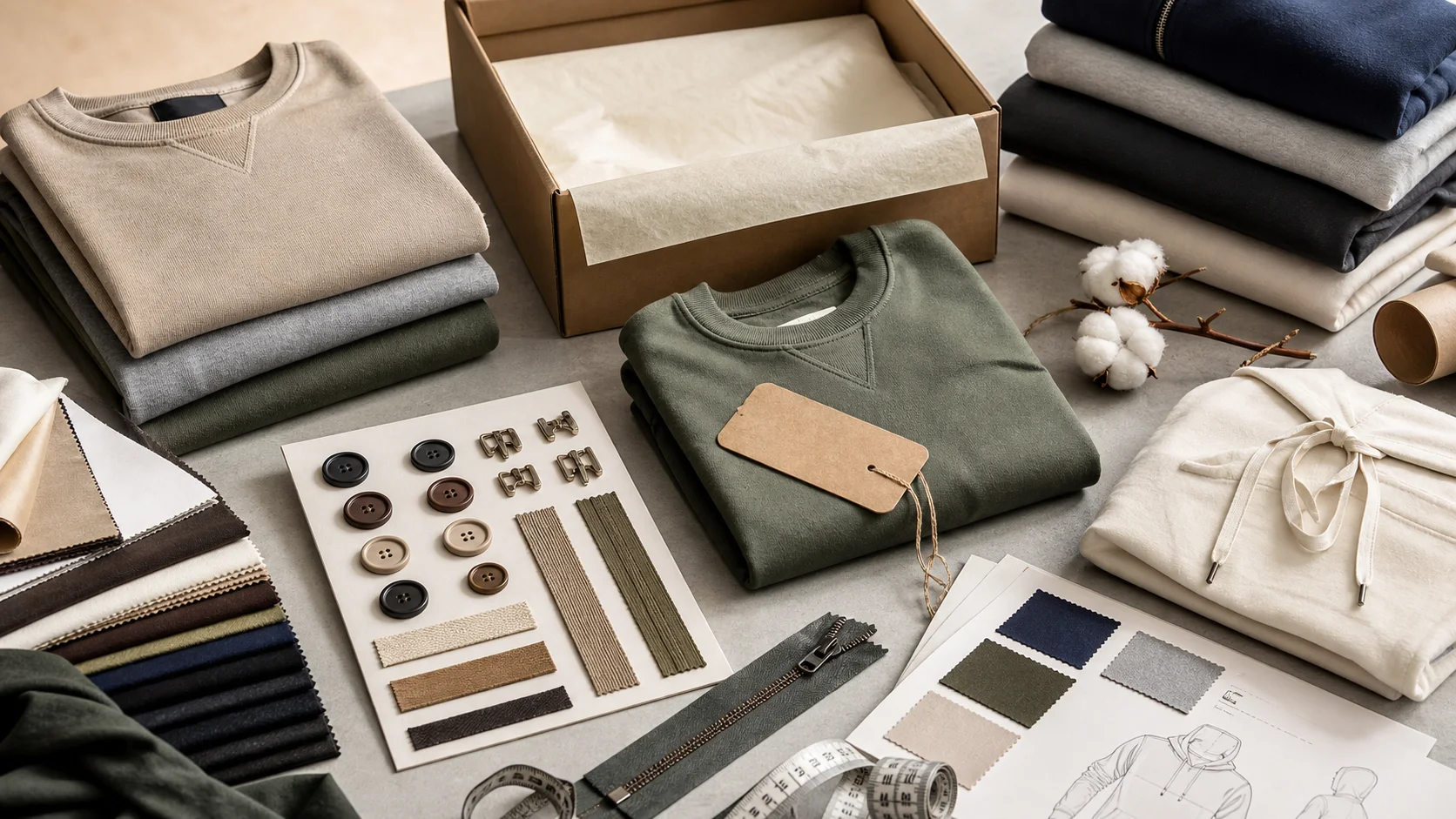
Sustainable Garment Packaging Buyer Checklist with checks for samples, fit, MOQ, QC evidence, pricing terms, and delivery risk.
Fast answer: Sustainable Garment Packaging Buyer Checklist: Claims, Materials, Test Proof, and MOQ should be judged by production evidence, not by a generic sourcing promise. The buyer needs sample proof, cost breakdowns, QC checkpoints, and delivery buffers in writing.
Ask for recent sample photos, measurement tolerances, fabric or print test assumptions, decoration test notes, packing examples, and a named inspection checkpoint. These details show whether the team can repeat an approved sample at bulk volume.
Separate garment cost, decoration, labels, packaging, sampling, testing, freight, and rush charges. When every cost line is visible, it becomes easier to reduce colorways, adjust size depth, or reserve more time for sampling.
A T-shirt can leave a factory wrapped in more plastic than fabric, which is why plastic free packaging for clothing ecommerce brands is no longer a side conversation. I have watched a 180 GSM cotton tee go into a polybag, get taped into a master carton, travel inside a shrink-wrapped pallet, arrive in a mailer, and then come back again after a return. By the time the order is settled, the packaging mass can outweigh the garment itself.
When I visited factories in Vietnam, China, Turkey, and Portugal, the contrast was stark. Many Asian factories still default to full polybag layers, size stickers, silica gel packets, and carton liners. Some European brands had already stripped out the inner plastic, reduced carton volume by 8% to 14%, and cut their freight cube enough to fit 40 to 60 more units per pallet.
The numbers get ugly fast. A basic tee may use four to six separate plastic components before it reaches a customer. If that order is returned, the footprint can double overnight. In apparel ecommerce, returns are not a side note. They are a cost center, an emissions multiplier, and a packaging design problem all at once.
Clothing behaves differently from beauty, electronics, or home goods because SKU variety is extreme and demand is seasonal. A denim jacket in September, a rib tank in June, and a holiday dress in November each need different protection, different carton sizes, and different packing speeds. Change the packaging too late and you pay for it in labor, damage, or dead stock. That is why I treat packaging as part of product development, not an afterthought.
Plastic free packaging for clothing ecommerce brands means replacing petroleum-based components with paper-based or fiber-based alternatives wherever the shipping system allows it. That usually includes kraft mailers, recycled corrugated boxes, paper garment bags, water-activated tape, molded fiber inserts, and paper void fill. For some brands, it also means changing outer labels, inner wraps, and return inserts so the whole pack is consistent.
It does not mean a brand is suddenly plastic-free just because the outer mailer changed. I still see companies remove the shipping bag, then keep polybags, plastic hang tags, and bubble cushioning inside the carton. That is plastic-reduced packaging, not plastic-free packaging. Buyers confuse the two because the unboxing looks cleaner, but the material audit tells a different story.
Apparel packaging has to do more than look virtuous. It needs moisture resistance for cross-border shipments, tear strength for warehouse handling, print quality for brand presentation, and enough rigidity to survive compression in transit. A recycled kraft mailer that tears at the fold is worse than useless. A neat paper wrap that slows the pack line by 12 seconds per order can cost more than the plastic it replaced.
Here's what most people miss: some paper-based systems fail because they increase pack weight by 18 to 30 grams or force a larger carton footprint. That raises dimensional weight charges and can push freight cost up by 3% to 7%, especially on air shipments. I have seen a “better” packaging spec add emissions because the box grew by 2 cm in every direction.
The price comparison is never just unit cost. A poly mailer may cost $0.06 to $0.12, while a kraft mailer often lands around $0.10 to $0.22 depending on print, thickness, and order volume. A plastic garment bag can run $0.02 to $0.05, while a paper wrap or FSC paper garment sleeve may cost $0.05 to $0.14. Recycled corrugated boxes can start near $0.25 for small formats and rise to $0.80 or more for branded, custom sizes.
That raw spread matters, but hidden costs matter more. Packing speed can shift by 5 to 20 seconds per order. Storage space can change by 10% to 25% if the box format becomes more rigid. Damage rate can fall, stay flat, or rise depending on how the new pack fits the product. Returns handling also changes, because a reusable carton is easier to re-pack than a torn mailer. For high-AOV items, even a 1% reduction in transit damage can pay for a 2- to 5-cent packaging upgrade very quickly.
Regional sourcing changes the math. European suppliers often charge more upfront, yet disposal fees, plastic taxes, or retailer compliance costs can be lower. Asian suppliers may quote lower unit prices, especially on runs of 10,000 to 50,000 units, but minimums can be higher and lead times can stretch to 6 to 10 weeks if artwork or tooling changes. I have seen a brand save $0.03 per unit in Vietnam and lose it all in extra freight cube and slower replenishment.
According to ISO and the packaging guidance used across the industry, packaging design should be assessed against performance requirements, not material type alone. That is the right frame. If a paper mailer fails a drop test at 90 cm, the environmental story ends there. If a recycled box protects a $180 dress, a $0.18 increase in packaging cost is easier to defend than a 4% markdown hit from damaged goods.
At the factory level, I compare three trades constantly: poly mailer to kraft mailer, plastic mailer to corrugated box, and plastic garment bag to paper wrap. The first usually increases material cost by a few cents but can improve brand perception. The second often raises freight and storage, yet cuts crush damage. The third is the most sensitive, because garment presentation and dust protection are both part of the buying experience.
Supplier screening should start with proof, not promises. I ask for FSC or PEFC paper documentation, recycled content certificates, adhesive chemistry details, print ink specifications, and written confirmation that no hidden plastic layers are embedded in the structure. If a manufacturer or supplier cannot provide a technical data sheet within 48 to 72 hours, that is a warning sign.
Testing needs to reflect real warehouse conditions. I want humidity exposure at 65% to 80%, scuffing against conveyor belts, drop tests from 75 to 100 cm, folding endurance, and line-speed checks across 200 to 500 packing cycles. Paper that looks perfect on a sample table can buckle once it is handled by a team packing 300 orders per hour. I have seen that happen more than once.
Local converters usually win on iteration speed. They can revise a dieline in 3 to 5 days and send a new sample run quickly. Overseas factories can quote a lower unit price, especially for 20,000-unit orders, but they may need 2 to 3 rounds of back-and-forth before the fit is right. That delay matters if you are launching a new season or trying to align packaging with a product drop.
For apparel brands with complex assortments, packaging often sits alongside product development decisions. A brand that needs clothing packaging solutions for swimwear, knits, or structured outerwear should treat the spec as a technical file, not a marketing brief. I always request a pilot run of 500 to 2,000 units before any full switch. That is enough to expose weak folds, ink rub, and sealing mistakes without locking up too much cash.
When comparing a factory in China with a smaller local converter, I look at quality, MOQ, production stability, and how quickly the team can support custom changes at wholesale or bulk scale. The cheapest quote is not always the best production partner if the print registration drifts or the cartons fail compression after stacking.
Tees, underwear, and other basics usually perform well in paper mailers or slim kraft wraps, especially when the order value sits around $20 to $40. Denim, sweaters, and coats need more structure. A recycled corrugated box with a paper wrap or tissue can reduce edge damage and preserve shape. Luxury apparel tends to need a more rigid presentation, often a recycled rigid box with a paper sleeve, because the unpacking moment is part of the product.
Price point changes expectations fast. A $25 basic can absorb plain kraft branding and a simpler tuck closure. A $180 dress usually cannot. The customer expects a cleaner reveal, stronger paper stock, and fewer crushed corners. Yet the expensive option is not always the safer option. I have watched a $1.20 rigid box perform worse than a well-sized $0.18 mailer because the box had too much headspace and the garment shifted during transit.
Different categories fail in different ways. Knitwear suffers from snagging and compression. Swimwear needs moisture protection more than bulk. Shoes require heel support and shape retention. That is why the packaging spec should follow the product, not the logo. Some of the best results I have seen came from brands that used the simplest possible structure and spent the budget on fit accuracy instead of embellishment.
For premium labels, especially those building a differentiated brand through custom bra manufacturing or other intimate categories, tactile packaging matters because the product is small, delicate, and often gifted. Still, the core rule holds: protection first, aesthetics second, then cost. In factory visits, I have seen a paper mailer outperform a poorly packed box 7 times out of 10.
A phased rollout saves more money than a big bang switch. I recommend testing one SKU family, one warehouse, or one region first. That might mean starting with 3,000 units of cotton basics in one fulfillment center before moving to denim, knitwear, and outerwear. The goal is to catch line-speed issues, carton mismatches, and customer complaint patterns while the risk is still small.
The rollout calendar should be explicit. Artwork approval usually takes 1 to 2 weeks. Sample sign-off can take another 7 to 10 days. Warehouse training needs a real session, not a memo, and label changes must be checked against ERP and shipping software. Customer service also needs scripts, because shoppers notice packaging shifts quickly and they will ask why the mailer changed.
Switching too fast creates messes that look like sustainability gains on paper but fail in execution. I have seen inventory mixed between old and new box sizes, packing stations slowed by 15%, and oversized cartons used because the correct pack size was not in stock. That kind of mismatch can erase savings from removing plastic entirely.
Metrics should be tracked from week 1 through week 12. I monitor packing time per order, damage rate, return rate, customer complaints, packaging spend per shipment, and any change in dimensional weight. For a brand with custom baby clothing manufacturing programs, the return sensitivity can be lower, but the presentation standards are often higher because gifting is common. One weak metric is enough to delay a rollout.
According to trade.gov, cross-border logistics costs can swing sharply with carton size, shipping mode, and seasonal capacity. That aligns with what I see on factory floors. A packaging change that saves 20 grams but adds 1.5 cm of height may look green and still cost more.
Start with an audit. List every plastic component in the current pack: polybags, tape, warning labels, inserts, air pillows, shrink wrap, and void fill. Then rank each item by volume, cost, and failure risk. A supplier once told me they had “mostly paper” packaging. The audit showed 11 plastic parts in a single order flow. Only two were visible to customers.
Next, write a replacement spec. Make it measurable. Set 0% virgin plastic as the target where feasible, define minimum recycled content, fix the maximum box dimensions, and state an acceptable failure rate for drop and compression tests. If the brief says “eco-friendly,” the supply chain will improvise. If the brief says “FSC paper, 70% recycled content, no polyfilm layer, pass 90 cm drop test,” the quote gets sharper.
Internal approval is where many packaging projects stall. Operations wants faster packing. Finance wants a clear payback window. Sustainability wants the lowest plastic count. Merchandising cares about how it photographs beside the product. Customer care wants fewer complaints about crushed corners and bad unboxing. I have learned to put all four teams in the same room, with the same sample, before spending on tooling.
For private label brands scaling across styles and channels, packaging choices should sit beside assortment planning, especially if the business also uses private label clothing services. My 90-day sequence is simple: days 1-15 audit, days 16-30 spec writing, days 31-45 supplier shortlist, days 46-60 samples, days 61-75 pilot run, days 76-90 review and decision. That timeline is realistic, and it keeps a team from drifting into endless sampling. If a supplier cannot reach pilot shipment in under 12 weeks, I move on.
The final review should answer one last question: does the new system still work at wholesale volume, with realistic MOQ requirements, during peak production weeks, and across every factory shift? If the answer is yes, plastic free packaging for clothing ecommerce brands has moved from a nice idea to an operating standard.
Expect an increase of about $0.02 to $0.20 per shipment, depending on format and order volume. A kraft mailer may cost $0.10 to $0.22, while a recycled box can range from $0.25 to $0.80 or more. The real test is whether the new pack lowers damage, returns, or freight costs enough to offset that spend.
Sample approval usually takes 2 to 4 weeks, and a pilot run can be ready in another 2 to 3 weeks if the supplier is responsive. Overseas tooling may stretch to 6 to 10 weeks, especially if you need custom print or new sizes. I advise budgeting 8 to 12 weeks from brief to pilot shipment.
Paper mailers, recycled kraft boxes, paper garment bags, water-activated tape, molded fiber inserts, and paper void fill all count if they contain no plastic film or hidden poly layers. Always check adhesives, coatings, and lamination. A glossy paper surface can still hide plastic if the supplier uses a film finish.
Yes, but the structure has to match the product. Knitwear, dresses, and shoes need tighter sizing, stronger corners, and better internal restraint than a simple tee shipment. In higher-return categories, I focus on reducing damage and re-pack failures first, because return handling can double packaging waste if the first pack is weak.
Local converters are usually faster for changes, especially if you need revised artwork or a new dieline in under 2 weeks. Overseas suppliers can still be cost-effective on 10,000-unit and 25,000-unit orders, but response time is slower. If speed matters, request technical data sheets, confirm lead times in writing, and run a 500- to 2,000-unit pilot before scaling.
Look for a supplier or factory that can prove quality with test data, support custom sizes, and meet your MOQ without sacrificing consistency. Ask about production capacity, wholesale pricing, and whether they can handle China sourcing or local fulfillment if your lead times are tight. A clear technical spec will usually get you a better quote than a vague request.