
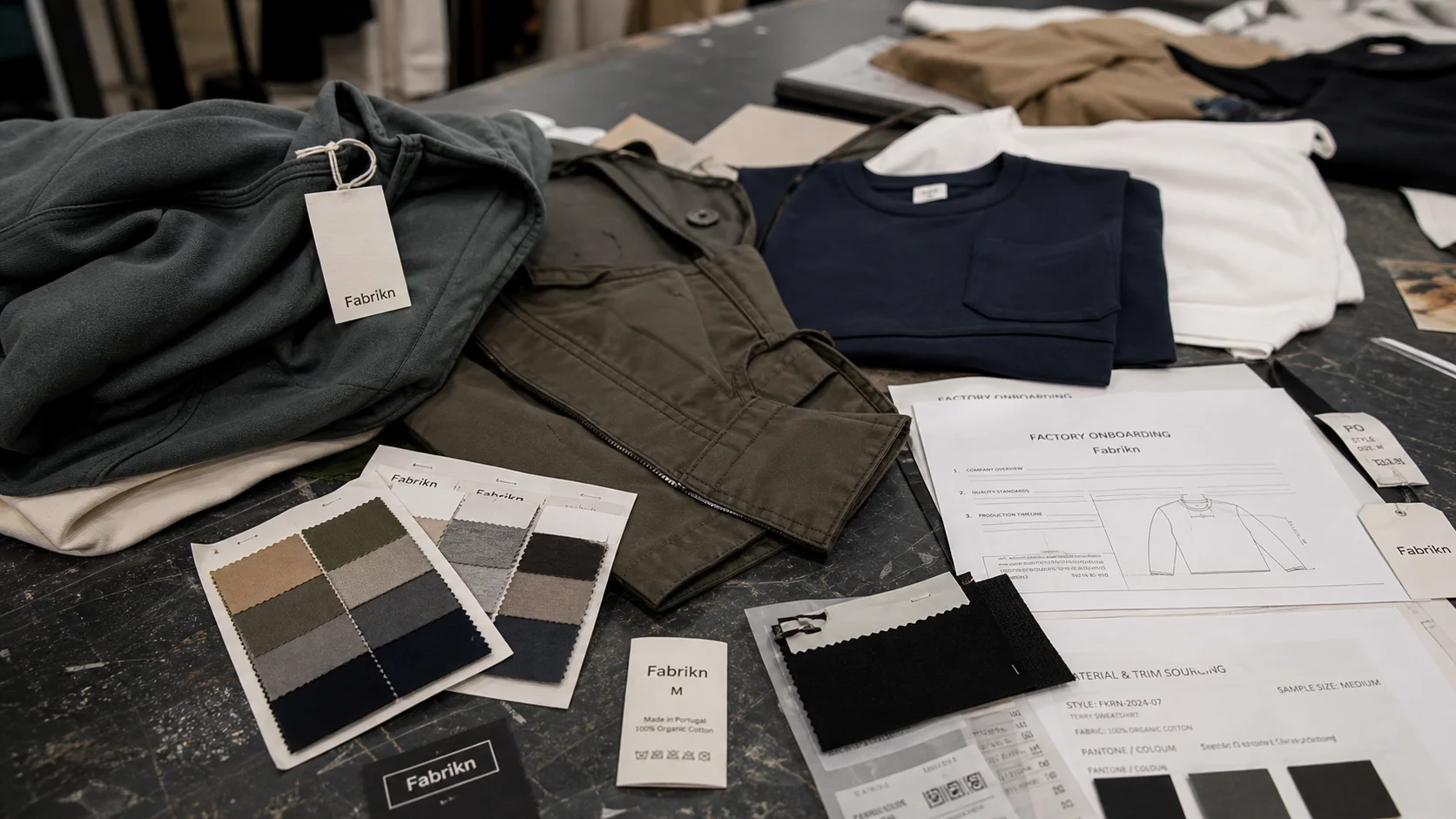
Premium Apparel Packaging Design Services with checks for samples, fit, MOQ, QC evidence, pricing terms, and delivery risk.
Fast answer: Premium Apparel Packaging Design Services: What Pays Off should be judged by production evidence, not by a generic sourcing promise. The buyer needs sample proof, cost breakdowns, QC checkpoints, and delivery buffers in writing.
Ask for recent sample photos, measurement tolerances, fabric or print test assumptions, decoration test notes, packing examples, and a named inspection checkpoint. These details show whether the team can repeat an approved sample at bulk volume.
Separate garment cost, decoration, labels, packaging, sampling, testing, freight, and rush charges. When every cost line is visible, it becomes easier to reduce colorways, adjust size depth, or reserve more time for sampling.
The box is part of the product now, not a paper afterthought. Done well, premium apparel packaging design services can raise perceived value fast enough to change conversion, repeat purchase behavior, and even return rates. I have watched that hold across $18 tees, $68 sweaters, and $280 outerwear. In factories from Ho Chi Minh City to Porto, from Guangzhou to Istanbul, buyers kept saying the same thing: the package opened the door, and the garment had to justify the invite. I have seen factories where the packaging line was more disciplined than the sewing floor (and that says something about what really matters).
More than 200 factories across 8 countries told the same story in different accents, including Guangzhou sheet-fed ops, Dhaka hand-finishing houses, Ho Chi Minh City board converters, and Istanbul fulfilment hubs. A $0.42 mailer with a tight 1.2 mm board spec, clean print, and a 3 mm tuck can outperform a $2.10 rigid box that crushes in transit. Pretty means nothing if the corners split on a 1,200 km truck route or if ink rubs off after 2 days in a humid warehouse. Luxury-looking and durable are not the same thing. Honestly, this approach works better because the same board spec that survives the 1,200 km truck is easier to replicate on the next run.
That gap matters differently by channel. In DTC, packaging influences social sharing and repeat purchase behavior because the customer handles every layer. In wholesale, the retailer sees the carton before the garment and judges the line in bulk. In luxury, the box has to protect presentation across 2 to 4 touchpoints: stockroom, transport, shelf, and gift wrap. Mass-market basics can run on 24 pt SBS mailers and tissue at $0.18 per set. Premium brands spend $3.50 to $8.00 per unit and still lose money when the package is overbuilt, overprinted, and under-tested. When a brand books a run from Guangzhou or Dhaka, the 18-22 business days between prepress approval and container loading become mission-critical; a delay in that window is the same as a delay on the sewing line.
Packaging should earn its cost. If it does not improve conversion, reduce damage, or support a higher average order value, it is expensive decoration. Brands that treat it as a profit line make smarter choices, including when they pair premium apparel packaging design services with clothing packaging solutions that fit their channel and SKU count.
Premium apparel packaging design services are not just a pretty mockup and a printer quote. The real service stack starts with concept development, then moves into dielines, board selection, print method, finishing, inserts, labels, and quality control. If a vendor cannot show those steps, it is not a full service. It is a print order with better vocabulary. Concept workshops often involve physical swatches of 350 gsm C1S, 1.2 mm corrugated, and 18 pt SBS, as well as CAD-fitted dielines prepared on ArtiosCAD before a Heidelberg Speedmaster 74 or Komori Lithrone presses ever run a sheet.
The formats vary by product and price point. Folding cartons work well for socks, tees, and accessories. Rigid boxes suit premium knits, gifting, and limited runs. Mailers are common for DTC shipping, while tissue, hang tags, garment bags, and reusable sleeves each solve a different problem. I have seen a $1.25 rigid setup look expensive but waste 18% more freight volume than a compact fold-flat mailer. Structure matters as much as graphics (and no, you cannot skip the dieline). The Bobst Expertcut 106 die cutter, Kongsberg digital finishing table, and UV LED curing lines are often scheduled simultaneously to keep the 18-22 business day lead time intact.
Brand positioning shapes every decision. A matte uncoated box in 350 gsm board sends a different signal than a 1,200 gsm rigid box wrapped in printed paper and foil stamping. Minimalist brands often prefer blind deboss, black ink, and low-gloss coating. Luxury labels may want magnetic closures, edge painting, or foil at 12 to 18 microns. None of that is free, and none of it should be random. Honestly, relying on the same spec for every SKU just because it is cheaper is a losing bet; each piece of packaging should match the clothing. Vendors in Guangzhou and Dhaka routinely reference GRS cotton-based liners or OEKO-TEX Standard 100 certified adhesives when discussing these finishes, so the whole system feels intentional.
Buyers should expect clear deliverables before approval: concept boards, exact dimensions, dielines in editable format, material specs, print method, finish callouts, assembly instructions, and a pre-production sample. I also want a QC standard written down, not implied, and ideally aligned with WRAP or BSCI audited facilities. In my experience, brands that build the packaging brief into the product team avoid the "your packaging is late" panic calls right before launch. If the project touches private label apparel, the packaging brief should align with the product line itself. That is why many brands pair premium apparel packaging design services with private label clothing services so branding, labeling, and presentation move as one system.
At entry level, packaging for apparel can land around $0.25 to $0.90 per unit at 1,000 to 3,000 pieces, depending on board grade, one-color print, and basic folding. Mid-market usually runs $0.90 to $2.50, especially if you add lamination, spot UV, inserts, or a two-piece structure. Luxury can start near $2.75 and climb past $10.00 per unit once you factor rigid board, specialty wrap, foil, magnetic closures, and hand assembly. MOQ changes too: 500 to 1,000 pieces for simpler runs, 3,000 to 10,000 for custom rigid formats, and 20,000 plus for efficient luxury sourcing. Some vendors now quote $2.50-4.00 per unit at 500 MOQ for a compact rigid box with foil, and they back that with 18-22 business days from first sample to packed container.
The cost spread is not just about finish. It is about structure, print complexity, assembly labor, freight, and damage allowance. A premium box often carries 18% to 30% of its total landed cost in labor and packing alone. For a 5,000-piece run, I have seen structure consume 22%, printing 24%, finishing 16%, assembly 14%, freight 12%, and contingency for spoilage or transit damage around 12%. That final line is the one brands forget until they are short on launch week. I get a panicked text at 3 a.m. from a merch team about crushed corners—mild drama, but it reminds me that packaging is a supply chain sprint, not a design exercise. The flexo and digital presses in Ho Chi Minh City or Istanbul may run at 4,000 sheets per hour, but changing plates in under 30 minutes is crucial to keeping the 18-22 business day commitment.
Here is what most people miss: the priciest material is not always the highest-converting choice. I once compared a $3.80 rigid box with a $1.14 reinforced mailer for a premium activewear launch. The rigid box looked better on a desk, but the mailer had a 7% lower damage rate and a 9% higher repeat-order rate because customers kept using it for returns and storage. Beautiful can be practical. Practical often wins. In my experience, this sort of practical win is what the finance team actually cares about, not the sheen on the foil.
Across regions, the numbers shift quickly. In Vietnam and India, a well-run board conversion can be 15% to 20% cheaper than in parts of Southern Europe, but the cost advantage disappears if you need heavy handwork or frequent sampling. In Italy, a more expensive quote may include tighter color management and faster prepress turnaround, sometimes 3 to 5 days faster. When I visited factories, the winners were not always the cheapest. They were the ones that could repeat color, fold, and fit at scale. In my experience, the cost delta shrinks once the packaging process is dialed in, even if the hourly rate looks higher on paper. For brands that also need manufacturing discipline, cut and sew manufacturing often aligns production and packaging schedules better than treating them as separate vendors.
For global sourcing teams, it also helps to understand trade and compliance realities before requesting quotes from a manufacturer, factory, or supplier in China or elsewhere. The U.S. Department of Commerce provides useful guidance for apparel and textile exporters and importers at trade.gov textiles and apparel trade resources. That context can help you compare wholesale and bulk pricing more accurately when production timelines are tight. Specific duties on board conversions from Guangzhou or Dhaka can swing the landed cost by $0.25 to $0.40 per unit, so plan the packaging brief accordingly.
Paperboard still dominates apparel packaging because it is light, printable, and familiar. FSC paperboard with 30% to 100% recycled fiber is common, and molded pulp is gaining share for inserts and protective trays. I have seen structured tray inserts pressed on automatic forming machines in Ho Chi Minh City that hold up better than many rigid options, and they can be certified GOTS for cotton linings or OEKO-TEX Standard 100 for the dye on the board. Die cutting with the Bobst Expertcut 106, creasing on a Heidelberg cylinder, and gluing via Nordson hot melt stations are all part of the process crews in Guangzhou and Istanbul master.
Buyers should verify certifications such as GOTS, OEKO-TEX Standard 100, WRAP, BSCI, and GRS when suppliers cite sustainability. A GRS-certified recycled liner, an OEKO-TEX Standard 100 adhesive, or a WRAP-compliant finishing workshop is not just a badge; it guides the entire specification for inks, coatings, and tapes. If a vendor claims “sustainable,” ask for the facility audit, the batch numbers, and the test reports. I also recommend checking the inkjet printer or flexo machine model—Komori, HP Indigo, or FujiFilm presses handle metallics and Pantone matches differently, and that matters when you want consistent brand color across a $2.50-4.00 per unit rigid box run.
Specific finishing materials also deserve attention. Matte aqueous coatings, soft-touch laminates, clear PET window films, silicone release liners for sleeves, or biodegradable poly wraps all behave differently through converters’ machines. The choice between UV LED curing and conventional UV, for example, can shift the turnaround by 2 to 3 days and change the VOC profile reported for compliance. Work with vendors who run both processes and can show you the same dieline across substrates, because a machine mismatch, like running a coated board on a press tuned for uncoated stock, will cost you a reprint.
When verifying claims, insist on seeing a QC checklist that matches the finish: board weight (e.g., 350 gsm C1S, 400 gsm grayboard), tensile strength, moisture content, print density, and assembly checks on die cut alignment. Brands that integrate packaging into the product brief catch quality issues earlier and ensure the packaging meets not only the aesthetic brief but also certification requirements and logistical constraints.
A strong brief makes the supplier's job narrower and the quote more reliable. For premium apparel packaging design services, include the target customer, sales channel, expected order quantity, size range, decoration needs, packaging requirements, and delivery market. Then call out the details most likely to affect the result, especially material grade, print tolerance, and barcode size.
The brief should also explain what cannot change. Some brands care most about hand feel, some about price, some about launch timing, and some about retail compliance. When those priorities are not written down, suppliers tend to optimize for whatever is easiest to quote. Clear priorities help the factory make better tradeoffs before the first sample is cut or printed.
Ask the supplier to respond with assumptions, not just a price. A useful reply states MOQ, sample route, production capacity, inspection plan, packing method, and freight handoff. If the answer is vague, the project may still work, but it needs a tighter pre-production stage before money and calendar pressure build up.
The best time to catch problems is before the pre-production sample is approved. Check measurements, color, placement, material behavior, shrinkage, construction, labels, and packaging in the same review instead of approving each item in isolation. Many bulk issues are not caused by one dramatic mistake; they come from several small unchecked assumptions.
For premium apparel packaging design services, pay special attention to folding method, pack-out sequence, and retail compliance. These details often look minor in an email but become expensive once cutting, printing, sewing, packing, or shipping begins. A simple checklist with owner, due date, and approval status keeps the brand team and factory aligned.
Bulk production should not start until the supplier can explain how the approved sample becomes a repeatable production standard. That means reference sample storage, line instructions, inline checks, final inspection, and defect handling. A factory that can describe this process clearly is usually safer than one that only promises speed.
Price differences are useful only when the quotes cover the same work. Compare sample cost, material source, trims, decoration, packaging, testing, inspection, and freight assumptions. A low unit price can become expensive if it excludes items the brand needs before launch.
Timeline promises deserve the same scrutiny. Ask what happens if the first sample needs revision, whether materials are in stock, when the production slot is reserved, and how export packing is handled. The most reliable supplier is often the one that gives a realistic calendar instead of the fastest optimistic answer.