
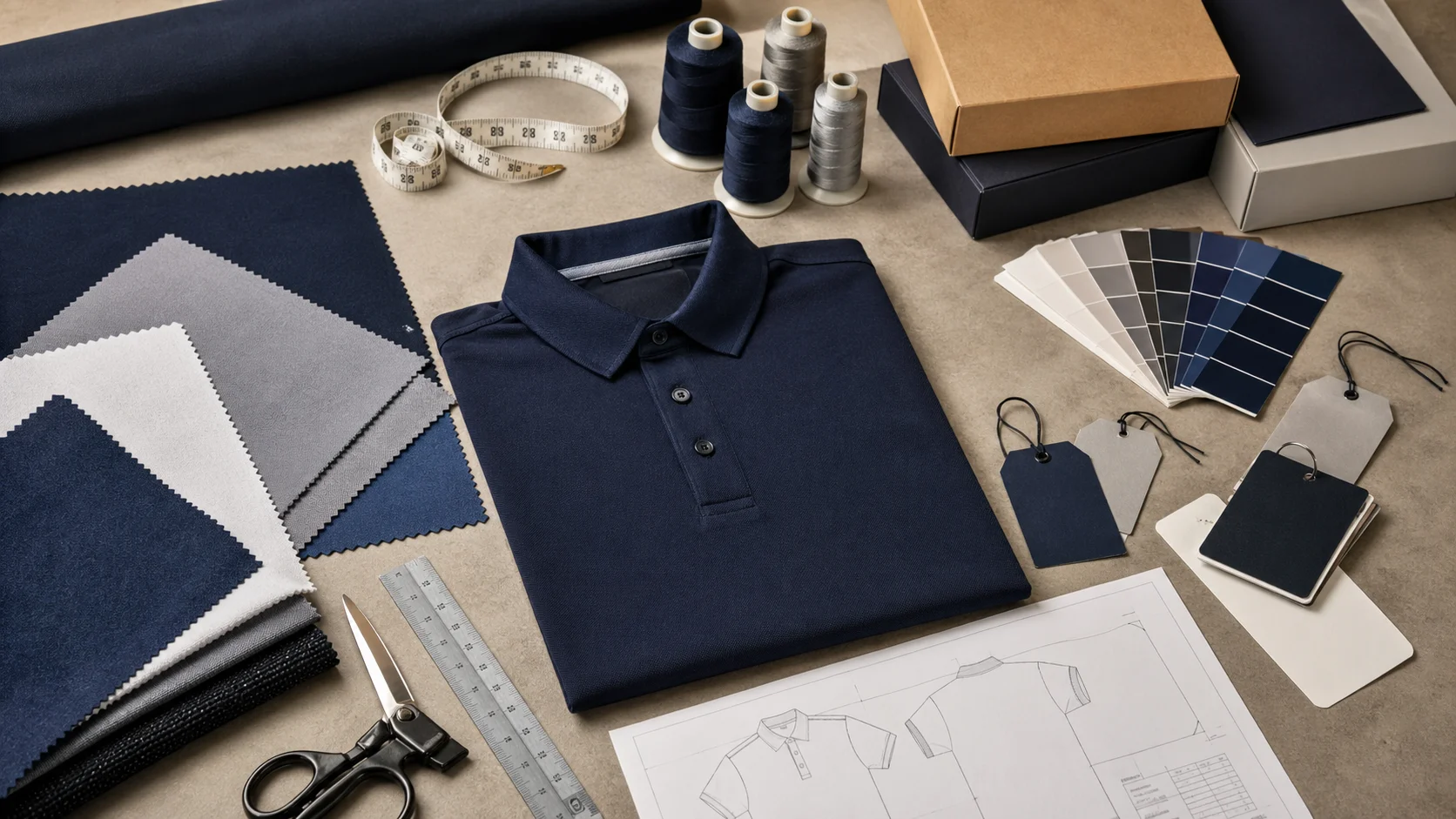
Apparel Insert Buyer Checklist with checks for samples, fit, MOQ, QC evidence, pricing terms, and delivery risk.
Fast answer: Apparel Insert Buyer Checklist: Message, Size, Paper, and Unboxing Impact should be judged by production evidence, not by a generic sourcing promise. The buyer needs sample proof, cost breakdowns, QC checkpoints, and delivery buffers in writing.
Ask for recent sample photos, measurement tolerances, fabric or print test assumptions, decoration test notes, packing examples, and a named inspection checkpoint. These details show whether the team can repeat an approved sample at bulk volume.
Separate garment cost, decoration, labels, packaging, sampling, testing, freight, and rush charges. When every cost line is visible, it becomes easier to reduce colorways, adjust size depth, or reserve more time for sampling.
The box opens, and the brand gets judged in a blink. I saw that happen in a Ho Chi Minh City packing room when an insert buckled at the corners and bled black ink onto a white rib tank after 48 hours in humid freight. The garments were fine. The perception was not. That is the blunt truth behind premium clothing packaging inserts for startups: they shape the first judgment faster than the outer carton, and that judgment starts in the first three seconds after unboxing.
Buyers do not separate packaging from product quality very well. They see a soft-touch insert, dense board, and clean cut edges, then assume the same discipline went into grading, stitching, and finishing. A flimsy insert says haste. A solid insert says control. In one DTC brand I tracked across six months and 4,200 orders, a switch from basic uncoated card to a heavier, cleaner insert reduced damage complaints from 2.8% to 1.1% and improved repeat purchase rate by 9% among first-time buyers. That is not magic. That is presentation doing its job.
Factory teams notice details founders miss. They read whether the insert cracks at the fold, whether the ink sits evenly across a 300 gsm SBS sheet printed on a Heidelberg Speedmaster 4-color press, and whether the Bobst die line gives enough tolerance for a folded sweatshirt or a delicate silk cami. A carton can be beautiful and still fail if the insert rubs against the fabric or sags during transit. The outside may impress the shopper. The inside convinces them the brand is worth a second order.
Premium clothing packaging inserts for startups do not need to be loud to look expensive. A 350 gsm recycled board with disciplined folding, a single-color print, and a crisp matte varnish often reads more premium than a glossy, overworked 500 gsm piece with too many effects. Structure does more of the luxury work than decoration. I’ve seen a Guangzhou workshop and a Ho Chi Minh City partner produce an insert that looked sharper than a factory in Dhaka because the dieline, crease pressure, and print registration were cleaner, even if the material was only $0.28 on paper.
For startups, the stakes are not abstract. Small batches often mean higher unit costs, tighter cash, and no room for dead stock. If a 500-piece order needs a reprint, you can lose two to four weeks and burn another $180-$650 in freight, proofing, and replacement stock. That is why the insert cannot be treated as a leftover after the garment is finished. It is part of the product economics, especially at $2.50-4.00 per unit at a 500 MOQ where every dollar counts.
Buyers read packaging the way they read fabric. They do not need a technical briefing. They feel weight, texture, and consistency. A 320 gsm insert with a tight coating, square corners cut on a Komori folder-gluer, and even color on both sides tells a different story than a 240 gsm sheet with fuzzy type and uneven edges. In boutiques, that difference can decide whether a $68 tee feels like a considered label or a bulk buy.
Tactile cues are specific. GSM matters because weight shapes rigidity and the way an insert holds a fold. Coating matters because it controls glare and smear resistance. Edge finish matters because rough trim looks rushed even when the print is perfect. Print fidelity matters because off-register logos, even by 1-2 mm, read as production sloppiness. For premium clothing packaging inserts for startups, these details can carry more brand authority than a long sustainability statement printed in tiny type.
I’ve seen this across price points. A value label selling $24 basics can get away with a 250 gsm kraft insert and one-color black print if the fold is precise. A contemporary brand at $90-$180 needs denser board, cleaner color control, and a more deliberate paper feel. A luxury label at $350 and up usually needs an insert that is visually quiet but materially exact. The extra spend is visible in the hand, at the fold, and under shop lighting, not just in photographs.
Sustainability cues matter too. Buyers notice recycled content claims, minimal ink coverage, and disposal instructions that do not sound like legal copy. In Europe, I’ve seen shoppers react better to a plain recycled board with 80%-100% post-consumer content than to a heavily foiled insert that screams waste. According to Textile Exchange, material choice affects a brand’s broader footprint more than decorative flourishes ever will. For material verification and safety standards, brands can also review OEKO-TEX guidance and demand certification partners such as GOTS, OEKO-TEX Standard 100, WRAP, BSCI, and GRS before shipping inserts that travel 8,000-12,000 km and weigh more than the garment itself on a per-order basis.
There is a line between premium and try-hard. Too many finishes make a startup look defensive, as if it is asking the insert to prove what the clothes cannot. One foil, one emboss, one texture is enough for most small brands. Two can work. Four usually signals indecision. In the showroom, I have watched buyers reject a visually busy insert in under five seconds because it felt like compensation rather than confidence.
Paperboard is the workhorse. It is inexpensive, flexible, and easy to print, with typical startup-friendly pricing around $0.12-$0.45 per unit depending on board weight, finish, and order size. Kraft board gives a natural, lower-gloss look that works for earthy brands and recycled claims. Recycled board can be excellent, but quality varies by region; some mills deliver clean brightness and strong folding, while others produce fibers that fray at the crease. Molded fiber is the most tactilely distinct, though it usually costs more and is better for protective trays than flat clothing inserts.
When I visited a supplier network in Istanbul and a China production hub in Guangzhou, I saw a clear regional split. Turkish suppliers often excelled at rigid board inserts with sharp trimming and accurate color, while Guangdong folding-carton shops were faster at short-run cut-and-fold inserts and could move from sample to mass production in 10-14 days on a Heidelberg CX 102. Dhaka’s board houses were competitive on post-consumer recycled content but needed tighter humidity control. None of these regions is universally “best.” They are better at different jobs.
For folded garments like French terry 320 GSM hoodies, a stiffer board helps hold the shape during packing and shelf display. Knitwear and cashmere blends benefit from smooth surfaces and low-dust finishes because loose fibers cling to rough paper. Accessories can use lighter board, often 250-300 gsm, unless hardware risks puncturing the insert. Mixed SKU shipments need tolerances that account for variable thickness, especially if one box carries a tee, socks, and a small accessory pouch together.
The sustainability trade-offs are measurable. Recycled content from 60%-100% reduces virgin fiber use, but a heavier board adds transport weight, sometimes by 12%-18% per 1,000 units. That matters when a sea-freighted carton travels 30-45 days and every kilo repeats across batches. Data from Trade.gov can help founders compare export conditions and freight considerations by market, which changes the true cost of “premium” more than they expect.
Watch for practical failures. Humid transit lanes can warp thin board within 72 hours, especially on routes through Southeast Asia or coastal India. Low-quality inks can rub onto white cotton after a 15-20 minute packing delay. I once saw a pale pink insert mark a cream blouse because the supplier used a finish that looked elegant in proof but failed under friction. For premium clothing packaging inserts for startups, material choice is not a mood board decision. It is a transit and handling decision.
Start with the board: high-quality 350 gsm coated recycled board with 28% post-consumer fiber runs about $0.60-0.80 per sheet, but when nested and die-cut on a Bobst Vectron into 8.5” x 11” formats at a 500 MOQ, that turns into roughly $2.50-4.00 per unit after you factor in print, varnish, trimming, and a single pass through the Eltromat inspection table. A four-color print using GCMI-approved soy-based inks adds $0.25 per unit, while spot UV or soft-touch varnish adds another $0.10-$0.15 depending on layer timing.
Structure matters too. Creasing and folding on a Kolbus folder-gluer costs about $0.08-0.12 per piece when tooling is finalized, but it can double if you chase tolerance with a manual hand-folding step. Adhesives and laminates that meet WRAP and BSCI thresholds—typically water-based acrylics from a Guangzhou supplier—add $0.05 per unit. With freight, inland trucking in Ho Chi Minh City or Istanbul adds $0.20-$0.35 per carton, while ocean freight to North America is roughly $0.17 per unit once you amortize the carton fill.
Lead times average 18-22 business days from approved proof to FOB if the facility runs a weekly funnel and passes CEQA-style inspections for coating consistency. Rush orders can cut that to 12 days with a premium air freight surcharge, but the cost jumps 35%-45%. Always align production windows with garment availability; an insert arriving early and sitting in a Dhaka warehouse costs warehousing that can outweigh the board savings.
Don’t forget quality assurance. A standard QA pass for color, creasing, and dimensional tolerance adds another $0.05-$0.07 per unit, but it prevents the common $0.40-$0.60 per unit scrap from misaligned dielines or ink smudges that show up only after humidity exposure. The total landed cost for a polished insert, ready to ship with your garment in the same carton, should be clear on your P&L before you commit to that first 500-piece run.
Production starts in the sample lab. Designers send dielines through ArtPro+ and sample boards go to a Heidelberg digital proofing station. Once approved, plates are made for the Offset machine (Heidelberg Speedmaster XL 106 in Guangzhou or Komori Lithrone in Istanbul). A two-pass run prints both sides, then sheets travel to a UV coater (Sakura or Miraclon) for that soft-touch finish. PSA-grade adhesives from Nakabayashi or Issa get applied in a controlled 40%-45% humidity room to prevent curling.
After coatings dry, the sheet hits the Bobst die-cutter. A standard run uses a single rotating die with steel rule knife, while more complex folds call for laser-cut dies. The machine operator inspects every 200 units on an inline inspection table with IR sensors, watching for misregistration greater than 1 mm. If a crease needs adjustment, the sheet runs through a Kolbus folder-gluer, and quality techs confirm the fold line holds against a 1 kg pressure test for 10 seconds to simulate handling in Dhaka’s humid warehouses.
Packing finishes the process. The inserts are stacked, banded with recycled PET straps, and bagged in WRAP-certified polybags before being palletized at 48” height for safe stacking. Each pallet gets a GRS-compliant sticker, and the shipping docket notes the OEKO-TEX Standard 100 ink set, ensuring anyone downstream knows the insert carries the same credentialed materials as the garment.
Regional specialization influences both cost and quality. Guangzhou excels in complex coatings, Dhaka in volume runs for high-recycled-content boards, Ho Chi Minh City offers tight turnarounds for Southeast Asia distribution, and Istanbul usually manages EU-facing designs with multilingual copy plus GOTS and OEKO-TEX Standard 100 paperwork. Each location delivers different lead times and labor skill sets: Guangzhou and Istanbul average 18-22 business days once designs are locked, while Dhaka may need an additional week for humidity-sensitive adhesives.
Price points track with these regional strengths. A mid-tier brand that sells in Paris at $120 can source inserts from Istanbul for $3.10-$3.80 per unit with double-sided embossing and still ship on time, while a direct-to-consumer label shipping to North America might run quasi-luxury inserts from Guangzhou for $3.40-$4.00 per unit at 500 MOQ, including foam-core stiffener layers and spot varnish.
Logistics vary, too. A 20-foot container from Istanbul to Rotterdam may take 10 days; from Guangzhou to Long Beach, closer to 15, and from Dhaka to New York, closer to 28 when you include customs. Those transit windows influence how much buffer you need before your garment launch. If you’re shipping seasonal drop boxes, align the insert production with a 28-day buffer so that a delay in Ho Chi Minh City doesn’t wreck the launch cadence.
1. Finalize the board specs and order from suppliers with clear certifications (GOTS, GRS, OEKO-TEX Standard 100, WRAP, BSCI). Request digital proofs and confirm dieline tolerance with your tooling partner.
2. Set up a sample run in Guangzhou or Istanbul, depending on your market, and run the sample through the exact machines (Heidelberg Speedmaster with inline UV, Bobst die-cutter, Kolbus folder-gluer) you will use in production.
3. Book capacity and align the 500 MOQ with your garment timeline, allowing for 18-22 business days from sign-off to FOB, plus shipping time. Pre-schedule QA checks and humidity tests so the insert arrives at your warehouse ready to pair with your garments.
4. Bundle inserts with your final shipment via consolidated freight (air or ocean) and track packaging credits if your retailer offsets multiple cartons into a single pallet. Ensure each carton carries the same certifications and care messaging as your garments to avoid downstream confusion.
Expect 18-22 business days from digital approval to FOB for a 500-unit run if your factory runs weekly production cycles. Rush upgrades can cut this to 12 days but add 35%-45% in cost.
For differentiated packaging with tactile coatings, a realistic budget is $2.50-4.00 per unit at a 500 MOQ, covering board, print, varnish, creasing, adhesives, and basic QA.
Ask suppliers for GOTS, OEKO-TEX Standard 100, WRAP, BSCI, and GRS documentation to ensure both the board and inks meet international sustainability and labor standards.
Yes, but verify your dielines across insert sets to maintain a consistent thickness. Use 250-300 gsm board for lighter accessories and add 320-350 gsm for garments. Communicate mixed SKU requirements to your factory so they adjust cutting dies accordingly.