
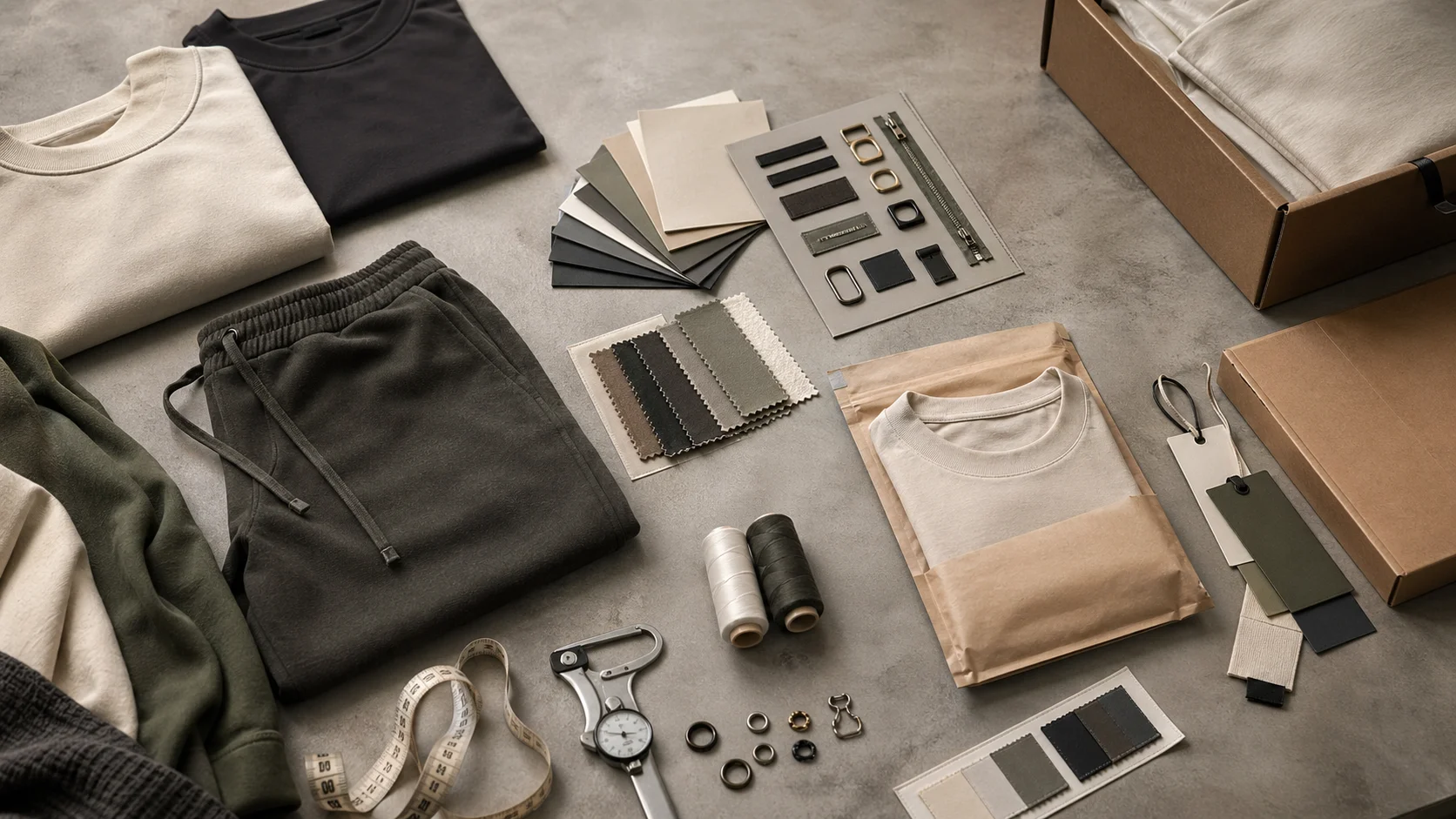
Premium Fashion Mailer Bags with checks for samples, fit, MOQ, QC evidence, pricing terms, and delivery risk.
Fast answer: Premium Fashion Mailer Bags: Material, Closure, Print, and Startup MOQ should be judged by production evidence, not by a generic sourcing promise. The buyer needs sample proof, cost breakdowns, QC checkpoints, and delivery buffers in writing.
Ask for recent sample photos, measurement tolerances, fabric or print test assumptions, decoration test notes, packing examples, and a named inspection checkpoint. These details show whether the team can repeat an approved sample at bulk volume.
Separate garment cost, decoration, labels, packaging, sampling, testing, freight, and rush charges. When every cost line is visible, it becomes easier to reduce colorways, adjust size depth, or reserve more time for sampling.
The first bag your customer touches can make your brand look sharp—or slightly undercooked. Fashion returns can run 20% to 30% in online apparel, which means a mailer bag is not a one-way ticket. For premium mailer bags for fashion startups, the package has to survive a warehouse, a carrier hub, a customer’s apartment, and sometimes the return journey too. That single object has to hold up through repeated handling while still making the brand look disciplined on arrival. I have seen startups save 6 cents on packaging, then lose $3.50 in damage, relabeling, or replacement labor. Not efficiency. Leakage.
When I visited factories in Shenzhen, Guangzhou, and Ho Chi Minh City, I saw the same lesson: don’t let unit price blind you to failure points. A matte black, 120-micron co-extruded polyethylene mailer with double-stitched ultrasonic seals and a clean pressure-sensitive strip kept up in a 18-22 business day transit covering the Pacific and North Atlantic. The faster-scaling ones focused on failure rate, not just the 2% defect tolerance that is tolerable on 500 bags but crippling on 10,000. A 2% defect rate on 500 bags is annoying. A 2% defect rate on 10,000 bags is a real budget line. Cheap mailers also tend to fail in places buyers cannot see on a spec sheet: seal strength, print alignment, and film consistency. They look fine in a sample photo. Then the sealing edge splits on carton compression.
The core argument is simple. Premium does not always mean expensive. It means tighter specs, lower damage risk, and branding that holds up outside a studio shoot. If you already have private label clothing services in place, packaging becomes the next control point. It is part of the product economics, not an afterthought. Brands that also use cut and sew manufacturing usually understand this faster because they already track fabric waste, trim quality, and production tolerance. Packaging deserves the same discipline.
Premium should be defined in measurable terms. I mean thickness, tear resistance, opacity, seal quality, and print accuracy. A bag can look elegant and still fail if the adhesive is weak or the film stretches unevenly. The difference between acceptable and premium often starts at 60 to 100 microns for poly mailers, depending on garment weight and shipping route. A light tee in a domestic parcel needs less protection than a wool blazer headed across borders.
Material choice changes the customer’s hand feel and the bag’s life span. Virgin polyethylene gives reliable consistency and excellent seal performance. Recycled polyethylene with 60% GRS-certified resin can bring a strong sustainability story, but quality varies by supplier and resin source. Co-extruded films help with puncture resistance and opacity, especially for darker prints and premium outerwear. Compostable PLA blends can work for some brands, though they need careful testing because heat, moisture, and warehouse dwell time can compromise performance. Paper-based mailers suit certain aesthetics, yet they lose points for water resistance and can crease badly in transit. According to the OEKO-TEX framework, material verification is only part of the sustainability picture; chemistry and traceability matter too.
The finish matters more than many founders think. Matte surfaces photograph better than high-gloss bags. Soft-touch coatings feel expensive in hand. A clean tear strip signals care. Double seals improve tamper evidence and reduce the chance of split edges in last-mile handling. The logo should land exactly where the factory approved it, not 4 mm off-center. That kind of error is small on paper and huge in a customer’s hand.
Regional supplier behavior varies. Some Asian manufacturers excel at print consistency at scale, especially across 5,000 to 50,000 units. Some European suppliers win on lower minimums, tighter regulatory traceability, and cleaner paper sourcing. I have seen brands pay for a “premium” finish and receive a bag that felt thin because the film gauge was not what they assumed. Ask for the spec, not the adjective. premium mailer bags for fashion startups should read as controlled, not decorative.
Price only makes sense when you separate unit cost from landed cost. For 500 units, a premium printed mailer that runs on a five-color flexographic press in Guangzhou with a 30 x 40 cm format, co-extruded 120-micron film, and a 10 cm resealable flap can land at roughly $2.50-4.00 per piece before freight, depending on gauge, print count, and closure type. At 2,000 units, that might fall to $0.65 to $1.20 when mixing in rotary gravure for sharper logos. At 10,000 units, it can drop further to $0.42 to $0.85 once you amortize plate charges and use inline lamination for tamper-proof seals. Those numbers are not promises. They are the band I see most often when founders ask for premium mailer bags for fashion startups and want real-world budgets, not marketing copy.
Now add the hidden charges. Freight from Guangzhou, Ho Chi Minh City, or Dhaka can add 8% to 25% on low-volume orders, especially if you opt for air freight instead of a 14- to 20-day sea leg through the Port of Long Beach. Duties vary by origin and destination, and a finished bag from Istanbul routed through EU customs can pick up unexpected VAT. Plate charges for custom print might be $60 to $250 depending on color count and whether you use UV or solvent-based inks on an 8-color machine. Sampling can run $30 to $150, even if the factory uses an automatic die-cutting blade, because you still need art-board printing proof. Some factories quote a lovely ex-works price, then add fees for artwork changes, custom sizing, and packaging inserts. I have reviewed quotes where the “cheap” option ended up 18% more expensive after those extras. Landed cost beats unit price every time.
There is a point where the extra 5 to 20 cents per unit is justified. If your average order value is $110 and your return rate is already 22%, a sturdier bag that reduces crush damage or re-sealing issues can protect revenue far beyond its own cost. Plain poly mailers are fine for low-value, low-return basics. They are a weak choice for silk sets, embellished tops, or premium athleisure that ships in multiple pieces. A bad bag can make a $78 garment feel like a $12 one.
I use a simple decision rule. Choose the cheapest option only if the product is low-value, low-return, and not heavily brand-led. If the item is part of a visual identity, the bag is part of the product. If the product lives in a crowded price band, packaging has to do more work. For a faster quote comparison, I often tell founders to request a packaging quote from fabrikn.com from at least three suppliers and compare them on the same sheet. Otherwise, the pricing game is smoke and mirrors. Data from U.S. International Trade Administration trade guidance supports this approach: shipping and compliance often swing the final number as much as manufacturing does.
China and Vietnam remain the scale leaders for premium mailer bags because they offer broad film choices, strong print options, and factories that can handle 5,000 to 100,000 unit runs without panicking. Guangzhou’s extrusion lines deliver consistent 90-micron films, while Ho Chi Minh City still outpaces others on quick-change flexo plates in 5-color and 8-color runs. Dhaka can outhustle on soldered seam strength and automatic insulation machine sealing if your bags require water-resistant laminates. Istanbul, meanwhile, shines when you need European compliance, WRAP and BSCI audits, and lower minimums of 1,000 units, often with mill certificates that reference OEKO-TEX Standard 100 and GOTS for cotton-based mailing bags.
Supplier choice also drives compliance. I toured a plant in Istanbul where a dedicated lab monitors heavy metals, maintaining OEKO-TEX Standard 100 certification and WRAP social compliance records. The same owner in Dhaka holds GRS and BSCI documentation because the recycled resin components come from a Portuguese regranulator. Those factories run a 6-color, 1,200 mm rotary gravure press and follow a clear lease on maintenance: rollers checked every 1,000 hours, dryers calibrated weekly, and heat-seal bar temperature verified before every run.
On the services side, some suppliers will offset a higher landed cost by handling kitting, polybag insertion, and pallet labeling. Others stick strictly to production, so you need to plan for 18-22 business days of transit plus another 5 days for inland trucking when your goods ship from Ho Chi Minh City to the Port of Oakland. The predictable rhythm comes from asking for documented cycle times and insisting on process flowcharts—when asked, a good factory will show you the injection molding line for its plastic closure strips and the lamination unit that applies biodegradable adhesives.
Packaging is an extension of the story you tell online. For fashion brands that rate Instagram and TikTok views per launch, the right texture, metallic ink, or foil stamp can support a 4% lift in conversion if executed properly. Matte-finish mailers highlight typography and keep the logo crisp, while soft-touch coatings convey premium without being loud. High-gloss or reflective film works when you’re pairing it with silver foil, but only if the printer can maintain 0.3 mm registration across the width of the bag, so your monogram doesn’t drift mid-run.
Branding touches have costs, and they also need precise processes. UV flexo printing on a Fujifilm GL-UV or a Bobst master cylinder can handle up to eight colors, including gradients, while embossed seals require a hydraulic die press with 10 tons of pressure. Certain factories offer spot varnish as a complimentary upgrade—others will charge $0.08 to $0.25 extra per unit. Consider how many areas you truly need a premium treatment versus sticking with a single-color PMS 186 logo that still communicates your identity.
Beyond visible branding, there are functional add-ons. A premium tear strip made on a K-5 die-cutter reduces frustration when customers open the bag. A discrete, branded return QR code on the back, printed with thermal transfer for scratch resistance, keeps the design clean without distracting from the front artwork. The process matters: a lamination line with corona treatment ensures your print stays vivid, and a final slitting machine for pre-cut die shapes keeps every bag identical so your next photoshoot doesn’t look like a patchwork.
Collect three quotes with identical specs and ask for a sample run sheet. Make sure one quote includes a GOTS-certified cotton bag option if your capsule collection uses organic materials. Another can be a high-shine poly mailer from Dhaka that passes WRAP and BSCI audits, and the third can be a paper-based bag from Istanbul with FSC-backed paper and OEKO-TEX Standard 100 certification for the ink. Compare them not just on price but on cycle time, defect rate, print methodology (rotary vs. flatbed), and in-line finishers.
Test your ideal bag on the same packaging line that fills your garments. That means pulling a batch of 10 bags, filling them with actual product weight, and running them through the same conveyors, heat tunnels, and palletizers your fulfillment center uses. Look for seam splits, curling, misaligned logos, and sealing failures. A single failed seal on a 500-unit order can reveal whether your first manufacturing partner has a robust quality-control protocol.
Watch out for ambiguous terms like “premium finish” or “luxury feel” without meaningful data. Always ask for the film gauge, tear strength (in Newtons), and adhesion test results. Don’t let a supplier skip the third-party approval by OEKO-TEX Standard 100 or GOTS when you claim sustainability. If your brand is US- or EU-based, demand WRAP and BSCI documentation if the production site is in Dhaka or Ho Chi Minh City; otherwise, you risk supply chain disclosure issues.
Don’t underestimate the cost of artwork changes. A single color swap on a six-color flexo plate can cost $120 to $250 in tooling, especially if it triggers a new CU plate. Plan your print approval in one round, and that round should include color lab dips approved under D65 light. Also, avoid the mistake of ordering a bag that cannot be automated by your fulfillment center’s inserting machine. Compatibility matters—if your warehouse uses a Packway PRO inserter, test a bag before committing to a full run.