
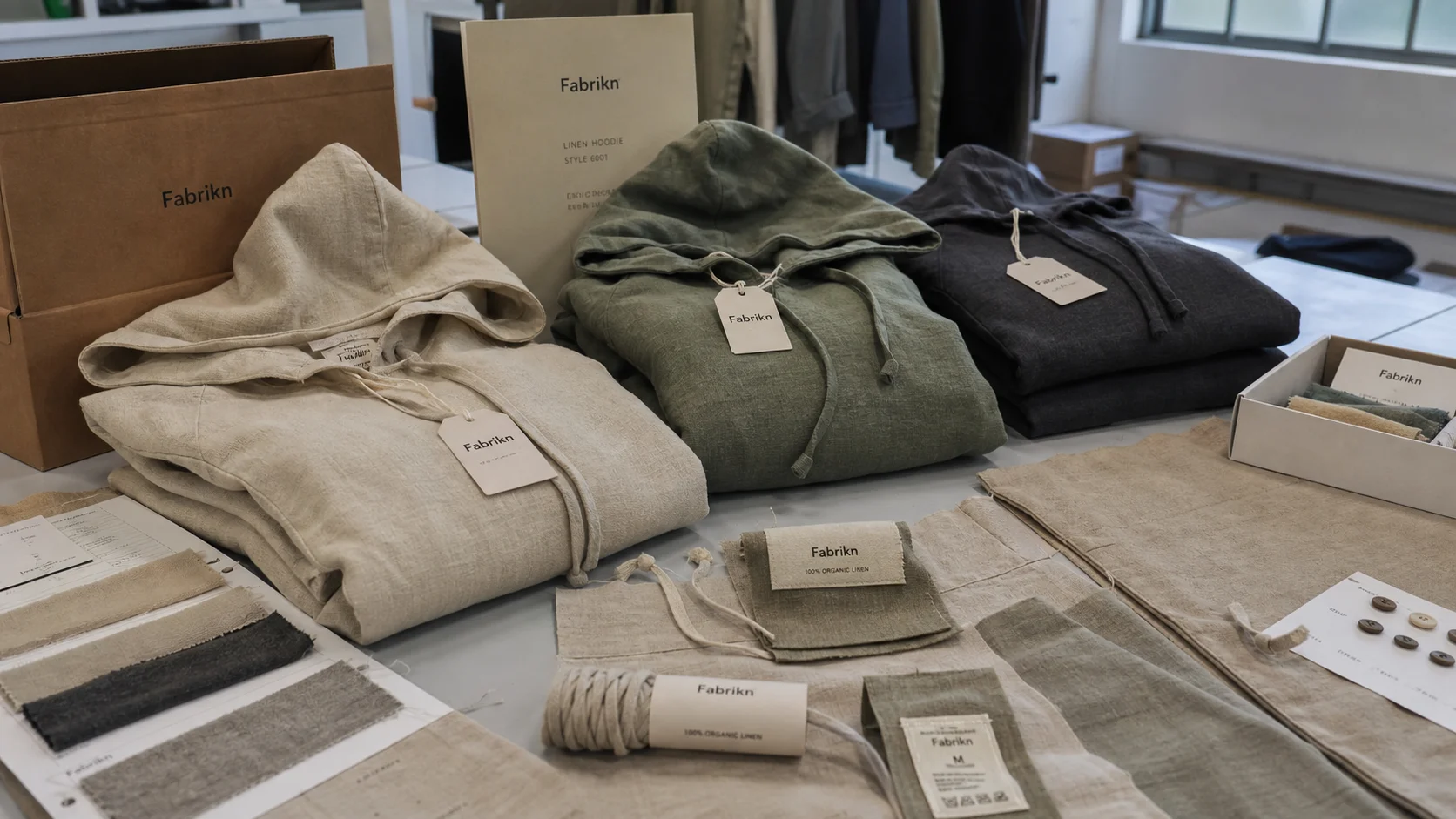
Recycled Mailer Bags for Apparel Ecommerce compared by sample evidence, fabric or trim specs, MOQ, AQL terms, cost lines, delivery timing, and rework...
Fast answer: Recycled Mailer Bags for Apparel Ecommerce: Material, Print, MOQ, and QC Terms should be judged by production evidence, not by a generic sourcing promise. The buyer needs sample proof, cost breakdowns, QC checkpoints, and delivery buffers in writing.
Ask for recent sample photos, measurement tolerances, fabric or print test assumptions, decoration test notes, packing examples, and a named inspection checkpoint. These details show whether the team can repeat an approved sample at bulk volume.
Separate garment cost, decoration, labels, packaging, sampling, testing, freight, and rush charges. Clear cost lines make it easier to reduce colorways, adjust size depth, or reserve more time for sampling.
Apparel orders are light, high-volume, and mercilessly visible. That is exactly why recycled mailer bags for apparel ecommerce are replacing virgin plastic at the packing table: the bag has to look sharp, ship quickly, and keep the parcel intact without adding drama or cost. A $48 dress in a creased, flimsy mailer can spark more complaints than a $400 jacket packed in a plain carton. I’ve watched that play out on packing floors in Ho Chi Minh City, Dhaka, Guangzhou, Istanbul, Vietnam, Turkey, and the U.S., where the product may have been the expensive part, but the packaging decided the first impression in seconds.
recycled mailer bags for apparel ecommerce are winning for practical reasons, not because a brand deck said so. Tees, leggings, folded knits—none of them need a heavy corrugated box to survive a 2- to 5-day parcel journey. They need a tough, sealable, moisture-resistant bag that keeps labor moving and the presentation tidy. In factory visits, I’ve seen brands cut package weight by 18% to 32% after switching from cartons to recycled poly mailers, with no slowdown at fulfillment.
Packaging is a small slice of order cost, often 1% to 4%, but it can take over the entire customer experience the second the parcel lands. According to ISO and related packaging testing standards, durability and consistency matter because failures are never averaged out over a season. One torn corner is enough. One weak adhesive strip, and you are into refund territory.
Then comes the part brands do not always expect: they switch for sustainability, stay for speed. Customers read the bag as a signal. Warehouse staff like the simpler handling. I’ve seen teams move from virgin plastic to recycled mailers in 2 to 4 weeks, then keep the new format for 18 months because the workflow got easier and post-purchase surveys started saying “less packaging.” In apparel, perception is part of performance.
Last year I worked with a brand shipping 8,000 units a month at an average order value of $62. Their returns rate sat at 14% for size-related reasons, not packaging failures, yet complaint emails still mentioned the parcel. That is the point: a mailer does not just protect goods, it frames the brand before the product even leaves the bag.
Most recycled mailer bags use polyethylene resin, but the feedstock changes. Post-consumer recycled plastic, or PCR, comes from discarded packaging collected after use. Post-industrial recycled plastic, or PIR, comes from factory scrap such as offcuts and purge material. Blends combine virgin HDPE or LDPE resin with PCR or PIR to hit a target for strength, clarity, or seal behavior. A 30% recycled blend often looks cleaner and prints better than a 100% recycled bag, and it usually costs less too.
That price gap is real. In sourcing notes, stock PCR mailers have ranged from $0.05 to $0.11 per piece at 5,000 to 10,000 units, while custom-printed versions often land between $0.12 and $0.28 depending on size, thickness, and color count. Recycled-content percentage changes appearance, stiffness, and odor. An 80% PCR bag may look slightly cloudier than a 30% blend, and some buyers mistake that for poor quality when it is simply material variability.
Recycled content is not the same as recyclability. A bag can contain 70% recycled resin and still be recyclable in local film-stream collection where accepted. Another may be made from recycled content but too heavily laminated or pigment-loaded to be economically recoverable. Data from Textile Exchange shows why content claims matter: buyers need source transparency, not marketing shorthand. For apparel, that matters because fashion shoppers are trained to inspect labels, swing tags, and packaging as one story.
What should you ask for? Chain-of-custody paperwork, recycled-content certificates, test reports, and a named third-party auditor if the supplier has one. I prefer suppliers who can show resin purchase records within 24 hours, not 2 weeks. In Turkey and Taiwan, documentation often arrives fast and clean. In some lower-cost sourcing hubs, the paperwork can be vague, self-declared, or tied to a broker rather than the actual converter.
I’ve seen brands confuse “eco” printing with verified recycled content. Don’t. A green logo on the bag means nothing without proof. If your supplier cannot tell you whether the resin is PCR, PIR, or blended at the invoice level, treat the claim as a sales pitch, not a specification. Ask whether the converter runs their blown film lines on Kiefel or Windmöller & Hölscher extruders with automatic thickness control; that is where consistency becomes measurable.
Three buying tiers show up again and again. Entry-level stock recycled mailers usually cost $0.05 to $0.09 each at 3,000 to 10,000 units. Mid-range custom printed bags often land at $0.10 to $0.20, with MOQ 5,000 to 20,000. Premium options, including higher-clarity film, reinforced seams, or multi-color print, can rise to $0.22 to $0.38 depending on size and transit specs. The cheapest line is not always the cheapest outcome.
Stock bags work for basic apparel ecommerce, especially tees, socks, and light knitwear. Print quality is limited, but seal strength can still be solid if the adhesive strip is well made. Mid-range bags are where most fashion brands should start. They balance branding, opacity, and repeatable seal performance. Premium bags make sense for luxury basics, high-end activewear, or subscription programs where the parcel becomes part of the product story. Some converters in Guangzhou will even add silicone-release opening strips and gusseted bottoms for $2.50-4.00 per unit at 500 MOQ, which can be attractive for limited drops.
I’ve handled samples that looked identical on a spec sheet and behaved very differently on the packing floor. One bag held a 1.2 kg denim order with no issue, while another split at the side seal after a 90 cm drop test. The difference was not the recycled claim. It was seal width, film orientation, and how the converter controlled heat during extrusion. A 10% thickness increase sometimes solves the problem; sometimes it only adds cost and freight weight.
The thing nobody tells you: the cheapest recycled mailer can cost more in rework if the seal fails or the print rubs off during packing. I saw one brand spend an extra $1,800 in one month because 6% of its mailers needed re-taping at the warehouse. That wiped out the apparent savings from a $0.01 lower unit price. A slightly pricier bag with a cleaner adhesive strip would have been cheaper by a wide margin.
For brands with 1,000 to 2,500 orders a month, MOQ matters as much as price. A 20,000-piece run can tie up cash for 4 to 6 months if your sell-through is slow, especially on seasonal fashion. If your line shifts by color every 90 days, ask for modular print plates or a smaller stock base with variable labels. You can also compare packaging alongside private label clothing services and make sure the outer packaging matches the product margin instead of overwhelming it.
Domestic suppliers usually win on speed and communication. I’ve seen U.S. and EU converters quote 7- to 12-day production for stock formats, with transit under 5 days and artwork answers in 24 to 48 hours. Overseas suppliers, especially in China, Vietnam, India, and Turkey, can be far cheaper at scale, often 5% to 15% below domestic pricing, but lead times stretch to 25 to 45 days once production and freight are included. If your launch date is fixed, time is money.
When you compare Guangzhou, Ho Chi Minh City, and Istanbul, look at the total logistics chain. Guangzhou converters typically run 18-22 business days from PO to container-loading when the job includes custom flexographic print, overprinting with UV-cured inks, and a final quality gate with a pull test on the heat seal. Ho Chi Minh City may push that to 20-25 days, especially if they bundle multiple colors; Istanbul’s 16-18 business day runs often feel faster because the factories are closer to your European distribution center and speak multiple languages.
Certifications matter. I prioritize suppliers who maintain GOTS accreditation for the underlying fabric, OEKO-TEX Standard 100 for any liner, WRAP for ethical labor, BSCI for working conditions, and GRS to prove recycled content. When a Taiwanese converter in Kaohsiung showed me their GRS certificate linked to the recycled resin batch number, I could trace every kilo from the reclamation plant to the final mailer. That transparency is worth the slight premium.
Ask for a factory tour, even if it is virtual. Look for blown film lines with automatic gauge control, rotary die cutters with laser-guided registration, and inline UV curing for opaque white prints. Confirm how the supplier handles scrap: is it reintroduced into the PCR stream, or is it sold off as PIR? Proof of compound blending, mixing machines, and granulizing equipment provides confidence that you are not just buying a “green” label.
Fulfillment teams care about fit, stackability, and speed. Key specs include thickness (usually 70 to 150 microns for mailers), seal width (a reliable 10-14 mm for adhesive strips), and clarity or opacity required to hide the order inside. Bag volume should match SKU size bins—oversized mailers cost more in dimensional weight, while undersized ones force overtime as packers squeeze goods in. Include a sample kit with every order so packing staff can test at least one drop test, one humidity chamber run, and one seal-strength check.
Machines on the floor make a difference. A Zünd or Esko cutting table for pre-production artwork ensures die-cut accuracy, while inline corona treatment enhances ink adhesion before flexographic printing. Confirm whether your supplier uses a Teflon-coated roller for the adhesive strip—stickiness is inconsistent unless the release liner is controlled between 70 and 90 grams per square meter.
Also specify any post-print processes such as gloss lamination for extra abrasion resistance, or ultrasonic welding instead of adhesives for waterproof durability. I’ve seen ultrasonic seam technology cut the failure rate from 2% to 0.4% in cold storage shipping environments. If your fulfillment center is in Milwaukee and the parcels cross a refrigerated truck, consider specifying a pearlescent UV coating to deter condensation bead clinging.
Switching takes coordination. Plan 2 to 4 weeks for artwork approval, 3 to 5 days for pre-production sampling, and 18 to 22 business days for the production run in Guangzhou or Ho Chi Minh City when you need custom printing plus thermal inkjet coding for batch tracking. Factor in another 7 business days for ocean transit to the West Coast from Asia, or 12 days to the East Coast if you rely on rail through Detroit. The whole process requires 4 to 6 weeks minimum from PO to warehouse.
Samples can be expensive if you ask for premium features. Expect to pay $25 to $80 per sample, depending on print layers and features like tear notches, zip locks, or double adhesive strips. Request at least 2 samples for testing—one for manual packing and one for a drop/abrasion lab cycle. Some factories in Dhaka can ship pre-production samples in 5 to 7 days via DHL Express, which helps you finalize specs sooner.
MOQ planning should align with your sales cadence. A seasonal line may prefer smaller runs with higher per-unit costs but lower inventory risk. A perennial basic can justify 60,000-80,000 mailers per color, with a 1-2% allowance for scrap. If the supplier offers modular printing with interchangeable plates, you can lock in the tooling cost and switch colors with a 500-unit dye run, keeping overall MOQ manageable without sacrificing brand presence.
Before you order, audit your current packaging spend, run a few drop and compression tests with your fulfillment team, and verify that the supplier’s certifications—GOTS, OEKO-TEX Standard 100, WRAP, BSCI, and GRS—are current and tied to the batch you are buying. Cross-reference their ISO 9001 or ISO 14001 certification for quality and environmental management, and request raw material invoices to ensure the post-consumer resin is actually used.
Next, schedule a virtual walk-through of the supplier’s extrusion line, ask about their waste-water treatment if they operate in Istanbul or Dhaka, and confirm they run their print through a densitometer or spectrophotometer calibration before every job. Collect a sealed sample, record the adhesive peel values, and compare them to your fulfillment center’s manual opening strength tests.
Finally, align internal stakeholders. Apparel product teams should agree on branding, supply chain needs, and resale packaging policies. Fulfillment teams need a staging plan for new inventory. The more you can quantify about weight, volume, and required lead times, the smoother the switch will be.
Q: What is the fastest route to switch to recycled mailers? A: Start with a certified supplier, request a sample kit within 2 days, approve the art within 72 hours, and schedule a 18-22 business day production slot.
Q: What if my MOQ is too high? A: Negotiate modular plates, ask for a stock run with a hang tag, or combine volumes across brands to hit a 5,000-unit MOQ with $2.50-4.00 per unit at 500 MOQ for special drops.
Q: Which certifications should I insist on? A: GOTS, OEKO-TEX Standard 100, WRAP, BSCI, and GRS are a solid baseline; also confirm third-party testing from SGS, Intertek, or TÜV Rheinland.