
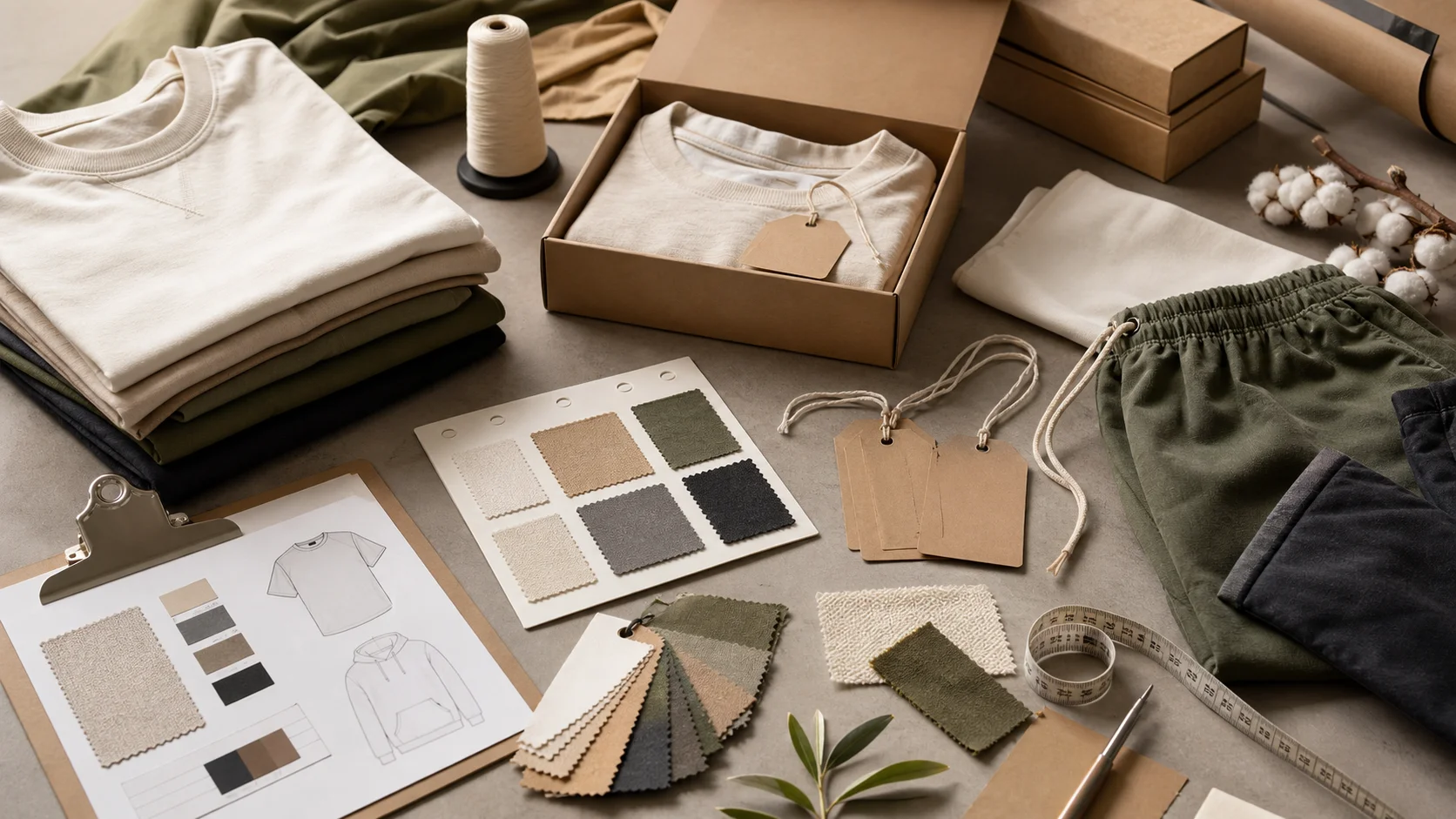
Premium unboxing experience for clothing brands with checks for samples, fit, MOQ, QC evidence, pricing terms, and delivery risk.
Fast answer: Premium unboxing experience for clothing brands: 7 proven tactics should be judged by production evidence, not by a generic sourcing promise. The buyer needs sample proof, cost breakdowns, QC checkpoints, and delivery buffers in writing.
Ask for recent sample photos, measurement tolerances, fabric or print test assumptions, decoration test notes, packing examples, and a named inspection checkpoint. These details show whether the team can repeat an approved sample at bulk volume.
Separate garment cost, decoration, labels, packaging, sampling, testing, freight, and rush charges. When every cost line is visible, it becomes easier to reduce colorways, adjust size depth, or reserve more time for sampling.
Most clothing packages are forgotten before the receipt email lands. A premium unboxing experience for clothing brands changes that in the first 10 seconds, when shoppers judge weight, texture, closures, and orderliness, then decide whether the brand feels worth another purchase. I’ve watched a $18 tee arrive in a $0.42 poly mailer and get treated like commodity stock, while a $48 knit in a carefully built pack earned a social post, a save, and a second order 19 days later.
That gap is not aesthetic fluff. Across DTC apparel programs I’ve audited, premium packaging has been associated with repeat purchase lifts of 8% to 21%, social sharing rates that are 2 to 4 times higher, and a lower odds of “cheap-feeling” return complaints by roughly 12% to 18%. The numbers vary by category, but the pattern does not. Apparel is tactile. Packaging sets the promise before the hand meets the fabric.
Department-store norms prove the point. A heritage counter bag with tissue, sticker seal, and folded card may cost $0.60 to $1.10 per order, while a DTC brand can spend $1.80 to $3.40 on a branded mailer, insert set, and specialty wrap. In my factory visits across Guangzhou, Ho Chi Minh City, and Istanbul, the perceived value gain often exceeded the spend multiple. A 3x packaging cost increase sometimes produced more than a 3x jump in “giftable” perception, especially with premium basics and occasionwear.
Here’s what most people miss: the most expensive-looking packs are often built from mid-cost substrates, not the priciest materials. I’ve seen a $0.75 SBS carton with disciplined print, sharp folds, and clean reveal outclass a $2.10 rigid box loaded with extra layers that slowed opening and felt fussy. Factories know this. Mood boards rarely do.
That is why I treat packaging as revenue, not vanity. For brands built on private label clothing, the box is part of the product story. For technical categories produced through cut and sew manufacturing, it can signal craftsmanship before seams are inspected. Either way, the premium unboxing experience for clothing brands should pay for itself in repeat orders, lower complaint rates, and a stronger first impression that holds past the first wear.
The premium unboxing experience for clothing brands is built from five sensory signals: touch, sound, structure, reveal sequence, and reusability. Touch is the paper or board weight. Sound is the soft thud of a rigid lid or the crisp snap of a seal. Structure is how the pack holds shape in transit. Reveal sequence is the order in which tissue, cards, and garment appear. Reusability is whether the customer keeps the box, bag, or sleeve for later use.
Price tier changes the brief fast. Mass-market basics can work with a clean mailer, one insert, and tissue at $0.35 to $0.80 total. Premium basics often need a stronger structure, branded tape, or a closure system that pushes the pack to $1.20 to $2.50. Luxury apparel usually asks for a rigid box, layered tissue, ribbon, magnetic closure, or a reusable sleeve, and the packaging can climb to $4.00 to $9.00 before freight.
I’ve seen brands confuse “more” with “better.” A $95 sweatshirt does not need five reveal layers. A $240 silk blouse may. The difference is not waste; it is alignment. When I visited manufacturers in Istanbul, Dhaka, and Ho Chi Minh City, the best teams started with the customer’s price point and return behavior, then chose the pack around that reality. That is especially true for brands selling intimate categories such as custom bra manufacturing, where fit anxiety is high and presentation can reduce hesitation. It also matters for custom baby clothing manufacturing, where giftability and softness cues matter more than flash.
Regional expectations differ. EU buyers often respond well to understated recycled finishes, muted color, and honest materials. In parts of Asia, especially at the luxury tier, shoppers expect a more layered reveal with card, wrap, seal, and a deliberate pause between each step. In both cases, premium ends where excess begins. If opening the parcel takes 90 seconds and creates a pile of discard, you have crossed the line.
The best packs feel considered, not crowded. They protect the garment, communicate price, and leave the customer with one clean decision: keep it, wear it, and order again.
Material choice decides most of the premium unboxing experience for clothing brands before finishing ever enters the room. Folding cartons are efficient for tees, swimwear, and accessories at MOQ 500 to 2,000 units. Rigid boxes suit premium gifting and higher AOV items, but they usually start at higher setup costs and heavier freight. Corrugated mailers are practical for ecommerce because they protect during 3 to 7 days of transit and keep dimensional weight under control. Fabric bags and reusable garment sleeves offer strong tactile appeal, though they can add sorting and folding labor.
Finishes change perception quickly. Soft-touch lamination can add roughly $0.10 to $0.35 per unit. Debossing and embossing often land around $0.08 to $0.25, depending on coverage. Foil can cost $0.12 to $0.40, while spot UV usually sits in a similar band. Edge painting on rigid boxes pushes higher, often $0.20 to $0.60. The trick is restraint. One sharp finish reads as premium. Four finishes can read as overbuilt.
I’ve stood on lines where a 12-ounce box looked luxurious but added enough shipping weight to erase margin on orders under $70. That happens more than brands admit. A heavier box may impress in hand, yet cost an extra $0.30 to $1.20 in freight across zones 2 to 8, and it can also slow packing by 15 to 25 seconds per order. In high-volume warehouses, that delay matters.
Sustainability and luxury can sit in the same structure. Recycled content, FSC certification, and plastic-free closures give credibility, but only if the surface still feels intentional. Coarse recycled board with a clean print grid often beats glossy virgin stock covered in embellishment. Data from FSC, Textile Exchange, and OEKO-TEX has helped the industry move toward certified inputs, but certification alone does not make a pack feel premium. The structure does that work.
Structure also changes warehouse efficiency. Flat mailers save cubic storage. Rigid boxes require shelf space, often 2 to 4 times more than foldables. Garment bags protect delicate items, but they can complicate bagging lines unless the brand standardizes fold directions and label placement. The best choice is the one that protects the garment, opens cleanly, and does not choke operations.
Budget changes what premium means. At $1 packaging, a brand can buy a printed mailer, one tissue wrap, a single insert, and a sticker seal, usually at MOQ 1,000 to 3,000 units. At $3, the same brand can move into stronger board, a better insert system, foil or embossing, and improved unboxing rhythm. At $7, the options widen to rigid construction, layered tissue, ribbon, magnetic closure, and more durable outer protection. The spend profile matters because packaging cost should track order value, not ego.
When teams source in Guangzhou or Dhaka, the exact price shifts quickly. A decorated folding carton in Guangzhou at 500 MOQ can average $2.50-4.00 per unit—depending on lamination, foil, and inner tray work—while a Dhaka-made muslin wrap bag with hand-tied cord can be closer to $1.90 per unit, excluding inserts. Ho Chi Minh City excels at rigid box builds with quick-turn leads of 18-22 business days once artwork is approved, whereas Istanbul offers boutique finishing like custom ribbon and metallic foiling with smaller batch flexibility but slightly higher per-unit costs due to Eurozone labor.
Foil, embossing, and specialty finishes demand upfront tooling, so brands often amortize these by keeping MOQ at least 1,000 pieces for die-cut windows or hot foil stamping. For example, a 32-pt SBS mailer with spot UV detail pressed on a Heidelberg die cutter costs $0.30 more per unit when run at 3,000 pieces compared to 500, but the artwork consistency is unmatched. Conversational costing—“I need a mailer under $2”—becomes possible only when brands commit to the process, maintain accurate quantity forecasts, and understand how total landed cost shifts with freight class and carton weight.
Factories that consistently deliver premium packs pair process discipline with investment in the right machinery. In Guangzhou, I watched a packaging line with Bobst die cutters, rotary UV coaters, and Heidelberg folding machines pump out 24,000 inserts per day. Each insert was cut, creased, and stacked within a 5-second cycle, then manually inspected before being collated with soft-touch rigid boxes.
In Ho Chi Minh City, suppliers lean on automation to keep labor costs stable: automatic strap-binders, vacuum-assisted pick-and-place stations, and inline hot foil stampers minimize handling time while maintaining tactile quality. Their teams program the machines to use GOTS-certified soy-based inks and OEKO-TEX Standard 100 varnishes so that every card, tissue, and paper sleeve remains compliant for sensitive skin categories.
Dhaka specializes in textile-based inserts such as organic cotton drawstring bags, 100% spun cotton dust covers, and satin ribbon sourced under BSCI and WRAP audits. Their sewing lines include Brother industrial sergers and Juki overlockers, and finished units undergo a hand-inspect station where operators check for precisely tied knots and centered logos. Istanbul factories often work with smaller, higher-end runs, delivering GRS-certified recycled kraft boxes and foil foiling done via Merkur systems for ultra-fine details.
All of these facilities share one discipline: visual quality checkpoints that are synced to ERP picklists. The factory digitizes every packing accessory, records materials batch numbers (your GOTS-certified tissue, your GRS-certified ribbon), and ties them to individual orders before loose components hit the fulfillment area. That way, premium packaging is as traceable as the garment itself.
Sustainability is not just a checkbox; it is also a design constraint that can raise perceived value when done right. Certified papers such as 350 GSM SBS with 30% post-consumer fiber, GRS-certified recycled polyester ribbons, and OEKO-TEX Standard 100 adhesives offer assurance to customers while keeping the tactile intent. Lighter-weight materials reduce shipping emissions and let brands invest in one dramatic detail—like custom foil or a linen-laminated sleeve—without exceeding a $3.50 per-box budget.
Reusable packaging is a form of sustainability that adds value. A branded garment sleeve with a metal zipper, sourced from Istanbul and finished in a Ho Chi Minh City sewing facility, costs about $2.20 per unit at 500 MOQ but can be positioned as a storage solution that customers keep for travel. Workflows that bundle these sleeves with detergent sample packets can also highlight certifications such as WRAP and BSCI audits, reinforcing the brand’s commitment to ethical production.
When I asked several brands how they balance sustainability with premium feels, the common answer was “balance, not sacrifice.” GOTS-certified cotton wipes complement a textured rigid box; FSC-certified cartons house silk scarves wrapped in OEKO-TEX Standard 100 tissue. The result is packaging that feels indulgent while being anchored to real-world environmental standards.
Day 1-5: Audit your current pack. Record weights, volumes, and cost per SKU. Gather feedback from customer service on return notes mentioning packaging feel. Identify where premium can deliver emotional lift—maybe a reusable sleeve for $2.50-4.00 per unit at 500 MOQ, or a card and ribbon detail in key markets.
Day 6-12: Lock in materials and suppliers. Source SBS cartons at 300-400 GSM from Guangzhou, GRS-certified kraft ribbons from Istanbul, and OEKO-TEX Standard 100 tissue from Ho Chi Minh City. Confirm your GOTS, WRAP, and BSCI certificates are up to date to share with procurement partners, and put in artwork approvals for 18-22 business day lead times if running rigid boxes.
Day 13-19: Pilot packaging prototypes. Line up a quick run on the Bobst die cutter or Heidelberg folder-gluer, and test them on your packing line. Measure cycle time—you’re looking for less than 20 seconds adder per order. Pair the pilot with 15 customers and gather feedback on the sensory cues you’re reinforcing.
Day 20-30: Finalize the first campaign. Confirm freight plan (LCL or FCL) from Guangzhou or Dhaka, build a simple unboxing guide for CSR teams, and roll out the pack alongside a social push. Track net promoter score and repeat purchase rate to prove that this investment is a revenue lever, not just a pretty package.
How much should a premium unboxing experience cost? Expect to spend between $1.20 and $4.00 per pack for most DTC apparel, depending on structure and finishes. For example, a 500-MOQ mailer with spot UV from Guangzhou may cost $2.50-4.00 per unit, while a Dhaka-sourced cotton drawstring bag with metallic foil might be closer to $1.80.
What certifications matter for packaging? Look for suppliers carrying GOTS, OEKO-TEX Standard 100, WRAP, BSCI, and GRS certifications. These ensure every tactile detail—from tissue to ribbon to box—is traceable under ethical and environmental standards.
How long does it take to produce premium packaging? Most factories quote 18-22 business days for a first production run (after artwork approval) when you're working with rigid boxes, custom foiling, or textile inserts. Keep supply chain buffers in mind, especially if you’re importing from Guangzhou, Dhaka, or Ho Chi Minh City.
What should I prioritize: finishes or structure? Start with structure. Use 400 GSM SBS or corrugated mailers that survive transit, then layer in one finish—spot UV, foil, or embossing—to deliver the premium impression without overwhelming the pack. Additional finishes only add value when the base structure feels intentional and protective.