
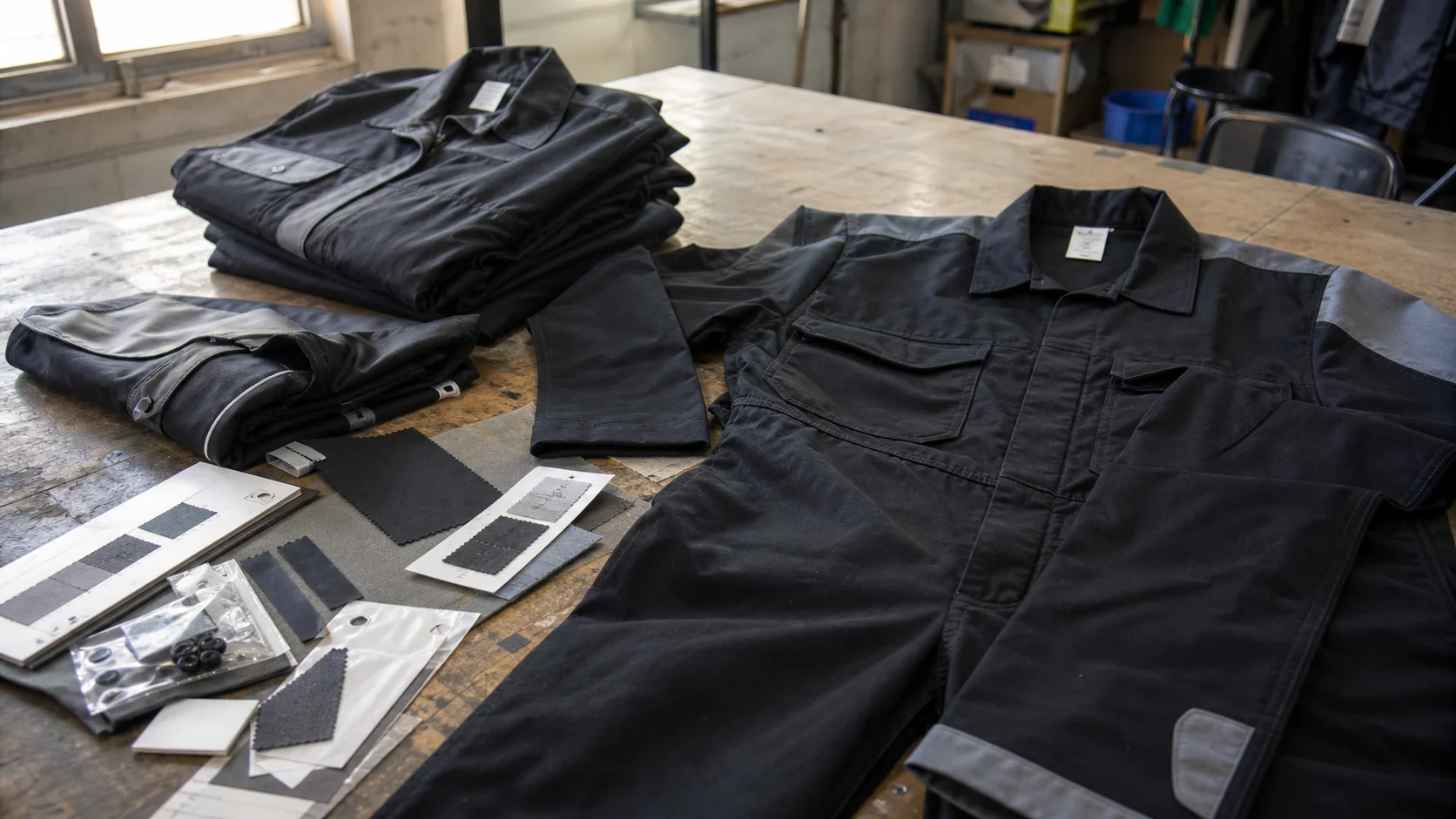
A quality and inspection-focused review of how coverall prints hold up for event staffing teams, including abrasion tests, wash performance, placement...
Printed coveralls for event staffing live in a hard-use category. The garment has to carry branding, survive transport and repeat wear, stay readable under venue lighting, and still look presentable after long shifts, spills, and frequent laundering. A print that looks sharp in a mockup can fail quickly if the fabric, ink system, or heat-setting process is poorly matched to the base cloth. For sourcing teams, the question is not only whether the artwork looks good on day one. The real test is whether the print still holds up after the first few washes, a few packed events, and the rough handling that comes with fast-paced staffing operations.
This review looks at print durability from a procurement perspective. It focuses on the variables that matter to event staffing teams: fabric choice, print method, seam placement, size consistency, wash performance, and inspection risks. It also covers practical buying points such as typical MOQ ranges, sample approval steps, and lead-time dependencies. If you are comparing suppliers, the useful question is simple: which setup gives the best balance of visibility, durability, and cost without creating avoidable rework?
Printed Coveralls for Event Staffing: Durability Review - Quality & Inspection manufacturing guide
Event staffing coveralls are usually worn in public-facing environments. That means the print is doing more than carrying a logo. It identifies roles, supports brand consistency, and helps teams look organized in front of attendees, sponsors, and venue operators. A cracked logo or faded chest print undermines that function quickly, especially when the same coveralls rotate across multiple events.
Durability matters because event garments are often exposed to a mixed workload. They may be worn indoors under lights, packed into transport bins, cleaned on short cycles, and reused with limited downtime. The print must tolerate repeated flexing at the shoulders, chest, knees, and elbows. Areas with frequent fold lines are where ink fatigue and film lifting tend to show first.
There is also a commercial reason to be strict about print durability. Replacing damaged garments is rarely just a cost of one unit. It creates reordering friction, SKU inconsistency, and visual inconsistency across a team. If one batch looks darker, shinier, or more faded than another, the entire program can look poorly managed.
For event staffing, print durability is not an embellishment issue. It is a uniform reliability issue.
A useful supplier review starts with the right questions. “Can you print this?” is too broad. A better brief should address substrate, decoration method, wash standard, and production control. Suppliers that answer clearly usually understand the difference between sample success and production stability.
Typical MOQ ranges vary by supplier and print method. For basic screen-printed coveralls, a common starting point is 100 to 300 pieces per colorway and artwork version. For more complex builds using specialized heat-transfer graphics or custom-dyed fabric, the minimum can move higher. Small runs are possible, but unit cost usually rises fast when the order requires multiple print positions, multiple sizes, or custom labels.
If you are early in development, ask for a quotation that separates garment cost, decoration cost, packaging cost, and freight assumptions. That separation makes tradeoffs visible. A low unit garment price can be misleading if the print method adds high setup charges or if the supplier is using a weak transfer that fails after repeated laundering.
For broader sourcing support, teams can review the supplier’s production and customization scope through services or use contact us to request a production discussion. Background on company capabilities belongs on an about us page, but procurement teams should still verify the exact process by sample and document review.
The best print method depends on artwork complexity, fabric type, and how hard the garment will be used. There is no universal winner. Event staffing coveralls often need a practical balance between durability, flexibility, and cost.
Screen printing is the most common choice for simple logos, text, and block graphics. It works well when the design has limited colors and the print area is large enough to keep edges clean. On cotton-rich or blended fabrics, a well-cured plastisol or water-based print can hold up well through repeated washes.
Its strengths are opacity, cost efficiency at volume, and good color visibility. Its risks are hand feel, cracking if overbuilt on stretch areas, and inconsistent results if cure temperature or flash time is poorly controlled. On heavier coveralls, screen print tends to be durable when the supplier uses the correct mesh, ink deposit, and cure profile.
Heat transfers are useful for multi-color logos, smaller orders, and detailed artwork that would be expensive to screen print. Modern transfer systems can perform well if the adhesive, film, and press settings are properly matched to the textile. The surface often looks clean and sharp, which helps event teams that need high visual impact.
The tradeoff is that transfer durability depends heavily on application quality. Poor pressure, inadequate dwell time, or incompatible fabric coatings can lead to edge lifting, peeling, or glossy wear patterns. Transfers can also feel less integrated with the garment than a properly cured direct print.
Embroidery is not a print method, but it often appears in the same sourcing conversation. For event staffing coveralls, embroidery is best reserved for small chest marks, name zones, or premium roles. It is durable, but it is heavier, can reduce comfort in high-mobility areas, and is not ideal for large logos where flexibility matters.
Some event staffing roles call for high-visibility marks or reflective strips near traffic, night setups, or outdoor staging. These features should be treated as functional components, not decoration. Their durability depends on stitch quality, tape adhesion, and how the trims react to laundering. If the garment includes reflective details, ask whether those components are tested separately from the logo print.
Method Best Use Durability Outlook Main Risk Screen printing Simple logos, bold text, larger runs Strong when properly cured Cracking or fading if cure is weak Heat transfer Detailed art, smaller orders, multicolor marks Moderate to strong with good process control Edge lift or peeling from poor application Embroidery Small premium marks Very strong Stiffness and comfort tradeoff Reflective trim/marking Visibility-driven roles Depends on tape and stitching quality Delamination or fraying at edgesPrint durability cannot be separated from the garment body. The wrong fabric can make a good print fail early. Event staffing coveralls are often made from cotton, polyester-cotton blends, or heavier workwear blends. Each one behaves differently under ink and wash stress.
Cotton fabrics generally accept many ink systems well, especially screen prints. They can give good print feel and solid wash performance, but they may shrink more than blends if the fabric is not properly pre-shrunk or controlled after laundering. Polyester-cotton blends usually offer better dimensional stability and faster drying, which is valuable for event teams with quick turnaround between shifts.
Pure polyester introduces another set of concerns. Some inks and transfer adhesives perform better than others on polyester, and migration or dye-sublimation issues can appear if the base fabric is dark and not properly controlled. If the coverall is intended for repeated wash cycles, the supplier should confirm print compatibility rather than assume it.
For event use, a midweight fabric is often the most practical range. Extremely light fabric can look clean but may wear faster at pressure points and accept damage from repeated packing. Very heavy fabric may be durable, yet it can feel bulky and reduce comfort during long shifts. A typical workwear weight often sits in the midrange where durability and mobility are both acceptable.
Print failures are sometimes blamed on ink when the actual problem is garment stress. Zippers, pocket corners, crotch seams, and knee articulation points all influence wear performance. If the garment pulls tightly across a printed chest or back panel, the print may fail before the fabric does. Strong stitching and correct seam allowance matter as much as the decoration method.
Trim details also matter. Cheap zippers, weak snap closures, and loose bar-tacks can shorten the life of a coverall long before the print itself is exhausted. A sourcing team should treat these as durability components, not cosmetic extras. If the event team is using the same garment across multiple programs, upgrade trims where the price delta is manageable.
Ask the supplier which ink system or adhesive family is being used and how it reacts with the selected fabric. Water-based and plastisol systems behave differently. Transfer systems vary widely in softness, adhesion, and wash tolerance. A print that looks acceptable on the press can still fail after laundering if it was not matched to the textile finish, coating, or weave.
A disciplined sample process is the best defense against print failure. Event staffing orders often move quickly, but skipping approval steps is expensive. A sample should verify both look and performance.
A practical workflow usually includes the following stages:
The most common mistake is approving a sample that was made with a different print setup than the bulk order. A digitally printed mockup or an oversized presentation sample may look convincing while hiding problems that only appear in real production. Ask whether the sample uses the same ink, same fabric lot, and same curing conditions as the bulk run.
Lead time also depends on the approval stage. A standard production timeline can be disrupted by artwork changes, color matching revisions, missing labels, or fabric stock issues. For many event staffing orders, a realistic window can range from 3 to 8 weeks after all approvals are locked, with longer timelines if custom materials are involved. Rush orders are possible, but they carry a higher risk of compromise in print quality or packaging accuracy.
Supplier reviews become useful when they identify likely failure modes before production starts. The main risks are usually predictable.
Cracking often appears when the print layer is too thick, too rigid, or applied to a moving fabric zone without enough stretch tolerance. Chest and back logos may survive while sleeve or knee graphics fail earlier. If the design must cross a seam or sit near a bend point, the supplier should explain how they will reduce stress on the print film.
Fading can result from weak ink penetration, low cure temperature, unsuitable detergent exposure, or poor fabric preparation. A print that loses brightness after only a few washes is usually a process problem, not just normal wear. Event teams should ask for a reference wash standard or an internal wash test report if the supplier has one.
Edge lift is common in transfers that were not pressed correctly or on fabrics with finish agents that interfere with bonding. The first sign is usually a corner that begins to lift after flexing. Once that starts, the failure tends to progress. This is why transfer samples should be bent, washed, and visually inspected before bulk approval.
Large logos on coveralls can appear misplaced if the garment panels shift during print placement. This issue is more visible on asymmetrical layouts or multi-position branding. A 5 mm to 10 mm offset can be acceptable in some programs, but only if the team has agreed on a tolerance before production begins. Without that agreement, disputes become subjective.
Color drift is often overlooked until the second replenishment order. Ink mixing, fabric dye variation, and curing differences can all create visible mismatch. For recurring event programs, request a retention standard or saved color target so future batches can be matched more consistently.
Bulk inspection should be practical and targeted. Event staffing buyers do not need an industrial audit framework for every order, but they do need a plan that catches the defects most likely to affect appearance and use.
An efficient incoming inspection usually checks:
For larger orders, a simple AQL-based inspection approach is usually more useful than a subjective spot check. Even if the buyer does not run a full third-party inspection, the receiving team should document defect types separately. A mix of one or two print defects, a zipper issue, and a size variance issue suggests process instability rather than isolated damage.
If the program is mission-critical, ask whether the supplier can support an inline check before packing. That is especially useful when the artwork is large or the coverall has multiple print placements. Repairs after packing are slow and often produce inconsistent aesthetics.
The best printed coverall is not necessarily the most complex one. Event staffing teams usually benefit from a garment that is easy to reorder, easy to size, and easy to keep visually consistent. Heavy decoration can look attractive on a sample and still be the wrong choice if it increases failure risk or makes repeat orders unstable.
A practical sourcing judgment is to favor the simplest construction that satisfies visibility and brand needs. If the logo can be handled with one strong chest print and one back print, that is often more reliable than stacking multiple specialty effects. If the role needs quick identification at distance, choose a print method that gives high contrast and consistent opacity rather than chasing unusual textures.
Cost should be evaluated across the lifecycle, not just the unit quote. A slightly more expensive garment with stable print performance can be cheaper than a low-cost alternative that fails after a short service life. Replacement cost, staffing disruption, and visual inconsistency all belong in the comparison.
For teams building a repeatable uniform program, it helps to standardize the core spec: fabric composition, print size, placement, trim quality, and packaging format. Standardization makes future orders easier to manage and reduces the chance that a different buyer will unknowingly change a critical detail.
If the event staffing operation is growing, the procurement model should grow with it. Small ad hoc orders can survive on manual approvals and informal testing. Once the uniform program becomes recurring, the process should tighten.
It is worth escalating to a more structured program when any of the following apply:
At that point, the supplier should be able to hold a master sample, maintain an artwork file, and keep key materials consistent where possible. That reduces variation and helps purchasing avoid requalifying the same item every cycle. Teams can also use the supplier relationship pages on services and contact us to coordinate updates when the line expands. A reliable long-term program usually depends more on process control than on a single lucky sample.
Get a free quote from Fabrikn — your trusted B2B clothing manufacturer with 10+ years of experience. MOQ as low as 200 pieces.
Get a Free Quote →Screen printing is often the most durable for simple logos when the fabric and curing process are correct. Heat transfers can also perform well, especially for complex artwork, but they depend more heavily on application quality. The best choice depends on artwork complexity, fabric composition, and expected wash frequency.
Many suppliers start around 100 to 300 pieces per colorway or artwork version for standard printed coveralls. MOQ can increase if the order needs custom fabric, multiple print placements, specialty trims, or complex branding. Smaller runs are possible, but pricing usually rises.
Approve a sample only after checking print placement, color, garment fit, stitch quality, and wash tolerance. The safest approach is to use a pre-production sample made with the same fabric, print method, and curing conditions planned for bulk production. A mockup alone is not enough.
The most common early failures are edge lift, cracking at fold points, fading after wash, and registration drift. These issues usually point to process problems, not normal wear. A controlled sample test helps catch them before production.
Service life depends on fabric weight, print method, laundering frequency, and the physical demands of the job. A well-made garment can survive repeated event cycles, but the exact lifespan varies too much to promise a fixed number without knowing the spec. Teams should evaluate durability through sample testing and pilot use.
Include fabric composition, GSM or fabric weight, print method, print dimensions, placement, color references, trim details, sizing range, packaging requirements, and inspection tolerances. A better spec sheet reduces rework and limits interpretation errors during production.
Yes, if the supplier retains the artwork files and the production settings are documented well. Reorders are easier when the original sample approval, print dimensions, and color references are stored as a master standard. Reconfirming the details before each reorder is still a good practice.
Printed coveralls for event staffing work best when durability is treated as a sourcing requirement, not a styling preference. The garment should remain legible, wearable, and consistent across repeated use. That outcome depends on the combined quality of the base fabric, the print process, and the supplier’s control over approval and production. If those elements are managed carefully, the result is a uniform that holds up in the field and stays presentable long enough to justify the buy.