
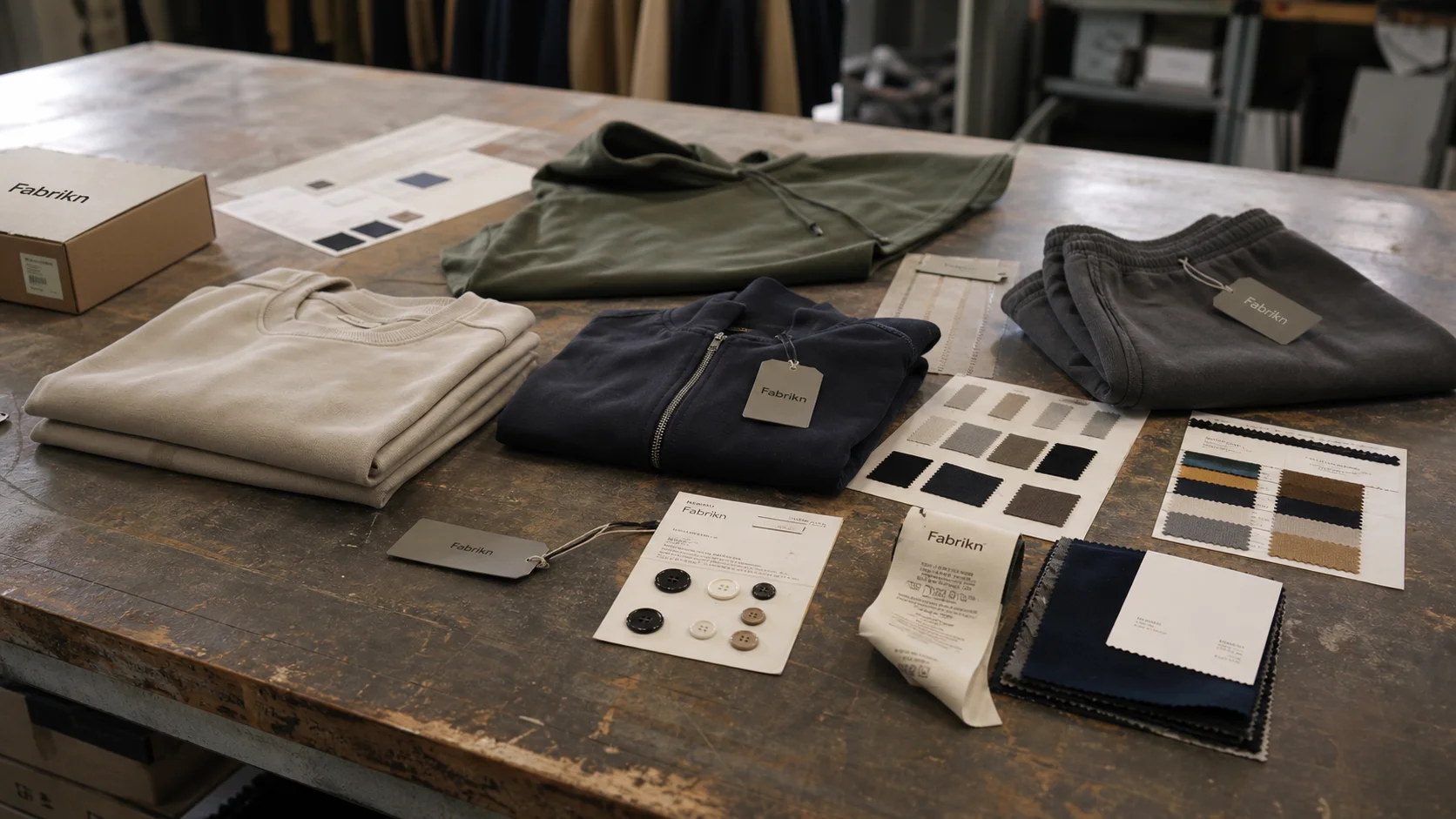
Private Label Insert Cards with checks for samples, fit, MOQ, QC evidence, pricing terms, and delivery risk.
Fast answer: Private Label Insert Cards: Message, Size, Paper, and Packing Flow should be judged by production evidence, not by a generic sourcing promise. The buyer needs sample proof, cost breakdowns, QC checkpoints, and delivery buffers in writing.
Ask for recent sample photos, measurement tolerances, fabric or print test assumptions, decoration test notes, packing examples, and a named inspection checkpoint. These details show whether the team can repeat an approved sample at bulk volume.
Separate garment cost, decoration, labels, packaging, sampling, testing, freight, and rush charges. When every cost line is visible, it becomes easier to reduce colorways, adjust size depth, or reserve more time for sampling.
A good insert card can make a $24 T-shirt feel like a considered purchase instead of an afterthought. With private label apparel packaging insert cards, that first touch matters because packaging often shapes the decision before the buyer ever checks the seams. Retail packaging studies routinely show that more than 60% of shoppers say packaging influences purchase decisions, and apparel is even more sensitive because the garment is usually the first thing they touch and the last thing they remember.
I have seen private label apparel packaging insert cards separate premium and budget programs at the same FOB price, with no change to fabric, stitch count, or carton count. In Guangzhou, Tiruppur, Izmir, and Dhaka, the contrast was impossible to miss. Two brands could be paying $3.10 FOB for a knit top and still tell very different stories at checkout.
One had a heavy 350 GSM fold card, clean Pantone-matched ink pumped through Heidelberg Speedmaster presses, and a scannable QR code that led to care instructions and the return policy. The other shipped a flimsy 200 GSM slip with blurry type printed on an aging six-color press in Ho Chi Minh City. Same garment. Different perception.
Shoppers notice three things fast: whether the insert looks intentional, whether it gives clear care instructions after the hang tag is gone, and whether it signals authenticity with a lot number, size guide, or QR code that resolves in under three seconds. Hang tags help on the floor. Insert cards keep working inside the parcel, where the unboxing decision is made.
The business case is not abstract. A card that costs $0.07 to $0.18 at 5,000 pieces can lift perceived value on an $18-$60 item and reduce post-purchase confusion. I have seen brands use a simple return-code QR on private label apparel packaging insert cards to cut “how do I wash this?” tickets by 12%-18% over 90 days. Returns also drop when buyers can verify sizing and care before the first wash. For private label clothing, that matters because the retailer owns the relationship, not the mill.
Across eight countries, one thing kept showing up: the insert card often did more brand work than the fabric label. A great garment can still feel generic if the parcel opens to silence. A modest garment can feel worth more if the card is clean, legible, and exact.
Private label apparel packaging insert cards have six jobs, and they are not decorative. They brand the product, carry compliance text, explain care, push the next purchase, support anti-counterfeit efforts, and direct the customer to digital content. In contract manufacturing, the card is often the only branded surface the retailer fully controls after production ends.
Private label brands use them differently from label-owned brands because the merchant owns the customer relationship. That means the card may carry a thank-you note, a QR code, a reorder prompt, or a registry link. It may also include fiber content, country of origin, wash symbols, RN or VAT references, and multilingual instructions. In a parcel, that is not extra. It is the operating manual.
I see five common formats in the factories I visit: folded inserts, flat cards, thank-you cards, care cards, size-assist cards, and loyalty prompts. Basics brands often use a single-sided 250 GSM card. Intimates programs lean toward smaller, discreet cards with fabric content and hygiene notes. Activewear adds stretch recovery guidance. Luxury uses thicker stock and fewer words. Children’s apparel often needs two languages and more explicit safety copy. Replenishment items, such as socks or underwear, often carry a reorder code that pushes repeat purchase within 30 days.
There is a design logic here. A $9.90 tee does not need the same card architecture as a $120 cashmere blend. In clothing packaging solutions, the smartest brands match the card to the category, not to ego. I have seen one-line care cards outperform elaborate storytelling cards on low-priced basics simply because buyers want clean instructions, not a manifesto.
For private label apparel packaging insert cards, the strongest versions do one thing especially well: they make the product feel finished. That finish can be practical, emotional, or compliance-led. The best cards do all three without looking busy.
Material choice changes everything for private label apparel packaging insert cards. FSC-certified paper, recycled board, virgin paper, coated stock, and specialty papers each land differently on cost, print fidelity, and disposal. FSC or recycled board usually sits in the 180-350 GSM range for small inserts, while premium folding cards often move up to 400 GSM. The jump from 250 GSM to 350 GSM can add only a few cents, but it changes stiffness, hand-feel, and the way the card sits against folded apparel. Bamboo-fiber board with GRS-certified recycled content works well for brands promoting closed-loop stories.
Coated stock prints sharper. Recycled board feels more honest. Virgin paper is often the easiest route to consistent color, especially for small type and QR codes. The trade-off is obvious in the bin. Foil, lamination, soft-touch coating, embossing, and spot UV all improve shelf appeal, yet they complicate recyclability and can make waste streams harder to sort. A soft-touch card may be beautiful; it is also more likely to be rejected by a recycling mill than an uncoated matte sheet.
According to OEKO-TEX Standard 100, material safety and restricted-substance control are no longer niche concerns in apparel supply chains. In my audits, the more disciplined factories treat paper the same way they treat fabric trims: they track ink, coating, glue, and folding accuracy. That matters because a low-grade adhesive can turn a premium card into waste before it reaches the packer; I recommend solvent-free adhesives that already align with GOTS and WRAP guidelines.
Some lower-cost plants produce cleaner registration than pricier suppliers because their press calibration and QC routine are tighter. I have seen a $0.11 card from a mid-tier print house arrive with fewer rejects than a $0.19 card from a glossy showroom supplier. The price tag did not predict quality. Discipline did. Suppliers that run Komori Lithrone or Heidelberg Speedmaster presses with inline die cutting, UV curing, and automatic stacking deliver more repeatable results than offset shops without SPC dashboards.
Sustainability is easier when the spec is lighter. A 220 GSM insert at 10,000 units uses roughly 22 kilograms of paper; a 350 GSM version uses about 35 kilograms. That 13-kilogram difference is not trivial when you multiply it across seasons. For most brands, the lightest viable construction is the responsible choice, especially if the card still carries a sharp QR code and clear care text. A bigger card does not make a better brand. It often makes more waste.
For brands that work with a manufacturer on cut and sew programs, the best results happen when the paper spec mirrors the garment spec. A heavyweight French terry hoodie can support a sturdier insert. A $14 basic tee usually cannot justify luxury finishes. Sourcing specs that reference GRS, OEKO-TEX Standard 100, and BSCI compliance help the packaging team stay synchronized with the fabric mill.
When sustainability is part of the buying brief, it is also worth reviewing recognized standards such as Textile Exchange and current sourcing guidance from Trade.gov. Those references help teams align paper choices, production claims, and supplier documentation.
The biggest cost lever is not design; it is execution. For a 500 MOQ with two-color offset, suppliers in Guangzhou and Istanbul quote $2.50-4.00 per unit when the spec includes 300 GSM recycled kraft board, 2400 DPI imagery, and clear varnish front/back. A similar spec in Dhaka using flexo printing can drop to $1.90-2.60, but the brands there must invest in tighter QC to hit barcode tolerances. Ho Chi Minh City suppliers with in-house die cutting and lamination typically stick around $3.10-3.80 at the same MOQ, primarily due to higher labor costs and imported adhesives.
When you bump MOQ to 2,500 or 5,000 units, unit cost falls roughly $0.05-0.12 per card, depending on the finishing. Spot UV, cold foil, and embossing add $0.12-0.25 per card because each pass demands a separate plate and set-up on machines like the Bobst SP 102 E. Die-cutting for intricate shapes or fold lines tacks on another $0.06-0.15, and assembly for double-sided folding cards with interior pockets can increase lead times by 2-3 business days.
Lead times cluster between 18-22 business days for complete packages with proofs, multiples of coatings, and compliance inserts. Fast-follow programs that run 250 GSM single-sided cards without varnish sometimes hit 12-14 business days, but you lose time when approving corrections that require new print plates. Shipping from Guangzhou or Istanbul via air freight to the U.S. adds roughly five days, while sea freight requires 18-22 business days once the containers hit the port.
Don’t forget amortized tooling. A custom-fitted pocket, shaped edge, or embossed logo often uses a steel rule die costing $250-650. That expense spreads across the MOQ, so the effective per-unit cost drops significantly only after you run 5,000 pieces or more. For seasonal drop runs, consider keeping dies and plate files on the supplier’s server to avoid repeat set-up fees.
Start with the garment brief. Match the card board weight to the fabric hand—lightweight viscose gets 250 GSM uncoated matte, midweight knits sit well with 320 GSM recycled board, and heavyweight wool or cashmere supports 380-420 GSM linen stock with soft-touch lamination. Call out fiber content explicitly (e.g., “85% recycled post-consumer cotton, 15% GRS-certified binder”) so both the designer and the print house know the compliance story.
Specify the process steps: “four-color offset, UV curing, foil stamping, die cutting, and flat folding.” Annotate finishing using industry language like “cold foil, emboss, and kiss-cut for fold lines,” then assign tolerances (±0.5 mm). List adhesives, such as “solvent-free PVA by Henkel with 18-20 seconds tack time,” and note drop-shadow or QR placement referencing a Pantone bridge book. Include a BOM table: paper type, GSM, coatings, adhesives, packing method, and ink set (e.g., “Pantone 5463 C, 120% ink limit, 220 LPI screen”).
Certification requirements must appear in the spec. Ask for factory compliance to GOTS for any cotton-based cards, OEKO-TEX Standard 100 for dyes, WRAP and BSCI for social responsibility, and GRS for recycled content. That ensures the card production mirrors the apparel’s green credentials. Embed sample language like “Supplier must provide OEKO-TEX Standard 100 certificate for inks and varnishes used on this job” to avoid surprises during audits.
Finally, define inspection criteria: “Inspect 20% of cards per batch with digital calipers, check QR readability via smartphone app (≤3 seconds to resolve), and sample 1% for adhesive strength (peel test 90°).” Include shipping instructions (e.g., “Pack in kraft layers of 500 cards separated by glassine; ship flat pallets from Guangzhou through Yantian port to Los Angeles or from Istanbul via Fos to Hamburg”) to align the packaging vendor with your logistics team.
LOCATION: Guangzhou, China – Large offset houses with Heidelberg Speedmaster CX 104 machines handle high volumes. Certifications: WRAP, BSCI, OEKO-TEX Standard 100, and GOTS for cotton-laminated boards. Lead time: 18-22 business days. MOQ: 1,000+ favoured, but select shops quote $2.50-3.60 per unit at 500 pieces when the spec demands 320 GSM recycled board, matte varnish, and QR/lot numbering. Processes: four-color offset, UV curing, inline die cutting, automated stacking, and carton packing. Supply chain: quick access to Dongguan paper mills for FSC and GRS-certified sheets, and bonded warehouses keep adhesives and coatings on standby.
LOCATION: Dhaka, Bangladesh – Smaller runs leverage Komori Lithrone presses and local skilled operators. Certifications: GOTS, GRS, BSCI. Lead time: 19-22 business days, often synchronized with garment shipments via Chittagong. Cost: $1.90-2.60 per card at 500 MOQ for simple specs (250 GSM, single color, no lamination); high-definition two-color prints push toward $3.10. Processes include flexo printing for bulk work, die cutting on Mitsubishi machines, and manual finishing for niche specs. Need mindful QC because humidity swings can skew registration.
LOCATION: Ho Chi Minh City, Vietnam – Mid-tier houses do hybrid presses (digital + offset) and handle complex embellishments. Certifications: BSCI, WRAP, and OEKO-TEX Standard 100. Lead time: 18-20 business days for standard jobs, 14-16 for quick-turn, limited to 5,000 units. Costs: $3.10-3.80 per card at 500 MOQ when including silicone-coated release liners or foil stamping. Processes include digital proofing, cold foil, magnetic closure tests for fold cards, and in-line packaging to prep cartons for air freight out of Tan Son Nhat.
LOCATION: Istanbul, Turkey – European-style houses focus on luxury kits with embossing, soft-touch coatings, and multilingual copy. Certifications: BSCI, OEKO-TEX Standard 100, WRAP. Lead time: 18-21 business days, sometimes extended to 23 with customs checks for specialty materials. Costs: $3.40-4.00 per unit at 500 MOQ for 380 GSM coated board plus foil. Production steps often include Bobst SP 104 die cutting, lacquer, hand assembly for folding, and pallet loading for transit to EU hubs.
1. Start with a spec matrix. List material (e.g., 320 GSM recycled kraft with GRS certificate), process (four-color offset, UV varnish, die cut), certifications (GOTS, OEKO-TEX Standard 100, WRAP, BSCI), and desired lead time (18-22 business days).
2. Source vendor samples tied to the spec. Approve at least three proof rounds, including at least one in-hand sample printed on the exact stock and coated the same way your production run will be. Include adhesives (solvent-free PVA with a minimum peel strength ≥2.2 lb/inch) and confirm QR code scanning at 0.5m.
3. Build in QA checkpoints. Require a print report from the supplier showing Pantone matches within ΔE ≤ 1.5, registration marks checked before lamination, and humidity readings within 45%-55% RH. Perform inline inspections of 1% of the run with portable densitometers and optical brightener readers.
4. Align packaging with fulfillment. Choose shipping pallets that match your garment cartons, and require that insert cards be packed flat, sealed with stretch wrap, and labeled with DSCSA-compliant labels for traceability. Keep die files on the supplier server for rapid reorder, but confirm retention periods (typically 12-18 months).
5. Document cost impact. Track the perceived value lift per SKU. A $0.15 incremental card that reduces returns by 12% and increases repeat rate by 6% often covers its own cost in 4-6 weeks of sales. Use these numbers in margin reviews and to justify premium specs for higher ticket items.
Q: What minimum certifications do I need on private label insert cards? A: Look for suppliers that maintain WRAP or BSCI social compliance, alongside OEKO-TEX Standard 100 for inks and coatings and GRS for recycled content. GOTS is also critical if the paper contains certified cotton fibers or if the card supports organic apparel claims.
Q: How soon can I expect a prototype? A: Most facilities in Guangzhou, Ho Chi Minh City, or Istanbul can deliver a PDF proof within 48 hours and a physical prototype in 5-7 business days if they already stock the specified board. Budget at least 18-22 business days for the first production run to allow for proofs, die setup, print, finishing, and QA.
Q: What machines should my supplier be using? A: Target vendors that run modern equipment like Heidelberg Speedmaster CX 104 or Komori Lithrone sheets for consistent color, Bobst SP die cutters for precision cuts, and inline UV varnish or cold foil units for special finishes. Digital presses like HP Indigo can supplement short runs but demand check proofs to ensure Pantone accuracy.
Q: How do I keep costs under control? A: Match card weight to garment perceived value, run at least 2-5 SKUs per print plate, amortize tooling, and lock in adhesives that are compliant yet cost-effective. Maintain MOQ discipline; the $2.50-4.00 per unit price point only holds at 500 MOQ when the spec is strictly followed. Bigger runs (2,500+) can reduce cost by 10%-15%.
Q: What documentation should I receive? A: Require Certificates of Conformance for materials (GOTS, OEKO-TEX Standard 100, GRS), WRAP/BSCI audit reports for the factory, color swatches, die sketches, and an inspection report with measurements, adhesive tests, and QR scans. That paperwork keeps your quality team aligned and saves time during brand audits.