
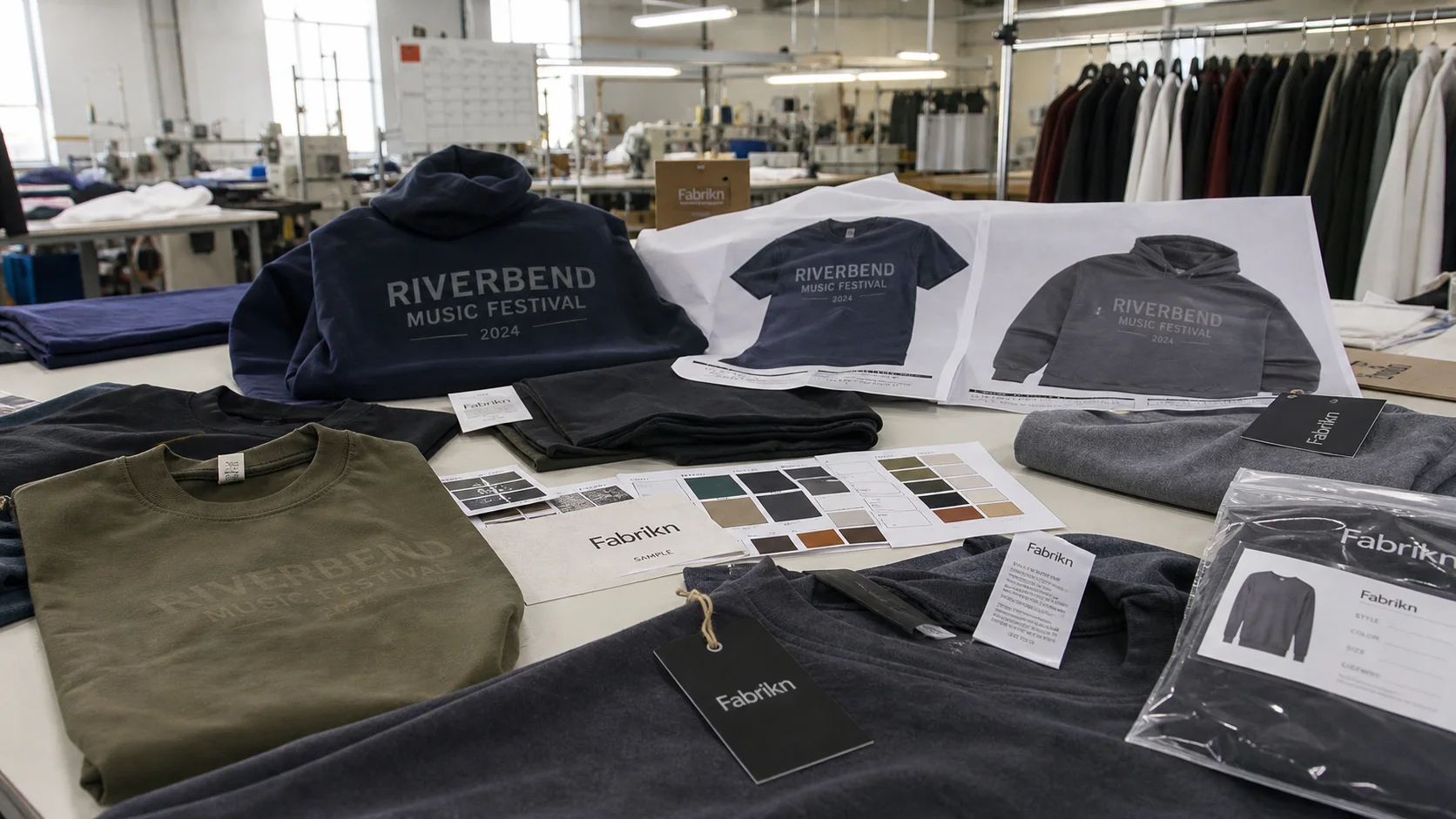
Private Label Apparel Packaging Supplier with checks for samples, fit, MOQ, QC evidence, pricing terms, and delivery risk.
Fast answer: Private Label Apparel Packaging Supplier: Cost Lines, Samples, and Risk should be judged by production evidence, not by a generic sourcing promise. The buyer needs sample proof, cost breakdowns, QC checkpoints, and delivery buffers in writing.
Ask for recent sample photos, measurement tolerances, fabric or print test assumptions, decoration test notes, packing examples, and a named inspection checkpoint. These details show whether the team can repeat an approved sample at bulk volume.
Separate garment cost, decoration, labels, packaging, sampling, testing, freight, and rush charges. When every cost line is visible, it becomes easier to reduce colorways, adjust size depth, or reserve more time for sampling.
The cheapest quote is often the most expensive mistake in disguise. If you are sourcing from a private label apparel packaging supplier china team, that is the first thing to remember: the number on the spreadsheet is never the number that lands at your door. Packaging can add 3% to 12% to landed apparel cost, and that swing usually has less to do with “China” than with format, MOQ, and the buyer’s approval habits. I’ve seen a $0.18 poly mailer turn into a $0.41 landed line item once the plate fee, inner carton spec, and inland trucking were added. Clean quote. Messy invoice.
In Ningbo, Dongguan, and Foshan, the split shows up quickly. Coastal export plants usually run tighter print calibration, faster prepress checks, and cleaner label traceability. Inland shops often have lower labor rates, sometimes by 18% to 25%, but they pay for it in longer sampling cycles and more handwork at the packing table. That is why the same manufacturer can look cheap on paper and expensive in practice.
A factory quote can hide three separate cost layers: unit price, setup cost, and logistics. Two suppliers may both offer foldable cartons at $0.32 a piece on paper, yet one adds a $120 die fee, a $65 plate charge, and a heavier outer carton that pushes freight up by 9%. The other bundles tooling but saves on shipping because the cartons nest better. Compare only the first number, and you are comparing fiction.
Cheap suppliers can be expensive in quieter ways. I have watched brands lose two weeks to rework because a barcode sat 4 mm off center, a tissue paper color drifted from ivory to cream, or a hang tag hole punch split under pressure. A cheap quote with a 7-day lead time can become a 21-day delay once revisions begin. Not abstract. That delay pushes photo shoots, fulfillment booking, and retail launch dates.
Export-ready suppliers beat traders for one simple reason: they control process, not just price. Better plants keep written QC standards, batch codes, and Pantone libraries. They know how to stack a mixed SKU shipment for DDP or FOB terms, and they can explain board thickness in gsm instead of waving at a sample. If your brand cares about packaging and not just packaging cost, this matters. It protects margin without dulling presentation, which is the real job of a clothing packaging solutions partner.
Polybags, mailer bags, hang tags, tissue paper, garment boxes, belly bands, stickers, FSC cartons — those are the core categories. The mix changes fast once a factory starts assembling real orders. An e-commerce brand selling basics at $18 to $35 retail usually needs leaner formats, while a boutique label at $90+ retail often wants heavier paper, soft-touch coating, and tighter color control.
Private label customization lives in the details buyers overlook. Logo placement can move 3 to 5 mm and still ruin shelf appeal. Paper weight can shift from 250 gsm to 400 gsm depending on box structure. Foil stamping, embossing, recycled content, matte lamination, and barcode systems all change cost and compliance. A hang tag that looks simple may require 2 print passes and 1 die-cut tool. A mailer bag may need film thickness control at 50 to 70 microns.
Private label, OEM, and ODM sound similar until you place a real order. Private label usually means the supplier prints or builds your brand assets onto an existing format. OEM often means you provide a spec and they manufacture to it. ODM means the supplier offers a developed structure, and you adapt it. Many buyers assume every supplier makes every item. They do not. I have seen catalogs listing rigid boxes, sewn garment labels, and molded paper inserts from the same company, yet the factory only made cartons and outsourced the rest.
That gap matters because region and price point dictate supplier type. Mass-market basics often source from high-volume packaging plants near Shenzhen or Dongguan, where a 10,000-piece run can move fast and cheaply. Premium brands lean toward factories that can handle color control, board calibration, and specialty finishing in-house. The production setup shapes the brand signal. A $2.50 tee does not need the same unboxing as a $150 merino sweater, and pretending otherwise burns money.
For brands building from scratch, packaging should align with the garment program. If your knitwear line already uses private label clothing, the packaging should echo fiber story, seasonality, and return behavior. Otherwise, the carton becomes an afterthought, which is how brands end up paying for excess print and unnecessary inserts.
Before sampling, I ask for six documents: business license, export records, FSC or recycled claims, ISO certificates, QC process documents, and compliance test reports. The paperwork should match the product. If a supplier claims recycled paper but cannot produce chain-of-custody evidence, I treat that as a warning. According to ISO, documented process control is the basis for repeatability, and packaging suppliers that ignore that tend to drift on color, strength, or both.
Check whether you are dealing with a supplier, a trader, or a hybrid operation. A supplier with real production can show press lines, creasing equipment, lamination machines, and QC stations. A trader usually shows samples and a sales office. A hybrid sits in between, with some production in-house and some outsourced. None of those models is automatically bad. Mismatch is the problem. A buyer who needs 5,000 identical cartons with a 4-color print cannot afford a supplier who farms out each stage to three subcontractors.
Across 200+ factory visits, I kept seeing the same red flags. Paper gsm varied by 10 to 25 gsm between sample lots. Mockups were recycled from previous client jobs, with logo shadows still visible under the new art. There was no color-management system, only “close enough” checks under mixed light. Lead times were vague, like “two or three weeks,” which usually means the schedule is not controlled. Ink and adhesive traceability was weak, so when a carton failed in transit, nobody could isolate why.
Here is the audit checklist I use on site. Check print accuracy at 1 mm tolerance. Measure die-cut precision on both folds and lock tabs. Test glue strength by holding the box loaded for 30 minutes. Do a carton compression check for outer shippers, especially if the brand ships from a humid port. I also ask for batch photos, not just final sample photos, because batch photos show whether the plant is repeating the same standard or hiding variation.
Higher-priced plants can still fail if they lack discipline. I once reviewed a premium supplier quoting 18% more than the market, yet its color drift on navy cartons was worse than a mid-priced facility in Zhejiang. The reverse happens too. A moderate-price manufacturer with strong process control can outperform flashy competitors by keeping waste under 2%. Price is a signal. It is not proof.
Material type drives most of the quote when you work with a private label apparel packaging supplier china partner. Paper bags often land around $0.12 to $0.55 per piece, depending on paper weight, handles, and print coverage. Poly mailers can sit at $0.04 to $0.22, with recycled film usually costing more than virgin film. Folded cartons commonly run $0.18 to $0.80. Rigid boxes jump to $1.10 to $4.50, and hang tags may range from $0.03 to $0.16 when printed in volume.
The unit price is never the full story. Plate fees often start around $35 to $120 per color, and tooling can add another $60 to $250 if the structure needs custom cutting. Sampling may cost $25 to $90 per version, while specialty finishing such as foil, embossing, spot UV, or soft-touch coating pushes the line higher. Outer-carton specifications matter too. A thicker export carton can add 8% to 14% to shipping weight even before products leave the dock.
MOQ changes the economics fast. A 3,000-unit run can price very differently from 20,000 units, even at the same plant, because setup costs are spread across fewer pieces. On a carton project I reviewed last quarter, the per-unit cost fell from $0.74 at 3,000 pieces to $0.39 at 20,000 pieces. The buyer saved $7,000+ over the larger run, but only after confirming the inventory would sell within a season. For most brands, that is where wholesale planning and bulk buying decisions start to matter.
China still tends to win on tooling speed and print breadth. Vietnam can be attractive on certain labor-intensive formats, but many suppliers there quote longer sample windows and less finishing depth. India often offers competitive paper cost, particularly on kraft and simple tags, yet freight variability and color consistency can be less predictable. Domestic sourcing shortens transit and cuts communication lag, but the unit price is often 20% to 60% higher, especially on small MOQs. Trade data from the U.S. International Trade Administration shows how strongly packaging flows follow labor and freight economics, and OEKO-TEX Standard 100 remains a useful reference when you need better visibility into chemical safety on textile-adjacent materials.
The counterintuitive part is this. The cheapest quote often becomes the most expensive after reprints, color drift, and damaged transit cartons. I’ve seen a brand save $0.06 per mailer and then spend $480 on emergency air freight because the first shipment arrived crushed. That is why experienced buyers compare landed cost, not factory price. The useful comparison is not China versus another country in the abstract; it is which supplier can deliver a stable finished result within your margin. If you need support on the garment side too, cut and sew manufacturing coordination can simplify the whole chain.
A realistic timeline starts with brief, not production. I budget 2 to 4 days for artwork prep, 3 to 7 days for first samples, 7 to 21 days for revisions if Pantone matching or structural changes are involved, then 10 to 25 days for production on standard paper packaging. Inspection and packing can take 1 to 3 days, and shipping adds another 5 to 40 days depending on whether you choose air or sea.
Fast-turn items are printed mailers, stickers, and simple tissue. Slower items are rigid boxes, magnetic closures, and specialty finishes. A sticker order can often move in 5 to 8 days after approval. A rigid box with foil and insert may need 20 to 35 days, especially if the factory is also waiting on plated tooling. Lead time gets longer when buyers change structure after sampling. A board thickness change from 1.2 mm to 2.0 mm sounds small. It can force a new die.
Air freight works for launches under pressure. It costs more, often by 3x to 6x versus sea on the same carton weight, but it protects dates. Sea freight is cheaper and better for replenishment, though it can add 18 to 35 days port-to-port. For brands with narrow launch windows, I usually recommend air on the first 500 to 1,000 units and sea on the balance, provided the packaging is not too fragile. The best factories will tell you when transit humidity matters and when it does not.
Many buyers lose weeks by approving artwork before they confirm board thickness, closure style, or packaging regulations. I’ve watched teams sign off on a hang tag mockup and only later discover the barcode size failed retail scan tests. Fixing that late is expensive. It also creates friction between marketing and operations, which should have been solved in the spec sheet. Data from WTO helps explain why freight timing remains so influential on apparel import planning.
The right private label apparel packaging supplier china partner depends on product type, retail price, sustainability claims, and reorder frequency. A luxury basics brand selling $120 knitwear needs tighter finish control than a volume basics label selling $22 tees. If you reorder every 30 days, supplier responsiveness matters more than deep customization. If you reorder twice a year, tool durability and archive accuracy matter more. I use that split to narrow the field quickly.
One factory may be excellent for rigid folding boxes and poor for poly mailers. Another may excel at recycled paper sleeves but struggle with foil alignment. That is why buying “all packaging from one place” is often a false economy. I would rather split sourcing than force a supplier beyond its discipline. For a brand with mixed needs, packaging can be treated as a portfolio, not a single purchase order.
Communication speed is a serious test. Ask for a revised quote, a changed Pantone, and a corrected dieline. Time the response. If the factory needs 48 hours to answer basic revision questions, expect the same delay in production. Ask for defect data too. A good supplier should tell you its reject rate, even if it is 1.5% or 3%. If they cannot share that, they may not track it.
I like to compare vendors on five axes: cost, consistency, customization depth, compliance, and sustainability credentials. Some suppliers score high on recycled content but low on print precision. Others are cheap but cannot prove FSC sourcing. For a brand selling mid-market apparel, the best compromise may be a supplier with moderate pricing, documented QC, and a decent record on clothing packaging solutions. Clean records, stable sample repeatability, clear escalation path — those factories scale better than glossy sales decks suggest.
Build a 10-point brief before you ask for quotes. Include dimensions, artwork files, material target, finish, MOQ, color standards, packing method, destination port, deadline, and compliance needs. If you send only a logo and a vague idea, you will receive vague prices. If you send a tight brief, you can often cut quote time from 5 days to 24 hours.
Ask every supplier for three quote versions: economy, standard, and premium. That exposes where the real cost sits. Request a pre-production sample, a production sample, and photo or video QC evidence. I also recommend a supplier scorecard with five columns: price, lead time, defect handling, sustainability proof, and communication speed. Compare five vendors side by side and score them out of 10.
To lower first-order risk, start with one core SKU. Test the packaging fit on finished apparel, not on flat mock garments. Then scale to more SKUs only after you verify carton compression, print alignment, and shipping survivability. A small first order of 1,000 to 3,000 units can save a brand from a 20,000-piece mistake. If the supplier handles that pilot cleanly, expanding becomes a calculated move rather than a gamble. If you are ready to test the market, request a custom quote for apparel packaging and compare it against two backup suppliers.
For simple paper bags, I often see $0.12 to $0.55 per piece. Folded cartons commonly sit at $0.18 to $0.80, while rigid boxes can move above $1.10. The final number depends on MOQ, finishing, and whether tooling is included.
Standard packaging usually takes 10 to 25 days after sample approval, then shipping adds 5 to 40 days. Sampling can add another 7 to 21 days if color matching or structure changes are involved. Air freight shortens launch risk but raises cost sharply.
Ask for a business license, export records, and photos of machinery, QC stations, and raw material storage. A real factory can explain process steps, batch traceability, and lead times without changing the story. Traders usually sell from samples and outsource most production.
Yes, but small runs change pricing fast. At 3,000 units, setup cost is spread thinly, so the unit price is usually much higher than at 20,000 units. For first orders, ask for economy, standard, and premium quotes to see the breakpoints clearly.
Send dimensions, artwork files, material target, finish, MOQ, color standards, packing method, destination port, deadline, and compliance needs. That package usually cuts back-and-forth by several days and makes the quote far more accurate. Include one finished garment sample if fit matters.