
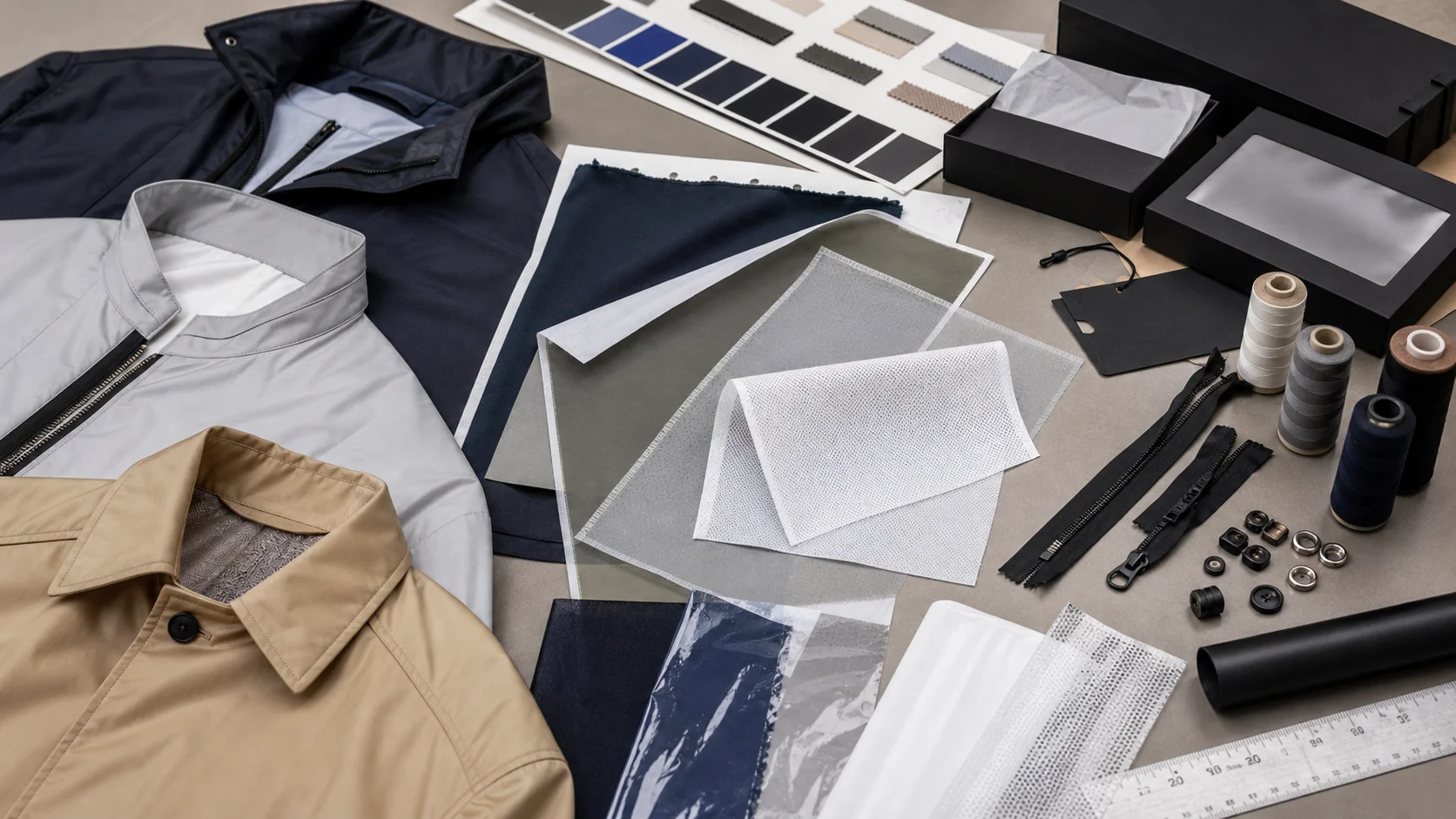
Private Label Clothing Minimum Order Quantity China with checks for samples, fit, MOQ, QC evidence, pricing terms, and delivery risk.
Fast answer: Private Label Clothing Minimum Order Quantity China: Text, Placement, Material, and MOQ should be judged by production evidence, not by a generic sourcing promise. The buyer needs sample proof, cost breakdowns, QC checkpoints, and delivery buffers in writing.
Ask for recent sample photos, measurement tolerances, fabric or print test assumptions, decoration test notes, packing examples, and a named inspection checkpoint. These details show whether the team can repeat an approved sample at bulk volume.
Separate garment cost, decoration, labels, packaging, sampling, testing, freight, and rush charges. When every cost line is visible, it becomes easier to reduce colorways, adjust size depth, or reserve more time for sampling.
If you are building a clothing brand, one of the first questions you will face is simple but critical: what is the minimum order quantity, or MOQ? For brands sourcing private label clothing from China, MOQ can influence everything from your startup budget and product selection to your profit margins and inventory risk.
Understanding private label clothing minimum order quantity in China is essential for both new and established brands. A low MOQ can help you test the market with less risk, while a high MOQ may unlock better pricing and stronger customization options. The key is knowing how Chinese apparel factories structure their orders, what drives MOQ up or down, and how you can negotiate terms that match your business model.
In this guide, we will explain what MOQ means, why it matters, what typical order quantities look like in China, and how your brand can work with a manufacturer to achieve the best balance between cost, quality, and flexibility. If you are actively planning a private label collection, you can also explore Fabrikn’s services and learn more about our manufacturing approach through the about us page.
Minimum Order Quantity is the smallest number of units a manufacturer is willing to produce for a specific item, color, size run, or style. In private label clothing, MOQ is often tied to how the factory manages fabric purchasing, production scheduling, printing or embroidery setup, labeling, packaging, and quality control.
For example, if a manufacturer sets an MOQ of 300 pieces per style and color, you may need to order at least 300 units to proceed. In some cases, the MOQ is based on total order volume rather than per style. Other factories may set different requirements for each component, such as:
Private label apparel usually involves applying your own brand identity to existing or custom-developed garments. This may include woven labels, printed neck tags, hang tags, custom packaging, embroidery, screen printing, or fully tailored patterns. Each added customization step can affect MOQ because it increases setup complexity and production cost.
China remains one of the world’s most important apparel manufacturing hubs because of its supply chain depth, production capacity, fabric access, and technical expertise. However, MOQ is especially important when sourcing from China because factories are often optimized for scale and efficiency.
Many Chinese garment manufacturers serve wholesale buyers, export brands, and established retailers. They want production runs that justify machine setup, labor planning, raw material procurement, and quality inspections. For this reason, MOQ is not just a number; it reflects the economics of production.
Here is why it matters:
For brands trying to enter a competitive market, the ability to work with a factory that supports practical order quantities can make or break the launch phase. If you are in that stage, reaching out through Fabrikn’s contact us page can help you discuss your project requirements directly.
MOQ in China varies widely depending on the garment category, customization level, and factory size. While there is no universal standard, the following ranges are common in the private label clothing industry:
These figures are only benchmarks. Some factories, especially those working with startups or niche brands, may offer lower MOQ. Others, particularly larger factories focused on export contracts, may require significantly higher volumes.
It is also important to note that MOQ can differ for:
Several variables influence how a manufacturer sets MOQ for private label apparel in China. Understanding these factors helps you negotiate more effectively and choose the right production strategy.
Custom fabrics usually require higher MOQ because the manufacturer must source or develop the material specifically for your order. Stock fabrics are more flexible and often allow smaller production runs. If you want a custom knit, premium blend, or special finish, expect MOQ to increase.
A basic crew neck T-shirt is easier to produce than a multi-panel jacket with zippers, lining, reinforced stitching, and technical trims. The more complex the garment, the more likely the factory will ask for a higher MOQ to cover setup and labor coordination.
Decoration methods can affect MOQ because each print or embroidery design may require separate setup. Simpler methods such as heat transfer or small embroidery may be available at lower quantities, while large all-over prints or multiple placement designs may require larger runs.
Private label is not just about the garment; it also includes branding. Woven neck labels, care labels, swing tags, custom polybags, and branded boxes all add production steps. Some factories will still accommodate low MOQ for branding, but many will set minimums based on label and packaging suppliers’ own requirements.
Each color often counts as a separate SKU. If you want the same style in five colors, the factory may require MOQ per color. This is one of the most common reasons brands underestimate their total order size.
Some manufacturers expect full size runs based on their standard grading system. If your size distribution is unusual, the factory may require additional quantities to compensate for production planning complexity.
Large factories usually prefer bigger orders because they are built for efficiency and mass production. Smaller or boutique factories may be more flexible and suitable for brands with lower volumes. The best choice depends on your target quantity and quality expectations.
Factories with tighter production calendars may accept lower MOQ only for off-peak periods. During busy seasons, they may prioritize higher-volume clients. Timing your order carefully can sometimes help you secure more favorable terms.
If your brand is launching with a limited budget, negotiating a lower MOQ may be one of your top priorities. The good news is that many Chinese manufacturers are open to discussion, especially if you present a clear plan and professional communication.
Instead of launching ten styles at once, begin with one or two core products. This makes it easier for the factory to approve a lower total commitment and helps your brand test demand more efficiently.
Choosing materials the factory already has on hand can reduce setup requirements. Standard zippers, buttons, drawcords, and labels also help lower production barriers and may improve your chances of obtaining a smaller MOQ.
Limiting colorways is one of the easiest ways to lower total order volume. If the factory counts MOQ per color, choosing one or two core shades instead of multiple variations can make the order more feasible.
A clean design with fewer embellishments usually allows for a smaller MOQ than a highly technical or heavily decorated garment. If your goal is to enter the market quickly, simplicity can be a strategic advantage.
Factories are more willing to work with brands that demonstrate potential for repeat business. If you can show that the initial order is part of a broader roadmap, the manufacturer may agree to a lower first run in exchange for future orders.
Some factories may accept a lower bulk MOQ if you are willing to pay a slightly higher sample fee, cover part of the material sourcing, or accept longer lead times. Flexibility in one area can create room in another.
Manufacturers are more likely to support serious buyers. Provide technical packs, size charts, clear artwork files, estimated order plans, and realistic timelines. A professional inquiry can make a strong difference in how a factory responds.
To reduce risk and improve your sourcing experience, approach MOQ with a strategy rather than a guess. Here are some best practices for brands ordering private label clothing from China.
Brands that treat MOQ as part of a larger sourcing strategy tend to manage cash flow better and scale more sustainably. A manufacturer that can support that approach is often worth more than one offering the absolute lowest unit price.
Many new apparel brands run into avoidable problems when dealing with MOQ in China. Avoiding these mistakes can save money, time, and frustration.
The right partner should offer more than production capacity. They should understand your brand goals, support your product development, and provide practical guidance on MOQ, materials, and timelines.
When evaluating a private label manufacturer in China, consider the following:
At Fabrikn, we work with brands looking for reliable apparel development and production support. If you want to discuss your concept, target order volume, or product category, our team is available through the contact us page.
Private label clothing minimum order quantity in China is one of the most important factors to understand before launching or scaling an apparel brand. MOQ affects your startup costs, product flexibility, inventory risk, and overall sourcing strategy. While Chinese manufacturers often work at scale, many are willing to consider brands with smaller first orders if the product is well planned and the business case is clear.
The best approach is to match your MOQ to your current stage of growth. Start with a focused collection, use standard materials where possible, simplify design choices, and communicate professionally with manufacturers. By doing so, you can build a private label clothing line that is both commercially viable and operationally efficient.
If you are ready to move forward with your private label project, explore Fabrikn’s services, learn more about us, or get in touch through our contact us page.
Get a free quote from Fabrikn — your trusted B2B clothing manufacturer with 10+ years of experience. MOQ as low as 200 pieces.
Get a Free Quote →A good MOQ depends on your business stage and product type. For startups, 100 to 300 pieces per style may be workable for basic apparel, while more complex products may require higher quantities. The ideal MOQ is one that balances cost efficiency with manageable risk.
Sometimes yes, especially if you use stock fabrics, simple designs, or are willing to pay a higher unit price. Some factories may also allow a trial order below standard MOQ if they see long-term potential in your brand.
High MOQs help factories cover setup costs, material sourcing, labor allocation, and machine scheduling. Larger production runs are more efficient and profitable for many manufacturers, especially those focused on wholesale or export orders.
No. Private label clothing can involve either custom-developed garments or existing styles with your branding added. Many brands begin with private label basics before moving into more customized product development.
Use standard fabrics and trims, limit color options, simplify designs, and work with a manufacturer experienced in serving growing brands. Clear specifications and a professional approach can also improve your negotiating position.
Not always. A very low MOQ may come with a higher unit price or limited customization. The best choice is usually the MOQ that supports your launch strategy while leaving room for profitable growth.
Prepare a tech pack or product brief, include your desired quantity, size range, colors, branding details, and target timeline. Then send your request to a manufacturer through their inquiry process, such as Fabrikn’s contact us page.