
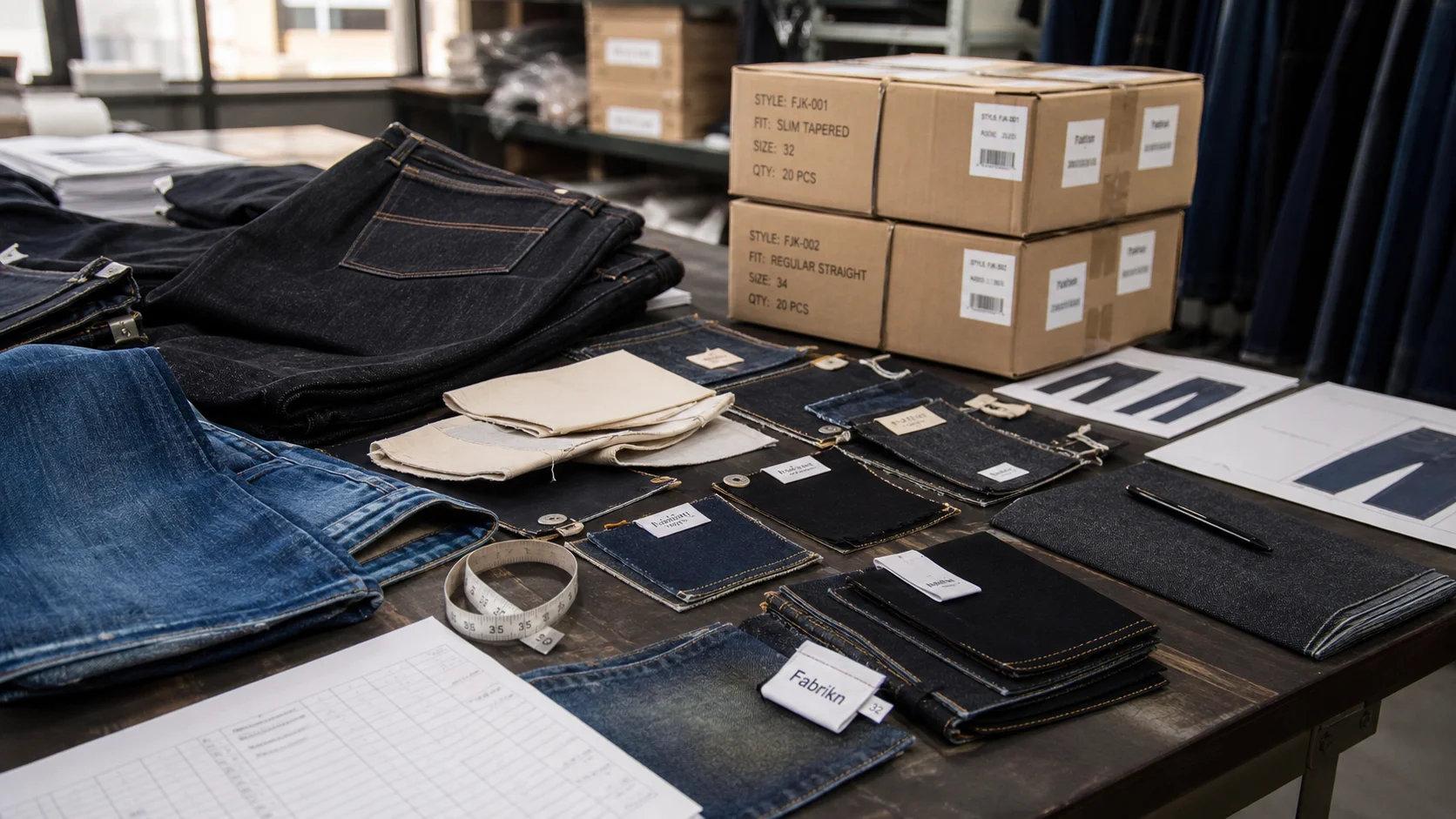
Private Label Clothing Order Minimums Explained with checks for samples, fit, MOQ, QC evidence, pricing terms, and delivery risk.
Fast answer: Private Label Clothing Order Minimums Explained should be judged by production evidence, not by a generic sourcing promise. The buyer needs sample proof, cost breakdowns, QC checkpoints, and delivery buffers in writing.
Ask for recent sample photos, measurement tolerances, fabric or print test assumptions, decoration test notes, packing examples, and a named inspection checkpoint. These details show whether the team can repeat an approved sample at bulk volume.
Separate garment cost, decoration, labels, packaging, sampling, testing, freight, and rush charges. When every cost line is visible, it becomes easier to reduce colorways, adjust size depth, or reserve more time for sampling.
If you are building a fashion brand, one of the first manufacturing terms you will encounter is MOQ, or minimum order quantity. Understanding private label clothing order minimums explained in practical terms can save your business time, money, and a lot of frustration. For many new brands, MOQ is the difference between launching with confidence and getting stuck before the first production run even starts.
Private label apparel can be one of the most efficient ways to bring a branded product to market. You choose existing or custom-developed garments, add your label and packaging, and sell under your own brand name. But because clothing manufacturing involves fabrics, labor, setup costs, sampling, and production planning, manufacturers typically require a minimum number of units per style, color, or size run.
In this guide, we will break down what order minimums mean, why they exist, what influences them, and how brands can work with manufacturers to find a production setup that fits their goals. Whether you are launching a streetwear label, activewear collection, basics line, or premium boutique brand, understanding MOQ is essential to scaling the right way.
Private label clothing order minimums are the smallest number of units a manufacturer agrees to produce for a specific style, color, or order. In simple terms, it is the lowest quantity you must buy to start production.
These minimums can apply to several parts of the order:
For example, a manufacturer may require 100 pieces per style, but if you want three colors, your total order may need to reach 300 pieces or be split according to the factory’s production rules. Some factories set minimums at the order level, while others set them per design or per fabric.
It is important to remember that MOQ is not just a random number. It reflects the real economics of clothing production. The factory must purchase materials, prepare machines, cut fabric, organize labor, and manage quality control. Minimums help make production efficient enough for both the manufacturer and the brand.
Manufacturers use order minimums to keep production profitable and organized. Clothing production has several fixed costs that do not change much whether you order 20 units or 200 units. These include sample development, pattern creation, machine setup, cutting markers, and production scheduling.
Here are the main reasons minimums exist:
For brands, understanding this logic makes MOQ easier to negotiate and plan for. If a manufacturer is willing to produce smaller quantities, they are usually compensating for the reduced efficiency in another way, such as charging a higher unit price or offering a limited range of customization options.
MOQ can have a major effect on cash flow, inventory risk, and product strategy. New brands often need to balance the desire for variety with the realities of production minimums. A first collection may look exciting on paper, but if the quantities are too high, you can end up with excess inventory and limited budget for marketing or future development.
Here are the main ways minimum order quantities impact brands:
Ordering 300 or 500 units requires upfront investment. If your brand is just starting, tying up too much capital in inventory can reduce your ability to pay for ads, content, influencers, packaging, or website development.
The more units you order, the more risk you take if a product does not sell as expected. A high MOQ can leave you with unsold stock in the wrong color, size, or style.
When minimums are high, brands may need to focus on fewer styles or colors. This can be a smart strategy early on because it allows you to launch with a tighter, more focused collection.
On the other hand, larger orders often lower the cost per unit. If you have proven demand, a higher MOQ can improve margins and make your brand more profitable.
In other words, MOQ is not automatically good or bad. The right quantity depends on your sales strategy, budget, and stage of growth.
Minimums vary widely depending on the manufacturer, product category, and level of customization. Some suppliers offer very low MOQs for startups, while others focus on larger production runs for established brands.
Typical private label clothing MOQ ranges may look like this:
These are general ranges, not fixed rules. A simple cotton tee with a standard fit may have a much lower MOQ than a technical performance garment with custom fabric, multiple trims, and specialized stitching.
If you are comparing factories, always ask whether the MOQ applies per color, per size run, or per total style. That one detail can change your budget significantly.
Several production variables affect MOQ. Knowing these can help you understand why one manufacturer may offer a smaller minimum than another.
Custom-dyed fabrics, specialty blends, and high-performance materials often require larger minimums because suppliers work in bulk. Standard fabrics available in stock are usually more flexible.
The more custom your garment is, the higher the MOQ tends to be. A basic private label tee with a logo label is easier to produce in smaller quantities than a fully custom cut-and-sew item with unique panels, zippers, embroidery, and custom packaging.
Simple products are easier to manufacture at lower volumes. Complex items take more time, more setup, and more labor, which increases the minimum required to make production worthwhile.
Some factories require each color to meet its own minimum. If you want black, white, and navy versions of the same hoodie, the minimum may apply separately to each color.
Screen printing, embroidery, heat transfer, DTG, puff print, and woven details all have different setup requirements. Some decoration methods are more cost-effective at larger runs, while others are easier to use on small batches.
A manufacturer that handles everything in-house may be able to offer more flexible minimums than a factory that outsources parts of production. Full-service partners often provide a smoother workflow, but flexibility still depends on their production model.
When a factory has strong demand or is planning around other larger orders, they may prefer minimums that help fill their production schedule efficiently.
Understanding these factors helps brands ask better questions and avoid comparing quotes unfairly.
Many brands assume MOQ is fixed, but in some cases, it can be negotiated. A lower minimum may be possible if you approach the conversation strategically and show the manufacturer that you are a serious partner.
Here are a few practical ways to negotiate:
Negotiation works best when you communicate clearly about your brand, your growth plan, and your expected reorder strategy. Manufacturers are more open to flexibility when they see long-term potential rather than a one-time transaction.
If you are evaluating production support, it can help to review a manufacturer’s capabilities and process before discussing numbers. You can learn more about our approach at Fabrikn Services.
Not every factory is the right fit for every brand. The best manufacturer for your business is one whose MOQ aligns with your budget, product goals, and growth stage.
When comparing manufacturers, consider these points:
Choosing a partner is not only about price. A manufacturer with slightly higher minimums may still be the better option if they deliver better quality, fewer delays, and stronger support.
If you want to understand more about our company and how we work with brands, visit our About Us page. If you are ready to discuss your project, you can also reach us through our Contact Us page.
The smartest way to handle MOQ is to plan your first order around actual launch needs, not just creative ambition. A focused first order helps you test demand, collect feedback, and prepare for future reorders.
Here is a simple planning process:
Start with one or two hero products that represent your brand clearly. This could be a premium t-shirt, heavyweight hoodie, or fitted leggings style.
One or two colors is often enough for a launch. This keeps your stock cleaner and your production simpler.
Use your target customer profile to decide how many units to produce in each size. If you are unsure, start with a balanced size curve and adjust based on sales data.
Sampling is a separate cost from production. Always budget for prototypes, revisions, and testing before you place your bulk order.
Think beyond the first launch. If a product performs well, you want a supplier who can repeat production efficiently and ideally lower some of the friction in the next order.
Do not order so much inventory that your brand cannot market or ship it properly. A smaller, well-executed order often beats a larger, risky one.
Brands often misunderstand MOQ and make avoidable mistakes during the buying process. These errors can slow down production or hurt profitability.
Being strategic early helps your brand build a healthier product line and a more reliable supply chain.
At Fabrikn, we understand that every brand has different production needs. Some are launching their first collection and need a flexible path to market. Others are scaling an existing line and need a dependable partner who can maintain quality and consistency.
Our private label manufacturing approach focuses on helping brands move from idea to finished product with clarity and support. Whether you need guidance on styles, materials, branding, or order planning, our team can help you evaluate the best path forward for your business.
Working with the right manufacturer can make MOQ easier to manage because you get clear communication, better planning, and a production process designed to match your goals. If you are exploring private label options, learning how order minimums work is the first step toward a smarter launch.
Private label clothing order minimums are one of the most important manufacturing concepts for apparel brands to understand. MOQ affects your budget, product assortment, inventory risk, and ability to grow sustainably. While minimums may feel restrictive at first, they are really a practical part of the production process.
The key is to treat MOQ as a strategic tool rather than a barrier. By choosing simpler products, limiting early variations, and working with the right manufacturing partner, you can launch with confidence and build a stronger foundation for future orders.
If you are ready to explore private label manufacturing and want support from a team that understands brand building, production planning, and scalable apparel development, Fabrikn is here to help.
Get a free quote from Fabrikn — your trusted B2B clothing manufacturer with 10+ years of experience. MOQ as low as 200 pieces.
Get a Free Quote →MOQ stands for minimum order quantity. It is the smallest number of units a manufacturer will produce for a specific garment, color, or style.
Minimums help manufacturers cover setup, sourcing, labor, and production costs efficiently. They make the order worthwhile for both the factory and the brand.
Yes, sometimes. You may be able to lower MOQ by simplifying the product, using stock fabrics, reducing color options, or agreeing to a higher unit price.
Not always. Lower minimums can reduce risk, but they may also increase unit cost. The best MOQ is the one that fits your budget and sales plan.
It can be either, depending on the manufacturer. Always confirm whether the minimum applies per style, per color, per size run, or per total order.
There is no single answer, but many new brands start with smaller runs between 50 and 300 units per style depending on the product and factory.
Fabrikn helps brands navigate private label production, from planning and development to manufacturing support. If you want to discuss your project, visit our Contact Us page.