
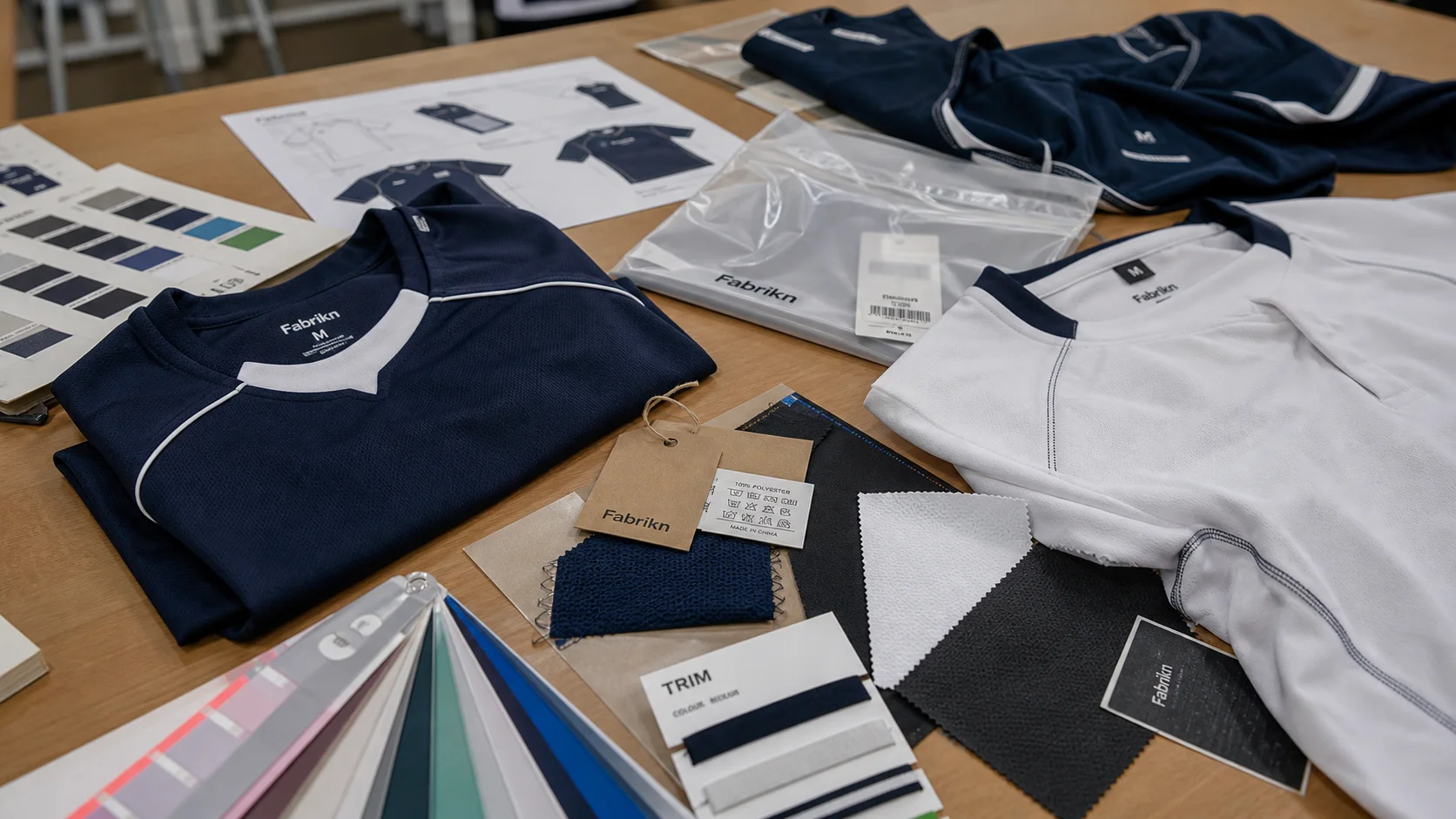
Private Label Clothing Retail Margin compared by sample evidence, fabric or trim specs, MOQ, AQL terms, cost lines, delivery timing, and rework responsibility.
Fast answer: Private Label Clothing Retail Margin: Material, Print, MOQ, and QC Terms should be judged by production evidence, not by a generic sourcing promise. The buyer needs sample proof, cost breakdowns, QC checkpoints, and delivery buffers in writing.
Ask for recent sample photos, measurement tolerances, fabric or print test assumptions, decoration test notes, packing examples, and a named inspection checkpoint. These details show whether the team can repeat an approved sample at bulk volume.
Separate garment cost, decoration, labels, packaging, sampling, testing, freight, and rush charges. Clear cost lines make it easier to reduce colorways, adjust size depth, or reserve more time for sampling.
Private label clothing can be one of the most profitable ways to build a fashion brand, but only if pricing is managed with discipline. Many brands focus heavily on design, product development, and branding, then underestimate the impact of retail margin on long-term success. In apparel, even a small pricing mistake can erase profit across an entire collection.
A private label clothing retail margin guide is essential for founders, buyers, and merchandising teams who want to price products strategically instead of emotionally. Whether you are launching a new basics line, scaling activewear, or expanding into premium lifestyle apparel, your margin structure will determine how much room you have for marketing, returns, freight, discounts, and growth.
This guide explains how to calculate margin, understand your costs, set profitable prices, and avoid the most common pricing traps in private label fashion. It is designed for brands that want to create a strong business, not just a good-looking collection.
Before setting prices, it is important to understand the difference between margin and markup. These two terms are often used interchangeably, but they are not the same.
Gross margin is the percentage of revenue left after subtracting the cost of goods sold. In clothing, this usually includes the factory price, trims, packaging, and sometimes inbound freight depending on how you account for landed cost.
Gross margin formula:
Gross Margin = (Retail Price - Cost of Goods Sold) / Retail Price x 100
Markup is the percentage added to your cost to arrive at a selling price. It is based on cost, not retail price.
Markup formula:
Markup = (Retail Price - Cost of Goods Sold) / Cost of Goods Sold x 100
A product can have a high markup but still have a weak margin if the retail price is too low relative to cost. For example, if a T-shirt costs $8 and sells for $20, the markup is 150%, but the gross margin is only 60%. Both figures matter, but margin is usually the more useful metric for retail planning.
Gross margin is only the beginning. To understand true profitability, you also need to account for operating expenses such as salaries, warehousing, ad spend, payment processing, chargebacks, returns, and customer acquisition costs. A product with a healthy gross margin can still lose money if overhead is too high.
One of the biggest mistakes private label brands make is pricing from factory cost alone. In reality, the full cost of a garment includes several layers, and each one affects your final margin.
This is the base cost quoted by your clothing manufacturer. It includes materials, labor, sewing, and basic finishing. For custom private label items, this price often changes depending on fabric quality, complexity, size range, and order quantity.
Labels, hangtags, woven neck labels, polybags, cartons, tissue paper, and custom packaging all add to your cost. These details are important for branding, but they should be built into your margin model from the beginning.
Inbound freight from factory to warehouse, customs duties, import taxes, and final-mile delivery costs all affect your landed cost. If you ignore logistics, your margin will look better on paper than it really is.
Private label product development usually involves fit samples, lab dips, prototyping, revisions, and approvals. These are often treated as one-time costs, but they should still be considered when evaluating product profitability.
Apparel businesses must account for returns, exchanges, and product defects. A high return rate can quietly destroy margin, especially in eCommerce. Even a 5% to 10% return rate can materially impact profit if it is not planned for.
Advertising, wholesale commissions, sales samples, trade show fees, and retailer discounts should be factored into your pricing strategy. A product is not profitable just because it sells above cost; it must sell above total cost.
Pricing private label clothing is both an art and a math problem. The goal is to find a price that the market will accept while still leaving enough room to build a sustainable business.
Decide what gross margin you need before setting retail prices. Many fashion brands target gross margins of 60% to 75% depending on channel, category, and brand positioning. DTC brands often need higher margins because they bear customer acquisition costs, while wholesale brands may work on lower unit margins but larger order volumes.
Calculate price based on landed cost, which includes the full expense of getting product into sellable inventory. This gives a much more realistic view of profitability. If your landed cost is $12.50 and you want a 70% gross margin, your retail price should be approximately $41.67.
If you plan to sell through wholesale, DTC, marketplaces, or retail partners, each channel has different margin expectations. A price that works online may not work in wholesale, and a wholesale price may leave you with limited room for promotional discounts.
Fashion is rarely sold at full price all year. Seasonal promotions, bundle offers, clearance events, and retailer markdowns are part of the business. Your initial price should be high enough to allow for 20% to 40% discounting without wiping out profitability.
Two brands can sell a similar hoodie at very different price points depending on branding, quality perception, fit, packaging, and customer experience. If your brand is premium, your price should reflect that positioning. If you compete as a value brand, your margin structure must be engineered differently from the start.
There is no single correct margin for every private label garment. However, benchmarks can help guide your pricing decisions.
T-shirts, socks, underwear, and simple loungewear typically carry lower unit costs and can support strong margins if sourced efficiently. These products often target retail margins in the 60% to 75% range.
Shirts, sweatshirts, leggings, joggers, and casual dresses often sit in the middle of the market. These items usually require a balance of quality, design, and price competitiveness. Margins often fall in the 65% to 70% range.
Jackets, coats, and technical apparel may have higher production costs but can also command higher retail prices. Gross margin targets may still be strong, but the final percentage depends on construction, material complexity, and brand positioning.
Bags, caps, and small accessories often have different margin profiles because they may be lower cost but sold at premium perceived value. These products can be highly profitable if sourced and branded effectively.
Wholesale often operates on a lower gross margin percentage per unit than DTC, but the economics can still work if production runs are efficient and inventory turns are healthy. DTC has more pricing flexibility but usually requires more marketing spend and stronger cash flow management.
Improving margin does not always mean raising prices. In many cases, the best way to increase profit is to reduce hidden costs or improve buying efficiency.
Higher order quantities often reduce per-unit manufacturing cost. This can improve margin, but only if the product is likely to sell through. Overstocking to chase a lower unit cost can backfire if inventory becomes aged or heavily discounted.
Design choices affect cost more than many founders realize. Complex stitching, multiple fabric panels, specialty trims, and custom wash treatments all increase production cost. Streamlining product design can preserve brand quality while improving margin.
Fabric selection has a major impact on retail margin. A small change in GSM, fiber blend, or sourcing origin can improve or weaken product economics. The goal is to match fabric quality with your brand promise and your target selling price.
Better sizing, clearer product descriptions, improved fit consistency, and better photography can reduce returns. Since returns eat into both revenue and logistics budgets, lowering return rates directly improves profit.
High sell-through means less markdown risk. If products sell quickly at full price, your margin improves even if retail prices stay the same. This is why demand planning is just as important as production planning.
Sometimes brands focus only on factory cost and ignore packaging and logistics. Better carton planning, more efficient shipping methods, and smarter packaging specs can create meaningful savings across a collection.
Many private label brands lose profit because of avoidable pricing errors. Here are the most common ones.
If you ignore duties, freight, packaging, and returns, your margin estimate will be inaccurate. This is one of the fastest ways to underprice a product.
Underpricing may improve conversion in the short term, but it can damage your brand and reduce cash flow. If your prices are too low, you may not be able to invest in marketing, inventory, or product development.
If your category typically sells at a discount, your initial price must account for that reality. A full-price-only model is rarely sustainable in fashion unless you have exceptionally strong brand demand.
Too many SKUs can lead to fragmented inventory and weaker buying power. A tighter assortment often produces better margins because it improves production efficiency and inventory turnover.
Your customer must feel that the price is justified by the product and brand experience. If the price is too high for the perceived value, sell-through suffers. If it is too low, you may leave money on the table.
Let’s look at a few simple examples to show how private label pricing works in practice.
Gross margin = ($24.00 - $6.50) / $24.00 x 100 = 72.9%
This is a healthy margin for a basic item, especially if the brand can keep marketing and fulfillment costs under control.
Gross margin = ($58.00 - $17.00) / $58.00 x 100 = 70.7%
This leaves room for a promotional discount and still maintains a strong margin.
Gross margin on wholesale price = ($20.00 - $10.00) / $20.00 x 100 = 50%
This looks lower than DTC margin, but wholesale may still be profitable if order volume is high and sales costs are lower.
At Fabrikn, we understand that successful private label clothing is built on more than aesthetics. A strong product line must be manufacturable, scalable, and priced for profit. That is why we work with brands to balance quality, lead time, cost efficiency, and private label execution from the start.
If you are planning a new collection or reworking your pricing structure, our team can help you think through fabric choices, construction methods, MOQ strategy, and product positioning. Explore our services to see how we support private label development, or learn more about our company on the about us page.
When you are ready to discuss your product goals, visit our contact us page to start the conversation. The earlier margin is considered in the development process, the easier it is to create a commercially successful product line.
A private label clothing retail margin guide is not just about formulas. It is about building a pricing strategy that supports your brand, your channel mix, and your long-term business goals. The brands that win in apparel are usually the ones that understand their costs deeply, price with intention, and protect margin from the beginning.
When you know your landed cost, set realistic gross margin targets, and leave room for promotions and operating expenses, you can price for profit instead of guesswork. That discipline gives you more than just better numbers; it gives you a stronger, more resilient clothing business.
Get a free quote from Fabrikn — your trusted B2B clothing manufacturer with 10+ years of experience. MOQ as low as 200 pieces.
Get a Free Quote →Many private label clothing brands target gross margins between 60% and 75%, depending on category, channel, and brand positioning. DTC brands often need higher margins than wholesale brands because of marketing and fulfillment costs.
You should always use landed cost. Landed cost gives a more accurate picture of what each garment truly costs to bring into inventory and helps prevent underpricing.
Discounts reduce your realized selling price, which lowers gross margin. That is why your original retail price should include enough room for seasonal promotions and markdowns.
Yes. Wholesale can be profitable when production is efficient, order sizes are healthy, and sales costs are controlled. The margin percentage may be lower than DTC, but volume can make the business model work.
The biggest mistake is pricing based only on manufacturing cost and ignoring freight, duties, packaging, returns, and marketing. This often leads to margins that look good on paper but fail in real operations.
Fabrikn helps brands develop private label apparel that is both market-ready and commercially viable. We can support product development, manufacturing decisions, and cost planning so your retail pricing is built for profit from day one.