
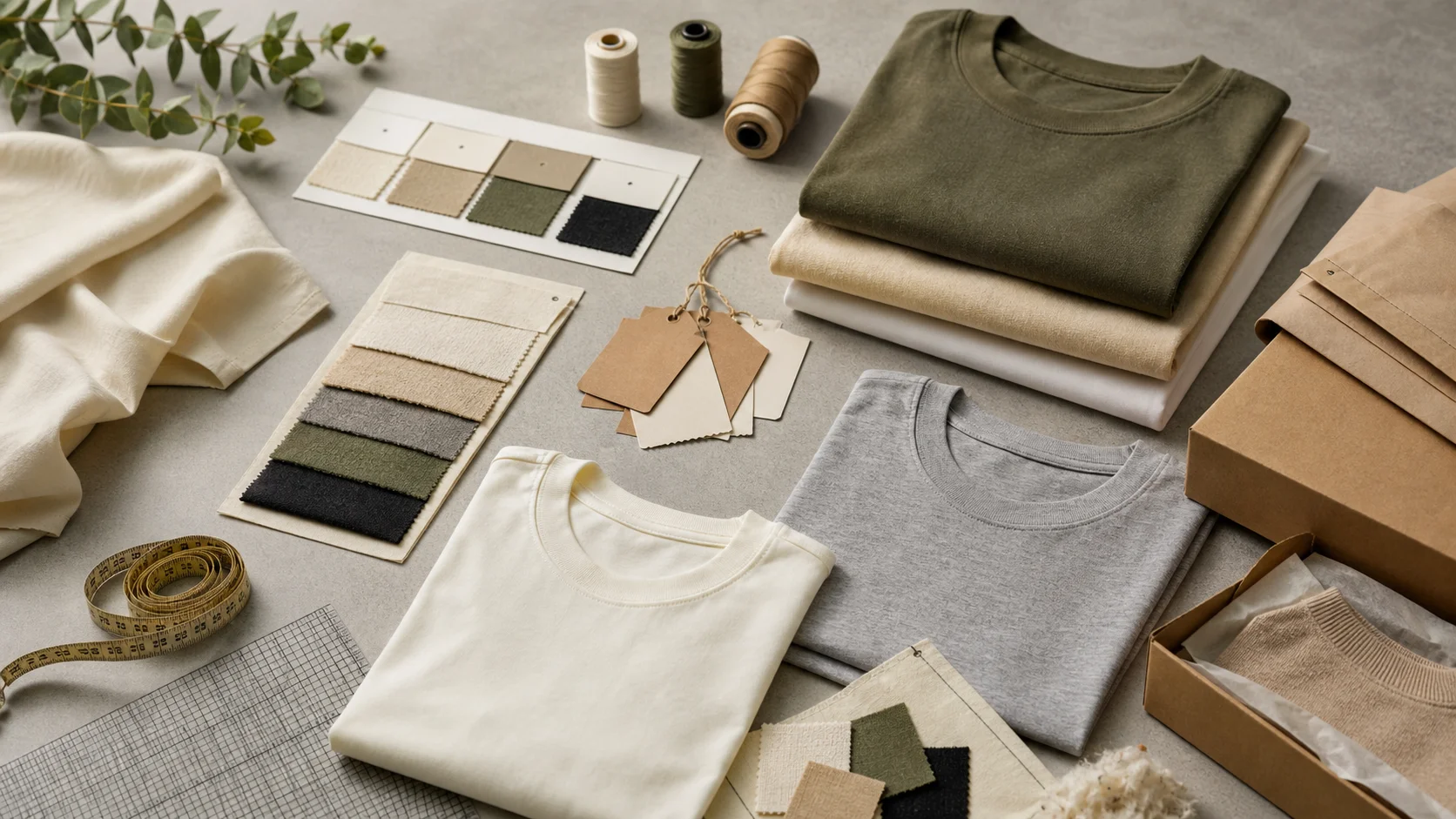
Private Label Clothing Vendor Evaluation Criteria compared by sample evidence, fabric or trim specs, MOQ, AQL terms, cost lines, delivery timing, and...
Fast answer: Private Label Clothing Vendor Evaluation Criteria: Material, Print, MOQ, and QC Terms should be judged by production evidence, not by a generic sourcing promise. The buyer needs sample proof, cost breakdowns, QC checkpoints, and delivery buffers in writing.
Ask for recent sample photos, measurement tolerances, fabric or print test assumptions, decoration test notes, packing examples, and a named inspection checkpoint. These details show whether the team can repeat an approved sample at bulk volume.
Separate garment cost, decoration, labels, packaging, sampling, testing, freight, and rush charges. Clear cost lines make it easier to reduce colorways, adjust size depth, or reserve more time for sampling.
Choosing a private label clothing vendor is one of the most important decisions a brand can make. The right partner can help you launch faster, improve product quality, reduce risks, and scale confidently. The wrong one can lead to missed deadlines, inconsistent sizing, quality complaints, and costly inventory problems.
If you are evaluating private label clothing vendors, you need a structured process. That means looking beyond sample garments and quoted prices. You need to assess production capabilities, quality systems, communication, compliance, flexibility, and long-term fit with your business model. In other words, you need a complete set of private label clothing vendor evaluation criteria.
This guide explains exactly what to look for when comparing vendors, how to weigh the most important factors, and how to identify a manufacturer that can support your brand as it grows. If you are exploring production support, you can also review Fabrikn’s services to see how a manufacturing partner can support private label apparel development, sourcing, and production.
Leading sourcing hubs such as Guangzhou, Dhaka, Ho Chi Minh City, and Istanbul each offer different strengths for private label brands. Guangzhou specializes in fast turnarounds for knit basics, Dhaka brings cost-effective cut-and-sew for woven shirts, Ho Chi Minh City offers high-capacity performance apparel with advanced dye houses, and Istanbul is known for premium cotton jerseys, technical trims, and contemporary finishing techniques. Understanding where a vendor operates helps you plan logistics, duty structures, and product positioning.
Private label apparel is not just about putting your logo on a shirt. It involves selecting fabrics, approving construction details, ensuring fit consistency, managing lead times, and maintaining brand standards across every reorder. Vendor evaluation matters because your manufacturer directly affects your reputation in the market.
A strong private label vendor can help you:
In contrast, a weak vendor relationship can create hidden costs that are much bigger than the unit price. Reworks, delayed launches, rejected shipments, and customer returns can erode margins quickly. That is why the vendor evaluation process should be systematic, not based on gut feeling alone.
The best private label clothing vendor evaluation criteria focus on both product quality and business reliability. A vendor should be judged on what they can make, how consistently they can make it, and how professionally they manage the relationship.
Not every manufacturer is equally strong across all apparel categories. Some excel in activewear, others in basics, streetwear, loungewear, uniforms, or premium fashion. Ask whether the vendor has direct experience in your product category.
For example, if you are launching women’s leggings, a vendor with strong knitwear and stretch fabric expertise is more suitable than one that primarily produces woven shirts. Category experience matters because it affects pattern accuracy, stitching methods, fabric behavior, and fit outcomes.
Vendors in Ho Chi Minh City frequently specialize in performance blends such as 85% recycled polyester with 15% spandex using high-stitch-density Juki machines that preserve stretch recovery. Istanbul suppliers may focus on premium cotton modal blends with laser-cut detailing and bonded construction for elevated loungewear.
Evaluate whether the vendor can handle your current order volume and future growth. A small brand may only need low minimum order quantities at first, but that should not come at the expense of a manufacturer’s ability to scale later.
Questions to ask include:
For instance, a Guangzhou factory might run three 8-hour shifts with 6 Gerber Paragon automatic cutters feeding 120 sewing stations, enabling them to handle 30,000 units of basics per month while reserving 30% of capacity for new private label launches.
Private label clothing often requires custom labels, packaging, trims, fits, colors, embroidery, prints, or fabric treatments. A vendor should be able to offer meaningful customization without creating unnecessary complexity.
Look for flexibility in:
A vendor in Dhaka might provide reactive-dye color matching for viscose dresses, while a partner in Ho Chi Minh City could offer Kornit Storm HD6 direct-to-garment printing and M&R Stryker automatic screen printing for high-resolution graphics.
Samples reveal much more than marketing materials do. Examine sample construction, stitching, seam finishing, fabric hand-feel, wash performance, and fit consistency. A vendor should be able to make samples that closely reflect bulk production quality.
Be cautious if samples look excellent but the vendor cannot explain how they will replicate them at scale. Sampling quality should be consistent with production quality, not dramatically better.
Ask for a sample run that includes your intended fabric—such as OEKO-TEX Standard 100 certified combed cotton or GRS-certified recycled nylon—and confirm that the same automated machines used on the sample (for example, Brother PR630e embroidery heads or Kansai Special overlockers) will be used in production.
Even a high-quality vendor can be problematic if their delivery performance is unreliable. Ask about standard lead times, sampling timelines, and how they handle urgent orders or seasonal peaks. Delays in apparel production can impact product launches, retail partnerships, and cash flow.
A dependable vendor should provide realistic timelines and communicate openly when issues arise. Promises that sound too fast to be true often are.
Industry averages in Guangzhou, Dhaka, and Ho Chi Minh City are typically 18-22 business days for full cut-and-sew production once materials are confirmed, so plan your launch calendar accordingly and factor in additional time for overseas inspection, packing, and shipping.
When evaluating private label clothing vendors, manufacturing capability is more than just equipment. It includes the systems, people, and processes that determine whether your product is produced accurately and efficiently.
Ask how the vendor sources fabrics and trims. Do they have reliable supplier relationships? Can they source sustainable materials, organic cotton, recycled fabrics, or performance textiles if needed? Strong sourcing capabilities can improve both product quality and cost control.
You should also ask how they inspect incoming materials. Fabric defects, shade variation, and shrinkage problems often begin before production starts. A vendor with strong material control reduces these risks.
Look for vendors with access to GOTS-certified organic cotton, OEKO-TEX Standard 100 pre-dyed ribbed cotton, GRS certified recycled polyester, and WRAP-compliant trim suppliers. A partner that maintains shade cards, tensile testing, and shrinkage reports for every lot of fabric (e.g., using Datacolor SpectraLux instruments) will reduce costly production surprises.
Fit is one of the most important factors in apparel success. A vendor that offers professional pattern making and grading can help you create better-fitting products across a full size range. This is especially important for private label brands that want repeatable sizing and lower return rates.
Ask whether patterns are developed in-house or outsourced, and whether the vendor can adapt patterns based on your target market. Fit standards can vary significantly by region and category.
Some factories use advanced CAD systems like Optitex or Lectra, and can provide digital markers for nesting efficiency; others rely on experienced pattern cutters who have industry experience in markets such as Istanbul or Guangzhou. Ensure the vendor can grade to your spec, whether that means a modest size chart for European markets or inclusive sizing that accounts for extended waist and hip measurements.
Evaluate how the vendor handles cutting accuracy, sewing consistency, and finishing details. Poor cutting can cause sizing inconsistencies, while weak sewing can lead to seam failures and poor garment appearance. Finishing details such as thread trimming, pressing, folding, and packaging also affect the final product presentation.
Ask whether they use Gerber Paragon or Eastman automated cutting spreaders, Juki or Brother high-speed sewing machines, and automated finishing lines with hand-press stations. Confirm that they maintain consistent tensions, spool changes, and thread types to avoid puckering or skipped stitches.
If your products require embroidery, screen printing, garment dyeing, heat transfer, laser cutting, bonding, or technical construction, confirm that the vendor has proven experience with those methods. Specialized techniques should be done in-house or through vetted, consistent partners.
Examples include digital printing labs in Ho Chi Minh City equipped with Kornit Storm HD6 printers, Guangzhou houses running M&R Challenger manual screen presses for discharge inks, or Istanbul workshops capable of laser-cut applique with Amada fiber lasers. Verify they can replicate your specs across large runs and provide certified color-matching reports.
One of the most important private label clothing vendor evaluation criteria is quality control. You need a partner that can consistently deliver garments that meet your standards and comply with market regulations.
Ask about the vendor’s quality assurance process at every stage of production. A reliable vendor should inspect raw materials, monitor in-line production, perform final inspections, and document defects or corrections.
Look for answers to questions such as:
Vendors should be able to point to systems such as in-line operators using digital inspection apps to log stitch counts, final inspectors measuring garments on board with 3-point fit boards, and QC managers maintaining AQL 2.5:4.0 sampling plans. Ideally, they will have GPS-linked cameras for real-time status updates so you can see whether garments are passing inspection before shipping.
Depending on your market, you may need compliance with regulations related to fiber content labeling, country-of-origin labeling, restricted substances, child safety, or social responsibility standards. If you sell into retail channels or regulated markets, compliance is not optional.
Ask whether the vendor has experience producing for your target market and whether they can support documentation, testing, and labeling requirements.
Look for certifications such as GOTS, OEKO-TEX Standard 100, WRAP, BSCI, and GRS. These demonstrate that the factory meets international standards for environmental impact, worker health and safety, and chemical restrictions. For example, a Ho Chi Minh City supplier with WRAP and BSCI audits and Turkish partners with GOTS and OEKO-TEX show that they’ve invested in third-party verification.
Social responsibility is increasingly important to conscious consumers. Vendor evaluation should include audits, worker welfare programs, and documentation on payroll transparency.
Ask whether the factory has conducted recent WRAP or BSCI audits, what corrective actions were implemented, and how they manage overtime. Vendors that provide living wage roadmaps, independent worker hotlines, and transparent social compliance dashboards are more trustworthy partners.
Also, inquire about waste management practices, wastewater treatment plants, and whether the vendor participates in circular initiatives (e.g., collecting off-cuts for recycling through GRS-certified recyclers).
Strong communication is the foundation of a productive partnership. Your vendor should provide a dedicated account manager, project tracker, and clear escalation paths.
Expect weekly production updates, landing of tech packs in shared folders, and visibility into CMT (cut, make, trim) schedules. Ask how they handle time zone differences (e.g., overlapping working hours between your New York headquarters and the team in Guangzhou or Dhaka) and whether you can reach them via email, WhatsApp, or dedicated portals.
Service excellence also includes proactive problem-solving. For example, if a shipment to Ho Chi Minh City is delayed due to customs, a good partner will offer rail alternatives or consolidate other orders to avoid further disruption.
Transparent pricing is crucial. A vendor should outline unit costs, packaging charges, shipping terms, and any tooling or dye lot fees. Understand how the cost changes with volume, trim selection, and special finishes.
Base pricing often ranges from $2.50-4.00 per unit at a 500 MOQ for basic tees produced in Dhaka or Guangzhou, depending on fabric choice and finishing. Expect higher costs for premium materials such as 100% GOTS-certified organic cotton or double-faced French terry from Istanbul. Ask if the vendor can tier pricing for larger runs at 1,000+ units and whether they offer fulfillment options like polybagging or kitting.
Also discuss payment terms—commonly 30% deposit, 60% production, and 10% pre-shipment—or net 30 for established brands. Confirm how they handle currency fluctuations, especially if materials are purchased in USD but production happens in local currency.
Sampling is where ideas become reality. A vendor should align sample timelines with your launch deadlines and provide documentation on how the samples compare to bulk production.
Typical sampling timelines are 10-14 business days for proto samples and an additional 5-7 days for fit samples, depending on fabric availability. From there, expect 18-22 business days for the first production run once approvals are completed.
Ask about testing capabilities. Can the factory send garments to third-party labs for colorfastness, pilling, or shrinkage (especially relevant for markets with strict requirements)? Do they maintain test records for your order, and can they coordinate with labs in Guangzhou or Istanbul to certify compliance?
Ensure they have sample rooms with temperature and humidity control, pattern blocks for going to size, and the ability to produce strike-offs for prints using technologies like Kornit’s digital printers or M&R screen presses.
Guard against the following red flags during evaluation:
Create a scorecard to quantify your evaluation. Include weighted metrics like:
Assign scores based on documented evidence such as facility tours, sample reviews, and audit reports. Adjust weights to reflect your priorities—for a sustainable brand, give extra weight to certifications like GOTS, GRS, and OEKO-TEX Standard 100.
Use the scorecard to compare vendors in Guangzhou, Dhaka, Ho Chi Minh City, and Istanbul objectively. This approach helps you identify the best fit rather than the lowest price.
The best vendor relationship feels like a partnership rather than a transaction. Look for a manufacturer that invests in your success, offers creative input on materials and processes, and prioritizes continuous improvement.
Consider how closely they align with your values—whether that’s sourcing from WRAP-compliant factories in Turkey, innovating with recycled GRS-certified yarns in Vietnam, or maintaining transparent payroll records in Dhaka. Ask whether they are comfortable with ongoing feedback loops and whether they will recommend optimizations over time.
Remember that switching vendors midstream is expensive. Choosing a partner who satisfies your core private label clothing vendor evaluation criteria today will save you time, money, and headaches tomorrow.
Private label clothing vendor evaluation is a strategic process that combines technical scrutiny with business judgment. By focusing on capabilities, quality, compliance, communication, and commercial fit—backed by real-world data such as lead times, MOQ costs, specific certifications, and manufacturing geography—you can select a partner that supports your brand through every stage of growth.
Use this guide to ask the right questions, document your findings, and build a roadmap to a long-term manufacturing relationship.
Use these adjacent sourcing guides to compare supplier capability, costing, and production planning before you brief a factory.
For production planning, review Fabrikn services or contact the team through the sourcing brief form.
Q: How much should I expect to pay per unit for basic tees? A: A reasonable range is $2.50-4.00 per unit at a 500 MOQ for standard cotton tees produced in markets like Dhaka or Guangzhou, depending on fabric weight and finishing.
Q: What certifications should I look for? A: Seek vendors with GOTS, OEKO-TEX Standard 100, WRAP, BSCI, or GRS certifications. These ensure environmental, safety, and ethical standards.
Q: What is a typical lead time? A: After sampling and approvals, expect 18-22 business days for full production runs, plus extra time for shipping and customs.
Q: How can I ensure consistent quality across vendors? A: Use a vendor scorecard, require detailed measurement charts, demand in-line inspections, and schedule independent quality checks or third-party lab testing to verify consistency.