
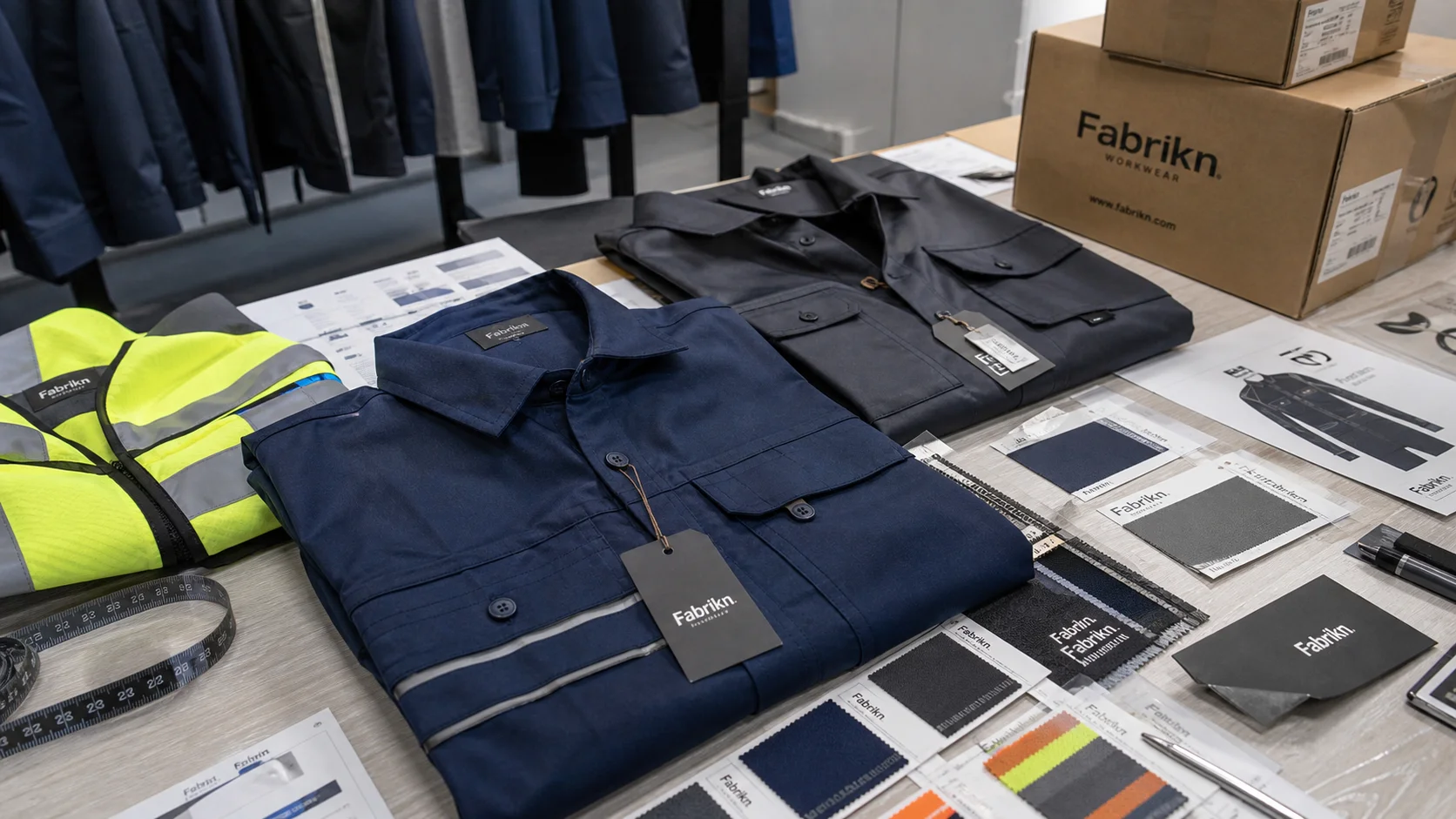
An SEO-focused outline for distributors planning a workwear launch, covering private label coveralls MOQ, unit cost drivers, decoration choices, sample...
Private Label Coveralls MOQ Cost for Distributors - Fabrikn production reference
Private label coveralls are a straightforward product on paper and a nuanced buy in practice. For distributors launching a workwear line, the real questions are not only what the garment costs, but what the factory will accept as a minimum order, how decoration changes the quote, and where launch budgets get trapped in sampling, trims, approvals, and freight. A good program starts with a clear view of MOQ cost structure, then works backward from the market price the distributor needs to hit.
This matters even more in Decoration & Printing, because artwork placement, logo method, and branding consistency can change both production flow and rejection risk. A coverall is a large, technically simple garment, yet it is not a low-risk blank. Zippers, pocket layout, stitch density, seam strength, reflective tape, and print or embroidery location all affect cost and lead time.
MOQ is the minimum quantity a supplier will produce per style, color, or SKU. For coveralls, MOQ is rarely just a single number. The factory may set separate minimums for fabric color, size run, decoration method, and trim package. A distributor that asks for “1,000 coveralls” may still find that the real order needs to be split by color, with an additional minimum for each logo treatment.
For private label launches, MOQ is often the first place where sourcing reality shows up. A low MOQ can be useful for market testing, but it usually comes with tradeoffs: higher unit cost, limited fabric choice, fewer trim options, and less room to negotiate branding details. A higher MOQ reduces unit cost and improves production efficiency, yet it increases cash tied up in inventory. The right number depends on sales channel confidence, size curve complexity, and how much customization the distributor needs.
There is no universal MOQ for coveralls, but distributors can use practical ranges to frame discussions. These are not promises from any supplier; they are common sourcing patterns that depend on factory capacity, fabric sourcing, and the complexity of the spec.
Program Type Typical MOQ Range Cost Implication Stock fabric, basic private label 300 to 800 pcs per color/style Lower development cost, moderate unit price Custom color or custom fabric blend 800 to 2,000 pcs per color/style Higher fabric commitment, better control of branding Heavy-duty workwear with special trims 1,000 to 3,000 pcs per style Higher material and testing cost, better durability profile Decorated launch with embroidery or print 300 to 1,500 pcs per placement or artwork set Setup fees and decoration run charges matter moreA distributor comparing quotes should not focus only on the headline MOQ. A factory offering 500 units may still be more expensive than one quoting 1,000 units if the smaller order carries higher fabric waste, limited trim availability, or a less efficient sewing layout. The smarter question is what the landed cost per sellable unit looks like at the intended size mix, decoration spec, and replenishment forecast.
Coverall pricing is built from a few core inputs. Fabric usually carries the largest share, but the final cost is shaped by construction details and launch requirements as much as by raw material. For distributors, the quote needs to be read as a complete system, not a single unit number.
Heavier fabrics cost more and take more labor to sew. A cotton twill, polyester-cotton blend, flame-resistant construction, or water-resistant finish will each push pricing differently. A lighter general-purpose coverall may use simpler materials, while industrial or safety-focused styles require stricter performance specs.
Typical sourcing details that should be locked early include GSM or oz weight, fiber content, weave type, shrinkage tolerance, and finish. If the spec is vague, the factory will price conservatively or revise the quote after sampling. That creates delay and weakens cost control.
More pockets, reinforced knees, action backs, two-way zippers, storm flaps, elastic inserts, and bartacks all add sewing time and material usage. A basic one-piece coverall is much cheaper to produce than a high-function workwear garment with multiple reinforcements and utility features.
Construction also affects consistency. The more components a garment has, the greater the chance of mismatch between pieces, poor alignment, or skipped reinforcement. That matters for both quality and inspection pass rates.
A broad size curve adds cost. Larger sizes use more fabric and can alter consumption enough to change the quote. If a distributor wants extended sizing, it should confirm whether the supplier prices by full size spread or by a blended average. A narrow size range is easier to execute and often easier to replenish.
Private label programs often underestimate packaging. Neck labels, woven labels, hangtags, size stickers, polybags, cartons, carton marks, and barcode labels all add cost. Some distributors want retail-ready packaging, while others only need bulk-packed goods for warehouse distribution. The difference can be material.
Workwear may need fiber verification, colorfastness testing, dimensional stability checks, or safety-related certification depending on the market. Testing itself is not usually the biggest line item, but it can shape lead time and create rework if the fabric or trim does not meet spec.
For a distributor starting a new line, it is usually safer to approve a simple, repeatable package first and then expand into more complex trims or finishes after the style proves itself.
Because this article sits in Decoration & Printing, the decoration decision deserves direct treatment. Branding on coveralls is more than placing a logo. It changes setup cost, production sequence, and final resale value. A clean logo can make a program feel established. A poorly planned decoration package can become the reason margins collapse.
Embroidery is often chosen for chest logos or name positions because it looks durable and holds up well in industrial use. It also creates a premium impression. The tradeoff is that embroidery adds digitizing cost, thread charge, and machine time. Dense logos can distort on heavy fabric or across thick seams, so placement needs review before approval.
Print can be less expensive at lower decoration complexity, especially for large logo runs. It may be suitable for promotional workwear or distributor-branded programs where cost control matters more than premium appearance. The risk is durability. Industrial laundering, abrasion, and repeated bending can weaken some print methods faster than embroidery.
If the coverall includes reflective tape or safety markings, the decoration decision becomes part of the compliance discussion. Placement, width, stitch method, and wash performance need to be confirmed in writing. A supplier should not be left to interpret safety decoration loosely. That is where avoidable inspection failures come from.
For distributor launches, the safest approach is usually to separate brand decoration from functional safety elements. Treat logo placement and reflective placement as two different approvals, each with its own sample sign-off.
Heavier branding often increases perceived value, but it can also limit the audience. Industrial buyers sometimes prefer restrained decoration and clear functionality. Retail-oriented channels may accept more visible branding. The better choice depends on who is buying, how the garment is sold, and whether the distributor is trying to build a premium private label or a value-driven replenishment item.
If the launch requires decoration support, the distributor can review service options at fabrikn.com/services/ and use the contact page for a direct quote request at fabrikn.com/contact-us/.
Sampling is where many private label coverall programs either stabilize or lose time. The sample process should be treated as a sequence of approvals, not a single garment approval. Each step reduces the chance of a costly mistake in bulk production.
A distributor should not approve bulk from a proto sample if fabric handfeel, shrinkage, or decoration placement still has open questions. That shortcut often saves a week and costs far more later. The best use of sampling is to test the exact items that drive rework: zipper function, tape alignment, pocket symmetry, thread tension, and logo positioning.
Lead sample timing varies widely. A simple proto may arrive in one to two weeks if the supplier has materials on hand. A sample that requires custom fabric, special dyeing, or logo tooling can take much longer. Pre-production approval should be documented clearly, ideally with annotated photos and a written revision list.
Launch schedules for private label coveralls are often tighter than expected. The sewing time itself may be only part of the timeline. Fabric procurement, trim sourcing, decoration setup, and final inspection can all stretch the calendar.
A realistic production window for a private label coverall launch can range from 30 to 75 days after sample approval, with longer timelines for custom materials or higher-compliance products. That range can move quickly if the supplier is waiting on fabric or if the approval process stalls. A distributor should ask for a critical path view, not a generic “production time” estimate.
For distributors wanting to understand how fabrication and branding support fit into the broader sourcing plan, company background is available at fabrikn.com/about-us/.
Coveralls are durable products, but they still fail inspection for ordinary reasons. The main risk is not usually one dramatic defect. It is a collection of small inconsistencies that become visible across a full order.
Inspection risk rises when the order is split across too many size ratios or when the decoration method interacts with heavy seams. A chest logo stitched across a thick panel may look acceptable in sample stage and still produce distortion in production. That is why final placement checks matter. The same is true for pockets, tape, and labels that sit too close to functional seams.
Distributors should ask whether the factory uses inline inspection, final inspection, or both. Inline checks help catch recurring defects early. Final inspection protects against packing errors and last-minute deviations. Neither one replaces a good pre-production sample, and neither one fixes a vague spec.
A launch budget for private label coveralls should include more than the unit price multiplied by MOQ. That is the common mistake. The first order absorbs setup work that may not repeat on every replenishment cycle, and those costs need to be visible before the order is placed.
There is a tradeoff between low MOQ and unit economics. A lower first order reduces exposure, but it spreads fixed setup cost over fewer pieces. That can push the true launch cost high enough to squeeze margin. A larger MOQ improves cost efficiency but raises inventory risk. The best answer is usually tied to demand visibility. If the distributor has confirmed accounts or a repeat channel, a higher MOQ can be justified. If the program is exploratory, controlled volume is usually the better discipline.
A practical way to negotiate is to ask the supplier to quote three levels: test run, base reorder, and target annual program volume. That gives the distributor a view of where savings begin and what volume is needed to make the program sustainable.
Before committing to a private label coverall program, the distributor should ask questions that expose hidden cost or schedule risk. A factory that answers clearly is usually easier to manage. A factory that avoids detail on fabric, trims, or sample control is a warning sign.
The most useful quote is not the cheapest one. It is the one that states assumptions cleanly. A distributor can work with a fair price. It is much harder to work with an underquoted program that relies on later revisions, expensive substitutions, or informal tolerances.
Private label coveralls are a workable category for distributor workwear launches because the garment is familiar, easy to explain, and adaptable across industrial, maintenance, and branded trade channels. The challenge is not product complexity alone. The challenge is managing MOQ, decoration, and launch cost in a way that preserves margin and avoids preventable quality problems.
Distributors should think in terms of total landed cost, not just factory unit cost. The right order size depends on fabric availability, trim package, decoration method, sample control, and the level of confidence in the channel. Lower MOQ can help prove demand. Higher MOQ can improve economics. Either choice can be justified when the underlying spec is tight and the approval process is disciplined.
Get a free quote from Fabrikn — your trusted B2B clothing manufacturer with 10+ years of experience. MOQ as low as 200 pieces.
Get a Free Quote →Common MOQ ranges start around 300 to 800 pieces for simpler stock-fabric programs and move up to 1,000 to 3,000 pieces for custom fabric, heavier construction, or more technical workwear. Final MOQ depends on color, size spread, and decoration.
Decoration adds setup work, production time, and sometimes its own minimums. Embroidery, print, and reflective graphics can each introduce extra charges or tighter approval steps, especially when placed near seams or thick panels.
The safest approval is a pre-production sample made with final fabric, trims, labels, and decoration method. Proto samples are useful for shape and layout, but they do not prove the finished production result.
A simple program may move through sampling and production in roughly 30 to 75 days after approval. Custom fabric, special trims, and multiple sample revisions can extend that timeline.
Common surprises include trim substitutions, decoration setup fees, higher fabric consumption in larger sizes, and packaging changes. Inspection rework and freight can also change the final landed cost.
That depends on sales confidence. Lower MOQ protects cash and reduces exposure. Lower unit price usually comes with higher volume commitment. For a first launch, the better choice is often the one that keeps inventory risk manageable while still leaving room for margin.