
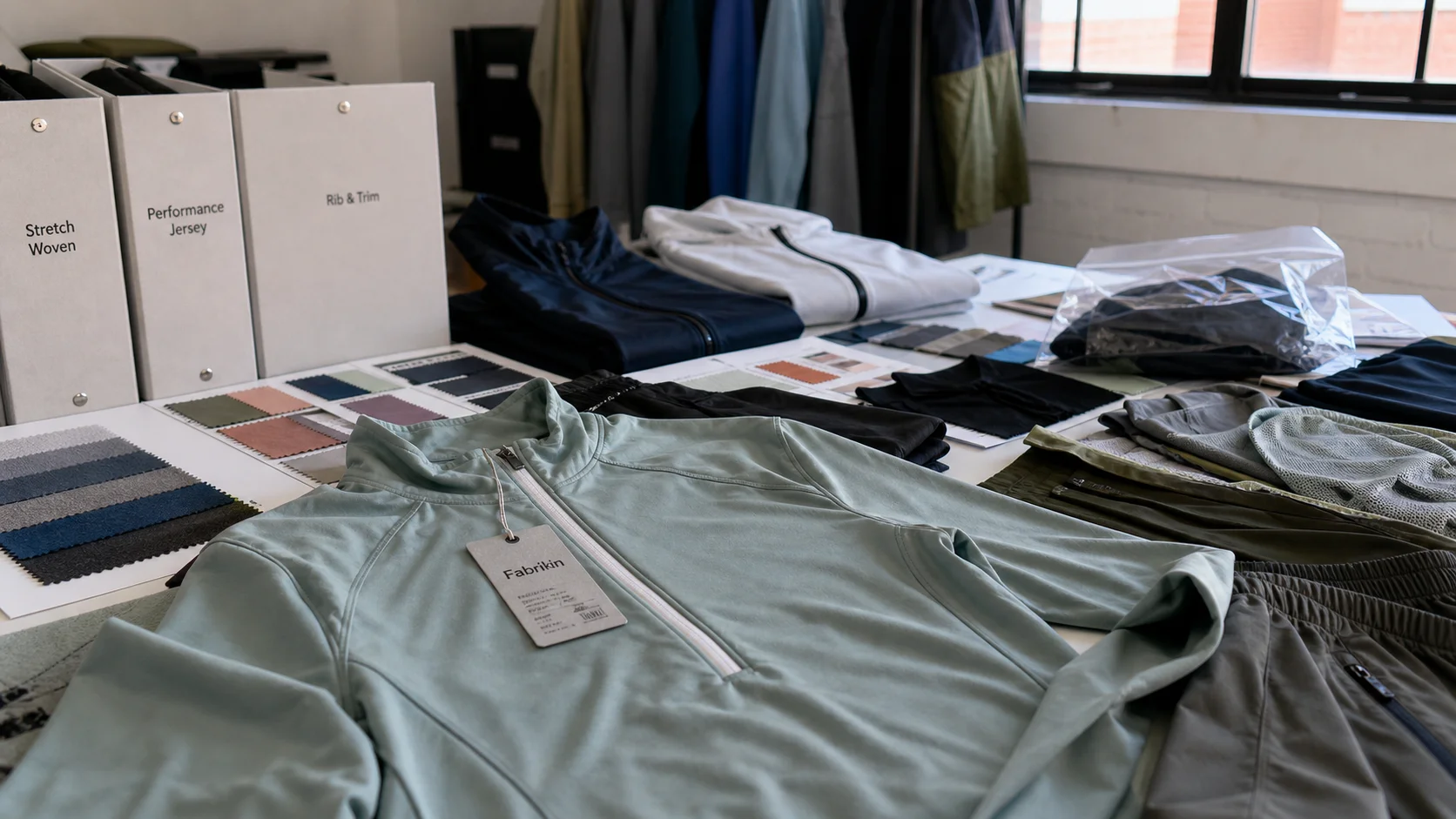
A 2,500-word SEO outline for sportswear distributors evaluating private label tracksuits with fabric testing, MOQ tradeoffs, and sourcing costs.
Private Label Fabric Testing Tracksuits MOQ Buyers Guide - Fabrikn production reference
For sportswear distributors, private label tracksuits can look simple on paper: choose a fabric, add branding, confirm size ranges, and place the order. In practice, most sourcing problems start earlier. They start when buyers treat MOQ as a standalone price hurdle instead of a production planning issue tied to fabric testing, trim development, color continuity, and quality risk.
The phrase private label fabric testing tracksuits MOQ for sportswear distributors points to a real purchasing concern. Buyers are not only trying to secure a competitive minimum order quantity. They also need confidence that the tracksuits will perform in retail and end use. A low MOQ with unstable fabric performance can create chargebacks, return problems, and repeat-order failure. A higher MOQ with better testing discipline may reduce long-term risk, even if the opening buy feels heavier.
This is where sourcing judgment matters. The cheapest entry point is not always the best commercial decision. Distributors usually need a balance of manageable MOQ, acceptable landed cost, reliable testing documentation, and repeatable bulk quality. That balance is the core of this guide.
If your team is comparing sourcing options, it helps to review supplier capabilities beyond price alone. Fabrikn’s services page is a useful starting point for understanding how development, production support, and sourcing coordination typically fit together.
Private label tracksuits are usually built around an existing factory capability, then adjusted with custom branding, fabric selection, fit revisions, and packaging details. That matters because MOQ is rarely just one number. It is often a combination of several thresholds:
For example, a distributor may request one men’s poly-spandex brushed tracksuit in three colors with printed neck labels and zipper pockets. A supplier may quote a style MOQ of 600 sets, but also require 200 sets per color and a separate minimum for custom fabric dyeing. The buyer hears one number in the quotation, but the production team manages several different minimums behind it.
This is why early MOQ discussions can be misleading. A supplier may agree to a lower sewing MOQ, then recover margin through higher fabric surcharges, limited color options, or stricter packaging consolidation. Buyers should read MOQ as an operational commitment, not just a sales line item.
Fabric testing should be addressed before final MOQ negotiation, especially for sportswear distributors serving multi-door retail, teamwear, fitness chains, or e-commerce accounts with return exposure. Tracksuits face repeated wear, laundering, abrasion, and fit stress. Fabric failure tends to damage both brand credibility and replenishment economics.
Common test areas for private label tracksuits include:
Distributors often make a costly mistake here. They accept a standard fabric description such as “95% polyester 5% spandex interlock” without locking performance parameters. That leaves too much room for variation. Two fabrics with the same nominal composition can behave very differently in bulk.
Purchasing judgment: if fabric performance is central to the sales claim, treat lab dips and handfeel approval as only the first gate. Bulk fabric test approval is the real protection.
A factory that offers a very low MOQ but resists pre-bulk testing, test report sharing, or clear tolerance alignment should be reviewed cautiously. Small opening quantities are attractive, but they do not offset the downstream cost of failed goods.
MOQ ranges vary by material, customization level, and whether the supplier is working from stock fabric, greige fabric, or fully custom knitting. Still, buyers can use practical benchmarks when screening options.
Order Type Typical MOQ Range Buyer Notes Stock fabric, basic branding 100-300 sets per style Best for testing new programs, but limited color and fabric control Custom dye fabric, simple private label 300-800 sets per style Common range for distributors needing brand identity without heavy development Performance fabric with multiple trims 500-1,200 sets per style More realistic when zippers, tapes, silicone logos, or specialty finishes are involved Full custom development across colors 800-2,000+ sets per style Often needed to optimize fabric pricing and trim sourcingThese are not fixed industry rules. They are working ranges. Some suppliers will quote below them to win business, then limit options later. Others will quote above them because they are building in fabric wastage, trim minimums, or production line efficiency requirements.
For sportswear distributors, a realistic first-order target often sits in the middle: large enough to support consistent bulk production, small enough to avoid inventory strain. When sales demand is uncertain, stock-supported programs can reduce opening risk, but they also reduce design control and replenishment consistency.
MOQ moves up or down based on the production architecture behind the tracksuit. Buyers should expect the minimum to change when any of the following variables change:
Using available stock fabric usually lowers MOQ. Custom knitting, custom brushing, peach finish, bonded layers, or special moisture-management treatment usually raises it. Mills often require their own minimum yardage, which then sets the floor for the garment supplier.
Three colors at 150 sets each may look like a 450-set order, but fabric dyeing may still be inefficient if the supplier’s dye lot minimum is higher per color. This is one of the most common reasons buyers receive revised MOQ terms after initial quotation.
Embroidery, screen print, heat transfer, reflective transfer, and silicone patch applications all carry different setup economics. Small runs with several logo techniques are rarely cost-efficient.
Wide size curves, especially with plus sizes or separate men’s and women’s graded fits, can complicate marker efficiency and raise fabric consumption. The nominal order volume may stay the same while cutting efficiency drops.
Custom zipper pullers, branded elastic, woven labels, printed hangtags, polybags with warning text, and retail-ready packaging each introduce separate minimums. Buyers focused only on garment MOQ often miss this point.
Extra testing itself does not always increase MOQ, but it does affect cost per unit on smaller orders. When testing cost is spread over low volume, the commercial result can feel similar to a higher MOQ threshold.
MOQ and cost are tied together, but not in a straight line. Buyers often expect unit price to drop steadily as quantity rises. In garment sourcing, the bigger shifts usually happen at a few operational breakpoints.
These breakpoints often include:
A 250-set order may carry extra fabric cost, trim surcharge, and logo setup cost. A 600-set order may remove some of those penalties. A 2,000-set order may lower CMT and trim pricing further, but only if the spec is stable and the supplier can plan production efficiently.
Tradeoff to watch: a low MOQ is valuable when demand is uncertain. It becomes expensive when too many custom components are forced into a small order.
Distributors should calculate more than ex-factory price. They should compare total commercial exposure:
The right MOQ is the one that supports clean production and acceptable margin after quality control, not simply the smallest number a supplier will accept.
Tracksuit sourcing becomes easier when the tech pack includes measurable fabric and trim detail. Generic descriptions invite substitution risk. Buyers should lock the following before bulk commitment:
For sportswear distributors, the fabric handfeel also matters commercially. A tracksuit that tests well but feels stiff or cheap at retail may still underperform. Buyers should approve both technical and aesthetic standards at the sample stage.
Supplier communication is cleaner when the brand side documents these expectations clearly. If you are mapping out a sourcing process or need support structuring development requirements, the Fabrikn about us page provides useful context on how sourcing-focused apparel support is generally positioned.
Sample control is one of the clearest predictors of bulk outcome. Distributors that rush from one proto to purchase order usually end up managing preventable disputes later.
A disciplined sample approval flow for private label tracksuits often includes:
For testing-sensitive programs, one extra control point is worth adding: bulk fabric submission before cutting. This is where many quality issues can still be caught without full order damage.
Buyers should also confirm what sample stage establishes the “seal sample” standard. Without that reference, factory and buyer may each assume a different approved benchmark.
Lead time for private label tracksuits depends less on sewing time than many new buyers expect. The larger variables are usually upstream.
Typical lead-time components include:
A practical range for repeat styles using stable materials may be around 45 to 75 days from final approval, while fully custom programs can extend beyond that depending on fabric and trim route. Buyers should be careful with aggressive promises attached to new developments. Fast lead-time commitments sometimes rely on unapproved substitute inputs or compressed inspection windows.
If replenishment planning matters, ask a direct question early: is the fabric repeatable by spec, or is the first order using a one-time available lot? That answer affects the viability of the program more than a short-term launch quote.
Tracksuits combine fit, stretch fabric, multiple panels, and visible branding. That makes inspection more complex than basic knit tops. Several recurring risk areas deserve attention:
Color inconsistency between jacket and pants is a frequent problem, especially when components are cut from different lots or processed at different times. This is a major retail issue because tracksuits are sold as matched sets.
Stretch fabrics can relax or tighten depending on finishing and packing conditions. Measurements should be checked against a clear method, not only a tolerance table.
Zipper insertion, side seam handling, and cuff attachment can show puckering if tension control is poor. The visual defect rate may be higher on lighter or shinier performance fabrics.
Heat transfers and reflective prints may crack, peel, or shift if application settings are not stable. Inspection should include adhesion and appearance review, not placement only.
Fine-gauge synthetic fabrics can show damage more easily than heavier fleece programs. This risk rises when line speed is prioritized over handling control.
Retail programs often fail on carton assortment, barcode errors, or incomplete size ratio packing rather than garment quality itself. Distributors should not treat packing approval as a small detail.
Direct sourcing judgment: if the order is small, inspection discipline matters even more. Lower-volume runs do not automatically get more attention on the factory floor.
Most distributors do better with a phased strategy than an all-or-nothing custom launch.
A sensible approach often looks like this:
This approach may not create the absolute lowest first-cost sample. It usually creates a stronger sourcing base. Buyers who over-customize too early often end up with inflated MOQ pressure and slower approvals.
For smaller or mid-sized distributors, one of the most practical decisions is choosing where to accept standardization. Standard zipper pulls, stock drawcord colors, or simplified packaging can make the difference between a workable MOQ and an inefficient one.
That does not mean settling for weak branding. It means protecting the areas customers actually notice first: fit, fabric feel, color, logo clarity, and set consistency.
The right supplier for private label tracksuits is not simply the one with the lowest quote or the smallest opening MOQ. The better partner is usually the one that can explain the logic behind MOQ, testing, sample control, and replenishment feasibility in a way that matches your sales model.
When evaluating suppliers, buyers should ask:
Clear answers here are more useful than polished sales language. Buyers should be cautious when a supplier says “no problem” to every request while leaving specifications open. That usually leads to change later, when leverage is lower and deadlines are tighter.
If you are comparing options for sportswear development or preparing an RFQ with more structured sourcing questions, the fastest route is usually a direct discussion through the contact us page.
The buying question behind private label fabric testing tracksuits MOQ for sportswear distributors is not only how low the order can go. The better question is how low it can go while still protecting quality, repeatability, and margin. That is the real sourcing threshold.
MOQ should be evaluated together with fabric testing, trim complexity, color count, sample discipline, and inspection control. Buyers who isolate MOQ from those factors often end up paying more through delays, failures, or limited replenishment options. Buyers who plan the order architecture properly usually find a more durable commercial result.
For most distributors, the practical path is clear: simplify the first program where possible, lock technical specifications early, treat testing as a decision tool rather than a formality, and negotiate MOQ based on realistic production conditions. That is how private label tracksuit sourcing becomes scalable instead of reactive.
Get a free quote from Fabrikn — your trusted B2B clothing manufacturer with 10+ years of experience. MOQ as low as 200 pieces.
Get a Free Quote →A typical MOQ can range from about 100 to 300 sets for stock-supported programs and from 300 to 1,200 or more sets for custom private label production. The exact number depends on fabric route, color count, trims, and branding method.
Yes, but there is usually a tradeoff. Lower order quantities can still be tested, though testing cost per unit becomes higher and custom fabric options may be limited. Buyers should compare total cost, not only garment price.
Tracksuits rely on stable color, stretch recovery, seam performance, and wash durability. Fabric testing helps reduce return risk, claim disputes, and inconsistent repeat orders.
It often can. Custom labels, zipper pullers, silicone patches, special transfers, and branded packaging may each carry their own minimum requirements even if the garment sewing MOQ is lower.
Repeat programs may run roughly 45 to 75 days after final approval, while new custom programs can take longer depending on fabric development, trim sourcing, sample revisions, and testing timelines.
The safest approach is usually to start with fewer colors, controlled trim customization, a clear size ratio, approved pre-production samples, and verified fabric testing where performance claims matter.