
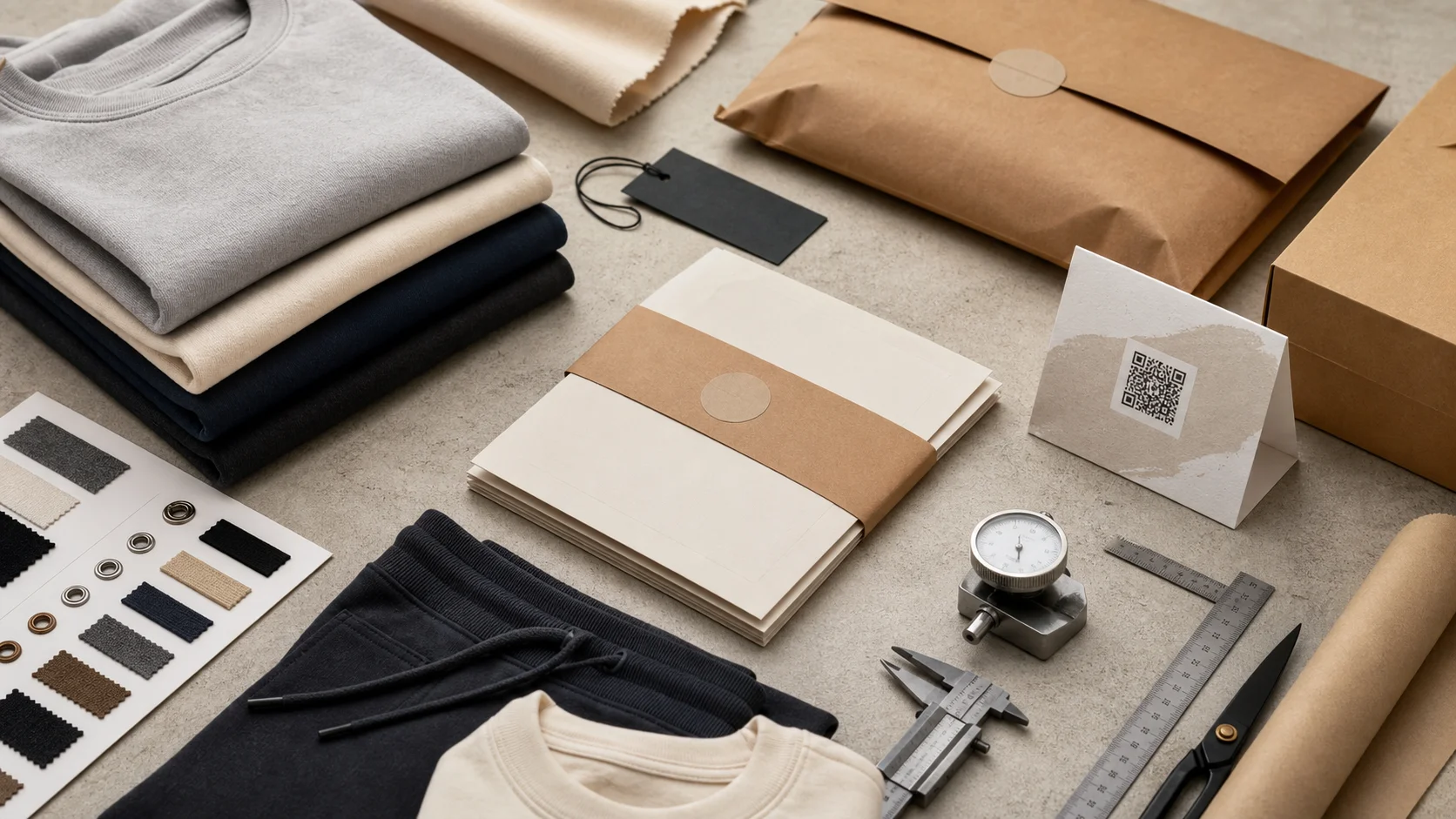
Private Label Packaging for Fashion Brands with checks for samples, fit, MOQ, QC evidence, pricing terms, and delivery risk.
Fast answer: Private Label Packaging for Fashion Brands: Costs, Timing should be judged by production evidence, not by a generic sourcing promise. The buyer needs sample proof, cost breakdowns, QC checkpoints, and delivery buffers in writing.
Ask for recent sample photos, measurement tolerances, fabric or print test assumptions, decoration test notes, packing examples, and a named inspection checkpoint. These details show whether the team can repeat an approved sample at bulk volume.
Separate garment cost, decoration, labels, packaging, sampling, testing, freight, and rush charges. When every cost line is visible, it becomes easier to reduce colorways, adjust size depth, or reserve more time for sampling.
The wrong box can torch a margin faster than a bad fit. In private label packaging for fashion brands, the damage rarely looks dramatic at first; it hides in claims, re-ships, and oversized cartons that cost too much to send and too much to store. I’ve watched a $14 tee line go underwater because the mailers split in transit. I’ve also seen a $68 blouse brand spend so much on rigid boxes that the packaging looked luxurious right up until it arrived crushed. First orders are delicate. The packaging math is even more delicate. And it’s why, in Guangzhou and Ho Chi Minh City, inspection teams study 80-ton die-cutting press reports, UV coating tables, and hot foil units to make sure C1S board folds without splitting, especially when those cartons then spend 18-22 business days en route to U.S. fulfillment centers.
I still shudder when I remember the Dhaka converter who quoted $2.50-4.00 per unit at a 500 MOQ for a laminated mailer with a magnetic flap, yet no WRAP or BSCI documentation accompanied the run, so customs held the cartons and the margin evaporated. That is how fragile first orders really are.
Shelf test. Shipping test. Not the same thing. In Guangzhou I watched a Bobst die cutter drop sleek boxes from 1.5 meters after UV varnish and rotogravure print, and the glossy option failed even though it made the showroom catalog.
A carton can photograph beautifully in a showroom and still fail after 600 miles on a parcel belt. A poly mailer can look plain on a table and still beat a rigid box in a 3 kg carton stack. When I visited factories in Vietnam, specifically in Ho Chi Minh City, I saw fast-fashion buyers choose 90 gsm kraft mailers printed on a 12-color flexo press because they kept freight low and fit 500-unit MOQs. In Istanbul, premium labels were using 1200 gsm rigid boxes with soft-touch laminate and foil-stamped logos, then shipping them in outer shippers that added $0.40 to $0.90 per unit. Lovely finish. Unlovely economics.
Europe tends to reward restraint. North American DTC brands often chase the unboxing moment, even when average order value sits at $42. In Asia, especially in export factories, buyers care more about compression strength, barcode clarity, and carton fit than ribbon or foil. None of that is abstract. A boutique swimwear brand in Los Angeles spent $1.85 per set on packaging, then lost 11% of its margin because the cartons were 18% larger than needed. Wrong shipper size, and private label packaging for fashion brands stops being a savings story very quickly.
Packaging is not a decorative afterthought. It is a cost center, a damage barrier, and a brand signal all at once.
Rigid boxes tend to serve luxury and gifting, while folding cartons tackle accessories, socks, small leather goods, and intimates. Poly mailers are the workhorse for e-commerce apparel because they cost $0.06 to $0.22 each in volume and weigh almost nothing. Garment bags protect hanging product in wholesale, showroom, and boutique deliveries. For bras and delicate sets, I often point brands to custom bra manufacturing because packaging and product engineering need to match the same support expectations. I’ve seen 100% recycled kraft garment bags and GRS-certified polyester dust covers run through a Heidelberg varnishing line before being tied with GOTS-certified cotton ribbon.
I break packaging down into three jobs. First, it protects fabric from moisture, compression, and dye transfer. Second, it merchandises the product so the buyer understands value in five seconds. Third, it signals the brand through color, texture, and print finish. A matte folding carton with one-color ink can feel cleaner than a glossy box with three metallic inks if the positioning is sharp. I’ve seen that with a $24 activewear line and a $180 knitwear line. The expensive package did not win. The clear one did.
Plain materials can outperform flashy ones in transit. Kraft mailers with a strong seal and the right caliper often survive parcel handling better than laminated mailers with weak adhesive strips. In a Guangzhou factory, I watched two samples go through drop testing from 1.2 meters on a DuPont compression table. The embellished mailer split at the side seam. The plain one held. That matters across channels. Marketplaces punish damage quickly. Boutiques care about finish. Wholesale buyers care about carton efficiency and consistent labeling.
Apparel and accessories expect different things. T-shirts can travel in thin mailers or folding cartons. Luxury outerwear may need tissue, hangtags, and a reinforced carton. Footwear needs structure, venting, and shoe-size coding. The package should fit the channel, not the fantasy. Oversized boxes look premium until freight eats the margin and slower delivery annoys the customer anyway.
Every raw material choice carries a trade-off: recycled paper, virgin stock, plastic mailers, or mixed-material formats. Recycled content usually costs 5% to 18% more than virgin stock at small volumes, and print contrast can be a bit duller. FSC paper helps buyers document fiber sourcing, while compostable mailers can be 20% to 40% more expensive than standard polyethylene mailers and often underperform in moisture resistance. Data from OEKO-TEX and Textile Exchange shows how fast sustainability claims need traceable inputs, not just green ink on a box. When I audit a supplier, I want to see OEKO-TEX Standard 100 swatches, GOTS cotton ribbon tags, and GRS certificates before endorsing the packaging plan.
Factories rarely carry every eco option in the brochure. They stock what can be sourced in two to four weeks, at the MOQ the market will actually absorb. I’ve seen brands ask for recycled mailers at 300 units, then wait six weeks because the mill required 5,000 units of a custom gauge. That is not a strategy. It is wishful procurement. A manufacturer with a real production plan will explain what can be made in bulk, what is available wholesale, and what is realistic at a low MOQ. Virgin paper can make sense for premium cartons because it prints cleaner, folds more crisply, and handles embossing better. For budget brands, recyclable mono-material mailers can cut waste without adding the split rate that compostable blends sometimes bring.
Mixed-material traps are common. A box lined with plastic film, sealed with metallic tape, and wrapped in a glossy sticker cannot be called recyclable in any honest way. I’ve seen premium labels overspend on green signaling with seed paper inserts and cotton ribbon, then ignore the fact that the package needed three material streams and a manual assembly step. On the other side, cheap brands underinvest in recyclability and use black plastic mailers that complicate sorting. Same mistake, different budget. Lower waste comes from fewer materials, stronger specs, and packaging that fits the product in the first place.
Buyers should start by asking for recycled content, FSC certification, and proof of print adhesion. Prioritize moisture resistance for transit, especially on sea freight or humid routes. A carton that fails at the dock is not sustainable; it becomes scrap. The most useful sustainability claim is the one that cuts damage, rework, and double shipping. Look for WRAP, BSCI, and OEKO-TEX Standard 100 audits in the supplier dossier, and require a GRS report if recycled polyester liners show up.
A strong brief makes the supplier's job narrower and the quote more reliable. For private label packaging for fashion brands, include the target customer, sales channel, expected order quantity, size range, decoration needs, packaging requirements, and delivery market. Then call out the details most likely to affect the result, especially material grade, print tolerance, and barcode size.
The brief should also explain what cannot change. Some brands care most about hand feel, some about price, some about launch timing, and some about retail compliance. When those priorities are not written down, suppliers tend to optimize for whatever is easiest to quote. Clear priorities help the factory make better tradeoffs before the first sample is cut or printed.
Ask the supplier to respond with assumptions, not just a price. A useful reply states MOQ, sample route, production capacity, inspection plan, packing method, and freight handoff. If the answer is vague, the project may still work, but it needs a tighter pre-production stage before money and calendar pressure build up.
The best time to catch problems is before the pre-production sample is approved. Check measurements, color, placement, material behavior, shrinkage, construction, labels, and packaging in the same review instead of approving each item in isolation. Many bulk issues are not caused by one dramatic mistake; they come from several small unchecked assumptions.
For private label packaging for fashion brands, pay special attention to folding method, pack-out sequence, and retail compliance. These details often look minor in an email but become expensive once cutting, printing, sewing, packing, or shipping begins. A simple checklist with owner, due date, and approval status keeps the brand team and factory aligned.
Bulk production should not start until the supplier can explain how the approved sample becomes a repeatable production standard. That means reference sample storage, line instructions, inline checks, final inspection, and defect handling. A factory that can describe this process clearly is usually safer than one that only promises speed.
Price differences are useful only when the quotes cover the same work. Compare sample cost, material source, trims, decoration, packaging, testing, inspection, and freight assumptions. A low unit price can become expensive if it excludes items the brand needs before launch.
Timeline promises deserve the same scrutiny. Ask what happens if the first sample needs revision, whether materials are in stock, when the production slot is reserved, and how export packing is handled. The most reliable supplier is often the one that gives a realistic calendar instead of the fastest optimistic answer.
Before making the final decision, write down the specification, approval owner, delivery expectation, and the one or two risks that would cause the most trouble if missed. For private label packaging for fashion brands, this usually means checking material grade, print tolerance, barcode size, and the support process after the order is placed.
This last review does not need to be complicated. It simply makes the decision easier to repeat, easier to explain, and easier to verify when the finished product or jewelry arrives.
One useful way to pressure-test the decision is to ask what would happen if the order had to be repeated in six months. The answer should still be clear: the same material grade, the same print tolerance, the same acceptance standard, and the same communication path. If a second order would depend on memory or guesswork, the first order is not documented well enough yet.
Another useful check is to separate preference from requirement. Preference is the look, wording, or finish the brand likes. Requirement is the measurement, tolerance, certificate, material, or delivery condition that cannot fail. Good buying decisions keep both visible, so the final choice is not pushed around by the last email, the cheapest quote, or the prettiest sample photo.
Finally, ask who owns each approval. A project with one accountable owner for sample review, one owner for final content or artwork, and one owner for delivery sign-off usually moves faster than a project where every decision is shared loosely across a team. Clear ownership reduces delays and makes the finished result easier to judge.