
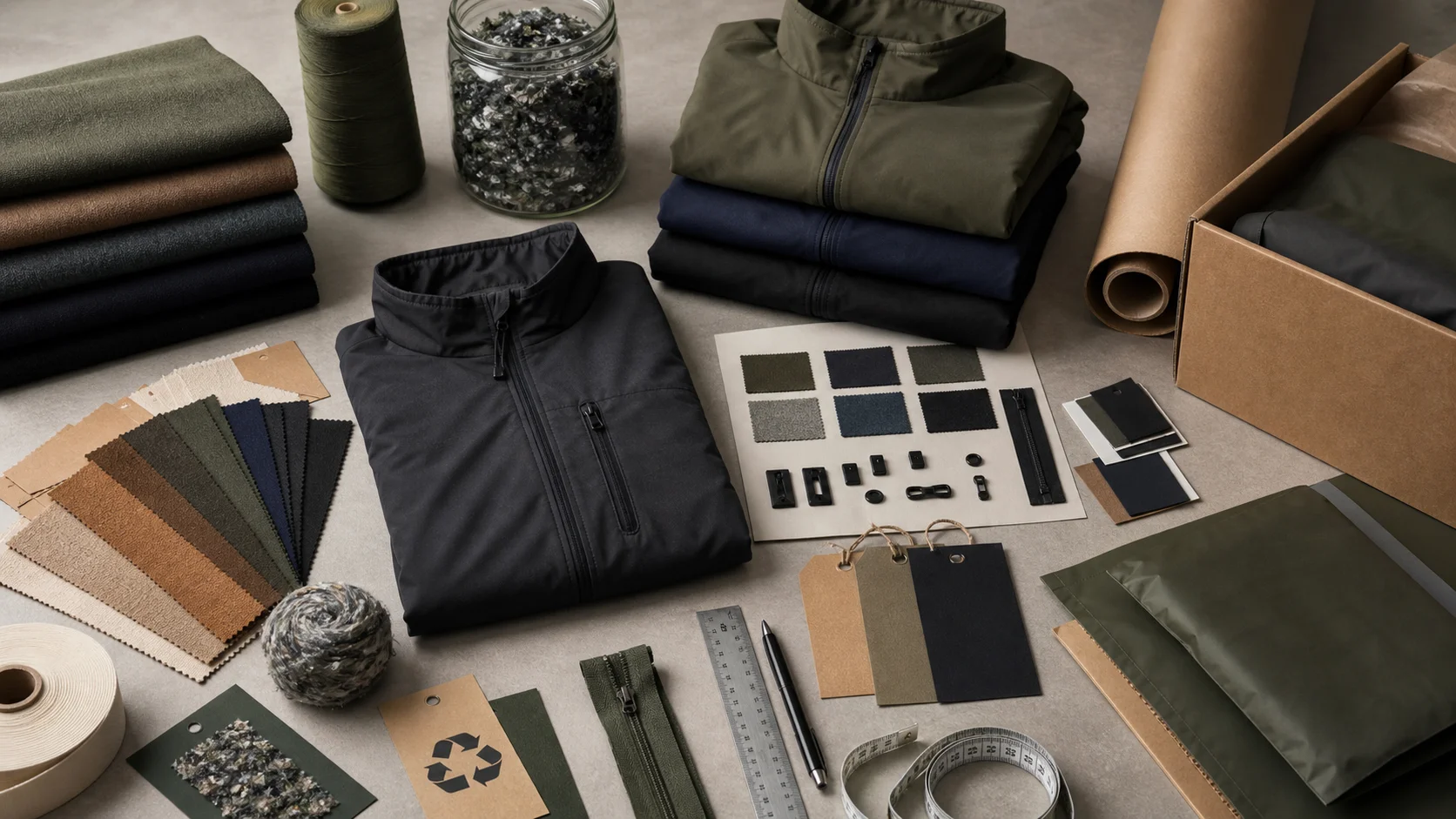
Private Label Packaging Supplier for Clothing Brands compared by sample evidence, fabric or trim specs, MOQ, AQL terms, cost lines, delivery timing, and...
Fast answer: Private Label Packaging Supplier for Clothing Brands: Material, Print, MOQ, and QC Terms should be judged by production evidence, not by a generic sourcing promise. The buyer needs sample proof, cost breakdowns, QC checkpoints, and delivery buffers in writing.
Ask for recent sample photos, measurement tolerances, fabric or print test assumptions, decoration test notes, packing examples, and a named inspection checkpoint. These details show whether the team can repeat an approved sample at bulk volume.
Separate garment cost, decoration, labels, packaging, sampling, testing, freight, and rush charges. Clear cost lines make it easier to reduce colorways, adjust size depth, or reserve more time for sampling.
A crushed mailer can make a $58 hoodie feel like an $18 mistake. Wrinkled tissue, a peeling sticker, or a carton that caves in before the customer reaches the hem can ruin the first impression. I have seen it across 200+ factories in 8 countries, including Guangzhou, Dhaka, Ho Chi Minh City, and Istanbul, and the difference between a private label packaging supplier for clothing brands and one that only prints cartons shows up fast, usually in the first 10 seconds. And it still stings when a fresh delivery looks amateurish.
Damage is never just damage. One bad shipment in 100 can trigger a support spike, and each complaint or reshipment can eat 8-12 minutes from a service team. Premium unboxing has also pushed repeat purchase intent up by measurable points for several DTC brands, sometimes 10-20% in post-purchase surveys. Packaging is not decoration. It protects margin, cuts return friction, and tells buyers whether the brand understands quality, custom presentation, and cost control. That ripple is real.
In Guangzhou, Istanbul, and Vietnam, the contrast was hard to miss. Some suppliers operated like high-volume print shops: 50,000 units at a time, thin board, quick turnaround, and loose print consistency, often relying on average-speed offset presses. Others ran tighter production lines, smaller batches, stronger adhesive from Henkel, better registration from Heidelberg Speedmaster CD 102 runs, and less color drift across 3-4 reprints. One carton collapsed under 8 kg of stacked pressure after a 90-minute compression test performed on a Mecmesin MultiTest, while another held shape after 12 kg—all after undergoing a Bobst die-cut and hot-foil process. That matters when cartons sit in a warehouse for 2-3 weeks before fulfillment. Bottom line, you can feel the difference.
Clothing brands still treat packaging like a side note. Bad move. And it sits inside landed cost, affects shrinkage, and shapes how wholesale partners judge the line. A brand selling $24 basics and a brand selling $180 outerwear should not buy the same packaging. The question is not whether to spend. It is which private label packaging supplier for clothing brands can match brand position, order volume, MOQ, and sustainability targets—including WRAP and OEKO-TEX Standard 100 compliance—without turning every shipment into a gamble.
Private label packaging is built around one brand’s rules, not pulled from a shelf and slapped with a logo. A private label packaging supplier for clothing brands may produce branded bags, boxes, tissue, hangtags, mailers, and inserts using your size, your artwork, and your closure method. In practice, that can mean a 250 gsm folding carton with matte aqueous coating printed via a UV-flexo press and finished with a Komori infrared drying line, or a 60 micron GRS-certified recycled PET polybag with a suffocation warning and custom barcode window cut on a Bobst 106 ER die cutter.
Stock packaging is quicker and cheaper at low volumes, but control gets thinner. Private label packaging usually asks for higher minimum order quantities, longer sampling, and more coordination, yet it gives the brand more authority over presentation and compliance. A supplier that also handles dielines, sample rounds, freight booking, and carton consolidation saves weeks of back-and-forth. That difference shows up when a launch date is fixed and the production window is only 21-28 days (often stretching to 18-22 business days once you factor in post-approval revisions).
Think folding cartons first, then rigid boxes, compostable mailers, garment bags, polybags, stickers, tissue paper, and thank-you cards. Each one sits at a different point in the chain. Packaging must fit production, because mis-sized bags slow packing lines. It must fit fulfillment, because oversized mailers raise parcel rates. It must fit returns, because weak packaging increases the odds of damaged goods coming back in unsellable condition.
Last year I worked with a brand that moved from generic polybags to branded mailers and inserts tied to private label clothing. Their carton damage rate dropped from 2.3% to 0.8% over 4 months, and their customer service tickets about missing or crushed items fell by nearly a third. Packaging can do that when it is designed as part of the operating system, not a last-minute marketing add-on. The win felt overdue.
Start with physical performance. Material thickness, color consistency, coating options, closure strength, carton crush resistance—compare all of it before price enters the room. A 200 gsm paper mailer may sound adequate until it tears on a wet receiving dock, while a 250-300 gsm SBS board with reinforced seams and a high-strength water-based adhesive survives a 5-7 day transit and rough warehouse handling. I also check print registration on machines such as the Heidelberg CX 102. A logo shifted by 2 mm looks sloppy on a $90 garment. So yeah, those millimeters matter.
MOQ tells you who the supplier is built for. In Guangzhou or Ho Chi Minh City, folding cartons often start at 1,000-3,000 pieces and polybags at 5,000-10,000 pieces. In Istanbul or the United States, the starting point may be 250-1,000 pieces, but unit cost can rise 15-40%. Smaller brands pay more per unit because setup time is spread across fewer cartons, fewer plates, fewer sheets. That is normal. Pretending otherwise leads to bad forecasts. And you just have to plan for it.
Timeline matters as much as price. A realistic sequence looks like this: 3-5 days for artwork and dieline confirmation, 7-14 days for samples (often involving salt spray or tack tests), 10-25 days for production, 5-30 days for shipping depending on origin. Air freight can cut transit to 3-7 days, but it can add $1.20-$4.50 per kg. For a launch tied to a seasonal drop, those days are not cosmetic. They decide whether inventory arrives before marketing spend starts. No wiggle room.
On sustainability, I want evidence, not slogans. According to FSC, chain-of-custody documentation tracks responsible fiber through the supply chain. Standards and testing frameworks from ISO also matter when a supplier claims process control. For textile-focused packaging and materials, see Textile Exchange and OEKO-TEX for additional guidance. Ask for recycled content percentage, FSC certification, compostability standards, and recyclability by market. A paper mailer that is recyclable in Germany may not be accepted in another market if it has a mixed-material window or too much coating. Demand documentation for GOTS, OEKO-TEX Standard 100, WRAP, BSCI, and GRS if the supplier claims vertically integrated textile or fiber sourcing. Proof, please.
Good suppliers send a spec sheet, a test report, and a refusal to overpromise. Weak ones send glossy photos and hope no one asks how a 120 micron film passed a tear test. If a supplier cannot tell you adhesive type, board caliper, or print tolerance, move on.
Low-tier packaging is built to communicate, not impress. A basic printed poly mailer often lands around $0.12-$0.35 per unit at 5,000-10,000 pieces, while a simple folding carton may sit near $0.35-$0.
A strong brief makes the supplier's job narrower and the quote more reliable. For private label packaging supplier for clothing brands, include the target customer, sales channel, expected order quantity, size range, decoration needs, packaging requirements, and delivery market. Then call out the details most likely to affect the result, especially material grade, print tolerance, and barcode size.
The brief should also explain what cannot change. Some brands care most about hand feel, some about price, some about launch timing, and some about retail compliance. When those priorities are not written down, suppliers tend to optimize for whatever is easiest to quote. Clear priorities help the factory make better tradeoffs before the first sample is cut or printed.
Ask the supplier to respond with assumptions, not just a price. A useful reply states MOQ, sample route, production capacity, inspection plan, packing method, and freight handoff. If the answer is vague, the project may still work, but it needs a tighter pre-production stage before money and calendar pressure build up.
The best time to catch problems is before the pre-production sample is approved. Check measurements, color, placement, material behavior, shrinkage, construction, labels, and packaging in the same review instead of approving each item in isolation. Many bulk issues are not caused by one dramatic mistake; they come from several small unchecked assumptions.
For private label packaging supplier for clothing brands, pay special attention to folding method, pack-out sequence, and retail compliance. These details often look minor in an email but become expensive once cutting, printing, sewing, packing, or shipping begins. A simple checklist with owner, due date, and approval status keeps the brand team and factory aligned.
Bulk production should not start until the supplier can explain how the approved sample becomes a repeatable production standard. That means reference sample storage, line instructions, inline checks, final inspection, and defect handling. A factory that can describe this process clearly is usually safer than one that only promises speed.
Price differences are useful only when the quotes cover the same work. Compare sample cost, material source, trims, decoration, packaging, testing, inspection, and freight assumptions. A low unit price can become expensive if it excludes items the brand needs before launch.
Timeline promises deserve the same scrutiny. Ask what happens if the first sample needs revision, whether materials are in stock, when the production slot is reserved, and how export packing is handled. The most reliable supplier is often the one that gives a realistic calendar instead of the fastest optimistic answer.
Before making the final decision, write down the specification, approval owner, delivery expectation, and the one or two risks that would cause the most trouble if missed. For private label packaging supplier for clothing brands, this usually means checking material grade, print tolerance, barcode size, and the support process after the order is placed.
This last review does not need to be complicated. It simply makes the decision easier to repeat, easier to explain, and easier to verify when the finished product or jewelry arrives.
One useful way to pressure-test the decision is to ask what would happen if the order had to be repeated in six months. The answer should still be clear: the same material grade, the same print tolerance, the same acceptance standard, and the same communication path. If a second order would depend on memory or guesswork, the first order is not documented well enough yet.
Another useful check is to separate preference from requirement. Preference is the look, wording, or finish the brand likes. Requirement is the measurement, tolerance, certificate, material, or delivery condition that cannot fail. Good buying decisions keep both visible, so the final choice is not pushed around by the last email, the cheapest quote, or the prettiest sample photo.
Finally, ask who owns each approval. A project with one accountable owner for sample review, one owner for final content or artwork, and one owner for delivery sign-off usually moves faster than a project where every decision is shared loosely across a team. Clear ownership reduces delays and makes the finished result easier to judge.
The finished result should be judged against the approved standard, not against a vague idea of what looked good at the start. Compare the delivered item with the approved sample, written specification, photos, and any measurement or certification notes. If the result meets those points, the project is easier to reorder and easier to improve later.
If something is off, record it in practical terms: where the issue appears, how often it appears, whether it affects use, and what change would prevent it next time. That turns a complaint into a useful production note and helps the next order become more consistent.