
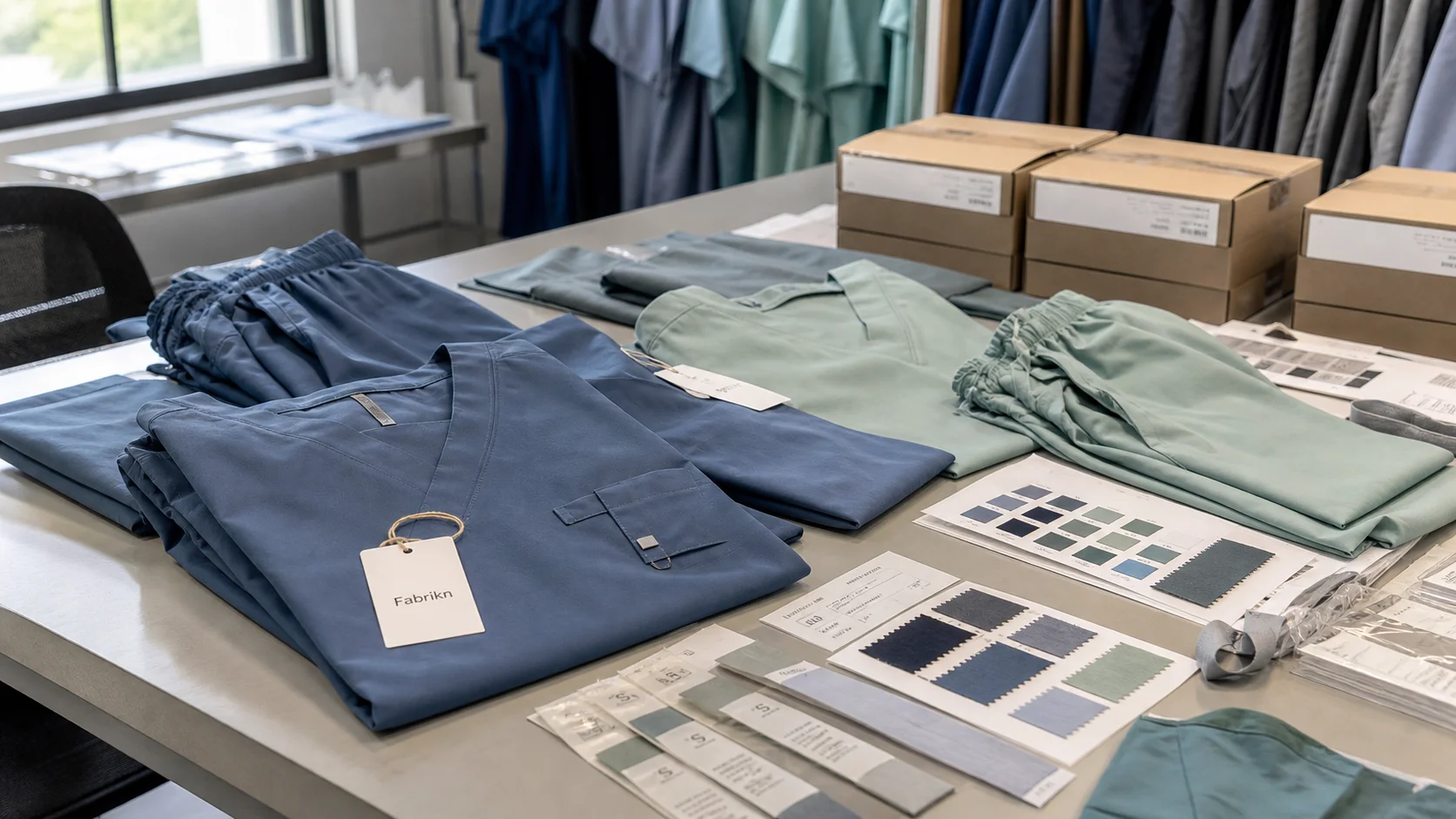
A focused outline for medical startup founders evaluating private label scrubs MOQ, branding details, and production decisions needed to launch a scrub line without overbuying.
Private Label Scrubs MOQ for Startup Brand Launches - Fabrikn production reference
For a startup entering the medical apparel segment, MOQ is one of the first hard numbers that shapes the entire launch plan. In private label production, MOQ means the minimum order quantity a manufacturer requires before moving a scrub style into bulk cutting, sewing, finishing, labeling, packing, and shipment.
In plain purchasing terms, MOQ is not just a factory preference. It is a cost-control mechanism tied to fabric booking, trim sourcing, line setup time, marker efficiency, labor planning, and packaging preparation. If a startup brand wants private label scrubs with custom fit, branded labels, size grading, color consistency, and logo decoration, the MOQ usually rises compared with a basic blank garment order.
This matters even more for medical startup brand launches because scrubs are rarely a single-SKU product. A usable opening range often includes at least a top and pant, several sizes, one or more core colors, and some form of branding. Even a modest product plan can multiply unit counts quickly.
Buyers should treat MOQ as a planning variable, not just a hurdle. A low MOQ can reduce inventory pressure, but it may raise unit cost, narrow fabric choices, and limit decoration options. A higher MOQ can unlock better pricing and stronger consistency, but only if the launch forecast is realistic.
Startup medical brands usually have three competing priorities: keep cash exposure manageable, present a credible branded product, and launch quickly enough to test the market. MOQ sits in the middle of all three.
If the order is too small, the brand may end up paying a premium for every custom detail. If the order is too large, the business risks tying up cash in slow-moving stock. Scrubs can look straightforward, but sizing depth and fit expectations create real inventory complexity. A startup may assume 300 sets is conservative, then discover that size ratios were wrong and the remaining stock is stuck in less popular sizes.
There is also a credibility issue. Medical buyers, clinics, and healthcare professionals tend to notice quality consistency faster than casual consumers. Uneven color matching between tops and pants, poor embroidery placement, twisting side seams, or rough care labels can damage a young brand quickly. That means startups cannot focus on MOQ alone. They need an MOQ structure that still supports stable production control.
The practical goal is not to find the absolute lowest MOQ. It is to find the lowest MOQ that still allows acceptable quality, repeatability, and margin.
MOQ varies by factory type, fabric sourcing method, and product complexity, but some broad market ranges are useful for planning. These figures are not universal commitments. They are working benchmarks buyers can use during supplier comparison.
Production Type Typical MOQ Range Notes Blank scrubs with relabeling 100-300 pieces per style/color Often the easiest entry point for startups Private label using stocked fabric 200-500 pieces per style/color MOQ depends on available fabric shades and trims Custom-dyed fabric scrubs 500-1000+ pieces per color Dye lot minimums often drive the number Scrubs with embroidery or print branding 250-600 pieces per style Decoration setup and placement approvals affect feasibility Performance scrubs with special trims 500-1500+ pieces Stretch fabric, antimicrobial claims, and custom packaging can increase MOQFor a startup launch, the most realistic MOQ path is often a stocked-fabric private label program rather than a fully custom fabric development route. This reduces dyeing minimums and shortens sourcing timelines. It also gives the buyer a clearer idea of repeat order feasibility.
Some suppliers quote MOQ per style, others per color, and others per total order split across a collection. That distinction matters. A 300-piece MOQ sounds manageable until it becomes 300 pieces for the top and another 300 for the pant in each color. Buyers should always ask the supplier to break the MOQ down at SKU level.
If you are evaluating broader production support beyond MOQ and customization structure, it helps to compare the available manufacturing scope through pages such as /services/ before requesting detailed quotations.
MOQ in scrub manufacturing is driven by a mix of technical and commercial factors. Some are visible in the quote. Others only appear after the supplier reviews the tech pack.
Fabric is usually the biggest MOQ lever. If the factory already holds a suitable scrub-weight fabric in a standard blend such as polyester/rayon/spandex or polyester/cotton/spandex, MOQ can stay relatively low. If the buyer needs a custom GSM, stretch level, weave, finish, or color match, the minimum often rises because mills have their own production thresholds.
Typical scrub fabrics for startup launches fall around 140-220 GSM depending on hand feel, opacity, and stretch target. Lightweight fabric may reduce cost, but it can create transparency issues in light shades. Heavier fabric can improve durability and drape, though it may feel warm in long shifts.
Three launch colors create more complexity than many startups expect. Navy, ceil blue, and black are common commercial choices, but each may require separate fabric availability confirmation, dye-lot control, and matching thread decisions. If the fabric is piece-dyed to order, each color can trigger its own minimum.
A simple V-neck top with chest pocket and straight-leg pant is easier to run at lower MOQ than a modern jogger set with multiple utility pockets, knit cuffs, contrast panels, and zipper compartments. More pattern pieces and operations mean more setup cost and greater defect exposure.
Woven main labels, printed care labels, size tabs, branded drawcord tips, zipper pulls, hangtags, barcode stickers, polybags, and cartons all affect purchasing thresholds. Individually these may seem minor. Together they can push an order beyond a startup-friendly level.
Extending into XXS through 5XL is commercially smart for inclusivity, but it complicates fabric consumption, grading, and ratio planning. Some suppliers accept broad size runs at the same MOQ. Others expect additional volume to support efficient cutting and marker utilization.
Since this topic sits in Decoration & Printing, it is worth being direct: branding method can change the economics of a private label scrub launch more than many new buyers realize.
Embroidery is common for scrub tops, sleeve branding, and chest logos. It gives a professional look and is familiar to medical buyers. Still, it adds setup, thread matching, backing selection, placement approval, and potential puckering risk on lighter stretch fabrics.
Embroidery can work on lower MOQs than all-over printing, but buyers should confirm whether the supplier charges a one-time digitizing fee, a repeat setup fee, or a per-thousand-stitch rate. Small left-chest logos are usually practical. Large or dense embroidery on performance scrubs can distort the fabric and affect comfort.
Screen printing is less common for core scrub uniforms than for promotional medical apparel, but some startup brands use it for underscrubs, warm-up jackets, or event capsules. It can be cost-effective at moderate volume if artwork is simple and color count is limited. Complex multi-color prints or small runs tend to weaken the cost advantage.
Heat transfers, reflective details, and silicone badges can create a cleaner athletic look. They also introduce wash-performance questions. Buyers should request wash testing standards before approval, especially if the garments will face frequent industrial or high-temperature home laundering.
For most everyday scrub launches, sublimation is not the default route unless the brand has a strong graphic concept or is producing printed tops. MOQ may depend on print layout efficiency, fabric base compatibility, and cutting yield. This option can look distinctive, but color repeatability and hand feel need close review.
The key judgment is simple: decoration should support the brand story without creating a mismatch between launch volume and manufacturing complexity. For most startup scrub labels, restrained embroidery or clean relabeling is the safer first step than aggressive custom decoration.
The best startup launches are usually built backward from MOQ rather than forward from a large product wish list. That means deciding which details matter most commercially and trimming the rest.
A practical opening assortment often looks like this:
This approach keeps the line credible without spreading units too thinly across too many combinations. If the supplier MOQ is 300 pieces per style/color, two styles in two colors already produce a meaningful opening quantity. Adding a third style or excessive color variety too early can create dead inventory even when the total order appears reasonable on paper.
Buyers should also separate “launch essentials” from “phase two features.” Custom contrast bar tacks, printed pocket linings, branded elastic, and premium retail boxes can wait until reorder volume proves demand.
Many startups benefit from discussing their phased product roadmap before locking specifications. A supplier introduction page such as /about-us/ can help clarify whether the production partner is positioned for small-batch launch support or primarily structured for larger-volume programs.
MOQ discussions are incomplete without sample control. A startup can accept a workable MOQ and still run into expensive problems if the sample approval process is loose.
A disciplined scrub development path usually includes these stages:
For scrubs, fit approval deserves special attention because the garments need both professional appearance and shift-long mobility. Startups often focus on chest, waist, and inseam while overlooking armhole comfort, back reach, rise balance, thigh ease, and pocket strain points.
Pre-production approval should confirm more than measurements. It should also lock in fabric composition, GSM tolerance, shrinkage expectations, color standard, stitch density, logo placement, label artwork, packaging method, and carton assortment. If these are not documented before bulk production, MOQ savings can disappear through remakes, claims, or unusable stock.
Startups often ask for low MOQ, fast lead time, and full customization in the same inquiry. In practice, manufacturers usually treat those three requests as competing priorities.
Lower MOQ generally means higher unit cost. The factory spreads development time, cutting loss, and line setup across fewer units. Fast lead time may be possible with stocked fabric and simple branding, but not always with custom-dyed materials or special trims. Full customization improves brand differentiation, yet almost every custom component adds purchasing and approval time.
Typical lead times vary widely, but these planning ranges are common:
Shipping mode matters as well. Air freight may rescue a launch calendar, but it can heavily compress margin on bulky apparel orders. Sea freight lowers logistics cost but increases planning pressure and makes reorders less flexible.
The sound purchasing move is to decide which two priorities matter most. A startup may choose low MOQ and decent speed, accepting less customization. Another may choose stronger branding and better cost, accepting a larger opening order and slower launch.
In scrub production, small technical misses become visible quickly because the garments are washed often, worn for long hours, and compared side by side across teams.
Check pilling resistance, colorfastness, shrinkage, stretch recovery, and opacity. Performance claims should not be accepted casually. If antimicrobial, moisture management, or easy-care claims are part of the brand positioning, request supporting test references and confirm whether the claim applies to the fabric finish, the fiber content, or only marketing language.
Tops and pants sold as a set need shade consistency. Mixed dye lots are a frequent complaint area, especially on navy and ceil blue. Buyers should confirm whether bulk fabric comes from the same dye lot for paired items where possible.
Embroidery tunneling, cracked heat transfers, off-center logos, and inconsistent placement across sizes are common production issues. Approval should include exact placement measurements from fixed points, not just marked sample photos.
Scrubs need size consistency because healthcare professionals often reorder the same fit. A good-looking medium sample does not guarantee a balanced full size run. Size sets help catch grading problems before bulk cutting is complete.
Mislabeling is more common than many startups expect. Wrong size stickers, swapped care labels, or barcode mismatches create fulfillment problems that are expensive to correct later. Final packing lists and carton assortment rules should be approved in writing.
MOQ negotiation works best when the buyer gives the supplier a rational production plan instead of a vague request for “the lowest possible minimum.”
A stronger approach is to ask questions like:
This kind of discussion gives the factory room to propose alternatives. In many cases, MOQ can be reduced by simplifying decoration, using available fabric shades, standardizing packaging, or limiting the initial size range to the most commercial spread.
Buyers should still be cautious. An extremely low MOQ quote is not automatically a good sign. It may indicate that the supplier is assuming lighter specifications, subcontracting without clear controls, or expecting later price adjustments once development begins.
If a startup needs reliable launch inventory, the most useful supplier is not the one promising everything at the smallest quantity. It is the one clearly explaining what is feasible, what changes the MOQ, and where quality risks begin.
The right partner for private label scrubs is not always the factory with the biggest scale. For startup brand launches, supplier fit depends on communication quality, sample discipline, transparency on MOQ logic, and willingness to align product scope with commercial reality.
Ask for clarity on these points before placing a deposit:
It is also sensible to confirm the communication path for technical questions. Startups often move faster when they can discuss fit comments, decoration placement, and packaging revisions clearly before bulk begins. For direct inquiry on project specifics, a page such as /contact-us/ is the logical next step once the launch brief is organized.
In commercial terms, the best early-stage scrub program is usually not the most customized one. It is the one that gives the brand repeatable quality, controlled MOQ, acceptable landed cost, and a clean path to reorders. That is how startup medical labels build credibility without overextending inventory.
Get a free quote from Fabrikn — your trusted B2B clothing manufacturer with 10+ years of experience. MOQ as low as 200 pieces.
Get a Free Quote →A workable starting point is often 200-500 pieces per style or color program, depending on whether the fabric is stocked and how much customization is involved. Very small MOQs may be possible for relabeling programs, but customization options are usually more limited.
Yes, in many cases, but the result depends on logo size, placement, fabric type, and whether the base garment uses stocked materials. Small chest embroidery is usually more practical than large or dense stitched graphics on stretch fabric.
Custom fabric often triggers mill minimums for dyeing or knitting, plus added approval steps such as lab dips and fabric testing. That pushes the total volume requirement above what a basic stocked-fabric program needs.
It varies by supplier. Some quote per individual garment piece, while others discuss a coordinated top-and-pant program. Buyers should always ask for the MOQ at SKU level so the total commitment is clear.
Sampling can take 1-3 weeks, while bulk production often takes 30-60 days after final approval. Custom fabric, complex trims, or seasonal production congestion can extend timelines beyond that range.
Start with a narrow assortment: one top, one pant, a few commercial sizes, and two core colors in a stocked fabric program. Keep branding clean and practical. That usually gives the best balance of MOQ control, speed, and reduced inventory risk.