
Plan a 2500-word SEO article focused on private label workwear coats for contractor brands, covering coat types, performance specs, decoration methods,...
Private Label Workwear Coats Wholesale for Contractors - Fabrikn production reference
Contractor brands do not buy workwear coats the same way fashion labels buy outerwear. The priority is durability, repeatable quality, practical sizing, branding space, and a supply chain that can handle reorder cycles without creating fit drift or trim inconsistency. Private label workwear coats wholesale sits in that middle ground between industrial utility and brand presentation. The coat has to perform on site, hold up in cold and abrasive conditions, and still carry a contractor’s identity in a way that looks credible to crews, buyers, and distributors.
For sourcing teams, the real job is not just finding a factory that can sew a coat. It is finding a production partner that can consistently build around a spec, keep a stable fabric and trim package, support sample approvals, and ship repeat orders without surprise substitutions. That is where private label becomes useful. It gives contractor brands control over branding, labeling, and product positioning while keeping the manufacturing process anchored to a practical wholesale model.
Private label workwear coats are factory-made coats sold under the contractor brand’s name rather than the manufacturer’s name. The buyer usually defines the garment spec, branding method, packaging requirements, and size range, then places the order at wholesale pricing. This is a practical model for contractor brands that want a reliable outerwear line without investing in their own sewing line or full in-house production team.
The main advantage is control. A contractor brand can choose shell fabric, lining, insulation level, cuff construction, pocket layout, reflective trim if required, embroidery placement, and label language. A brand can also adjust the offering by season. Heavy insulated coats can sit beside lighter softshell or canvas styles, giving the range enough breadth to cover jobsite conditions without turning the catalog into a fashion assortment.
Private label also helps with long-term sales discipline. Contractors and distributors tend to reorder what works. If the coat fits well, the zipper holds, the sleeves are cut properly, and the garment survives real use, the product can become a stable line item. That is why the wholesale model matters. It supports repeat production against a known spec instead of one-off custom work with no continuity.
Wholesale pricing matters in workwear because the product has to survive margin pressure from distributors, dealers, and jobsite purchasing. Contractor brands usually need a price ladder that leaves room for brand markup, channel margin, and freight. Private label wholesale allows cost control through fabric selection, trim standardization, and production scale.
The tradeoff is that cost savings only help if quality remains stable. A cheaper coat with weak stitching, poor zipper selection, or inconsistent fill distribution can cause claims and returns that erase any savings. For contractor brands, the right wholesale choice is usually the one that balances unit cost with dependable construction. A slightly higher FOB price is often easier to defend than a low-cost garment that fails after a season of hard use.
Wholesale sourcing also supports broader procurement planning. Buyers can align coat orders with other outerwear and uniform programs, reducing shipping fragmentation and making size planning more predictable. Where the brand sells to distributors, procurement managers often need dependable replenishment windows, clear carton packing, and stable size curves. Those details matter as much as the garment itself.
Not every contractor coat serves the same use case. The right private label assortment usually starts with a narrow base and expands only where demand is visible.
Insulated coats are the most common starting point for contractor brands in colder regions. They usually need heavier shell fabric, quilted lining, and a pocket layout that stays usable with gloves on. Canvas coats appeal when the buyer wants a tougher, more traditional jobsite look. Softshell styles are easier to wear during active work and are often favored when the garment will be layered over base and midlayers.
There is a practical buying judgment here. A broad catalog can look attractive on paper, but too many coat families create forecasting problems. A focused range of two or three styles is easier to maintain, easier to sample, and easier to explain to channel buyers.
The spec sheet drives most of the value in private label workwear coats. Contractors are buying performance, not just a silhouette. That means the fabric package needs to match the expected jobsite use.
Common shell fabrics include cotton canvas, cotton-poly canvas, polyester twill, nylon oxford, and bonded softshell constructions. For rugged coats, buyers often look for a heavier canvas or twill in the 8 oz to 12 oz range, though the right weight depends on whether the garment is insulated or unlined. Lighter shells may work for softshell or rain-resistant styles, but they usually need better pattern engineering to avoid feeling flimsy.
Insulation choices affect both warmth and bulk. Quilted polyester fill is common because it is cost-effective and easy to scale. Thicker fill gives warmth but can reduce mobility and complicate sleeve shaping, especially if the coat is expected to fit over layers. Fleece or brushed tricot linings can improve comfort, while nylon lining can reduce friction and help with easy on-off wear.
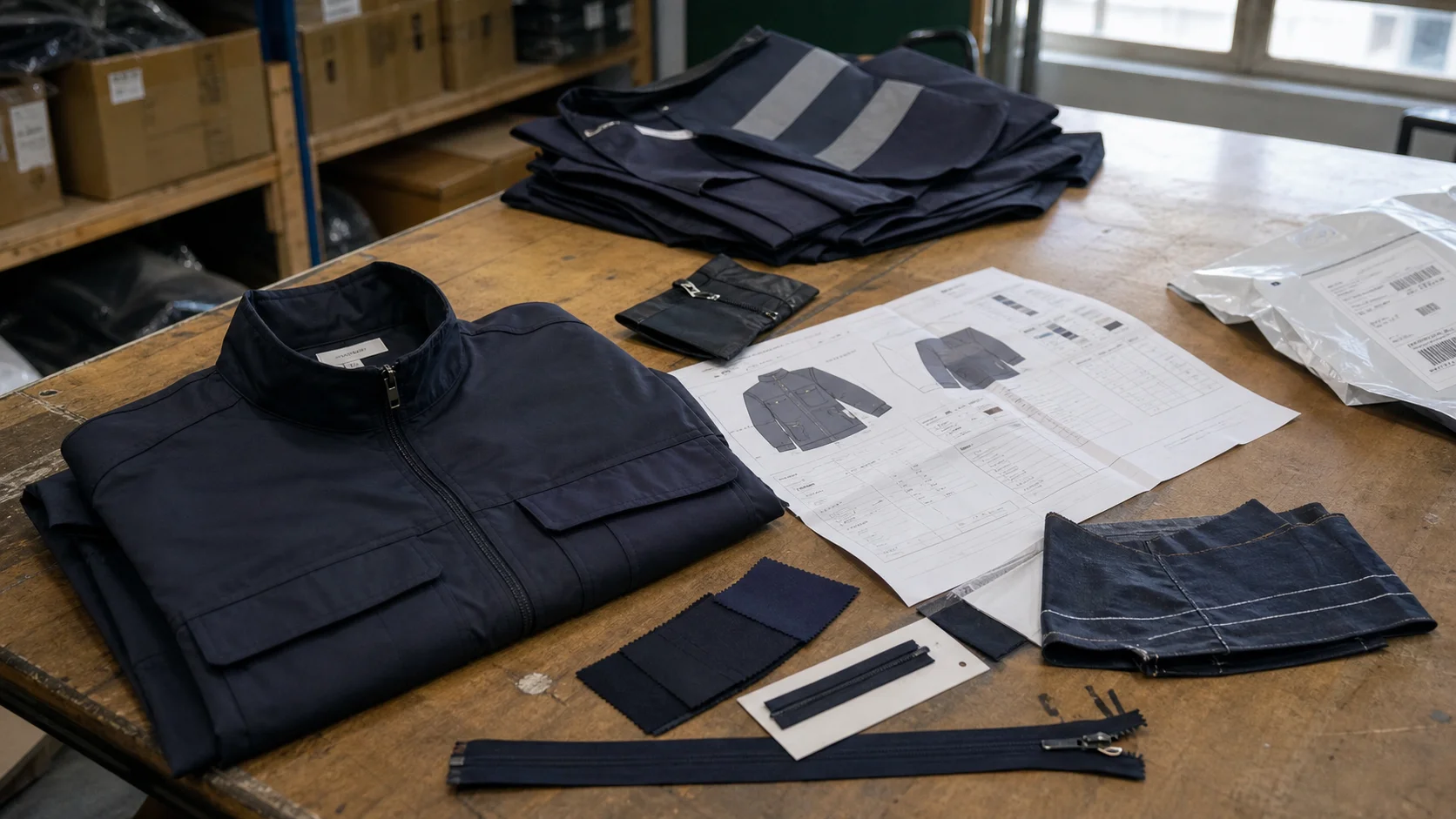
Trim choices are where many sourcing programs get into trouble. Zippers should be specified clearly by type, size, finish, and supplier quality level. Snaps, rivets, hook-and-loop closures, reflective tape, drawcords, and elastic components all need exact approval before bulk production. A vague trim brief often becomes a cost-control problem later, because factories will substitute to preserve margin unless the order documentation is precise.
Thread type, seam construction, bartacks, pocket reinforcement, and cuff finishing should be part of the conversation early. Workwear coats are handled roughly. If the stress points are not reinforced, the garment may pass visual inspection but still fail in use. That is not a minor issue for contractor brands. It affects reorder confidence.
Component Typical Spec Focus Buying Judgment Shell fabric Weight, weave, abrasion resistance, water resistance Choose durability first, then balance hand feel and cost Insulation Fill weight, loft, thermal retention Overbuilt warmth can hurt mobility and increase returns Zippers Gauge, puller style, corrosion resistance Do not downgrade zipper quality to save a small amount per unit Labels Woven neck label, size tab, care label, private label branding Keep branding clear but avoid clutter that confuses compliance labels Reflective trim Placement, width, compliance standard if required Only add if the end use justifies the cost and testing burdenMOQ depends on garment complexity, fabric availability, and whether the supplier is building from existing patterns or developing a new block. For private label workwear coats, typical MOQs often start around 300 to 500 pieces per color or style when using standard materials, and can move higher if the program requires custom fabric, special hardware, or compliance testing. Some factories will quote lower on a development basis, but that does not always translate into scalable repeat production.
Sampling should be treated as a structured approval process, not a courtesy step. A sensible sequence is first proto sample, then fit sample, then salesman sample or pre-production sample, followed by bulk approval after trim, size, and workmanship sign-off. If the coat includes embroidered logos, heat transfer, or printed branding, the decoration sample should be reviewed separately. The product can look correct in flat photos and still fail once worn, layered, or exposed to movement on site.
Lead time depends on several variables: pattern development, fabric sourcing, trim procurement, lab dips or shade approvals, sample revisions, production capacity, and inspection scheduling. Standard wholesale production may run 30 to 60 days after final approval when all inputs are ready, but custom programs can take longer. Fabric mills, not sewing lines, often drive the schedule. That is why a buyer should ask early whether the shell, lining, and trim are stock items or special-order components.
Inspection risk rises when the order is rushed. Shortcut scheduling tends to create problems in seam consistency, measurement tolerance, zipper alignment, and label placement. For contractor brands, it is usually better to protect the production calendar than to compress it for a marginal launch deadline.
Private label workwear coats can carry brand identity in several ways. The most common are woven neck labels, size labels, care and content labels, embroidery, woven chest tags, and hangtags. Some brands also use sleeve badges or rubber patches, but those should be chosen carefully. Decorative elements can make the coat feel more branded, yet they also add cost and may affect wear comfort in high-friction areas.
For contractor brands, the best branding is usually understated and durable. A clean woven label, a secure embroidery placement, and consistent packaging often do more than oversized decoration. In this category, buyers generally trust garments that look built for the job rather than styled for retail display.
Packaging should not be overlooked. Polybagging, size stickers, carton marks, and packing ratios can affect receiving efficiency. If the product ships into distribution, clear carton labeling and stable size assortments reduce warehouse mistakes. That is a small detail until the first mis-pick creates avoidable admin work.
Workwear coat quality issues usually show up in the same places: seams, zippers, sizing, and trim placement. The order can appear acceptable on a top-line inspection and still fail after wear testing or field feedback. That is why it helps to define acceptance criteria before bulk begins.
Watch for these common risks:
A practical inspection plan usually includes inline checks, pre-final audit, and carton review. AQL standards can be used for the final pass, but the exact tolerance should match the product’s risk profile. A simple shell coat is less risky than an insulated or hi-vis compliant style with multiple components. The more technical the coat, the more value you get from early inspection.
Buyer discipline matters here. If the brand accepts a deviation once, it can become the new baseline for the next purchase order. That is how quality erosion starts. The cleaner approach is to lock the spec, record approved samples, and require written confirmation for any substitute material or construction change.
Choosing a supplier for private label workwear coats is less about finding the lowest quote and more about finding the factory that can repeat the same result. A good wholesale supplier should answer clearly on fabric sourcing, sample timing, grading, labeling, stitching methods, and inspection support. Vague answers are a warning sign.
Ask for the full production path. A capable supplier should be able to explain where the shell fabric comes from, how trims are sourced, what the approval sequence looks like, and what happens if a material is unavailable. It also helps to review whether the factory regularly makes outerwear or only casual garments. Coat construction has more variables than many buyers expect.
Contractor brands often benefit from suppliers that can support both development and replenishment. The first order may be about creating the right product. The second and third orders are about keeping it consistent. That continuity is what protects the brand’s channel reputation.
Useful vendor review points include:
Fabrikn’s overview of manufacturing support is a reasonable starting point for buyers comparing service scope, and the contact path is useful when a sourcing team needs direct clarification on program fit. See services, about us, and contact us for the practical entry points.
The best order strategy is usually conservative at the beginning and disciplined after launch. Start with the styles that cover the widest demand and avoid overcommitting to fashion-driven variations. A contractor brand needs core continuity more than novelty. One insulated coat, one lighter shell, and one weather-resistant option can be enough for a first round if the spec is solid.
Color choice should also be practical. Black, navy, charcoal, and dark green often work well in contractor channels because they wear cleanly and are easier to maintain across repeat orders. Bright accent colors can be useful for differentiation, but they should be supported by a real sales rationale rather than a branding instinct.
Build reorder planning into the initial purchase. If the brand expects seasonal demand, ask the supplier whether the same fabric and trim package can be reserved or replicated later. Shortages in the fabric market can force a new shade or hand feel, which weakens consistency. For contractor brands, consistency is a business asset.
There is also a cost strategy worth stating plainly. A private label coat should be engineered to hit the right market price without sacrificing the features that make it credible. Removing one unnecessary pocket or simplifying packaging can improve margin. Cutting shell quality or zipper quality usually creates a false economy.
Get a free quote from Fabrikn — your trusted B2B clothing manufacturer with 10+ years of experience. MOQ as low as 200 pieces.
Get a Free Quote →It is a workwear coat manufactured by a supplier and sold under the contractor brand’s name, usually with custom labels, branding, and packaging.
Many suppliers start around 300 to 500 pieces per style or color, though the number can rise with custom fabrics, special trims, or technical requirements.
Sampling often takes several rounds. A simple program may move from proto to final approval in a few weeks, while custom outerwear can take longer if materials need sourcing or revisions are needed.
Common options include canvas, cotton-poly twill, nylon oxford, and bonded softshell. The right choice depends on abrasion resistance, weather exposure, warmth, and target price.
Fit drift, weak zippers, poor seam reinforcement, shade variation, trim substitution, and inconsistent insulation are the main risks. Those problems often show up after the first production run if approval controls are loose.
Yes, and that is usually the preferred path if the first order performs well. Repeat orders are easier when the supplier can hold materials, documents, and approved samples to the same spec.
A practical starting point is the supplier’s service page, then a direct contact request once the target coat type, order volume, and branding method are defined. Relevant entry points are services, about us, and contact us.
Private label workwear coats wholesale for contractor brands is a category where the details matter more than the pitch. The right product has to be durable, repeatable, and commercial enough to carry a brand through multiple replenishment cycles. Buyers who define the spec early, control approvals tightly, and avoid unnecessary complexity usually get the best result.