
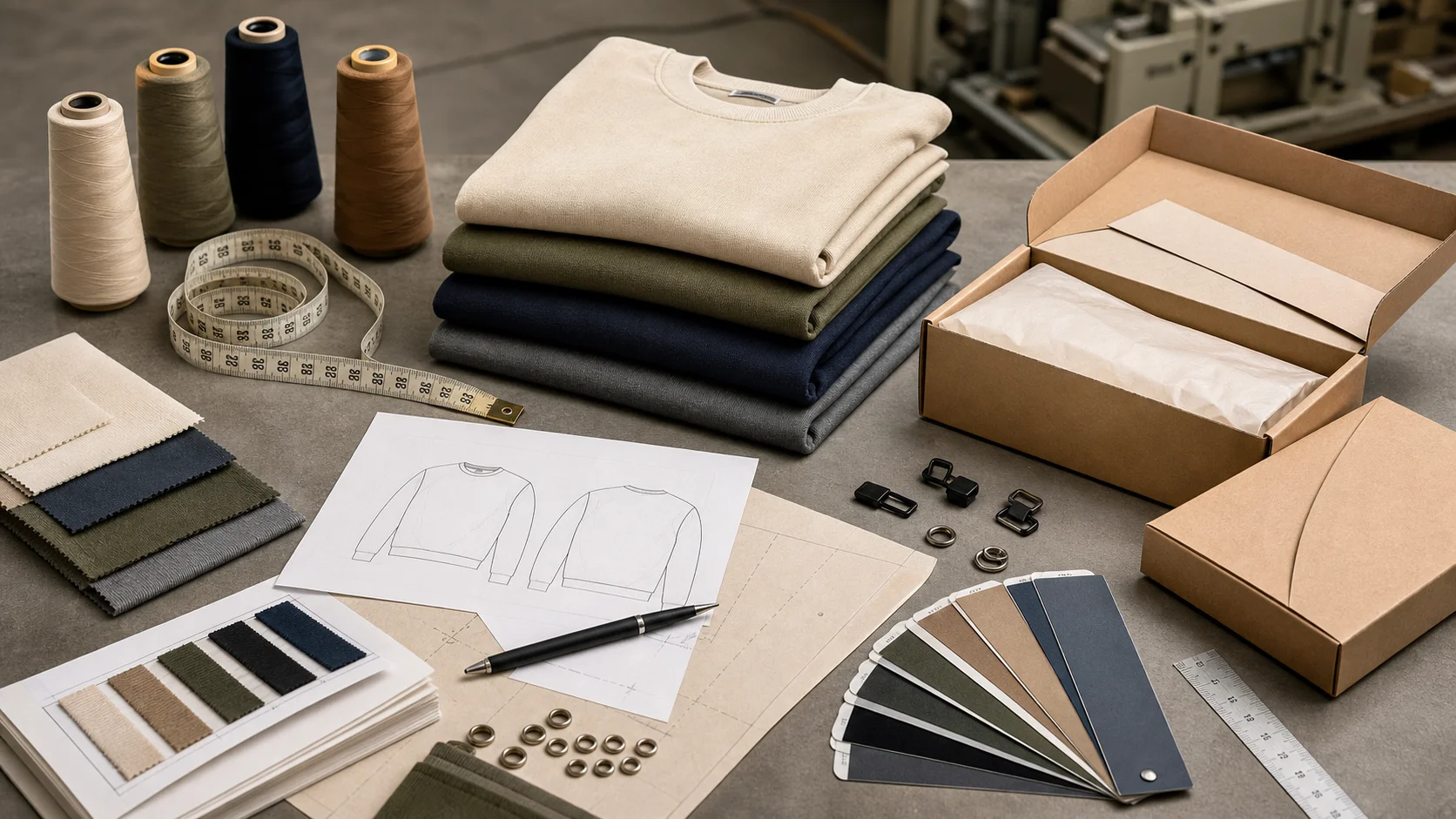
Clothing Order Quality Control with checks for samples, fit, MOQ, QC evidence, pricing terms, and delivery risk.
Fast answer: Clothing Order Quality Control: Inspection Points, Defect Limits, and Rework Rules should be judged by production evidence, not by a generic sourcing promise. The buyer needs sample proof, cost breakdowns, QC checkpoints, and delivery buffers in writing.
Ask for recent sample photos, measurement tolerances, fabric or print test assumptions, decoration test notes, packing examples, and a named inspection checkpoint. These details show whether the team can repeat an approved sample at bulk volume.
Separate garment cost, decoration, labels, packaging, sampling, testing, freight, and rush charges. When every cost line is visible, it becomes easier to reduce colorways, adjust size depth, or reserve more time for sampling.
A flawless sample can be the most convincing lie in the room. If you’re building quality control for clothing manufacturer orders, the first lesson is simple: one approved piece proves almost nothing about a full production run. I’ve seen a 12-piece sample pass without a blemish, then watched 8,000 units come off the line with stitch drift, shade variation, and waistband measurement variance because the factory shifted from one operator to three shifts and two subcontracted teams. The sample is a promise. Bulk production is the bill.
On paper, the manufacturer looked disciplined. On the floor, the story was different. One line ran French terry at 320 GSM with clean seams, while another was pushing rib trim that measured 6 mm narrower than spec. The buyer had signed off on a single sample set, not the process behind it. In my experience, defect rates rise when factories scale because line supervisors miss small drifts that compound fast: one cutting table out of calibration, one dye lot mixed too early, one operator rotating in with a different stitch tension.
Price point changes the tolerance for failure. A $3.20 basic tee may survive a few loose threads if the carton count is right and the shrinkage stays within 5 percent. A $28 woven shirt will not forgive a rough collar edge or a label that sits 3 mm off-center. Premium buyers pay for consistency in hand feel, button quality, and packing accuracy as much as for fabric itself. Low-cost programs often absorb minor flaws; premium programs punish them.
The thing nobody tells you: newer machines do not automatically mean tighter control. I’ve walked factories with automated cutters, digital print tables, and modern finishing tunnels that still failed at inspection discipline because nobody logged needle changes, trim checks, or shade approvals in a consistent way. I’ve also seen older plants with basic equipment outperform them because one QC manager physically checked every bundle, every 200 pieces, with a handwritten audit sheet and a strict reject bin.
That is why the real job is not catching defects at the end. It is building a system that stops them from multiplying. Strong quality control is a chain, not a checkpoint.
Quality control for clothing manufacturer orders starts long before cartons are taped shut. It covers fabric intake, trim checks, in-line inspection, midline audit, final random inspection, measurement verification, and packing review. Each stage catches a different failure. Fabric inspection finds yarn flaws, holes, slubs, and wrong shade lots. Trim checks catch broken zippers, weak snaps, wrong size labels, and off-spec drawcord tips. In-line inspection identifies skipped stitches, broken needles, or operator errors before thousands of pieces are sewn. Final inspection verifies carton mix-ups, size ratio errors, and packaging damage.
Quality assurance and quality control are not the same job. QA is the system: the specs, process controls, training, and records that prevent defects. QC is the checking: measuring, testing, and rejecting when the product misses the agreed standard. Buyers often pay for both, even when suppliers blur the difference. If a factory says it “does quality,” ask which records exist for seam strength, color tolerance, and needle control. Ask for the paperwork, not the pitch.
Standards should be measurable. I look for acceptable quality limits based on order size, measurement tolerances of ±1 cm on knits and ±0.5 cm on tailored items, color tolerance under a defined lab dip approval, and seam strength targets aligned with the garment type. Needle policy records matter too. If a plant uses broken needle logs and metal detection on children’s wear, that is a serious signal. If the team shrugs and says “we check visually,” I walk away.
Product type changes the inspection map. T-shirts need fabric shrinkage checks, print placement verification, and collar recovery. Denim needs wash consistency, inseam twist control, and pocket symmetry. Tailored woven items need collar roll, lapel balance, and button spacing checks. Activewear needs stretch recovery, elastic performance, and flatlock integrity. Children’s wear needs stricter trim safety and metal control. A factory that treats all products the same is usually missing half the risk.
For brands sourcing in China or elsewhere, it also helps to align factory expectations with independent standards from authority bodies such as OEKO-TEX certification standards for textile safety and Textile Exchange materials and fiber standards.
The order should be controlled in stages, not rescued at the end. I start with tech pack review. Then I lock pattern approval, size set, fabric shade, and trim cards before bulk cutting begins. If a factory is producing a 5,000-piece polo, the first decisions should include collar rib recovery, placket symmetry, and shrinkage after wash. If it is a 2,000-piece woven shirt, the critical checks shift to sleeve balance, collar stand height, and button placement. Every product has its own risk map, and quality control for clothing manufacturer orders works only when that map is respected.
Pre-production is where money is saved. A fabric shade approval caught at this stage costs a courier fee and 2-3 days. The same issue after cutting can mean 1,200 meters of dead stock, 10 days of rework, and a full production delay. Shrinkage testing before bulk can save a factory from cutting thousands of oversized garments that later wash down too far. Size set validation protects fit. Trim matching prevents the ugly mismatch that shows up only after 40 percent of the order is sewn.
In-line inspection is faster at finding repeat problems. Final inspection is better at confirming shipment readiness. I treat in-line QC like a smoke alarm. It should shout when one defect repeats across 50 units. Final inspection is the door lock. It confirms nothing critical is missed before dispatch. Waiting until final inspection gives the buyer 100 percent of the cost and almost none of the leverage. By then, cutting is done, trims are consumed, and the factory has little reason to absorb rework unless the contract forces it.
Here is the cost logic. Fixing a loose seam during sewing may take 15 minutes and one operator. Fixing it after packing may require 300 returns, repacking 60 cartons, and a 3-4 week delay. I’ve seen factories charge $0.12 per piece for on-line correction and $1.40 per piece for post-cut rework on the same defect. The numbers are not abstract. They decide who eats the mistake.
For cut and sew manufacturing, the sequence matters even more because panel alignment and grading errors can compound across multiple components. One bad marker can ruin an entire size run. That is not drama. It is arithmetic.
Strong quality control for clothing manufacturer orders is not free, but weak QC is more expensive. Direct costs usually include third-party inspection at $180-$350 per man-day, internal QC staff, lab testing at $25-$120 per test, sample rounds, and audit time. A 4,000-piece order may need one fabric inspection, one pre-production check, one in-line visit, and one final random inspection. That can total $900-$2,500 depending on complexity and location. Cheap? Not really. Affordable compared with a failed shipment? Absolutely.
Now compare that with failure costs. Air freight to fix a miss can add $1.80-$4.50 per kilogram. Re-cutting a panel run can waste $700-$3,000 in fabric alone. Line downtime can burn 2-3 days of output, which matters when a factory is already booked on a 24-day lead time. Chargebacks, markdowns, and customer returns can take the margin out of a whole program. One percent defect reduction on a 50,000-unit order protects 500 units. If each unit carries $6 of gross margin, that is $3,000 saved before returns even enter the picture.
I’ve compared low-cost suppliers with weak QC against slightly more expensive factories with tighter controls. The first quote may look 6 percent cheaper on paper. By the time you add re-inspection, replacement freight, and resale markdowns, the “cheap” order often lands 8-14 percent more expensive. That gap widens on tailored garments and outerwear, where one defect can trigger a full size-run review. Simple knits tolerate leaner QC. Jackets, structured shirts, and children’s products justify more checkpoints because the cost of an error is higher.
According to ISO, process control and documented verification are central to repeatable quality systems. That matters because repeatability, not heroics, is what protects margin.
Sales decks are polished. Defect data is not. The numbers that matter most are defect rate by category, on-time sample approval rate, first-pass yield, reinspection rate, and shipment hold frequency. If a supplier claims 98 percent pass rates but cannot show category breakdowns, the statistic is decoration. I want to see how many defects came from fabric, how many from stitching, how many from packing, and how many were caught before versus after corrective action.
Red flags appear in the documents. Inconsistent measurement reports. Vague pass rates. Missing fabric test records. Sudden operator turnover. I’ve walked into plants where the production floor looked immaculate, but the needle control log was blank for two weeks and the size grading sheet had been copied from an old order. That kind of paperwork gap often predicts bulk problems better than a bad photo ever will.
Regional patterns matter, but stereotypes do not. Some regions are faster at sourcing and sample turnaround. Others are stronger on finishing discipline or washing consistency. The best factories combine both. In Bangladesh, I’ve seen scale and price discipline on basic knits. In Portugal and Turkey, I’ve seen tighter finishing and more consistent woven garments. In Vietnam and India, I’ve seen strong technical capability paired with uneven documentation. None of that is destiny. It is factory management.
The thing nobody tells you: a 120-worker factory can outperform a 1,200-worker plant because supervisors can catch a needle break, a shade shift, or a trim mismatch before it spreads across 30,000 pieces.
That is not romantic. It is operational speed. Smaller teams can intervene faster, especially when one QC lead reviews every 150-200 pieces instead of waiting for a weekly summary. For buyers, that means size alone is not a proxy for reliability. Data is.
I build the plan before the first cut. Start with specs. Lock the tech pack version, measurement chart, construction details, and fabric composition. Then approve the golden sample, size set, pre-production sample, and production reference sample in that order. If the factory wants to swap the sequence, pause. Sampling hierarchy prevents arguments later because everyone knows which sample is the reference when production drifts.
Your purchase order should spell out the QC rules in plain language. Define the defect threshold, the rework responsibility, who pays for retesting, and who has the authority to hold shipment. State whether AQL 2.5 or 4.0 applies, whether critical defects trigger a zero-tolerance rule, and how many pieces can be reworked before a batch is rejected. Put the testing burden in writing too. If the factory promises colorfastness, seam strength, or shrinkage compliance, specify who pays the lab and which lab report counts.
Document control saves money quietly. Every tech pack version should be tracked. Every approved trim card should be dated. Lab dips need a sign-off trail. Sealed samples must be stored by both sides, not just the supplier. I also recommend photo evidence at each milestone: pre-cut fabric rolls, first-off sewing approval, midline checkpoints, and packed cartons. When a dispute appears, the photo trail shortens the argument by days.
For brands that need niche support, such as custom baby clothing manufacturing, the risk controls need to be stricter. Small parts, softer fabrics, and wash durability all need written checks. For private labels, private label clothing services should include label placement, branding accuracy, and carton marking rules in the approval pack. Miss one of those, and the whole order can look “made correctly” while still failing retail compliance.
Make the plan operational. Create a checklist with due dates, owner names, and sign-off points. A buyer should know by day 3 whether the fabric passed shade review, by day 7 whether the size set passed fit, and by day 14 whether the line is cleared for bulk. That is how control feels when it works. It is also how quality control for clothing manufacturer orders stays alive after the kickoff meeting ends.
Buyers need proof, not reassurance. Before approving a purchase order, request the measurement chart, test reports, line inspection logs, AQL plan, packing list review, and photo evidence from each stage. Ask for the sample approval dates and the target shipment date in writing. If the factory cannot produce those documents in 24-48 hours, that tells you something important about their discipline.
Set a weekly QC rhythm. Sample review on Monday. Inspection on Wednesday. Escalation deadline on Thursday. Shipment sign-off by Friday only if the corrective actions are closed. I use a simple scorecard: quality at 40 points, speed at 20, communication at 20, corrective-action speed at 20. A factory scoring 85 out of 100 with clear records is safer than one scoring 95 with vague answers. That is where quality control for clothing manufacturer orders becomes a decision tool instead of a slogan.
Keep your next move practical. Ask for one live video of the sewing line. Ask for one shade band comparison. Ask for one recent third-party report. Then decide whether the supplier is ready for volume or only for prototypes. If you need a quotation with clear inspection support, request a quote for clothing manufacturing and inspection support and compare the QC terms, not just the unit price.
Good order control is boring in the best way. It makes surprises rare, keeps margins intact, and gives you leverage before problems grow teeth.
Most buyers spend $900-$2,500 for one order that includes fabric checks, in-line inspection, and final random inspection. Third-party inspection often runs $180-$350 per man-day, while lab tests can cost $25-$120 each. Complex products like jackets or children’s wear usually need more checkpoints.
Basic QC can add 2-5 days across sampling, inspection, and sign-off. If a shade issue or fit problem is caught early, the fix is usually faster than waiting for final inspection. Late-stage rework can add 1-3 weeks, especially if cutting has already been completed.
The minimum standard should include fabric inspection, trim checks, measurement verification, and final random inspection using an agreed AQL. Buyers should also require approved samples, written tolerances, and a defect log. For children’s wear and activewear, add safety and performance testing.
Yes, but only if the product is simple and the factory has strong process control. A basic knit order with stable fabric and repeat trims may need fewer inspections than outerwear or tailored garments. Even then, skipping pre-production approvals usually costs more later.
Ask for measurement charts, fabric test reports, line inspection logs, AQL results, packing list checks, and photo evidence from each stage. You should also receive approval records for the golden sample, size set, and pre-production sample. If any of those are missing, treat it as a warning.