
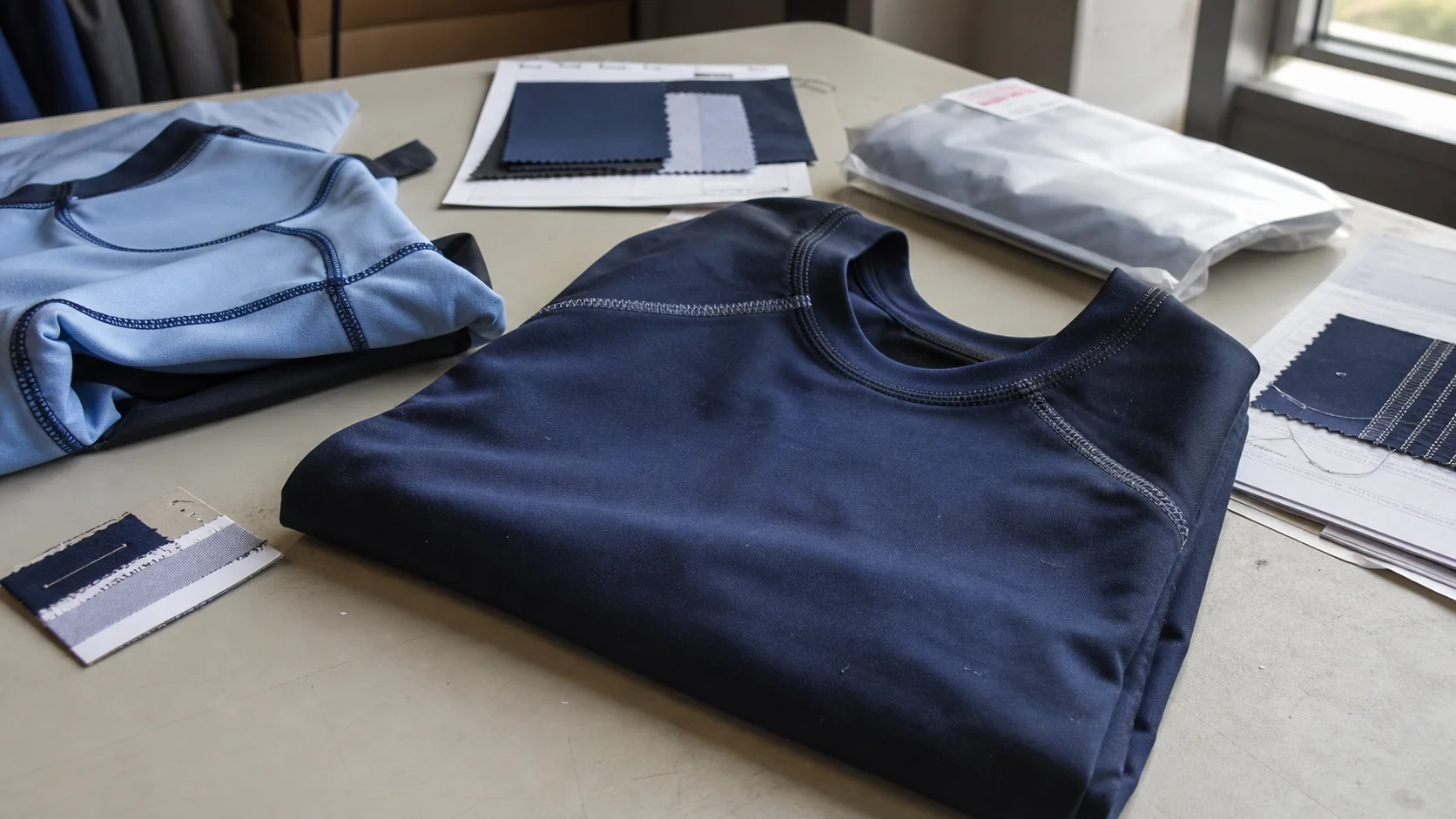
A product-specific SEO outline for outdoor school buyers evaluating rash guard factory shrinkage controls, from fabric relaxation and wash testing to...
Rash Guard Shrinkage Plan for School Buyers - Activewear & Teamwear manufacturing guide
Rash guards for outdoor schools have a different risk profile from general retail swimwear. A retail customer may tolerate a slightly tighter fit after several washes. A school buyer cannot manage that kind of inconsistency across 200, 500, or 1,000 students. When a rash guard shrinks unpredictably, the problem becomes operational: wrong fit distribution, parent complaints, replacement requests, delayed field activities, and higher landed cost per usable garment.
For outdoor education programs, camp schools, sailing schools, surf academies, water sports teams, and school trip suppliers, shrinkage control should be treated as a purchasing requirement rather than a factory afterthought. The garment has to perform after repeated chlorine exposure, saltwater use, sunscreen contact, washing, drying, and rough handling by students. Fabric recovery, seam stability, print durability, and sizing consistency all sit inside the same quality discussion.
A practical rash guard shrinkage control plan starts before the purchase order. It belongs in the tech pack, fabric approval, sampling process, bulk production controls, and final inspection checklist. Buyers who only test finished goods at the end of production have less leverage. At that point, the factory may have already cut, sewn, printed, packed, and allocated the goods. If shrinkage is out of tolerance, the choices are usually expensive: accept a risky shipment, negotiate a discount, remake part of the order, or delay the school delivery window.
For school buyers, the safest approach is to define shrinkage tolerance early, verify it during sampling, and lock the fabric and process before bulk cutting starts.
The target is not zero shrinkage. That is rarely realistic for knitted performance fabrics. The target is controlled, tested, and predictable shrinkage within agreed tolerance. For most school rash guard programs, a reasonable starting point is often within 3% lengthwise and 3% widthwise after approved wash testing, though stricter or looser limits may apply depending on fabric composition, construction, and end use. Kids’ sizing may need tighter control because a small measurement loss can move the garment into the wrong size bracket.
A clear buying brief reduces disputes. A vague line such as “must not shrink” is not enough. The factory needs measurable targets, testing methods, and decision rules. Outdoor school buyers should state the intended activity, wearing conditions, expected washing method, size range, delivery date, packing requirements, and whether the garment is issued as uniform, sold in a school shop, or bundled into a course fee.
The brief should define whether the rash guard is used for swimming, surfing, kayaking, paddleboarding, sailing, snorkeling, lifeguard training, or mixed outdoor education. Each activity affects the garment differently. Surf and board sports usually need higher abrasion resistance and stronger recovery. Swim programs may prioritize chlorine resistance. Sailing schools often need strong UV protection, easy identification colors, and durable logos. Field trip programs may prioritize cost, easy sizing, and fast replenishment.
School buyers should also confirm whether the garment must meet a UPF rating, such as UPF 50+. If yes, shrinkage control and UPF testing should be considered together. Fabric stretch, construction density, and color can affect sun protection. A fabric that passes UPF testing before repeated washing may need retesting if the buyer requires validated performance after laundering.
At minimum, the sourcing brief should include:
Buyers needing support with specification development can review manufacturing service options at fabrikn.com/services/. A more complete tech pack usually costs less than correcting a poorly controlled production run.
Fabric selection is the first major control point. Rash guards are commonly made from polyester/spandex, nylon/spandex, or recycled polyester/spandex blends. Each has different strengths. Polyester generally offers good chlorine resistance, colorfastness, and cost control. Nylon can feel softer and may give a premium hand feel, but it can be more vulnerable to heat and may need closer process control. Spandex gives stretch and fit, yet it also introduces heat sensitivity and recovery risks.
Typical rash guard fabric weights range from about 160 gsm to 240 gsm. Lightweight fabrics may dry quickly and cost less, but they can become sheer when stretched and may show more measurement variation. Mid-weight fabrics around 180 gsm to 220 gsm are common for school and teamwear programs because they balance opacity, durability, comfort, and print performance. Heavier fabrics can feel more protective but may increase cost and drying time.
Shrinkage risk is not only about fiber content. Knitting tension, yarn type, heat setting, dyeing process, finishing chemistry, fabric relaxation time, and cutting conditions all matter. A fabric roll that is not properly heat set can continue to move after garment production. A roll that is cut immediately after unrolling may relax after cutting, causing panel distortion and measurement variation. A garment that looks correct before washing can become short in body length or tight in chest after laundering.
The most common rash guard shrinkage problems include:
The factory should provide fabric test data before sample approval. Useful tests include dimensional stability to washing, spirality, colorfastness to washing, colorfastness to chlorinated water where relevant, colorfastness to seawater, pilling resistance, bursting strength, stretch and recovery, and UPF rating if claimed. Not every order needs every test, but school uniform and outdoor education buyers should not skip dimensional stability.
Polyester/spandex is often the practical choice for school rash guards. It supports sublimation printing, performs well in bright colors, and is generally easier to control for repeated school use. It can also support recycled yarn options for buyers with sustainability requirements. Shrinkage can still occur if heat setting is poor, but reliable mills can usually maintain reasonable tolerances.
Nylon/spandex may be chosen for softer hand feel or a premium fit. It needs careful testing because heat, dyeing, and washing can influence dimensional stability. Sublimation is not usually the default method for nylon in the same way it is for polyester, so logo and artwork planning must be aligned early.
Recycled polyester/spandex is increasingly requested by schools and outdoor programs. It can be a good option, but buyers should ask for traceability documents, fabric test reports, and bulk consistency confirmation. The recycled claim should not distract from basic performance testing. A sustainable garment that shrinks badly is still a failed procurement.
A rash guard factory shrinkage control plan should be written into the production workflow. The plan does not need to be complicated, but it must be specific. The strongest plans check shrinkage at fabric stage, pre-production sample stage, pilot run stage, inline production stage, and final inspection stage.
The factory should begin with fabric roll control. Fabric should be received with mill reports, roll numbers, batch numbers, color references, and width data. Rolls should be relaxed before cutting. For stretch fabrics, relaxation time may range from 12 to 24 hours, and some fabrics may need longer depending on roll tension and storage conditions. Cutting without relaxation is a common cause of post-sewing measurement instability.
Heat setting is another key factor. The mill or fabric finisher should stabilize the fabric under controlled conditions before the garment factory cuts it. Buyers do not need to manage the heat-setting machine, but they should require evidence that fabric has been stabilized and tested. When working with a new fabric, factory, or color batch, shrinkage testing before cutting bulk fabric is a sensible requirement.
A basic factory shrinkage control plan should include these steps:
The buyer should ask whether the factory measures shrinkage by fabric swatch, garment sample, or both. Fabric swatch testing is useful, but it does not fully represent garment behavior. Sewing, seams, bindings, prints, and mixed panels can change results. Garment wash testing is especially important for fitted school rash guards because body length, sleeve length, chest, and neck opening all affect wearability.
The wash test method must be realistic. If school staff will machine wash and line dry, the test should reflect that. If parents may tumble dry despite care label instructions, buyers should decide whether to test a harsher condition. A garment that passes cold wash line dry may fail warm wash tumble dry. That does not mean the garment is defective if the care label is clear, but it does affect complaint risk.
Common test setups include one wash cycle, three wash cycles, or five wash cycles. For higher-risk programs, three cycles before approval is a practical compromise. Five cycles provide stronger confidence but add time. For schools with strict launch dates, the testing timeline needs to be built into the development calendar.
Measurement points should be listed in the tech pack. For rash guards, the usual points include body length, chest width, bottom opening, shoulder width where applicable, sleeve length, cuff opening, neck width, and front neck drop. Raglan sleeve rash guards need different measurement references from set-in sleeve styles. Zip-front rash guards need added checks for zipper length, zipper waviness, and front panel balance.
Measurement should happen before wash and after wash. The factory should record both actual dimensions and percentage change. If the buyer only receives a pass/fail statement, it is harder to judge whether the result is stable or just barely within tolerance.
Sampling is where school buyers can prevent most shrinkage problems. The sample process should not focus only on appearance. A rash guard can look good on a hanger and still fail after washing. Buyers should approve fabric, fit, construction, shrinkage, print, trims, and packaging before bulk production.
A typical sample approval path includes:
For school orders, the size set deserves close attention. Youth sizing is often where problems appear. A size 6, size 8, and size 10 cannot simply be scaled down from an adult rash guard without checking neck opening, sleeve length, body length, and ease. Children need easy dressing, especially in group settings. A neck opening that becomes tight after washing can create immediate complaints.
The pre-production sample should be made from actual bulk fabric or a confirmed equivalent. If the factory uses substitute fabric for sampling, shrinkage approval becomes less reliable. The same caution applies to trims. Neck binding, cuffs, zippers, heat transfer films, and printed panels can all affect garment behavior.
Buyers should also approve the care label before production. Rash guards with spandex typically need low-heat care instructions. If the buyer expects institutional laundering, that must be raised early. Many performance fabrics are not designed for harsh industrial wash and high-temperature drying. A school that sends garments through a commercial laundry should request testing under those conditions rather than relying on standard home-laundry assumptions.
Bulk production introduces risk because conditions change. A factory may use several fabric rolls, multiple sewing lines, different operators, and more than one print batch. Shrinkage control must stay active during production, not only during sample approval.
Inline inspection should include measurement checks before and after wash where practical. For larger orders, the factory can pull garments from early production for wash testing before the full quantity is completed. This allows corrective action while there is still time. If the first production batch shrinks more than the approved sample, the factory should stop and review fabric batch, cutting relaxation, sewing tension, and finishing conditions.
Common inspection risks for school rash guards include:
Final inspection should not be treated as a paperwork exercise. The inspector should measure randomly selected garments across sizes and colors. AQL 2.5 for major defects and AQL 4.0 for minor defects is commonly used in apparel inspections, though buyers may set different levels depending on order value and risk. Shrinkage testing at final inspection is useful but has a timing limitation: wash tests take time, and failures are harder to correct when goods are already complete.
A better approach is to combine final inspection with earlier control points. Final inspection confirms that the factory maintained the approved standard. It should not be the first time shrinkage is tested.
School rash guards often carry school names, house colors, team logos, class groups, sponsor marks, or safety identification graphics. Print durability must be tested with shrinkage because fabric movement can damage decoration. A heat transfer that looks smooth before wash may crack, curl, or lift after repeated stretch. Screen print ink may feel heavy if applied too thickly, reducing fabric stretch. Sublimation is strong for polyester but needs color and panel matching control.
For outdoor schools, high-visibility colors can help instructors identify students on the water. Bright colors may require extra colorfastness checks, especially for saltwater, chlorine, and sun exposure. Dark colors can absorb more heat and may show sunscreen marks. White and pale colors may become transparent when stretched or wet. These are purchasing tradeoffs, not only design choices.
Flatlock seams are common in rash guards because they reduce bulk and improve comfort. Coverstitch and overlock constructions may also be used depending on price point and design. The important issue is seam elasticity. If the seam does not stretch with the fabric, students may feel restriction, and stitches may pop during activity.
Factories should check stitch density, thread quality, seam stretch, and seam recovery. Polyester thread is common. Bulk nylon thread may be used in some performance applications, but buyers should confirm suitability. Seam failure after washing is often blamed on fabric shrinkage, but it may be caused by improper sewing tension or poor thread selection.
MOQ depends on fabric availability, color, printing method, size range, and factory capacity. For stock fabric with simple logo printing, typical minimums may start around 100 to 300 pieces per color or style. For custom-dyed fabric, custom knitting, or all-over sublimation, practical MOQs often move toward 300 to 800 pieces per style, and sometimes higher. Recycled fabrics, special UPF claims, and uncommon colors can increase minimums.
School buyers should avoid comparing quotes without checking what is included. A low quote may exclude fabric testing, shrinkage reports, pre-production samples, lab dips, proper packaging, or third-party inspection support. Those omissions can be costly if the goods fail after delivery.
Lead time is also variable. A simple rash guard using available fabric and standard logo application may take about 4 to 7 weeks after sample approval. Custom fabric, lab testing, size set revisions, sublimation artwork, and peak-season capacity can extend production to 8 to 12 weeks or more. Shipping mode adds another layer. Air freight helps urgent programs but raises landed cost. Sea freight supports larger school rollouts but needs earlier planning.
Typical timeline dependencies include:
Buyers with fixed school launch dates should place more value on process reliability than on the lowest unit price. If the order is needed for a term start, camp opening, sports tour, or outdoor education week, late delivery can cost more than a small price difference. A factory that provides clear shrinkage data, realistic capacity, and disciplined sampling is usually a safer choice than a supplier promising aggressive delivery without testing time.
For project discussions, buyers can use fabrikn.com/contact-us/ to start with garment type, size range, target delivery date, and decoration requirements. Clear starting information helps narrow fabric and MOQ options faster.
The best purchasing decision depends on order size, delivery pressure, budget, and risk tolerance. A small school club buying 120 rash guards for a short seasonal program may choose stock fabric, standard colors, and a simple logo to keep MOQ and lead time under control. A national outdoor education provider buying thousands of pieces across campuses should invest in custom testing, size set validation, and stronger inspection controls.
For most school buyers, the main tradeoff is speed versus certainty. Fast production usually means using available fabrics and existing trims. That can work well if the factory has current test data and the buyer accepts standard colors. Custom development gives better brand alignment and sizing control, but it requires more time for lab dips, sampling, wash testing, and production planning.
Price also needs careful interpretation. A rash guard that is slightly cheaper but shrinks beyond tolerance may become more expensive after replacements, complaints, and administrative handling. Unit price should be judged alongside confirmed fabric stability, logo durability, packing accuracy, and delivery reliability. School procurement teams often focus on the purchase order price, while operations teams absorb the cost of failures. Better specifications align both sides.
Size planning is another practical issue. Outdoor school buyers should check historical size distribution if available. Rash guards are fitted garments, and students may prefer more ease than competitive swimwear sizing allows. If the garment is issued for mixed activities, a slightly more forgiving fit may reduce exchange requests. A slim performance fit can look professional, but it leaves less margin if shrinkage occurs.
Buyers should also decide whether to hold spare stock. For school programs, a small overage by key sizes can prevent disruption. Commonly needed extra sizes may include youth medium, youth large, adult small, and adult medium, though this varies by student age and region. Spare stock is especially useful when the style uses custom fabric or artwork that cannot be reordered quickly.
The factory should be evaluated on its ability to control process, not just produce a nice sample. A strong sample can be made carefully in a sample room. Bulk production needs systems: fabric batch tracking, cutting discipline, trained operators, measurement records, and honest communication when results drift. Buyers should ask direct questions about shrinkage testing before placing the order.
Useful supplier questions include:
A supplier that answers these questions clearly is usually lower risk. A supplier that avoids them may still produce acceptable goods, but the buyer is carrying more uncertainty. For school buyers, uncertainty is not harmless. It shows up later as size exchanges, missed deadlines, and budget pressure.
Buyers can also review company background and sourcing approach at fabrikn.com/about-us/ when comparing support partners for activewear and teamwear production.
A checklist keeps the order disciplined. It should be used before deposit, before sample approval, before bulk cutting, during production, and before shipment. The same document can be shared with the factory, buyer, inspection team, and internal school procurement staff.
This checklist is not only for large buyers. Even small school orders benefit from written expectations. The fewer assumptions in the process, the fewer disputes after delivery.
Shrinkage control does not end at shipment. Care instructions must be realistic and visible. Rash guards with spandex should usually avoid high heat, harsh bleach, and aggressive tumble drying. If the garment is line dry only, the label should state that clearly. If the school distributes care instructions to parents, the wording should match the garment label.
For outdoor schools, a simple care card can reduce complaints. It can advise rinsing after saltwater or chlorine exposure, washing cold with mild detergent, avoiding fabric softener where relevant, drying away from direct high heat, and not ironing prints. The care card should not make unsupported performance claims. It should support garment life and help users avoid preventable damage.
School buyers should be careful with promises. If the garment is described as “will not shrink,” expectations become unrealistic. A better statement is that the garment has been tested to meet agreed shrinkage tolerance when washed according to care instructions. That wording is more accurate and easier to defend.
A rash guard factory shrinkage control plan is a buying tool. It protects fit, budget, delivery schedules, and student experience. The strongest buyers do not wait for bulk goods to arrive before asking about shrinkage. They specify tolerance, test early, approve carefully, and inspect against measurable standards.
For activewear and teamwear programs, the best value usually comes from a balanced approach: stable fabric, realistic MOQ, tested samples, controlled production, and clear care instructions. The cheapest option is not always the lowest-cost option once school distribution and replacement risk are included. A reliable rash guard should fit correctly on day one and remain usable after repeated school activity and washing.
School buyers who treat shrinkage control as part of the sourcing plan will have fewer surprises. The work is not complicated, but it must be done before the fabric is cut.
Get a free quote from Fabrikn — your trusted B2B clothing manufacturer with 10+ years of experience. MOQ as low as 200 pieces.
Get a Free Quote →A common target is within 3% lengthwise and 3% widthwise after the agreed wash test, but the right tolerance depends on fabric, size range, and fit. Youth sizes may need tighter control because small measurement changes are more noticeable.
Both are useful. Fabric testing shows base material stability, while finished garment testing reveals the effect of seams, bindings, prints, trims, and construction. For school programs, finished garment wash testing is strongly recommended before bulk approval.
Polyester/spandex is often a practical choice for school rash guards because it supports strong color, sublimation printing, and good performance. Nylon/spandex can work well but needs careful testing. The factory’s heat setting, fabric sourcing, and quality control matter as much as the fiber name.
A typical process includes fabric swatch or lab dip, proto sample, size set, logo strike-off, and pre-production sample. The pre-production sample should be wash-tested before bulk cutting. Larger or higher-risk school programs should not skip the size set.
Yes. Heat can affect spandex and may increase shrinkage or damage recovery. If users are likely to tumble dry the garment, buyers should either test that condition or communicate low-heat and line-dry care instructions clearly.
For stock fabrics and simple logo application, MOQs may start around 100 to 300 pieces per color or style. Custom fabric, custom dyeing, sublimation artwork, or recycled material programs often require 300 to 800 pieces or more.
Simple programs using available fabric may take about 4 to 7 weeks after sample approval. Custom fabric, lab dips, size set revisions, wash testing, and peak-season capacity can extend the timeline to 8 to 12 weeks or more.
The main risks are measurement variation, uncontrolled shrinkage, shade differences, seam tension problems, logo failure, incorrect size labels, and poor carton assortments. School buyers should inspect both garment quality and distribution accuracy.
Yes. If UPF protection is claimed, the buyer should make sure fabric stability and UPF performance are both supported by testing. Shrinkage, stretch, color, and construction can influence sun protection performance.
Use tested fabric, approve wash-tested samples, choose a fit with enough ease, provide accurate size guidance, and include clear care instructions. Holding spare stock in common sizes can also reduce disruption when exchanges are needed.