
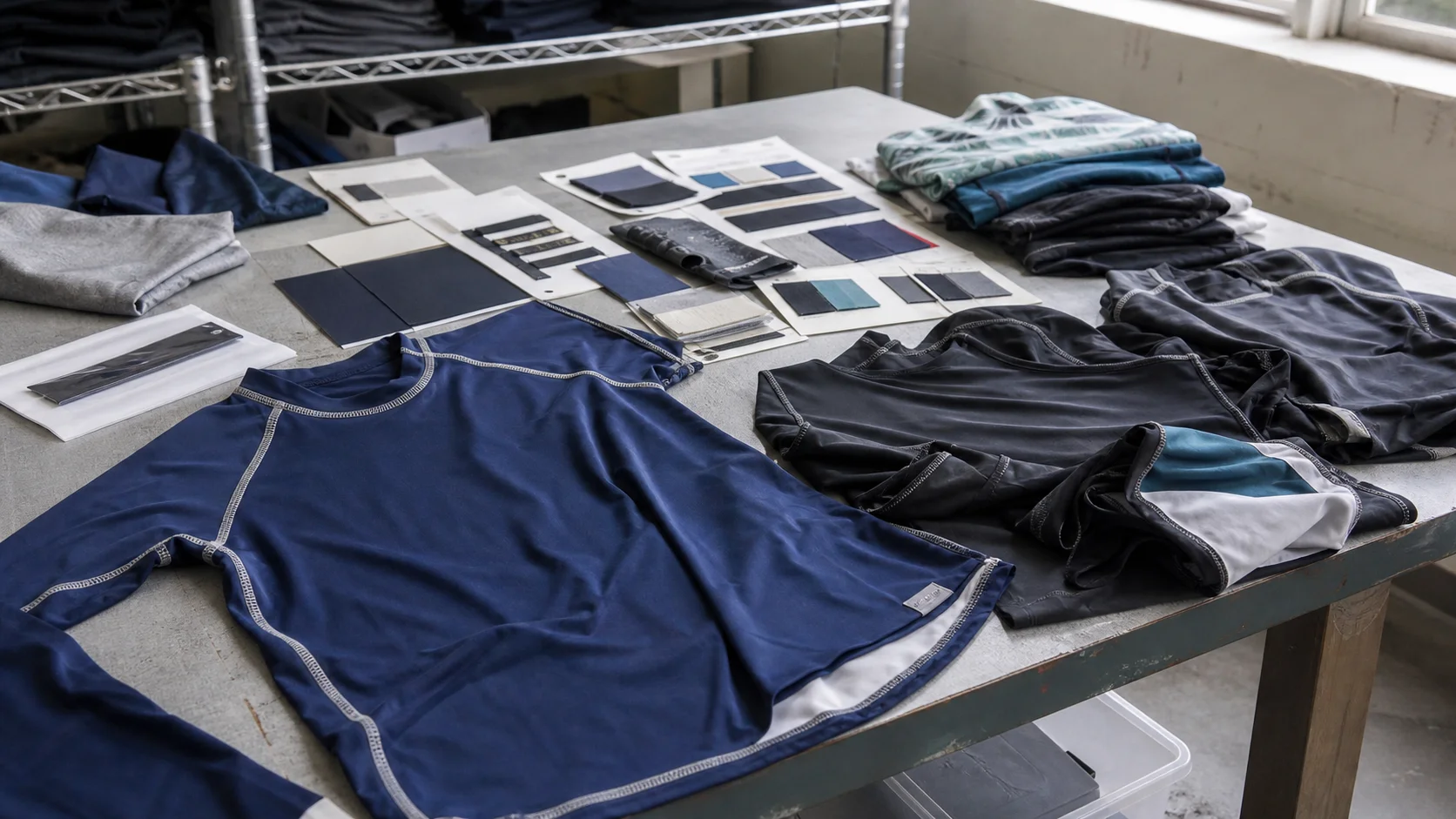
A facilities manager’s SEO-focused checklist for releasing rash guard orders to production, covering artwork, fabric specs, sizing, labeling, compliance,...
Rash Guard Order Checklist for Factory Release - Activewear & Teamwear manufacturing guide
A rash guard order should not move into bulk production because the design looks right on screen or because the team urgently needs uniforms before a season, event, training cycle, or facility launch. Factory release is the point where purchasing, operations, design, quality, and supplier teams agree that the order is technically complete enough to cut fabric, print panels, sew garments, inspect output, and pack cartons without guessing.
For facilities managers buying activewear and teamwear, this step is especially important. Rash guards are performance garments. They need stretch recovery, seam comfort, print durability, color consistency, and size reliability. A small error in fabric weight, sleeve length, neck binding, logo placement, or carton labeling can become expensive once the factory has started cutting and printing hundreds or thousands of units.
The factory release checklist is not paperwork for its own sake. It is a risk-control tool. It protects budgets, delivery windows, inventory accuracy, brand standards, and wearer satisfaction. A clear release package also reduces the number of questions coming back from the factory after production has already started.
Facilities managers often coordinate orders for gyms, aquatics centers, martial arts schools, surf programs, university recreation departments, lifeguard teams, corporate wellness events, resorts, and sponsored athletic groups. These environments have practical constraints: fixed training dates, staff turnover, multiple body types, size replenishment needs, and strict receiving procedures. A rash guard order factory release checklist gives those stakeholders a shared control point before money and production capacity are committed.
Direct purchasing judgment: do not release a rash guard order to bulk production until the approved sample, size specifications, fabric standard, artwork placement, packing method, and delivery terms match the purchase order. If one of those items is still “to be confirmed,” the order is not ready.
Factory release means the supplier can proceed without creative interpretation. The facility buyer should assume that every missing detail will be decided by someone else unless it is documented. That may be acceptable for a low-cost giveaway tee, but it is risky for rash guards where fit, stretch, print scale, and seam placement affect performance.
Before release, confirm the commercial order details first. These include style number, garment description, colorway names, gender or fit category, size range, order quantity by size, target delivery date, destination address, incoterms if applicable, payment terms, and any penalties or cancellation conditions. These details should match across the purchase order, supplier proforma invoice, tech pack, and final order confirmation.
Next, lock the technical order details. Rash guards are often made from polyester-spandex, nylon-spandex, recycled polyester-spandex, or blended performance jersey. The approved fabric must be defined by fiber content, weight, stretch direction, GSM tolerance, finish, color standard, and performance requirements. “Stretch fabric” is not enough. “Black 82% polyester / 18% spandex, 200 GSM, four-way stretch, moisture-wicking finish, UPF target where specified” is more useful.
Artwork must also be production-ready. Facilities managers should not rely on screenshots, mockups, or presentation PDFs alone. The factory needs vector logo files, Pantone or approved color references, print method, placement measurements, scale, orientation, and any restrictions around sponsor logos, institutional marks, or team graphics. If sublimation is used, panel artwork must match the final pattern shape and account for sewing tolerance.
Lastly, lock approvals. A factory release package should identify who approved the final sample, what date it was approved, what comments were accepted, and which version is active. Multiple file versions cause real production errors. A simple naming rule, such as style-code_colorway_version_date, helps prevent the factory from using outdated artwork or measurements.
The technical package is the core document behind the rash guard order. It should give the factory enough information to make the garment consistently across sizes and production lots. For facilities managers who are not apparel technicians, the practical test is simple: if a new production coordinator opened the file, could they understand exactly what to make?
Measurements should be listed by size, with tolerances. Common points of measure for rash guards include chest width, bottom opening, body length, sleeve length, bicep width, cuff opening, neck width, front neck drop, back neck drop, shoulder width where relevant, and sweep. Compression styles need especially careful review because small measurement changes can alter comfort and perceived sizing.
Facilities teams should ask for a graded size chart before release, not after production. If the order includes youth and adult sizes, confirm that the grade rules make sense. A youth large and adult small may look close on paper, but the torso length, neck drop, sleeve proportion, and chest ease can still differ in important ways.
Rash guards are exposed to repeated stretching, washing, sweat, chlorine, saltwater, sunscreen, and friction. Construction details should not be treated as generic. Confirm seam type, stitch density, thread type, needle type where relevant, seam allowance, binding width, coverstitch placement, bartack locations, and care label attachment method.
Flatlock seams may be requested for comfort and reduced chafing, especially for surf, swim, grappling, or endurance training applications. Coverstitch seams are common and can be cost-efficient, but the buyer should check bulk, stretch, and seam recovery. Overlock plus coverstitch may be suitable for many commercial activewear orders, provided the seam does not twist, pucker, or break under stretch.
The bill of materials should list the main fabric, contrast fabric, mesh insert if used, neck tape, zipper, puller, elastic, silicone gripper, labels, thread, heat transfers, hangtags, polybags, cartons, and barcode labels. Each item should include supplier reference, color, size, placement, and approved standard. If the factory substitutes trims without approval, the final garment may still look acceptable at first glance but fail in use.
Fabric approval deserves close attention because rash guard performance depends heavily on the textile. A buyer may approve a style based on a smooth prototype, then receive bulk goods with different stretch, opacity, handfeel, or recovery. The release checklist should prevent that gap.
A typical rash guard program may use 180–220 GSM polyester-spandex jersey for general training, teamwear, and recreational use. Lighter weights can feel cooler and dry faster, but may become sheer, clingy, or less durable. Heavier weights can improve coverage and compression, but they may feel warmer and cost more. The right choice depends on use case, not only price.
For aquatics and outdoor programs, colorfastness and UV performance may matter more than a soft handfeel. For martial arts, grappling, and contact training, abrasion resistance and seam strength carry more weight. For resort or event uniforms, appearance, color consistency, and comfortable fit may be the priority.
Labels and trims should be compatible with stretch garments. A stiff woven neck label can irritate wearers. Heat transfer labels can improve comfort, but they must be tested for wash durability and cracking. Zippers on rash guards need careful review because a poor zipper can create chest discomfort, corrosion issues, or wave-like distortion in stretchy fabric.
Confirm that care labels include accurate fiber content, country of origin, washing instructions, and any required compliance details. Facilities managers ordering for employees, members, students, or resale should keep labeling clean and traceable. Missing or incorrect care content can create customer service issues even when the garment itself is acceptable.
Sampling is the best opportunity to catch fit and performance problems before the order becomes expensive. The sample approval process should be documented in stages. For a custom rash guard order, a common approval path includes proto sample, fit sample, print or lab dip approval, pre-production sample, and sometimes a size set sample.
A pre-production sample should be made with bulk-intent fabric and trims. If the sample uses substitute fabric because the real fabric is not ready, it is not a true production approval. That may be acceptable for design review, but it should not be treated as final factory release.
Facilities managers should also consider who tests the sample. A design approver may focus on color and logo placement. A coach, instructor, lifeguard supervisor, or operations lead may notice that sleeves ride up, the neck feels tight, or the torso length is too short when the wearer reaches overhead. For teamwear, fitting only one body type is a common mistake.
Do not approve fit from flat measurements alone. Stretch garments should be worn, moved in, washed if time allows, and reviewed under likely use conditions. That said, sampling cycles can slow the order. The practical tradeoff is to sample enough to control risk without turning every minor styling preference into a new development round.
Rash guards often carry heavy decoration: team names, sponsor marks, facility logos, sleeve panels, chest graphics, back graphics, and event branding. Decoration errors are among the most visible and costly mistakes in bulk production.
Start by confirming the decoration method. Common options include sublimation, screen print, heat transfer, silicone print, reflective transfer, and embroidery for limited applications. Sublimation is popular for all-over graphics because it can cover panels without adding surface weight. It works best on polyester-rich fabrics and usually requires white or light base fabric. Screen print and transfers can work on solid fabrics but must stretch with the garment.
Artwork files should be production-ready. Vector formats are preferred for logos and text. Raster artwork for sublimation must be high enough resolution at final print size. Pantone references should be used where color control matters, but buyers should understand that sublimation on stretch polyester may not match coated-paper Pantone chips exactly. A physical strike-off is more reliable than a digital proof.
Artwork placement should be measured from clear garment reference points, such as high point shoulder, center front neck, sleeve hem, side seam, or bottom hem. Avoid vague instructions like “logo on left chest” without size and position. On stretch garments, placement can shift when worn, so test the sample on body if brand visibility is important.
For team and facility orders, confirm personalization rules before release. Names, numbers, staff titles, department labels, or competition divisions need a controlled spreadsheet. The spreadsheet should match the order quantity by size and style. Spelling errors are difficult to fix once printed, and extra units may be needed for staff changes.
Direct purchasing judgment: if branding accuracy matters more than unit cost, pay for the right approval steps. Skipping strike-offs or print panels saves time upfront but increases the chance of a full bulk dispute.
Minimum order quantity depends on fabric availability, decoration method, size range, color count, and factory setup. Facilities managers should treat MOQ as a planning variable, not a fixed universal number.
For custom rash guards using available stock fabric and standard decoration, typical MOQs may fall around 100–300 units per style or color. For custom-dyed fabric, custom knit fabric, all-over sublimation, or specialized trims, MOQ may rise to 300–1,000 units or more. Smaller runs may be possible, but the unit price usually increases and color or trim choices may narrow.
Size distribution affects production efficiency. A 300-unit order spread across youth XS through adult 4XL, with men’s and women’s fits, is more complex than a 300-unit order across five adult sizes. If the program needs broad sizing, ask whether the MOQ applies per style, per color, per print, or total combined order. This distinction affects budget quickly.
A basic custom rash guard order may need 4–8 weeks after final approval if fabric and trims are available. More complex programs can require 8–14 weeks or longer, especially when custom fabric, extensive sampling, or international freight is involved. These ranges are not guarantees. They are planning references that should be confirmed with the supplier before purchase order release.
Rush orders deserve caution. A factory may accept a compressed timeline, but the buyer should ask what step is being shortened. If the answer is shorter lab dip review, skipped size set, limited inline inspection, or no buffer for rework, the risk has moved from the factory to the buyer.
For structured sourcing support, buyers can review manufacturing service capabilities at Fabrikn services and use that as a reference point when building a release process for activewear and teamwear programs.
Inspection should be planned before production begins. Waiting until cartons are packed limits the options. A good rash guard inspection plan usually includes incoming material checks, inline production review, final random inspection, and carton verification.
Before cutting, the factory should check fabric width, GSM, shade consistency, defects, shrinkage, stretch recovery, and print suitability. Fabric rolls should be inspected under consistent lighting. Shade banding can become very visible when panels from different rolls are sewn into the same garment.
For sublimated rash guards, fabric stability matters. If the fabric shrinks or distorts during heat processing, panel matching and final measurements can drift. A buyer should confirm that pre-production testing has accounted for heat, stretch, and wash behavior.
Inline inspection is valuable because sewing defects can be corrected before the whole order is finished. This is particularly important for large facility programs where one bad sewing setting can affect every size.
Final inspection should verify quantity, size ratio, measurements, workmanship, fabric defects, decoration, labeling, packing, carton markings, and barcode accuracy if used. The acceptable quality limit should be agreed before production. Many apparel orders use AQL-based inspection, but the exact level depends on buyer risk tolerance, order size, and distribution plan.
Critical defects include wrong style, wrong logo, unsafe trim, severe stains, sharp components, incorrect fiber label, or missing required markings. Major defects include broken stitches, visible print defects, twisted seams, incorrect measurements beyond tolerance, or shade mismatch. Minor defects may include small thread tails, slight print specks, or minor sewing unevenness within an agreed limit.
Direct purchasing judgment: do not treat inspection as optional if the order is being distributed to staff, athletes, members, or paying participants. A missed defect becomes an operations problem, not just a supplier problem.
Packing details are often left until the end, then handled in a rush. For facilities managers, that creates avoidable receiving problems. The warehouse, campus mailroom, pro shop, equipment room, aquatics office, or event team needs cartons that can be identified quickly.
Confirm whether garments are individually polybagged, bundled by size, packed by team, packed by department, or bulk packed. Individual polybags help with cleanliness and distribution but add cost and waste. Bulk packing reduces packaging but can slow sorting and increase handling marks. Recyclable or reduced-plastic options may be available, but they should be confirmed early because packaging materials also have lead times.
For multi-location facilities, packing by destination can save labor. A buyer should decide whether the factory should pre-sort cartons by location or whether the central facility will handle allocation. Pre-sorting usually costs more, but it can be worth it when the receiving team is small or the rollout date is tight.
If the rash guards are for resale, hangtags, price stickers, SKU labels, and retail folding standards should be specified. If they are for staff or athlete issue, size visibility and department sorting may matter more than retail presentation.
A good factory release checklist does more than collect approvals. It helps facilities managers make purchasing decisions under real constraints. Cost, speed, quality, and customization rarely improve at the same time. The buyer has to choose the right tradeoff for the program.
Stock fabric is usually the practical choice for moderate quantities, urgent timelines, and teamwear programs where exact proprietary color is not required. It can reduce lead time and MOQ. The tradeoff is less control over shade, fabric composition, and long-term replenishment. If the facility expects repeat orders over several seasons, ask whether the fabric will remain available.
Custom fabric or custom dye makes sense when brand color, performance specification, or long-term program consistency is important. It can improve control, but it raises MOQ, development time, and financial exposure. Facilities managers should avoid custom fabric unless the order volume and future demand justify it.
Size sets are worth considering when the order covers a wide size range, includes youth and adult fits, or will be worn in demanding movement conditions. They add time and sample cost, but they reduce the risk of poor grading. For a small promotional order, a full size set may be excessive. For a staff uniform rollout or athletic program, it is often a sensible control.
Complex decoration can look strong in presentations but create production risk. Full sublimation, multiple sponsor marks, individual names, sleeve numbers, and department-specific graphics require stronger data control. If the facility has limited time or uncertain roster data, simplify the decoration plan. A clean logo placement with fewer variables may deliver better operational results.
Facilities managers should consider overage for staff changes, size exchanges, lost garments, event additions, and inspection fallout. A typical buffer may be 2–5% depending on order size and budget. For personalized garments, extra blank or generic units may be more useful than extra named units. Confirm whether the supplier can produce replenishment later, and at what MOQ.
Teams that need help translating operational requirements into a production-ready garment package can start with Fabrikn’s company background to understand the sourcing approach, then use the contact page when they are ready to discuss a specific activewear or teamwear order.
The checklist works best when it is tied to a clear workflow. A facilities manager can use the following sequence to keep the order controlled from initial request to factory release.
Document who will wear the rash guards, how often, in what environment, and for what activity. A lifeguard sun-protection shirt, a youth swim school uniform, a surf camp rash guard, and a grappling team compression top may all sit in the same category, but the performance priorities differ.
Decide how many styles, fits, colors, and sizes are needed. Avoid unnecessary style splits. Every extra colorway, fit block, or graphic version adds sampling, production, inspection, and packing complexity. If the order is small, standardize where possible.
Put the product requirements into one controlled file. Include measurements, fabric, trims, construction, artwork, labels, and packing. Use version control. Remove old files from circulation.
Review fabric, trims, strike-offs, fit samples, and pre-production samples. Close comments in writing. Avoid verbal approvals for important points such as sleeve length, logo size, or fabric handfeel.
Before release, compare the purchase order against the approved sample and tech pack. Check size breakdown, unit price, delivery date, shipping terms, packaging, and destination. This is the point where many avoidable mistakes are caught.
Send a written release that identifies the approved sample version, artwork version, fabric standard, size breakdown, and inspection expectations. Ask the supplier to confirm receipt and production start date.
Track fabric receipt, cutting, printing, sewing, inline inspection, final inspection, packing, and shipment. A release checklist does not replace production follow-up. It gives that follow-up a clean reference point.
Several mistakes appear often in rash guard programs. The first is approving a digital mockup as if it were a production sample. Mockups are useful for alignment, but they do not prove fabric, fit, seam quality, color, or print durability.
The second is using unclear size data. Facilities sometimes estimate size ratios without checking wearer demographics. Rash guards are fit-sensitive, and compression styles can produce more size exchanges than loose garments. Collect size requirements early when possible.
The third is leaving personalization data open too long. Names and numbers should have a cutoff date. Late changes disrupt printing and increase the chance of errors.
The fourth is assuming all black, navy, red, or royal blue fabrics are the same. Shade variation is common across mills and dye lots. If brand consistency matters, approve a physical standard.
The fifth is failing to align receiving needs with packing. A beautifully made order can still create a facilities headache if cartons arrive without size labels, department sorting, or PO references.
Before authorizing factory release, the facilities manager should ask one final question: if the factory produces exactly what is documented, will the order meet the operational need? If the answer is yes, release is appropriate. If the answer depends on assumptions, undocumented preferences, or pending approvals, pause and close the gap.
A rash guard order factory release checklist is valuable because it makes responsibility visible. It shows what has been approved, what remains open, and where the buyer is accepting risk. In activewear and teamwear, that discipline protects the final product and the rollout plan.
Get a free quote from Fabrikn — your trusted B2B clothing manufacturer with 10+ years of experience. MOQ as low as 200 pieces.
Get a Free Quote →A rash guard factory release checklist is a pre-production control document used to confirm that order details, tech pack, fabric, trims, samples, artwork, inspection requirements, packing, and delivery terms are approved before bulk production starts.
Facilities managers should approve the final purchase order, size breakdown, approved sample, fabric specification, artwork placement, label content, packing method, carton labels, delivery schedule, and inspection plan before factory release.
Typical MOQs may range from 100–300 units for simpler custom orders using available materials. Custom-dyed fabric, special trims, full sublimation, or broad size ranges may push MOQ toward 300–1,000 units or more. The exact MOQ depends on supplier setup and material sourcing.
A basic custom order may take about 4–8 weeks after final approval when fabric and trims are available. More complex orders can require 8–14 weeks or longer, especially when custom fabric, lab dips, strike-offs, sample revisions, inspection, and international freight are involved.
A pre-production sample is strongly recommended for custom rash guards. It should represent bulk-intent fabric, trims, construction, artwork, labels, and finishing. Skipping this step can save time but increases the risk of bulk production errors.
Common risks include poor stretch recovery, sheerness when stretched, twisted seams, popped stitches, print cracking, sublimation color variation, shade mismatch, incorrect measurements, uncomfortable labels, and inaccurate packing or size allocation.
Flatlock seams can improve comfort and reduce chafing, especially for swim, surf, endurance, or contact sports. They may cost more than simpler seam constructions. The right choice depends on wearer activity, budget, and durability expectations.
Use a locked spreadsheet with names, numbers, sizes, styles, and departments. Confirm spelling, capitalization, sponsor rules, and roster cutoff dates before release. Personalized mistakes are costly because the affected garment often cannot be reassigned.