
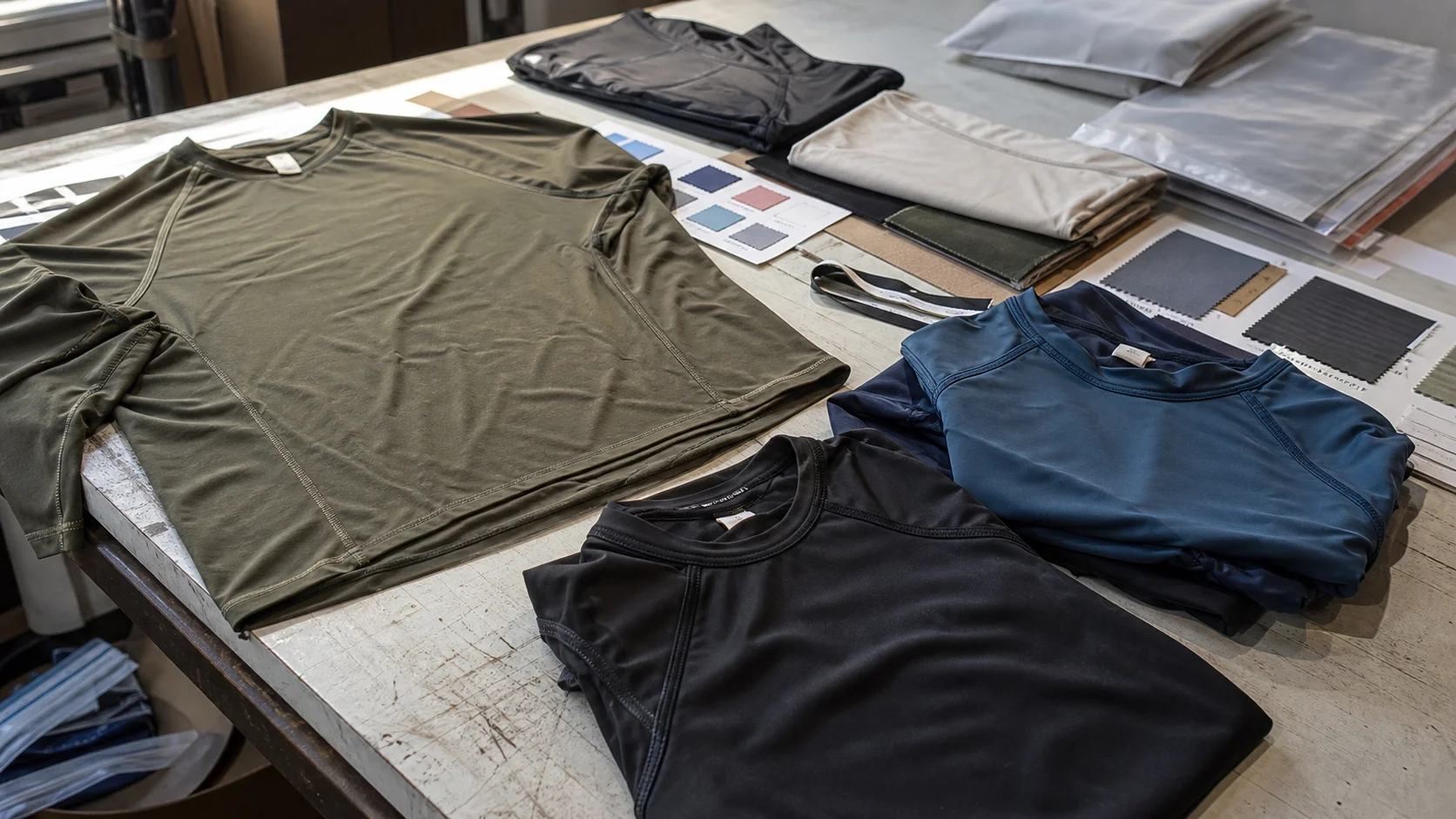
A distributor-focused outline for evaluating rash guard seam strength before placing bulk orders, covering stitch types, fabric stress points, lab checks,...
Rash Guard Seam Review for Distributor Orders - Activewear & Teamwear manufacturing guide
For distributor buyers, rash guard seam strength is not a small technical detail. It is one of the main factors that decides whether a bulk order survives real use, repeat washing, warehouse handling, and customer complaints. A rash guard may look clean on a product page, but if the underarm seam breaks, the side seam twists, or the neck opening loses recovery after wear, the buyer pays for it through returns and damaged sell-through.
Rash guards sit in a difficult product category. They are close-fitting, stretch-heavy garments used in water sports, combat sports, gym training, beachwear, and team programs. The seams must stretch with the body, resist abrasion, hold after chlorine or saltwater exposure, and remain smooth against the skin. A weak seam is not only a durability issue. It can become a comfort issue, a sizing issue, and a brand trust issue.
Distributor orders add another layer of pressure. Buyers are not usually ordering one style for one retail rack. They may be supplying clubs, surf schools, training academies, event programs, online resellers, or promotional uniform packages. A seam failure across a large shipment can affect multiple end accounts at once. That is why rash guard order seam strength review should happen before bulk cutting, not after cartons arrive.
Good seam review is practical risk control. It helps a distributor decide whether a style is ready for volume, needs a construction change, or should be rejected before purchase orders become expensive.
The best sourcing decision is rarely “use the strongest seam at any cost.” Buyers need to balance durability, handfeel, appearance, print method, target price, and production lead time. Flatlock seams may look premium and feel comfortable, but they can increase cost and require better machine control. Overlock seams can be efficient for entry-level programs, but they may not suit high-stretch compression fits if the stitch balance is poor. Bonded or taped seams can create a clean technical look, but they need careful testing and are not always suitable for every fabric or price level.
This article reviews what distributor buyers should check when evaluating rash guard seam strength for bulk orders. It covers seam types, fabric and trim impact, sample approval steps, typical MOQ ranges, lead-time dependencies, and inspection risks that often appear in production.
A seam strength review should start with the garment’s use case. A rash guard for a beginner swim school does not carry the same stress profile as a grappling rash guard used for jiu-jitsu training. A loose-fit sun protection top has different seam requirements from a compression rash guard worn under wetsuits or fight shorts. Distributor buyers should define the product’s intended use before approving construction.
The review should cover both performance and manufacturability. A seam may pass a quick hand stretch but still fail after repeated laundering. Another seam may perform well on solid fabric but pucker once sublimation panels, mesh inserts, or contrast trims are added. Buyers should not approve a seam based on appearance alone.
For distributor programs, one good pre-production sample is not enough. Buyers should ask for size-set samples when the order includes multiple sizes, especially if the style is close-fitting. Seam stress changes dramatically between small sizes and larger sizes. A seam that looks acceptable on size M may become stretched and unstable on size 2XL or 3XL if grading and sewing tension are not controlled.
For more structured development support, buyers can review production and sourcing capabilities through Fabrikn’s services page. The goal is not to overcomplicate the order. The goal is to catch seam risks while changes are still manageable.
Rash guards are usually made with stretch fabrics such as nylon spandex, polyester spandex, or recycled polyester elastane blends. These fabrics require seams that can expand without breaking. The right seam type depends on target price, end use, fabric weight, and buyer expectations.
Flatlock is common in performance rash guards because it lies flatter against the body than standard overlock seams. It is often chosen for compression tops, surf rash guards, swim training tops, and teamwear styles where comfort and a technical appearance matter.
The main advantage is reduced bulk. A properly balanced flatlock seam can stretch well and feel smooth against the skin. It also gives the garment a recognizable athletic look. The tradeoff is cost and quality control. Flatlock stitching requires suitable machinery, trained operators, and careful tension settings. Poorly controlled flatlock can ladder, skip stitches, or create weak points at seam intersections.
Distributor judgment: flatlock is a strong choice for mid-market and premium rash guards, especially where comfort is part of the selling proposition. It may be unnecessary for low-cost promotional orders unless the target customer expects a performance finish.
Four-thread overlock is widely used for stretch activewear. It is efficient, familiar to many factories, and suitable for many rash guard orders when paired with correct thread and stitch density. It creates more seam bulk than flatlock, but it can be durable when sewn properly.
The main risk is comfort and seam stretch. If tension is too tight, the seam can restrict stretch and pop during wear. If tension is too loose, the seam can look messy and lose stability. Overlock seams also create a raised seam allowance on the inside, which may cause irritation in close-fitting garments.
Distributor judgment: four-thread overlock is practical for value-driven rash guard programs, training tops, and looser sun shirts. For compression fits, request stretch testing and check underarm comfort carefully before approving.
Five-thread safety stitch combines overlock with a chain stitch for added seam security. It can work well in some activewear applications, but it may be too bulky for lightweight rash guards or tight compression styles. The extra stitch line can improve strength, yet it can also reduce stretch if not balanced correctly.
Distributor judgment: useful for selected stress areas or heavier garments, but not always the best choice for lightweight swim rash guards. It should be tested against the actual fabric and size range.
Coverstitch is often used at hems, sleeve openings, necklines, and sometimes panel finishes. It gives a clean athletic appearance and supports stretch. Neck bindings, cuffs, and hem finishes are common failure points because they experience repeated pulling during dressing and wear.
Coverstitch quality depends heavily on thread tension and fabric feeding. Wavy hems, tunneling, skipped stitches, or popped coverstitch threads are common inspection problems in bulk rash guard production.
Distributor judgment: coverstitch is suitable for most rash guard hems and openings, but buyers should define acceptable waviness and seam width in the tech pack. Do not rely on verbal instructions for these details.
Bonded seams and seam tapes can produce a sleek technical look and reduce stitching bulk. They are more common in higher-end performance apparel than in standard distributor rash guard programs. They require compatible fabric, correct adhesive, pressure, heat control, and wash testing.
The risk is delamination. Saltwater, chlorine, sunscreen, heat, and repeated stretch can weaken adhesive systems if materials are not matched properly. Bonded seams can also increase sampling time and cost.
Distributor judgment: bonded seams should only be used when the supplier can provide tested construction and realistic production controls. They are not a shortcut to quality. For many distributor orders, a well-made stitched seam is safer and easier to manage.
Seam Type Best Use Main Advantage Main Risk Buyer Judgment Flatlock Compression rash guards, surf tops, premium teamwear Low bulk and good comfort Requires skilled sewing and tension control Good for performance programs if price allows Four-thread overlock Value rash guards, looser sun shirts, entry-level programs Efficient and widely available Can feel bulky or restrict stretch Acceptable when tested on actual fabric Five-thread safety stitch Heavier styles or selected high-stress seams Added seam security Bulk and reduced stretch Use selectively, not automatically Coverstitch Hems, cuffs, necklines Clean stretch finish Skipped stitches and waviness Define tolerances clearly Bonded or taped Technical premium styles Smooth modern finish Delamination risk Approve only after wash and stretch testingSeam strength is not only a sewing issue. Fabric selection has a direct effect on how seams behave in bulk production and real use. A buyer can approve a strong stitch, but if the fabric has poor recovery or unstable stretch, the garment may still fail.
Most rash guards use polyester spandex or nylon spandex. Polyester is often preferred for sublimation printing and colorfastness. Nylon can offer a softer handfeel and strong abrasion resistance, but it is less suitable for standard sublimation and may require different printing or dyeing methods. Recycled polyester spandex is increasingly requested, but buyers should confirm stretch recovery, opacity, and color consistency before scaling.
GSM alone does not prove quality. A 220 gsm fabric with poor elastane recovery can perform worse than a 200 gsm fabric with better yarn and knitting stability. Buyers should ask for stretch percentage, recovery behavior, colorfastness expectations, and whether the fabric has been tested for the intended use. If UPF claims are part of the product offer, those claims should be supported by appropriate testing rather than assumed from fabric weight.
Seams become more vulnerable when fabrics have high stretch in both directions. Four-way stretch is valuable for movement, but it puts more demand on stitch elasticity. If the seam does not stretch enough, the thread breaks. If the seam stretches too much without recovery, the garment can look warped after wear.
Printing can change seam behavior. Sublimation is common for polyester rash guards, especially teamwear and custom distributor programs. Sublimated panels must be cut and sewn with attention to alignment, shrinkage, and edge curl. Heavy all-over prints may slightly change the fabric handfeel. Placement prints, heat transfers, and silicone logos can affect stretch in local areas.
For distributor buyers, the safest approach is to test seam strength on the final printed or decorated fabric, not only on greige or lab-dip fabric. A seam may behave differently after printing, curing, or heat application.
Thread is often treated as a factory decision, but it should be part of the seam review. Rash guard seams need thread that can handle stretch, moisture, abrasion, and repeated washing. Polyester thread is common because of its strength and colorfastness. Nylon thread may be used in some applications, but buyers should confirm suitability for chlorine, saltwater, and dye migration risk.
For high-stretch seams, thread elasticity and stitch formation matter more than thread thickness alone. A heavy thread may look strong but can create hard seams or needle damage. A fine thread may feel comfortable but fail if the stitch density or tension is wrong.
Stitch density should be defined in the tech pack when seam performance matters. Many rash guard seams fall into practical ranges such as 10–14 stitches per inch, depending on seam type, fabric weight, and machine setup. Higher stitch density is not always better. Too many stitches can perforate the fabric, reduce stretch, and create seam weakness. Too few stitches can reduce seam security and create gaps.
Thread tension must be balanced so the seam stretches without popping and lies flat without puckering. Buyers should check this with hand stretch, garment fitting, and wash review. A seam that looks neat on a table can still fail when stretched across the shoulder or chest.
Needle selection affects seam strength because stretch fabrics are vulnerable to needle cutting. Ballpoint or stretch needles are often preferred for knit fabrics because they reduce yarn damage. Sharp needles can cut yarns and create tiny holes that grow under stress. Needle size should match fabric weight and thread size.
Distributor buyers do not need to specify every machine setting, but they should require that the factory prevents needle damage, skipped stitches, and seam holes. Inspection should include stretching seams under good lighting to look for puncture damage around stitch lines.
Seam allowance must be consistent. Too narrow, and the seam may pull out under stress. Too wide, and the garment may feel bulky or distort the fit. Reinforcement may be needed at selected points such as neck binding joins, zipper ends in front-zip rash guards, or high-pull areas. Bartacks can help in some locations, but they can also create stiff points that irritate skin or restrict stretch.
Direct purchasing judgment: do not add reinforcement everywhere. Reinforce where stress is concentrated, then test comfort and appearance. Overbuilt rash guards can become uncomfortable and expensive without improving the customer experience.
A disciplined sample approval process reduces the chance of seam failure in distributor orders. This does not require a complicated laboratory program for every order, but it does require clear checkpoints.
The development sample confirms the general style, paneling, fit direction, seam type, fabric handfeel, and trim concept. At this stage, the buyer should check whether the proposed construction matches the intended use. If a close-fit grappling rash guard is made with basic overlock seams and light fabric, the buyer should challenge the construction early.
The fit sample should be tried on a suitable body form or fit model. Seam review should focus on high-tension areas: shoulders, underarms, chest, side seams, sleeve seams, neck opening, and hem. Buyers should look for seam grin, popped stitches, puckering, twisting, and discomfort.
Fit approval should not be separated from seam approval. If the garment is too tight in one area, seam stress increases. If the grading is poor, larger sizes may fail even if the base size looks acceptable.
Fabric approval should include weight, composition, stretch, recovery, color, handfeel, opacity, and print suitability. Trim approval may include labels, heat transfers, elastic, drawcords, zippers, neck tape, hangtags, packaging, and care labels. Trims that touch the skin should be reviewed for comfort and durability.
For rash guards, care labels are more than compliance items. A bulky woven label at the neck can cause irritation. Many buyers prefer printed neck labels or soft transfer labels, but these must be tested for wash durability and cracking.
If the order includes sublimation, screen print, heat transfer, reflective marks, silicone branding, or team names, seam review should happen after decoration. Heat and chemicals can affect stretch. Printed panels may also reveal alignment issues at seams.
For teamwear orders, artwork placement needs size grading review. A logo that clears the side seam on size M may land too close to a seam on size XS or 3XL. This creates both appearance and durability risks.
The pre-production sample, often called the PP sample, should represent the approved fabric, trims, print, color, stitching, labeling, and packaging. Distributor buyers should not approve bulk production if the PP sample is made with substitute fabric or temporary trims unless the substitution is clearly documented and later confirmed.
The PP sample is the final practical checkpoint before cutting. Seam strength should be reviewed through stretch testing, fitting, visual inspection, and washing if time allows. For larger orders, a washed PP sample is worth the delay because it shows seam behavior after shrinkage and relaxation.
Size set samples help confirm grading and seam stress across the range. This is especially important for compression rash guards and orders with youth-to-adult sizing. Buyers should check whether sleeve openings, neck openings, chest width, and body length remain balanced.
Direct purchasing judgment: skipping the size set may save time, but it increases risk when the order includes many sizes, tight fits, or custom team requirements. For repeat styles with proven patterns, the risk is lower. For new patterns, size set review is a safer buying decision.
Approval Stage Seam Review Focus Buyer Decision Development sample Seam type, fabric direction, garment use case Confirm construction is suitable before detailed work Fit sample Stress points, comfort, seam stretch Adjust fit and seam placement before grading Fabric and trim approval Stretch recovery, thread compatibility, label comfort Approve actual materials, not close substitutes Decoration sample Print impact, panel alignment, heat effect Confirm seams after final decoration method PP sample Final seam construction and bulk readiness Approve only when production details match order specs Size set Grading stress and seam behavior across sizes Required for new tight-fit or broad-size programsBulk production changes the risk profile. A sample may be sewn by a senior operator, while bulk production is spread across lines, shifts, or operators. Fabric lots may vary slightly. Cutting accuracy may drift. Machine tension may change during production. Distributor buyers should assume that seam quality needs active inspection.
Inspection should include more than a flat visual check. Inspectors should stretch seams gently but firmly, check recovery, and look for thread breakage or holes. They should review both inside and outside of the garment. The inside face is critical because it touches the body and often reveals seam quality more clearly than the outside.
Many distributor buyers use AQL inspection for finished garments. AQL can help organize defect classification, but it should not replace functional seam review. For rash guards, a small number of seam failures can be serious because the product is worn under stress. Buyers should define which seam issues are minor, major, or critical before inspection.
For example, a small loose thread may be minor if it does not affect seam integrity. A popped underarm seam should usually be major or critical depending on severity and order requirements. Needle holes along a high-stress seam may be critical if they indicate fabric damage. Poor neck stretch recovery may be major because customers will notice quickly.
Inline inspection is useful because seam defects can be corrected before the full order is completed. If skipped stitches appear early, the line can adjust needles or tension. If seam puckering appears after panels are joined, operators can correct feeding and handling. Waiting until final inspection may leave the buyer with hundreds or thousands of garments carrying the same defect.
Direct purchasing judgment: for small repeat orders with a proven supplier, final inspection may be enough. For new suppliers, new fabrics, new seam construction, or high-value distributor orders, inline inspection is a better risk-control tool.
Buyers planning a new supplier relationship can also use Fabrikn’s about page to understand the company background before discussing production requirements.
MOQ and lead time depend on fabric availability, customization level, decoration method, size range, color count, and order complexity. Distributor buyers should be cautious with suppliers who promise low MOQ, fast delivery, custom fabric, full sublimation, special trims, and premium seam construction at the same time without clear conditions.
MOQ varies by factory and material source, but practical ranges often look like this:
Smaller MOQ can be useful for market testing, team programs, and seasonal drops. The tradeoff is usually higher unit cost, limited fabric options, or less flexibility in trims. Larger MOQ can improve unit pricing and material control, but it increases inventory risk if sizing, fit, or seam construction has not been proven.
Typical lead times may range from about 2–4 weeks for sampling and 4–8 weeks for bulk production after approval, but this depends heavily on materials and order complexity. Custom fabric, lab dips, sublimation artwork, size sets, trims, packaging, and testing can extend the schedule.
Lead time should be counted from confirmed approvals, not from the first inquiry. If artwork is late, fabric is not approved, or the PP sample fails seam review, production should not be considered ready. Buyers should build approval time into the calendar, especially before peak swim, surf, or team sports seasons.
Seam strength improvements can affect cost in several ways. Flatlock stitching may increase sewing cost. Higher-quality thread may raise material cost slightly but reduce failure risk. Better fabric recovery may cost more but improve fit and durability. Additional inspection adds cost, yet it can prevent larger losses from returns.
The lowest unit price is not always the lowest total cost. If a cheaper seam construction creates returns, replacements, chargebacks, or damaged distributor relationships, the savings disappear quickly. A buyer should compare total order risk, not just quoted FOB price.
Cost Choice Potential Saving Potential Risk Practical Recommendation Basic overlock instead of flatlock Lower sewing cost More bulk and possible comfort complaints Accept for value styles after stretch testing Lower fabric GSM Lower material cost Reduced opacity, weaker recovery, more seam stress Use only when performance requirements are modest Skip size set Shorter approval time Grading and seam failures in larger or smaller sizes Avoid for new compression patterns Skip inline inspection Lower inspection cost Defects discovered too late Only reasonable for proven repeat orders Use stock fabric Faster lead time and lower MOQ Limited colors and specs Good for trial orders and urgent programsA good rash guard seam strength review does not need to be complicated, but it does need to be documented. Distributor buyers should turn seam expectations into written requirements before purchase order confirmation.
Buyers should be cautious with vague answers. “No problem” is not a seam review. Strong suppliers can usually explain why a seam type is suitable, where the risks are, and how they will control them. They may not provide laboratory-level answers for every order, but they should be able to discuss construction in practical terms.
Distributor buyers should also separate sample comments into must-fix items and preference items. Seam failures, poor recovery, needle holes, and skipped stitches should be treated as must-fix issues. Minor cosmetic preferences can be negotiated based on order level and target price.
Good specifications reduce interpretation. Instead of writing “strong seams,” a buyer should identify where strength matters and how it will be checked. For example, the tech pack can state that shoulder and underarm seams must stretch without popping stitches, seam grin, or visible needle damage. It can require a washed sample review before PP approval. It can identify flatlock or four-thread overlock by seam location.
For custom teamwear and distributor programs, repeatability is important. If the first drop sells well, the buyer may reorder. Reorders are easier when seam construction, fabric code, thread type, print method, and measurement tolerances are documented. Without these records, the second order may look similar but perform differently.
Packaging also affects quality perception. Rash guards packed while damp or under heavy compression can arrive with odor, creases, transfer marks, or distorted seams. Polybags should fit the garment without excessive folding pressure. Cartons should protect against moisture. Printed or sublimated garments should be cooled and handled properly before packing to avoid transfer or blocking issues.
For distributor buyers preparing a new order, early communication saves time. Share the target market, expected retail level, use case, size range, artwork method, and target delivery window before asking for final price. A supplier cannot quote accurately if seam construction, fabric, and decoration are still undefined. Buyers can start that conversation through Fabrikn’s contact page when they are ready to discuss activewear production requirements.
Rash guard seam strength review is a buying discipline, not a technical formality. The strongest order is usually the one where fabric, fit, seam type, thread, print method, and inspection plan are aligned before bulk production begins.
For entry-level distributor programs, a well-controlled four-thread overlock construction may be commercially sensible. For compression, surf, grappling, or premium teamwear, flatlock or carefully engineered stretch seams are usually worth the added cost. Bonded and taped seams should be treated as technical upgrades only when the supplier can prove compatibility and durability.
The main mistake is approving a rash guard based only on surface appearance. Seam strength must be checked under stretch, after decoration, across sizes, and preferably after washing. Distributor buyers who control these steps reduce returns, protect customer accounts, and make repeat orders easier to manage.
Get a free quote from Fabrikn — your trusted B2B clothing manufacturer with 10+ years of experience. MOQ as low as 200 pieces.
Get a Free Quote →Flatlock seams are often preferred for performance rash guards because they reduce bulk and improve comfort. Four-thread overlock can also work well for value or looser-fit styles if stitch tension and stretch are properly controlled. The best choice depends on use case, fabric weight, target price, and fit.
Buyers should review seam stretch, recovery, popped stitches, skipped stitches, seam grin, puckering, and needle damage. Testing should include fit review, hand stretch checks, inspection after decoration, and ideally wash review before PP sample approval.
Typical MOQ may range from about 100–300 pieces for simple stock-fabric styles, 100–500 pieces for sublimated designs, and 500–1,000+ pieces for custom-dyed or specialty fabric programs. Exact MOQ depends on supplier setup, fabric source, color count, and construction complexity.
Sampling may take around 2–4 weeks, while bulk production after approval may take around 4–8 weeks. Custom fabric, sublimation artwork, trims, size sets, testing, and inspection can extend the timeline. Lead time should be calculated from final approval, not initial inquiry.
Common causes include poor stitch tension, wrong needle choice, weak thread, low fabric recovery, excessive garment tightness, skipped stitches, seam allowance problems, and insufficient inspection. Failures often appear first at underarms, shoulders, neck openings, hems, and side seams.
For repeat styles with proven grading, skipping a size set may be acceptable. For new patterns, compression fits, youth-to-adult ranges, or broad size ranges, a size set is strongly recommended because seam stress changes across sizes.
Sublimation can affect handfeel, panel alignment, and fabric behavior depending on heat, ink coverage, and material quality. Seam review should be done on the final printed fabric, not only on plain fabric, especially for teamwear and all-over print orders.
Bonded seams can create a smooth technical look, but they are not automatically better. They require compatible fabric, adhesive, heat control, pressure control, and wash testing. For many distributor orders, a well-made stitched seam is more reliable and easier to inspect.