
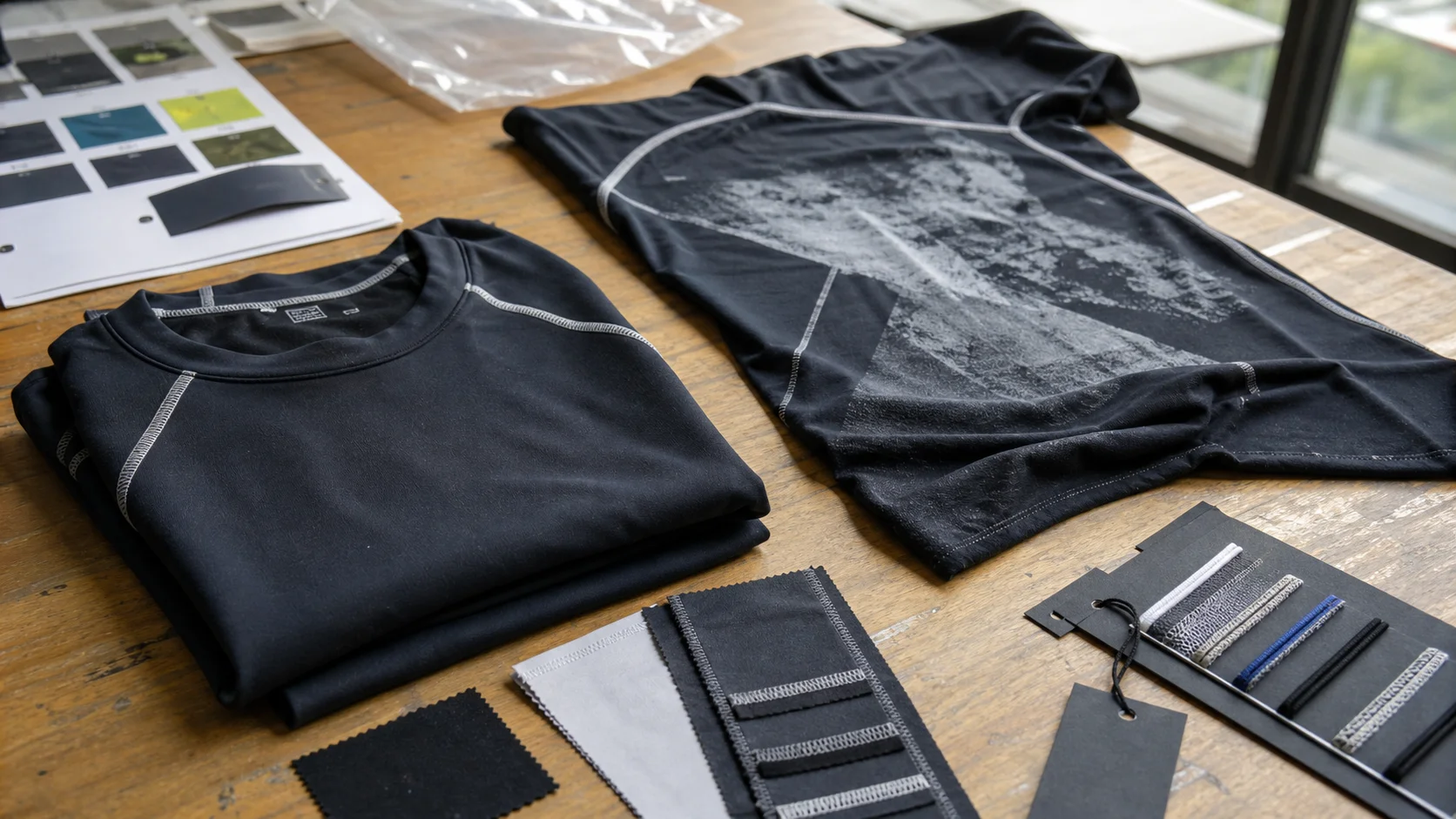
A practical review of how rash guard prints hold up in warehouse safety use, covering abrasion, stretch, wash recovery, visibility, and the print methods...
For warehouse safety teams, a rash guard is not just a piece of athletic apparel. It is often part of a practical workwear system used for outdoor inspections, dock activity, sun exposure, moisture management, or branded team identification. Once a print is added, the question changes from “does it look good?” to “will it still look acceptable after repeated wear, washing, stretching, and contact with equipment?” That is the real purchase issue behind rash guard print durability review for warehouse safety teams.
Printed rash guards can hold up well, but only when the decoration method matches the fabric, the use case, and the wash conditions. A buyer who ignores print chemistry, stretch performance, and inspection standards can end up with faded logos, cracked graphics, delamination, or garments that look worn long before the body fabric fails. For a safety team, that creates avoidable replacement cost and a poor image on the floor.
Rash Guard Print Durability for Warehouse Buyers - Activewear & Teamwear manufacturing guide
Warehouse buyers usually look for three things in printed rash guards: consistent branding, long service life, and comfort during active work. Print durability sits at the intersection of all three. If the graphic deteriorates quickly, the garment can still function technically, but it stops looking uniform. That matters for safety teams that use color-coding, role identification, or branded visibility during site visits and external audits.
Durability is also tied to replacement economics. A cheaper print that fails after a limited number of wash cycles can cost more than a better print with a higher initial price. The right buying model is not “lowest unit price.” It is “lowest cost over the expected useful life.” That usually means checking the print method, the fabric base, and the washing conditions together instead of treating them as separate decisions.
For broader sourcing support, buyers often start with a supplier page such as fabrikn.com/services/ to confirm decoration options, then move into sample approval and specification review before production.
Screen printing remains one of the most durable options for rash guards when the artwork is simple and the ink system is matched to stretch fabric. A good plastisol or water-based system can survive repeated wash cycles if cure temperature, ink deposit, and stretch additive levels are correct. The problem is not screen printing itself; the problem is poor control. Overly thick prints can feel stiff and crack at stress points, especially across chest logos or sleeve graphics that stretch with arm movement.
Screen printing is usually the best fit when the design is limited to one to four colors, the order volume is steady, and the buyer needs a robust result without a premium decoration method. It is less attractive for highly detailed graphics or gradient-heavy branding.
Sublimation performs well on polyester-based rash guards because the dye becomes part of the fiber structure rather than sitting on top of the surface. That makes it a strong choice for all-over prints, high-detail logos, and graphics that need to stretch without visible cracking. The tradeoff is fabric dependency. Sublimation works best on light-colored, high-polyester content fabrics. Dark garments and high cotton blends are not suitable.
For warehouse safety teams that want a durable logo and a lightweight feel, sublimation can be the cleanest option. It is especially useful when the garment also carries role-specific color blocks or branding across the sleeves and back panel. The buyer should still request wash testing. Sublimation does not crack in the same way as surface ink, but color shift, edge blur, and poor ink penetration can appear if the process is weak.
Heat transfer methods, including direct-to-film applications, can deliver sharp graphics and good flexibility if the adhesive system is strong and the press settings are controlled. These methods work well for short runs and multi-color logos. Their weakness is long-term edge wear. On high-stretch garments, transfers can lift at corners, soften with repeated heat exposure, or show surface gloss changes after many washes.
Buyers should be cautious with transfer methods on garments that will be washed frequently and worn in active conditions. They are not automatically poor choices, but they require more careful sample testing than sublimation or well-executed screen printing.
Specialty prints can create a premium look, but they often introduce durability tradeoffs. Silicone prints can feel flexible and clean, yet they may be more expensive and harder to source consistently. Puff or textured prints are more vulnerable to abrasion and can look tired faster in a warehouse setting. These effects are best reserved for promotional wear, not core safety-team stock.
For warehouse programs, the decoration method should be chosen for wash life and movement first, then appearance second. A graphic that looks premium on day one but degrades at the shoulder or hem is a poor procurement decision.
Print durability cannot be judged properly without reviewing the base fabric. Rash guards are often made from polyester-spandex blends, commonly around 80/20, 82/18, or similar ratios. Some programs use 100% polyester for better print consistency and easier color control. The more stretch the fabric has, the more the decoration must move with it. A rigid print on a highly elastic base is a predictable failure point.
Fabric finish also matters. Brushed or heavily finished surfaces can change how inks anchor. Smooth polyester usually prints more consistently. Moisture-wicking treatments may improve comfort, but they can interfere with certain inks or adhesives if the supplier has not adjusted the process. Buyers should treat any “performance finish” as a process variable, not a marketing claim.
Rash guards fail visually where the garment stretches most: shoulder tops, upper sleeves, chest, and side panels. Large chest graphics may distort if the design crosses the full chest width. Sleeve logos can degrade faster if workers frequently bend, lift, or handle cartons. A good print layout respects stretch zones and avoids placing critical branding where constant tension will pull it apart.
Warehouse conditions are harder on decorated apparel than many buyers expect. Garments may be washed more often because they absorb sweat and dust quickly. They may also face repeated friction from seat belts, harnesses, armrests, shelving edges, packaging tape, or repeated hand movement. None of this sounds dramatic, but it adds up.
When a rash guard is worn under other safety gear, friction becomes more important than flashy graphics. In that environment, the best print is often the one that sits flat, flexes quietly, and does not create a raised edge. That is one reason buyers should be skeptical of large, thick, decorative treatments on work-facing garments.
Good sourcing starts with a disciplined spec sheet. If the supplier only receives a logo file and a size list, the order will depend too much on their default process. A warehouse buyer needs explicit control over fabric, print placement, wash tolerance, and approval steps.
When a buyer needs help formalizing those requirements, it is sensible to review a supplier’s process page such as fabrikn.com/about-us/ and confirm whether the team can handle sample development, production oversight, and quality control communication in a way that matches a corporate procurement workflow.
Artwork quality affects print durability more than many teams realize. Fine lines can break up in wash cycles. Tiny reversed text can fill in or lose legibility. Gradients and shadow effects may not survive repeated laundering if the print method is too basic. The safest approach is to simplify logo art where possible and confirm minimum stroke widths before sampling.
Buyers should also ask whether the design has been optimized for stretch. A print that looks correct on a flat PDF can distort badly on a fitted rash guard. Good suppliers will send a layout proof showing exact placement on front, back, and sleeves. That proof should be reviewed carefully before any strike-off is approved.
Sample approval is where many problems can be prevented at low cost. The right process is not to approve a single visual sample and move on. Buyers should evaluate hand feel, stretch, print edge behavior, color accuracy, and wash performance. If the product will go to a warehouse safety team, the sample should reflect actual use as closely as possible.
If possible, request two sample types: one pre-production sample for design approval and one production-reference sample after the supplier has finalized the exact fabric and decoration settings. This is a better control than relying on the first prototype alone.
Warehouse buyers do not need a laboratory to catch obvious failures. A few controlled checks can reveal a lot. Rub the printed area by hand after washing. Stretch the fabric over a curved surface and inspect the edges. Fold and unfold the garment several times to see whether the print forms crease lines. Inspect under strong light for dull patches, raised film, or micro-cracking.
That does not replace formal testing, but it will stop many weak programs from moving into bulk order. A supplier that resists sample testing usually creates more risk than it removes.
MOQ for printed rash guards varies by supplier, decoration method, and fabric selection. For custom programs, a practical range is often 100 to 300 pieces per color or style for simpler production runs. Some factories can offer lower MOQs for digital or transfer decoration, while screen-printed or fully custom programs may require larger quantities to stay economical. Buyers should expect that all-over sublimation, custom labeling, and specialized trims can increase the minimum.
Lead time is driven by more than sewing. Print method, fabric availability, sample approval, trim sourcing, and QC workload all affect schedule. A typical timeline may run from approval to production in several weeks, but that window can widen if the buyer changes artwork late, adds extra colorways, or asks for revised sizing after samples are approved.
Trims deserve more attention than they usually get. A rash guard with printed branding can still fail commercially if the collar twists, the hem opens, or the label irritates the wearer. The buyer should review stitch quality, seam strength, and thread compatibility with the main fabric. Decoration and construction should be treated as one system.
Inspection should not focus only on print appearance. A batch can pass visual review and still be weak in use. The main risk areas are print alignment, wash inconsistency, color variation, and damage introduced during packing or transport.
Risk Area What It Looks Like Why It Matters Buyer Action Print cracking Fine breaks in the logo after stretch or wash Shortens usable life and hurts brand presentation Test stretch recovery and wash samples before approval Edge lifting Transfer corners or print borders peel up Creates early failure and snag risk Inspect corners, sleeve logos, and folded areas closely Color shift Logo or garment shade differs from approved sample Breaks uniformity across the team Set color tolerance and ask for shade band reference Placement drift Print sits too high, low, or off-center Looks unprofessional and may affect visibility Approve placement spec with measurement marks Heat damage Shiny spots, shrinkage, or warped print after pressing Signals poor production control Confirm curing temperatures and post-press handlingPre-shipment inspection should include random garment stretching, visual alignment checks, and carton sampling. If the program is large enough, ask for a wash test on production pieces before the shipment is released. That is a better use of time than discovering failures after receipt.
The right decision depends on usage intensity. For limited-use promotional wear, a transfer print may be acceptable if the budget is tight and the artwork is complex. For warehouse safety teams that will wear the garment repeatedly, a stronger process such as sublimation on polyester or a well-controlled screen print is usually the better value. The decision should also reflect how visible the branding must remain after months of use.
If the garment is part of a controlled uniform program, the buyer should prioritize consistent visual life over novelty. Large logos, heavy textures, and decorative effects often create more returns and replacements than they justify. Clean graphics, tested inks, and stable fabric specs are easier to manage across a team.
There is also a practical tradeoff between decoration flexibility and supply chain risk. The more complex the print, trim package, or fit, the more the program depends on perfect execution. That is manageable for a highly controlled brand launch. It is less desirable for a warehouse program that needs repeat orders and stable replenishment.
The safest procurement choice is usually not the most elaborate garment. It is the one that can be reproduced consistently, washed repeatedly, and inspected easily without surprise failure.
Supplier selection should be based on process discipline, not just price. A useful supplier will discuss fabric composition, print method limits, sampling sequence, and wash expectations in plain terms. They should be able to explain how they control placement, how they handle approval changes, and what they do when a print process does not suit the chosen fabric.
For buyers who need a production discussion, a contact page such as fabrikn.com/contact-us/ is the right place to request sample development, clarify MOQ, and confirm whether the supplier can support warehouse-team branding without compromising durability.
Questions worth asking include whether the factory has a standard wash test protocol, whether sample colors are matched against a control standard, whether print cure conditions are documented, and whether post-production inspection covers both print and seam quality. These are simple questions. The answer quality often tells more than the brochure does.
Get a free quote from Fabrikn — your trusted B2B clothing manufacturer with 10+ years of experience. MOQ as low as 200 pieces.
Get a Free Quote →For most polyester rash guards, sublimation is the strongest option for long-term visual durability because the design is embedded in the fabric. Well-executed screen printing can also be durable when the artwork is simple and the ink is properly cured. Heat transfers can work, but they usually need tighter quality control on stretch and wash performance.
For custom printed rash guards, a common starting range is 100 to 300 pieces per color or style, though the exact MOQ depends on fabric choice, decoration method, and trim complexity. Lower quantities may be possible for digital or transfer-based programs, but unit cost is usually higher.
A polyester-spandex blend such as 80/20 or 82/18 is common for active wear. High-polyester content usually supports better print consistency. The final choice should depend on stretch, recovery, UPF needs, and how frequently the garment will be washed.
Stretch the printed area, wash the sample using the planned care method, and inspect it for cracking, edge lift, fading, and placement drift. A sample that looks good flat on the table is not enough for a warehouse use case.
Some can, but the program has to be specified for it. The buyer should confirm the print method, fabric blend, ink system, and care instructions before assuming the garment will survive repeated heavy washing.
The most common mistake is choosing a print based on appearance or price alone. Durability depends on the interaction between decoration, fabric, stretch, wash conditions, and production control. Missing that connection leads to early failure and replacement cost.
Look for clear answers on fabric specs, print method limits, sample approval steps, inspection controls, and lead-time dependencies. A supplier that can explain process tradeoffs clearly is usually safer than one that promises every method works on every fabric.