
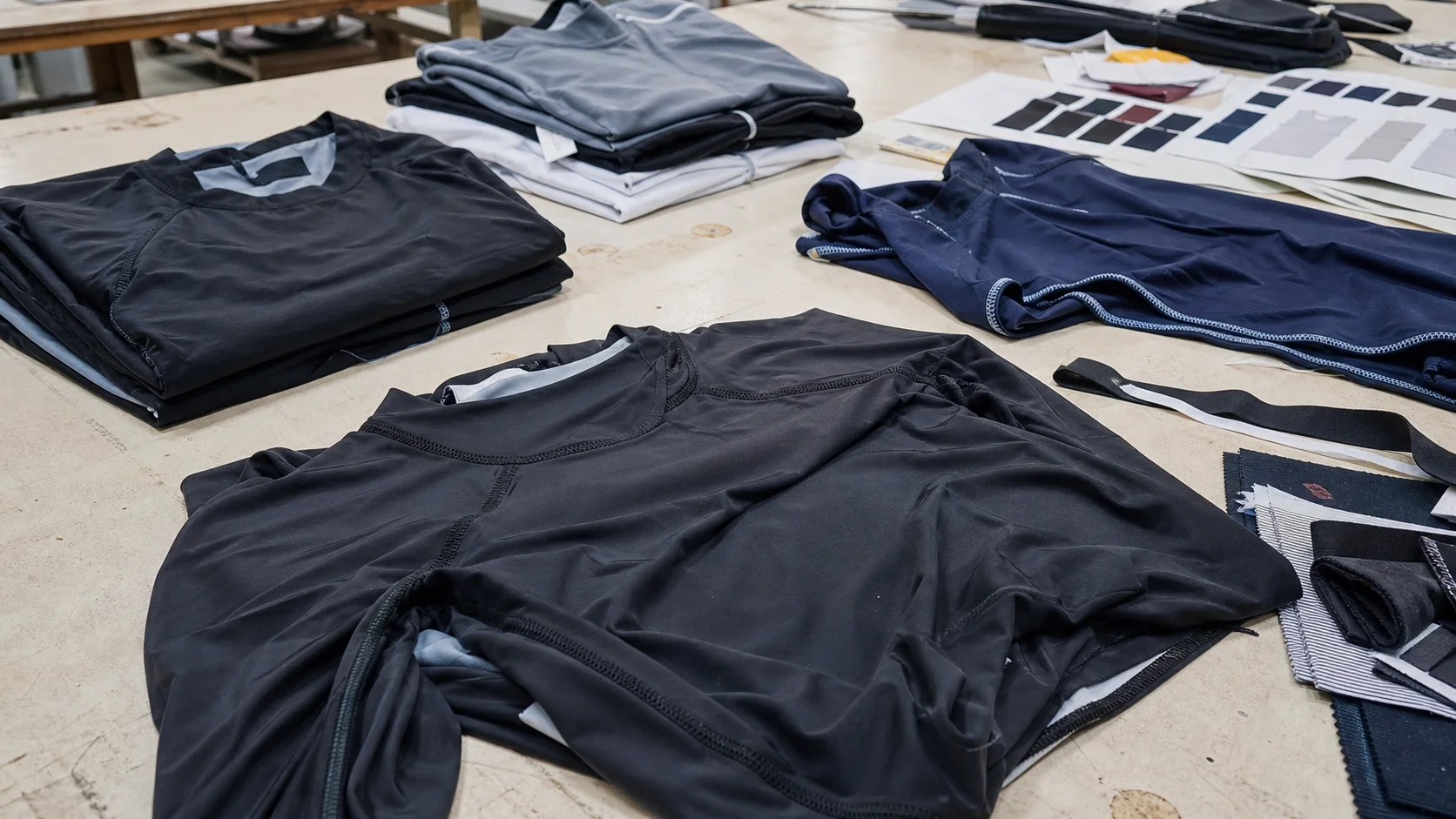
A product-specific supplier scorecard for facilities managers evaluating rash guard vendors, covering fabric performance, decoration durability, fit...
Rash Guard Supplier Scorecard for Facility Buyers - Activewear & Teamwear manufacturing guide
Facility buyers do not purchase rash guards in the same way a fashion retailer buys seasonal swimwear. The requirement is more operational. The garments must support staff uniforms, aquatic programs, surf schools, rescue teams, wellness facilities, water parks, hotels, camps, and sports clubs where garments are used repeatedly, washed frequently, and expected to look consistent across teams.
A rash guard supplier scorecard gives facilities managers a structured way to compare suppliers beyond quoted unit price. This matters because the cheapest rash guard often becomes expensive when sizing is inconsistent, sublimation fades early, seams fail under stretch, or replenishment orders no longer match the first production run.
The best scorecard is not complicated. It should rank suppliers on the issues that affect facility operations: fabric reliability, fit consistency, decoration accuracy, minimum order quantities, sampling discipline, lead-time dependability, quality control, and service responsiveness. A supplier that scores well in these areas is usually safer for recurring uniform programs than one offering a low opening price with vague specifications.
Purchasing judgment: for facility programs, consistency is usually more valuable than chasing the lowest unit cost. A rash guard that performs well across multiple wash cycles and reorder windows protects the buyer from complaints, replacements, and operational disruption.
This article provides a practical supplier scorecard for facilities managers sourcing rash guards for institutional, team, and activewear use. It covers what to ask, what to measure, where defects commonly appear, and how to make a buying decision that holds up after delivery.
A useful rash guard supplier scorecard should divide evaluation into measurable categories. Each category should reflect something that affects the facility’s cost, service level, or end-user satisfaction. Avoid broad categories such as “good quality” unless they are broken into specific checkpoints.
For most facility buyers, the following categories are worth scoring:
Each supplier can be scored from 1 to 5 in every category. A score of 1 means the supplier is weak, unclear, or unproven. A score of 5 means the supplier provides evidence, documentation, samples, and clear process control. Buyers should not rely only on promises in emails. The strongest suppliers can translate a requirement into fabric specs, size charts, sample comments, production checkpoints, and shipment documents.
For organizations building a broader activewear sourcing program, it is useful to compare rash guard sourcing against other custom apparel services. Fabrikn’s manufacturing services page is a relevant starting point for reviewing how cut-and-sew, customization, and production support can fit into a facility uniform program.
Fabric is the first scoring category because rash guards are performance garments. A supplier that cannot clearly specify fabric composition, weight, stretch, hand feel, colorfastness, and UV-related claims should not receive a high score, even if the price looks attractive.
Most rash guards use polyester-spandex, nylon-spandex, or recycled polyester-spandex blends. Polyester is common for sublimation because it accepts dye well and can hold bright prints. Nylon often has a smoother hand feel but may be more expensive and may not be suitable for standard sublimation in the same way polyester is. Spandex content supports stretch and recovery, but too much elastane without proper construction can increase cost and may affect drying or long-term stability.
Fabric Type Typical Use Buying Notes Polyester-spandex Team rash guards, uniforms, sublimated designs Good for bright prints and repeatable branding; check hand feel and snag resistance. Nylon-spandex Premium swim and surf programs Smoother touch; may cost more and needs careful decoration planning. Recycled polyester-spandex Facilities with sustainability requirements Ask for certification support and confirm color consistency between lots. Brushed or thermal stretch fabric Cooler-water programs or hybrid activewear Comfortable but may dry slower; evaluate weight and use conditions.Typical rash guard fabric weights often fall between 160 gsm and 240 gsm. Lightweight fabrics can feel cooler and dry faster, but may become sheer when stretched. Heavier fabrics may provide a more substantial uniform appearance and better opacity, but can feel warm in hot climates. For facilities buying for staff or guests, a practical middle range around 180 gsm to 220 gsm is common, depending on climate, coverage, and budget.
Stretch should be measured in both width and length. A supplier should be able to explain whether the fabric is two-way or four-way stretch. Four-way stretch is usually preferable for fitted rash guards, lifeguard tops, training programs, and surf instruction because the garment moves better with the body. Loose-fit sun shirts may not require the same stretch level, but they still need recovery after washing and wear.
Many rash guards are marketed with UPF 30, UPF 40, or UPF 50+ protection. Facility buyers should be cautious with unsupported claims. If sun protection is a key part of the purchase, request lab testing or documentation tied to the fabric, not just a catalog statement. Fabric color, stretch, weight, and construction can affect performance.
A supplier should receive a higher score if it can provide test reports or a clear path to testing. A lower score is appropriate when the supplier uses UPF language without documentation. For public facilities, schools, camps, or safety-sensitive environments, unsupported UV claims can create avoidable risk.
Rash guards used in pools face chlorine exposure, sunscreen, salt, sweat, and repeated laundering. No supplier should imply that every fabric is immune to fading. The practical question is whether the fabric and decoration method are suitable for the expected use.
Ask suppliers about colorfastness to washing, rubbing, perspiration, seawater, and chlorinated water. For pool-heavy facilities, chlorine resistance should carry more weight in the scorecard than for beach clubs or occasional-use programs. Dark colors and fluorescent shades may require extra caution because they can show fading more visibly.
Facility buyers often underestimate sizing risk. Rash guards can be tight, semi-fitted, or relaxed. A size medium in one supplier’s pattern may feel completely different from another supplier’s medium. If the program serves staff, students, guests, or mixed-age teams, poor sizing can trigger exchanges, complaints, and extra inventory cost.
The buyer should define whether the rash guard is intended to be compression-fit, athletic-fit, standard-fit, or loose-fit. A surf school may prefer a snug fit that stays in place during water activity. A resort or municipal facility may prefer a relaxed sun-protection shirt for broader comfort. A lifeguard team may need a balance: fitted enough for movement, not so tight that staff reject it.
The scorecard should reward suppliers that ask questions before making samples. Suppliers that simply accept a logo and size count without discussing fit should be treated cautiously.
Facilities may need men’s, women’s, youth, and unisex sizing. Each choice affects pattern work and inventory planning. Unisex sizing is simpler and can reduce SKU complexity, but it may not fit all users well. Separate men’s and women’s patterns improve comfort but increase MOQ pressure across sizes.
Ask for a full size chart with chest, waist, sleeve length, body length, neck opening, and bicep measurements where relevant. For youth programs, age labels are not enough. Body measurements are more reliable than age ranges because children’s sizing varies widely.
A strong supplier will support fit samples before bulk production. For larger programs, buyers should consider a small size-set sample run. This helps confirm fit across the actual user group before committing to bulk quantities.
Sample approval should not be limited to appearance. Users should test movement, shoulder comfort, sleeve length, neck tightness, torso length, and whether the hem rides up during activity. For facilities with frequent water use, a wet fit check is useful. A rash guard that feels acceptable dry may become uncomfortable or cling poorly when wet.
Most facility rash guards include logos, staff labels, sponsor marks, numbers, or department names. Decoration quality affects brand presentation and durability. It also affects lead time and defect risk.
Sublimation is common for polyester rash guards, especially when designs include full-body graphics, team colors, or multiple logos. It can be cost-effective for complex artwork because the print is integrated into the fabric rather than sitting on top. It also avoids heavy print hand feel.
The tradeoff is that sublimation depends on accurate color management, pattern alignment, and fabric suitability. White base fabric is typically used for bright sublimated colors. Any pattern mismatch at side seams, sleeves, or shoulders should be reviewed before approval. For facilities requiring strict brand colors, request lab dips or printed strike-offs rather than relying only on digital mockups.
Screen printing can work for simple logos on suitable fabrics, but stretch and water exposure must be considered. Thick prints may crack if the garment stretches heavily. Heat transfers can look clean and are useful for names or small runs, yet they may peel if the wrong adhesive, temperature, or application method is used.
For facility buyers, the key is not choosing the most fashionable decoration method. The key is matching decoration to use conditions. Pool staff, surf instructors, and rental programs need decoration that survives water, sweat, sunscreen, and washing. One-off event rash guards may tolerate a lower-cost decoration method if the expected use is limited.
Rash guards often use heat-transfer neck labels to reduce irritation. Woven labels can feel scratchy, especially near the neck. If care labels are required, placement should be reviewed. The label must remain compliant and readable, but it should not irritate the wearer.
Trims may include zippers for some swim tops, drawcords for related bottoms, hangtags, polybags, size stickers, barcodes, and carton labels. Facility buyers should score suppliers higher when trims are specified clearly and included in the quote. Vague trim assumptions often lead to cost changes later.
MOQ is one of the biggest commercial issues in rash guard sourcing. Facilities often need a practical mix of sizes, colors, and roles, not just a large quantity of one style. A supplier may advertise a low MOQ, but the real MOQ may apply per color, per design, per fabric, or per size ratio.
MOQ varies by supplier, fabric, decoration method, and production location. As a general sourcing guide, custom rash guard MOQs may fall into these ranges:
Program Type Typical MOQ Range Notes Stock blank with logo 25 to 100 pieces Good for small teams; less control over fit and color. Custom sublimated rash guard 100 to 300 pieces per design Common for teamwear and facility uniforms; size mix must be confirmed. Cut-and-sew custom fabric program 300 to 1,000 pieces per style/color Better control but higher development and inventory commitment. Recycled or special-performance fabric 300 to 1,500 pieces or more MOQ may be driven by fabric mill requirements.These ranges are not fixed rules. A supplier with available fabric and open production capacity may accept smaller orders. A supplier handling custom-dyed fabric may require higher quantities. Buyers should ask whether MOQ applies to total order quantity or each variant.
A disciplined sample process reduces the chance of bulk-production problems. For rash guards, the usual approval path may include:
Skipping samples can be tempting when the facility has a tight deadline. That shortcut is risky for fitted garments. If time is limited, prioritize at least a fit sample and decoration proof before bulk production.
Typical lead times for custom rash guards can range from 3 to 8 weeks after final approval, depending on order size, decoration, material availability, and production queue. Sampling may add 1 to 3 weeks, sometimes longer if multiple revisions are needed. Shipping method can add a few days by air or several weeks by sea.
Lead time does not begin when the buyer sends an inquiry. It usually begins after all approvals are complete, deposit or purchase order is confirmed, artwork is finalized, and materials are available. Facility buyers should build their calendar around the approval date, not the first quotation date.
Suppliers should be scored lower if they quote lead times without explaining dependencies. A realistic supplier may be less exciting at the start, but is often safer than one promising fast delivery while leaving fabric, sampling, or print approval unresolved.
Rash guards have specific inspection risks because they combine stretch fabric, close body fit, water exposure, and decoration. The quality standard must be defined before production. If the buyer only says “good quality,” the supplier has too much room for interpretation.
Measurement tolerance should be agreed before production. For stretch garments, common tolerances may be around plus or minus 1 cm for smaller points and plus or minus 2 cm for larger body measurements, depending on the point of measure and garment size. The exact tolerance should be realistic for the fabric and construction.
Neck opening, sleeve length, body length, chest width, and hem sweep are particularly important. A small measurement error can change comfort significantly on a fitted rash guard.
Flatlock seams are often used in rash guards because they sit flatter against the skin and reduce irritation. Coverstitching may also be used depending on design and factory equipment. The supplier should explain seam type, thread quality, stitch density, and expected stretch performance.
Seam strength is critical. Rash guards are pulled over the head, stretched around shoulders, and used in active conditions. A seam that looks fine on a table may fail when worn. Buyers should request stretch testing or at least manual seam checks during inspection.
For larger orders, buyers may use an AQL inspection approach. The inspection should include measurements, visual defects, logo placement, stitching, labeling, packaging, and carton count. For smaller orders, a simplified inspection may be enough, but it should still be structured.
A supplier deserves a higher score if it has internal QC checkpoints and will share inspection photos or reports before shipment. A supplier that resists inspection or cannot provide production references should be treated as higher risk.
Supplier performance is not only about the garment. Facilities managers need suppliers that communicate clearly, document decisions, and support repeat orders. A technically capable supplier can still be a poor fit if it responds slowly, changes terms late, or cannot manage replenishment.
A good supplier should confirm specs in writing, flag unclear requirements, and provide realistic timelines. Response time matters, but quality of response matters more. A fast reply that avoids the question is not useful.
Buyers should score communication on these points:
Rash guard quotes should specify unit price, sample cost, mold or setup charges if any, artwork fees, shipping terms, payment terms, packaging, labeling, and taxes or duties where applicable. If the quote is vague, the buyer may face surprises later.
Payment terms vary. Many custom apparel suppliers require a deposit before production and balance before shipment. Larger institutional buyers may request purchase-order terms, but not every manufacturer will accept them for custom goods. Facilities managers should involve procurement or finance early if payment terms need approval.
Facilities often need reorders. Staff turnover, new program sessions, damaged garments, and size exchanges all create replenishment demand. Before placing the first order, ask whether the supplier can repeat the same fabric, print colors, labels, and size specs for future runs.
Continuity is not guaranteed if the fabric is special, seasonal, or sourced from a small lot. A supplier should be transparent about this. For critical uniforms, buyers may want to hold extra inventory or commit to a planned reorder schedule.
If the facility is comparing production partners and wants to discuss requirements before issuing a purchase order, Fabrikn’s contact page can be used to start a sourcing conversation with specific specs, quantities, and timeline expectations.
The scorecard below is designed for facilities managers evaluating rash guard suppliers for activewear and teamwear programs. Buyers can adjust the weighting based on the use case. For a lifeguard uniform, durability and colorfastness may matter most. For a one-day event, MOQ and speed may carry more weight.
Category Weight What to Check Score 1-5 Fabric Specification 15% Composition, gsm, stretch, opacity, hand feel, UPF support Durability and Colorfastness 15% Wash performance, chlorine exposure, seam strength, print durability Fit and Sizing 12% Size chart, grading, fit sample, user comfort, youth or gender-specific options Decoration Accuracy 10% Logo placement, sublimation quality, print method, brand color control MOQ and Reorder Flexibility 10% MOQ per style, per color, per size, replenishment terms Sampling Process 10% Fit sample, strike-off, pre-production sample, revision process Lead-Time Reliability 10% Timeline clarity, material availability, production queue, shipping method Inspection and QC 10% AQL readiness, measurement checks, defect handling, photo reports Communication and Documentation 8% Spec confirmation, quote clarity, risk flagging, response qualityA supplier does not need to be perfect in every category. The decision depends on the facility’s priorities. A small swim school may accept limited packaging support if fabric and fit are strong. A resort with multiple departments may need stronger labeling, carton control, and reorder management. A municipal buyer may prioritize documentation and compliance because procurement records matter.
For facility rash guard programs, the safest supplier is usually the one that provides clear specifications, reliable samples, realistic lead times, and repeatable production. Price still matters, but it should be evaluated after confirming the supplier can meet the operational requirement.
A practical buying process should look like this:
The main tradeoff is control versus flexibility. Stock blanks with logo application are faster and lower MOQ, but fit, color, and fabric choices are limited. Fully custom rash guards offer better brand control and program consistency, but they require more sampling, higher MOQ, and tighter planning. Cut-and-sew production is best when the facility needs a repeatable uniform standard rather than a one-time order.
Facilities with multiple apparel categories may benefit from working with a supplier that understands broader teamwear and activewear development, not only rash guards. Fabrikn’s about us page provides useful context on its manufacturing-focused approach for buyers comparing long-term apparel partners.
Final purchasing view: choose the supplier that reduces uncertainty. A slightly higher unit price is often justified when the supplier provides better fit control, documented fabric specs, disciplined sampling, and dependable reorders.
Get a free quote from Fabrikn — your trusted B2B clothing manufacturer with 10+ years of experience. MOQ as low as 200 pieces.
Get a Free Quote →A rash guard supplier scorecard should include fabric specifications, durability, fit and sizing, decoration quality, MOQ, sampling process, lead time, quality inspection, communication, and reorder support. These categories help buyers compare suppliers on operational reliability rather than price alone.
Typical MOQs vary by supplier and construction. Stock rash guards with logo decoration may start around 25 to 100 pieces. Custom sublimated rash guards often start around 100 to 300 pieces per design. Fully custom cut-and-sew programs may require 300 to 1,000 pieces or more, especially when special fabric is involved.
Custom rash guard production often takes 3 to 8 weeks after final sample approval, depending on material availability, order size, decoration method, and production capacity. Sampling can add 1 to 3 weeks or more if revisions are required. Shipping time should be calculated separately.
Polyester-spandex is a common choice for sublimated team and facility rash guards because it supports bright prints and good stretch. Nylon-spandex can provide a smoother premium feel, while recycled polyester-spandex may suit sustainability requirements. The best fabric depends on use conditions, budget, decoration method, and required durability.
Yes, if sun protection is part of the product claim or user safety expectation. Buyers should ask for fabric-level testing or documentation supporting UPF claims. Unsupported UPF statements should receive a lower supplier score, especially for camps, schools, public facilities, and safety-related programs.
The most common risks include poor stretch recovery, popped seams, inconsistent sizing, fading, incorrect logo placement, print peeling, sublimation color variation, fabric snagging, and mislabeled sizes. These risks can be reduced through clear specs, fit samples, print strike-offs, pre-production samples, and final inspection.
Sublimation is often better for polyester rash guards with full-color graphics or multiple logos because it keeps the garment lightweight and avoids heavy print layers. Screen printing can work for simple logos, but stretch and water exposure must be tested. The right method depends on fabric, artwork, budget, and expected use.
Facilities should confirm whether the supplier can repeat the same fabric, colors, fit, labels, and decoration method. Buyers should also ask whether MOQ changes for reorders. For critical uniforms, holding extra inventory or scheduling planned replenishment can reduce the risk of mismatched future production.