
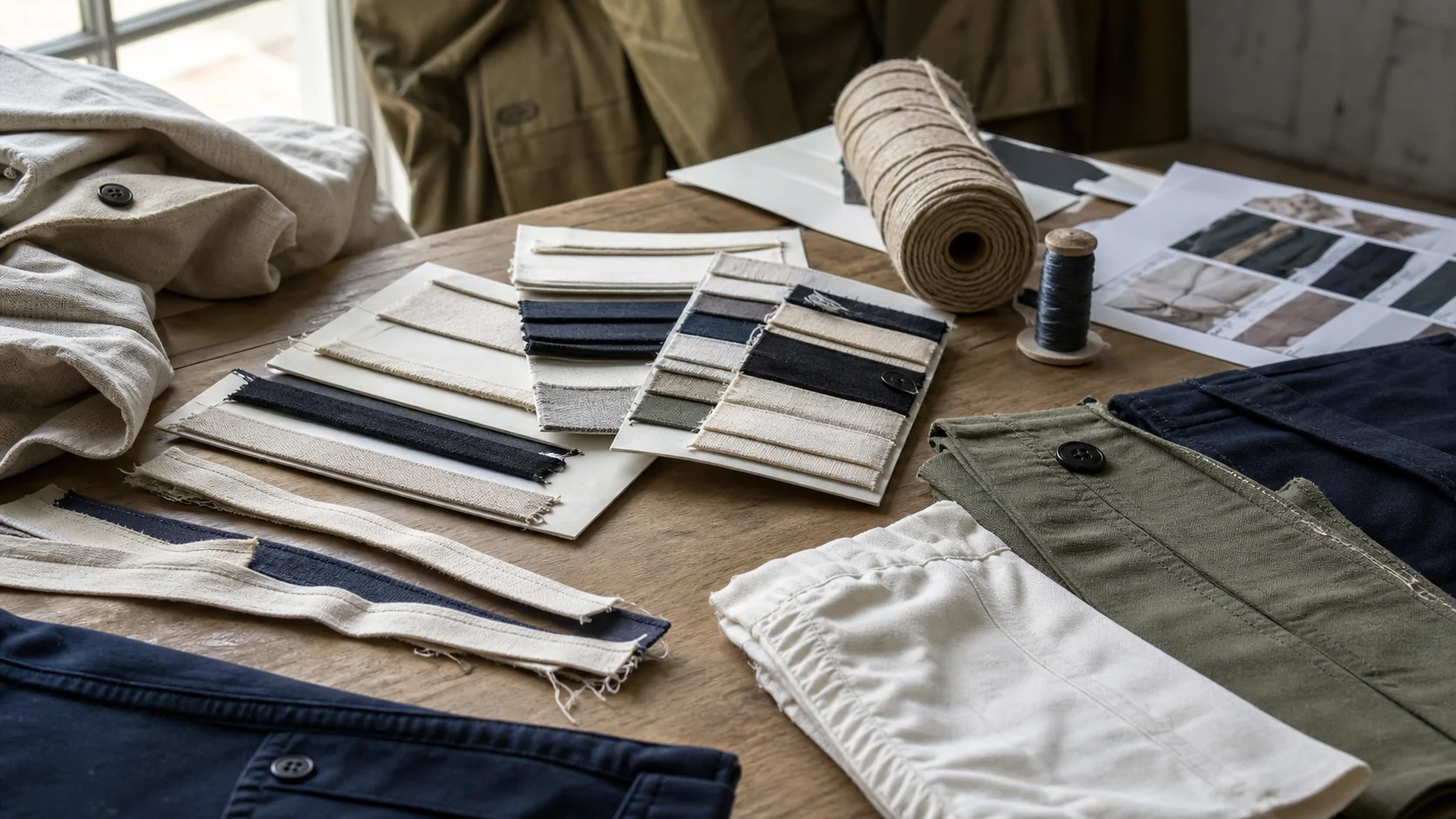
A distributor-focused outline for reviewing reclaimed cotton coat orders, trim sourcing choices, sustainability claims, costing risks, and production...
Reclaimed Cotton Coat Trim Sourcing for Buyers - Sustainable Fashion manufacturing guide
Reclaimed cotton coat trim sourcing is no longer a niche sustainability note buried at the end of a tech pack. For distributor buyers, it can affect cost, compliance, minimum order quantities, sample timing, inspection outcomes, and how confidently a finished coat can be sold into retail or uniform channels. The opportunity is clear: reclaimed cotton trims can reduce reliance on virgin inputs and support a more responsible materials story. The buying risk is also clear: inconsistent fiber content, variable color lots, weak reinforcement, and unclear documentation can turn a good sourcing idea into late shipments or failed quality checks.
This sourcing review focuses on the practical side of ordering reclaimed cotton trims for coats. That includes woven labels, tapes, drawcords, pocketing accents, binding, patches, hanger loops, waist ties, cuff tabs, and other cotton-based components used in outerwear. It is written for distributor buyers who need to brief factories, compare suppliers, control claims, and protect margin without overpromising sustainability performance.
For broader sourcing support, buyers can review manufacturing and development options through Fabrikn services, learn more about the company at Fabrikn about us, or discuss a coat trim sourcing project through Fabrikn contact us.
Coats use more trims than many buyers expect. A simple cotton-rich coat may include internal binding, back-neck tape, care labels, brand labels, drawcords, pocket bags, reinforcement patches, sleeve tabs, storm flap tape, button backing fabric, hanger loops, and packaging-facing trims. If the main shell fabric is sustainable but the trim package is conventional and poorly documented, the final product story becomes weaker.
Reclaimed cotton trim can help close that gap. It is usually made from pre-consumer cutting waste, post-industrial cotton waste, recycled yarn streams, or mechanically reclaimed cotton fiber blended with virgin cotton, polyester, or other fibers for strength. The best use cases are trims that do not carry the full structural load of the garment. Internal tapes, labels, binding, decorative patches, and certain drawcords can be suitable. High-stress areas need more caution.
Distributor buyers should treat reclaimed cotton trims as a controlled material substitution, not a simple swap. A trim that looks acceptable in a sales sample may behave differently in bulk production after dyeing, washing, pressing, abrasion, or wet crocking. The sourcing goal is not only to buy a greener trim. It is to buy a trim that performs consistently enough for the coat’s intended market and price point.
Purchasing judgment: reclaimed cotton trim is most attractive when it supports the product story without becoming the highest-risk component in the coat. Use it where the performance demand is moderate, the specification is measurable, and the supplier can document fiber content.
The term “reclaimed cotton” is often used loosely. Buyers need to define it before sending requests for quotation. A supplier may use “reclaimed,” “recycled,” “regenerated,” “upcycled,” or “waste cotton” to describe different inputs. These are not always equivalent from a certification, labeling, or customer-claim perspective.
Not every reclaimed cotton trim is suitable for every coat. A fashion coat with light seasonal wear allows more flexibility. A workwear coat, school outerwear program, uniform coat, or outdoor coat needs tighter testing. Trim failure on a coat is visible and expensive because repair, replacement, or rework can involve multiple components.
Pre-consumer reclaimed cotton usually comes from cutting waste, spinning waste, or textile production leftovers. It tends to be cleaner and more consistent than post-consumer cotton. Post-consumer cotton comes from used garments or textiles, which may introduce more variation in color, fiber contamination, and unknown finishing residues.
For distributor buyers, pre-consumer reclaimed cotton is often the safer starting point for coat trims. It is generally easier to control in color, hand feel, and yarn strength. Post-consumer cotton may support a stronger sustainability message, but it often requires better traceability, more testing, and more cautious claims.
Input Type Typical Advantage Common Risk Best Coat Trim Use Pre-consumer reclaimed cotton Cleaner, more consistent supply May be less compelling for consumer storytelling Tapes, labels, binding, patches Post-consumer reclaimed cotton Stronger circularity claim potential Higher variation and documentation burden Decorative patches, limited trims, capsule orders Blended reclaimed cotton yarn Improved strength and stability Lower total recycled cotton percentage Drawcords, webbing, reinforcement tape Undyed reclaimed cotton Lower dyeing impact and natural appearance Shade variation between lots Natural trims, internal details, eco-positioned coatsA reclaimed cotton trim RFQ should be more detailed than a standard trim inquiry. Vague requests lead to attractive quotes that may not survive sampling or bulk inspection. The buyer should lock the intended function, visible appearance, fiber content, finishing, testing requirements, and acceptable variation before comparing prices.
Distributor buyers should also specify how the trim will be used. A back-neck tape does not need the same tensile performance as a waist drawcord. A decorative patch may need better embroidery stability than wash durability. A cuff tab may require dimensional stability, edge strength, and buttonhole reinforcement.
Purchasing judgment: do not approve reclaimed cotton trim only from a photograph. Ask for a physical sample, stretch it, wash it, press it, rub it against the shell fabric, and test it on the actual coat construction.
MOQ is one of the main friction points in reclaimed cotton coat trim sourcing. Buyers often assume sustainable trims can be ordered in the same flexible quantities as conventional stock trims. That is not always the case. Reclaimed cotton yarn lots can be limited, and custom dyeing or weaving may require minimum batch quantities.
These ranges are typical commercial reference points, not fixed rules. A supplier with stock reclaimed cotton greige tape may offer lower MOQ. A custom-dyed, certified, yarn-dyed jacquard tape may require much higher quantities. Small distributor orders should consider trim standardization across multiple coat styles to improve buying power.
Reclaimed cotton trim is not automatically cheaper than virgin cotton trim. Mechanical recycling, sorting, blending, certification, smaller production lots, and extra testing can increase cost. Buyers should compare total landed cost rather than unit price alone.
A distributor buyer should challenge both extremes. A price that is far below the market may indicate weak documentation, mixed fiber content, or stock clearance material. A premium price may be justified, but only if the supplier provides better consistency, certification, performance, or service.
Sampling is where many reclaimed cotton trim programs either become realistic or fall apart. The buyer should not approve a trim only because it supports a sustainable message. It must work with the coat’s shell fabric, lining, sewing method, wash process, packaging, and end-use expectations.
The pre-production stage is particularly important. A development sample may be produced from available yarn, while bulk production may use a different reclaimed cotton lot. Buyers should request a bulk-lot approval sample before the trim is released to the garment factory.
Reclaimed cotton fibers may contain mixed shades before reprocessing. This can create attractive natural variation, but it also makes exact color matching harder. Natural ecru, oatmeal, grey melange, and muted earth tones are often more realistic than bright saturated shades. Dark colors can hide variation but may increase crocking or bleeding risk.
If the trim touches a light lining or shell fabric, wet and dry crocking must be checked. Dark reclaimed cotton drawcords and tapes can transfer color during packing, shipment humidity, consumer wear, or cleaning. This risk is higher when trims are heavily dyed, insufficiently washed off, or pressed against light fabric for long periods.
Lead time for reclaimed cotton coat trims depends on yarn availability, color development, certification requirements, trim construction, and shipping plan. Buyers should not build the production calendar from the garment sewing date alone. Trim development can become the critical path.
For standard trims in stock colors, the process may be faster. For custom-dyed, certified, reclaimed cotton trims, buyers should protect more calendar time. A realistic development window is often four to eight weeks before garment production, depending on complexity. Orders that require lab testing, customer approval, or retailer compliance review may need longer.
Seasonal coat programs are especially vulnerable to trim delays. Coats often have longer fabric lead times, heavier packaging requirements, and fixed delivery windows. A missing drawcord or back-neck tape can hold finished goods even when shell fabric and lining are ready. Buyers should approve backup trims early, not after the first supplier misses shipment.
Reclaimed cotton trim inspection should be more disciplined than conventional trim inspection because variation is part of the material reality. The buyer’s job is not to eliminate all variation. The job is to define what variation is acceptable and what creates commercial risk.
Buyers should set roll-level and lot-level controls. At minimum, inspect shade, width, hand feel, roll length, visible defects, and packing labels before trims enter garment production. For visible trims, compare bulk against the approved standard under consistent lighting. For functional trims, run pull tests or seam attachment tests before bulk sewing.
Dimensional stability matters. If a reclaimed cotton tape shrinks during steam pressing or washing, it can pull the coat seam and create puckering. This is especially visible around fronts, hems, cuffs, pocket openings, and neckline areas. Pre-shrunk trims may cost more but can prevent rework.
Cutting behavior should also be checked. Some reclaimed cotton tapes shed fibers at the ends. Heat cutting may not be suitable for high-cotton content because cotton does not melt like polyester. Ultrasonic cutting may also be limited depending on blend. Buyers may need folded ends, bartacks, binding, resin edge treatment, or mechanical end finishing.
Purchasing judgment: if a trim controls fit, closure, load, or safety, do not choose the highest reclaimed cotton percentage by default. Strength, shrinkage, and attachment performance should lead the decision.
Sustainability claims need discipline. “Reclaimed cotton” may sound positive, but retailer and regulatory expectations are becoming more demanding. Distributor buyers should confirm what can be claimed on product pages, hangtags, line sheets, and customer presentations.
A supplier declaration may be enough for internal material tracking, but it may not be enough for consumer-facing claims. Certification requirements depend on the buyer’s market, retailer standards, and claim language. A cautious phrase such as “contains reclaimed cotton trim” may still require substantiation. A stronger claim such as “made with recycled cotton” may require clearer chain-of-custody evidence.
Buyers should avoid broad environmental claims unless they are backed by data. Reclaimed cotton content does not automatically prove lower impact across every category. Mechanical recycling can reduce virgin fiber demand, yet processing, blending, dyeing, finishing, shipping, and wastage still matter. The safest commercial position is specific and measurable: identify the trim, the content, and the basis for the claim.
Distributor buyers often sit between factories, brands, retailers, and end customers. That position requires more control over communication. If a trim supplier fails to deliver, the distributor may still be responsible for the finished coat order. Supplier evaluation should cover more than price.
Ask suppliers what happens if the approved reclaimed cotton lot runs out. Some suppliers may replace yarn without notifying the buyer unless the purchase order blocks substitution. The order should state that fiber content, shade, construction, and lot changes require written approval.
Factory coordination is another issue. Trim suppliers may ship directly to the garment factory, but the distributor still needs visibility. Packing lists should identify item code, color, lot number, roll quantity, roll length, and purchase order. Factories should be instructed not to mix unapproved trim lots within the same style unless approved.
Reclaimed cotton coat trim sourcing is a tradeoff between sustainability value, cost, performance, and supply reliability. The right decision depends on the coat category and buyer promise.
A balanced sourcing strategy often works best. Use reclaimed cotton for selected trims, while keeping higher-strength components in proven blends. For example, a coat may use reclaimed cotton back-neck tape, internal binding, and woven labels, while using a cotton-polyester drawcord for strength. This gives the product a credible sustainability improvement without forcing every component into the same material story.
Distributor buyers should build the trim package before final garment costing. If reclaimed cotton trims are added late, the factory may quote based on conventional trims and then treat the sustainable option as an upcharge. Early specification allows proper costing, better MOQ planning, and more reliable production scheduling.
For distributor programs, trim standardization is often the main margin protector. A single approved reclaimed cotton tape used across three coat styles can reduce MOQ pressure and simplify inspection. A unique custom trim for every coat may look better in presentation, but it increases stock risk and supplier dependency.
Trim cannot be judged separately from the coat fabric. Reclaimed cotton tape on a wool-blend coat behaves differently than the same tape on a waxed cotton shell, recycled polyester shell, nylon canvas, or brushed cotton twill. Buyers should evaluate compatibility at the garment level.
Some coat styles use trims hidden inside the garment. Hidden does not mean low risk. Internal tape that shrinks can affect the outside appearance. Pocket trim that bleeds can stain lining. A hanger loop that tears can create a customer complaint even if the coat itself remains wearable.
Negotiation should focus on total order reliability rather than forcing the lowest trim price. Reclaimed cotton trims can fail in ways that cost more than the original trim saving. Distributor buyers should negotiate clear approvals, replacement rules, and documentation responsibilities.
Buyers should also agree who pays for failed testing, replacement trims, and air freight if the supplier’s bulk does not match the approved sample. These points are easier to settle before the purchase order than after the garment factory is waiting.
Reclaimed cotton coat trim is a sensible sourcing direction when it is specified carefully and approved through physical testing. It can strengthen the sustainability profile of a coat without redesigning the entire garment. It can also create avoidable problems when buyers rely on loose terminology, unclear claims, or visual approval only.
The best buying approach is selective and documented. Use reclaimed cotton trims where they add sustainability value and manageable risk. Keep technical trims performance-led. Confirm MOQ, lead time, testing, and claim support before final costing. Approve bulk lots before sewing. Inspect trims at roll level before they become part of finished coats.
For distributor buyers, the commercial answer is not “use reclaimed cotton everywhere.” The stronger answer is “use it where the product, customer, compliance position, and factory process can support it.” That is the difference between a sustainable trim story that sells and a material substitution that creates production risk.
Get a free quote from Fabrikn — your trusted B2B clothing manufacturer with 10+ years of experience. MOQ as low as 200 pieces.
Get a Free Quote →Reclaimed cotton coat trim refers to coat components made partly or fully from recovered cotton fiber, usually from pre-consumer textile waste, post-consumer garments, or recycled yarn streams. Examples include tapes, woven labels, drawcords, binding, patches, hanger loops, and pocket details.
The terms are often used interchangeably, but buyers should confirm the supplier’s definition. “Recycled cotton” may imply a specific recycled-content claim or certification, while “reclaimed cotton” may simply describe recovered cotton fiber. Documentation matters if the claim appears on hangtags, websites, or retail packaging.
Typical MOQs range from 500 to 2,000 pieces for patches, 1,000 to 5,000 pieces for labels, and 1,000 to 5,000 meters for tapes, binding, webbing, or drawcords. Custom color, certification, jacquard construction, and special finishing can increase MOQ.
It can. Pricing depends on reclaimed cotton percentage, certification, yarn availability, dyeing, trim construction, testing, and production quantity. Stock natural trims may be competitive, while custom certified trims often carry a premium.
Key tests include colorfastness to rubbing, colorfastness to washing, shrinkage, tensile strength, seam attachment strength, abrasion, pilling, and restricted substances compliance. The exact test package should match the trim function and coat care label.
Yes, but strength must be checked. Many drawcords use reclaimed cotton blended with virgin cotton or synthetic fibers to improve tensile performance and diameter stability. Pure reclaimed cotton may not be suitable for high-stress drawcord applications.
The biggest risk is approving a trim based on sustainability language without controlling bulk performance. Shade variation, shrinkage, weak strength, fraying, and poor documentation are common issues. Bulk-lot approval before garment sewing is essential.
Claims should be specific and supported. A cautious claim identifies the trim and its content, such as “contains reclaimed cotton trim,” if documentation supports it. Stronger recycled-content claims may require certification or transaction records depending on customer and market requirements.
Buyers should be cautious when the trim is load-bearing, safety-related, exposed to heavy abrasion, or required to match an exact color across many lots. Conventional or blended trims may be the better choice for technical coat functions.
Start trim sourcing during tech pack and costing development. Custom reclaimed cotton trims can require four to eight weeks for sourcing, sampling, color approval, testing, and bulk production. Late trim changes often create shipment risk.