
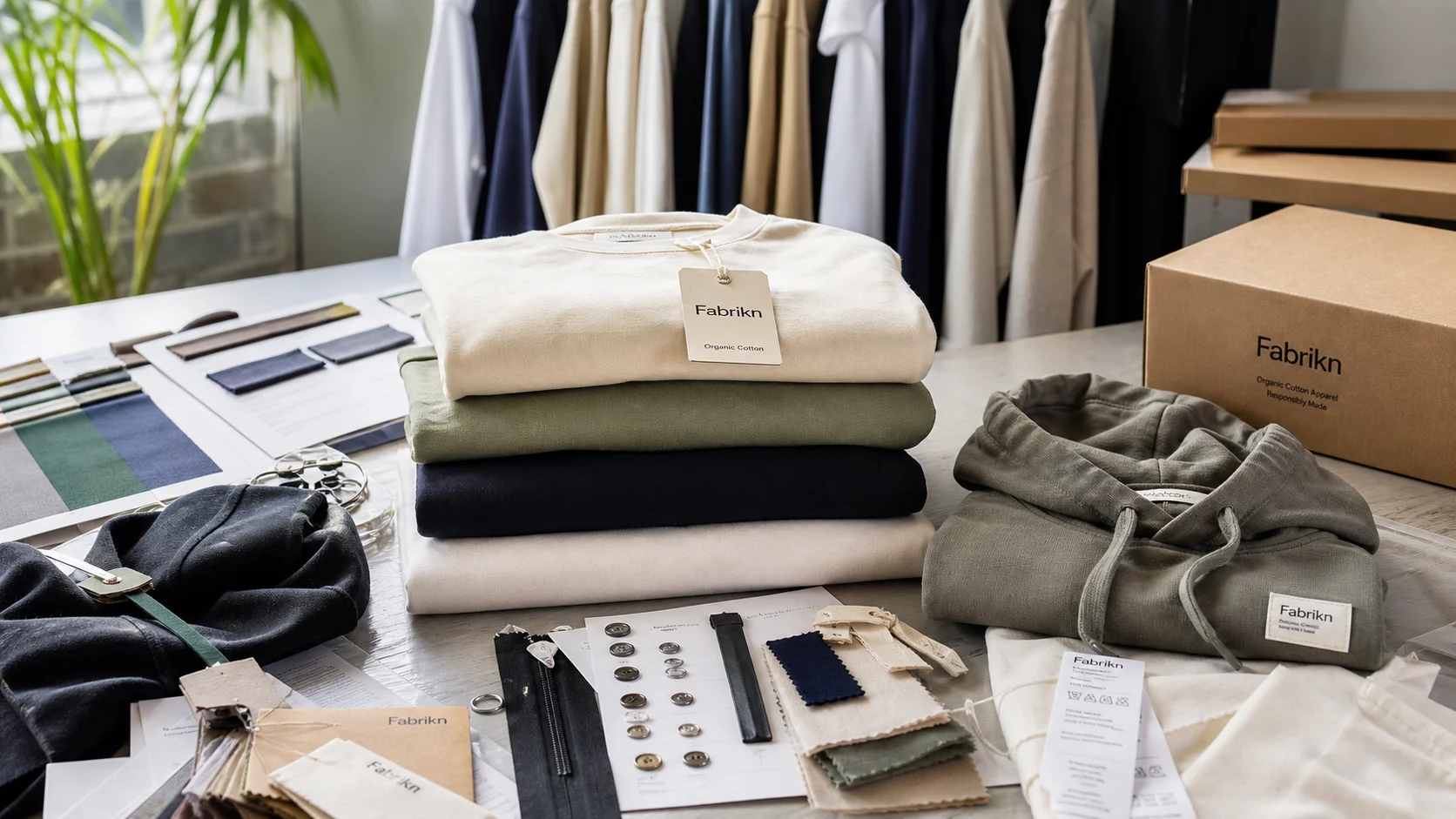
Recycled Cardboard Clothing Packaging Boxes with checks for samples, fit, MOQ, QC evidence, pricing terms, and delivery risk.
Fast answer: Recycled Cardboard Clothing Packaging Boxes: Costs, Quality, should be judged by production evidence, not by a generic sourcing promise. The buyer needs sample proof, cost breakdowns, QC checkpoints, and delivery buffers in writing.
Ask for recent sample photos, measurement tolerances, fabric or print test assumptions, decoration test notes, packing examples, and a named inspection checkpoint. These details show whether the team can repeat an approved sample at bulk volume.
Separate garment cost, decoration, labels, packaging, sampling, testing, freight, and rush charges. When every cost line is visible, it becomes easier to reduce colorways, adjust size depth, or reserve more time for sampling.
On a factory floor, recycled cardboard clothing packaging boxes are never just boxes; they are a quiet line item that decides whether a shipment arrives cleanly or turns into a headache with postage attached. A carton that fails once in every 40 orders sounds harmless until a brand ships 80,000 units and suddenly has 2,000 complaints, plus reships and customer service time. On a 12-hour packing shift, that becomes real money fast.
The waste shows up where the work happens. Boxes sit under pallets, scrape across concrete, and are packed beside steam irons or humid doors. In one Bangladeshi knitwear facility I visited, 8% of outer cartons showed corner deformation before they left the warehouse, and the team still paid for them because the print looked perfect. A premium brand selling at $120-$180 retail can absorb more packaging cost than a value label at $18-$28, yet the expensive mistake is often the same: overbuilding the box and paying for air.
That is where packaging waste slips into the margin, not just the trash bin. I have seen a $0.38 rigid mailer trigger a $6.50 replacement parcel once freight, labor, and a discount code were added. Mid-market brands often use recycled cardboard clothing packaging boxes with one-color print and no insert, keeping packaging near $0.22-$0.45 per unit at 5,000-10,000 pieces. Value brands usually aim lower still, but they also tolerate more scuffing and fewer embellishments. Premium brands want the lid to open like a ritual; the factory wants it to survive a 25-kg stack test.
According to ASTM, compression and material testing standards exist for a reason: shipping is mechanical violence, not a visual exercise. I have seen recycled cardboard clothing packaging boxes made with decent recycled content still fail because the board was specified for print beauty, not for stacking, humidity, and transport abuse. Sustainability helps, but overbuilt packaging erases the gains when it adds weight, fillers, and transport volume.
Most buyers use the phrase recycled cardboard loosely, yet the materials differ in feel, cost, and performance. Recycled linerboard is the face paper on corrugated board, often made with 30%-100% recycled fiber. Folding carton board is thinner, cleaner-looking, and better for presentation sleeves or inner boxes, while kraft paper wraps are used for tissue-style presentation or simple bands around folded garments. Board thickness matters, but so does the fiber mix. A 350 GSM folding carton can look luxurious and still buckle if the score line is weak.
Post-consumer fiber comes from recovered household paper and office waste. Post-industrial fiber comes from factory offcuts and trimmings. The first usually carries a more varied fiber length and a rougher surface, which can lower print sharpness by 5%-15% unless the mill calendering is tight. The second is cleaner and more consistent, but it is not the same as true consumer recycled content. Buyers who ask for “100% recycled” without a certificate often discover that the claim means 100% recycled fiber in the outer layer, not the full board construction.
That distinction matters when you are ordering at scale from a recycled cardboard clothing packaging boxes manufacturer or supplier. A box made from 100% recycled paperboard may be slightly less bright, slightly less stiff, and more prone to edge fuzzing, yet it can still perform well if the caliper is right and the flute profile matches the load. In contrast, a 70%-80% recycled board with better formation can outlast a weaker 100% claim. I ask for mill certificates, FSC Recycled documentation when relevant, and a spec sheet that lists caliper, basis weight, bursting strength, and ECT rather than marketing language.
For brands building custom clothing packaging solutions, the real question is not whether recycled content exists. It is whether the paper grade supports the garment, the route, and the retail promise. A 250 GSM sleeve works for folded tees; a 2.5 mm rigid setup can be justified for premium outerwear, but only if it does more than sit pretty on a shelf. When sourcing wholesale or bulk, the factory should also confirm production capacity, quality control, and lead times before approving the final spec.
I never approve packaging from a photo. I want numbers. Compression strength, edge crush test (ECT), bursting strength, moisture resistance, print rub resistance, and crease integrity all tell a different part of the story. On humid routes through South Asia or coastal Latin America, recycled cardboard clothing packaging boxes that pass in a dry showroom can warp after 48 hours in a warehouse at 75%-85% relative humidity. That is why the shipping route belongs in the spec sheet.
The main tests I request are straightforward: ECT for stacking performance, Cobb or water absorption data for moisture behavior, drop testing for transit impact, and a print adhesion test for scuff resistance. If the box has a lid, I ask for repeated open-close cycles, often 20-30 times, because the failure usually starts at the hinge or score line, not on the broad panel. A clean print can hide a weak fold. A beautiful lid can fail at the first corner pinch.
Low-cost boxes often fail in the same places. The score line cracks, the lid bows, or the fold memory disappears after the first shipment. In one factory in Portugal, I saw a batch of 400 mailer boxes with perfect offset print and a 1.8 mm variance in die-cut depth. The result was subtle: 14% of the lids popped open during packing, which slowed the line by nearly 2 minutes per carton. At 15,000 units, that is not a cosmetic issue. That is labor leakage.
Thicker is not automatically stronger. I have seen a 550 GSM board fail more often than a 420 GSM board because the flute geometry, die-cut pressure, and crease rule were mismatched. Too much rigidity can cause the score to split instead of flex. If you specify recycled cardboard clothing packaging boxes with the wrong flute, the extra paper just gives you a heavier failure.
Factory buyers should ask for sample testing under real conditions, not showroom conditions. If your route includes a 3-4 week sea shipment, then stack the sample for 72 hours, mist it lightly, and rub the printed face with a cotton cloth after packing. A box that survives that trial is far more valuable than one that only photographs well.
For soft goods, I compare packaging checks with garment checks. A brand that cares about custom baby clothing manufacturing already understands how tiny tolerances matter, because a 2 mm deviation can change fit or comfort. Packaging behaves the same way. Small errors become expensive in volume.
Independent standards can also help teams align internal testing with outside benchmarks. See OEKO-TEX certification guidance and Textile Exchange sustainability resources for broader material and sourcing references that many apparel teams use alongside packaging specs.
Price changes quickly with board grade, print process, and finishing. At the budget end, a simple folding carton or mailer can land around $0.12-$0.28 per unit at 10,000-20,000 pieces, usually with one-color flexo, minimal finishing, and no insert. Mid-tier boxes often sit around $0.28-$0.65, with better board, stronger caliper control, spot color print, and perhaps a dust flap or tissue insert. Premium builds can run $0.75-$2.50 and higher, especially if you add foil, soft-touch coating, magnetic closures, or rigid construction.
Volume changes the math. A 2,000-piece run may cost 20%-35% more per unit than a 10,000-piece run because setup, plates, and die-cut tooling are spread over fewer cartons. Customization adds another layer. A box with CMYK print, a custom insert, and foil stamping can carry a tooling bill of $180-$650 before production even starts. I have seen brands focus on the unit quote and ignore the initial tooling, then wonder why the first PO is 18% above budget.
Hidden costs matter more than most procurement teams admit. If a box takes 12 seconds to assemble instead of 5, labor cost climbs. If 3% of cartons arrive warped, the rejection bill can wipe out the savings from a cheaper supplier. Air freight can multiply packaging cost by 4x to 8x when a launch is delayed and cartons must be rushed. Over-ordered inventory hurts too; 50,000 boxes sitting for 9 months eat storage space, and climate damage can reduce usable stock by 5%-10%.
I use a simple decision framework. If the product sells for under $30 and the margin is thin, choose the lightest box that protects the garment and looks clean on arrival. If the retail price sits between $50 and $150, invest in sturdier board and tighter print, but skip unnecessary finishes. If the brand is luxury, the box must support the story, yet it still needs to pass transport tests. Fancy cardboard that fails in transit is a bad luxury.
Brands building private label programs often find this balance earlier. A private label clothing services team can often align packaging with product tier, order cadence, and retail margin more precisely than a one-off launch team.
Asia, Europe, and North America each bring a different sourcing pattern. In China and Vietnam, MOQ often starts at 3,000-5,000 pieces for custom carton work, with lead times around 2-4 weeks after approval. In parts of Europe, MOQ can be similar, but smaller converters may accept 1,000-2,000 pieces at a higher unit cost, and communication is usually faster on technical questions. North American suppliers often quote quicker sample turnaround, sometimes 5-10 days, but their board and freight costs can push the landed price up by 10%-25%.
I have walked factories where the sample looked perfect and the production run drifted. Glue viscosity changed, board caliper shifted by 0.15 mm, and print registration moved by 1-2 mm across panels. Those are small numbers. They are also enough to make a lid look crooked or a fold split. A good audit checks storage conditions, humidity control, glue application, waste rates, and whether the production sample matches the golden sample byte-for-byte, not just visually.
The cheapest quote can become the most expensive if samples and production diverge. I worked with a brand that saved $0.07 per box on paper, then lost $0.21 per box through rework, replacement, and delayed launch. The supplier had excellent sales communication and weak process control. That combination is common. A low quote without a stable factory floor is not a bargain; it is a future complaint queue.
For brands producing complex apparel lines, packaging often interacts with garment construction. A team managing cut and sew manufacturing should know how a folded sweatshirt, a structured blazer, or a baby romper changes the box dimensions and the load profile. That is where regional supplier fit really shows up.
Trade data from trade.gov confirms that lead times and freight exposure remain central sourcing variables, not footnotes. The region that looks cheapest on paper may not be cheapest once transit, duties, and sample drift are included. For many brands, China remains a major sourcing base because the factory ecosystem can support custom, wholesale, and bulk programs at scale.
The fastest impact reduction comes from size. Right-sizing a box can cut void space by 15%-40%, which reduces filler, lowers carton count per pallet, and improves freight density. A box that fits a folded knit top within 5-8 mm of clearance usually performs better than a box with 20-30 mm of dead air. Flat-pack designs help too. They ship more efficiently, store with less damage, and often cut warehouse volume by 30%-50% before assembly.
Material choice matters, but only after size discipline. Mono-material builds are easier to recycle than boxes with plastic windows, magnets, foam inserts, or mixed laminates. Water-based inks generally create fewer recycling headaches than heavy solvent systems or UV coatings. I have seen brands add a matte laminate for “premium feel,” then lose recyclability claims because the local mill would not accept the mixed structure. That is not sustainable packaging. That is a nicer-looking problem.
The sustainability claims go wrong most often at the details. Magnetic closures increase weight and complexity. Soft-touch films can look beautiful but complicate recovery. Metallized foils may be tiny in area and large in consequence. If a box contains four materials, the consumer is sorting for you. Most will not. The box should be designed for simple recovery, not for a footnote on a pitch deck.
My practical hierarchy is simple. Reduce first. Specify recycled content second. Improve recyclability third. A lighter box with 70% recycled content can outperform a heavier box with 100% recycled content if it uses less board, travels more efficiently, and still arrives intact. That tradeoff becomes clearer when teams compare packaging against broader production decisions and choose a factory supplier that can balance quality with sustainability.
Clean programs are rarely ornate. They are disciplined. A 240 GSM sleeve, soy-leaning or water-based ink, plain kraft tissue, and a box footprint trimmed by 12% can do more for emissions than a glossy statement carton that demands extra freight and extra repairs. Brands that manage recycled cardboard clothing packaging boxes well usually standardize specs across product tiers and reserve embellishment only for the highest-value items.
Start with the use case. Define the garment type, folded dimensions, shipping route, and shelf presentation. Then request samples in the actual size you need, not a generic mockup. I would also test the sample under real handling: 24-72 hours of stacking, one humid cycle, and one drop from shoulder height onto a hard surface. If the box fails any of that, the production quote is irrelevant.
Ask suppliers five direct questions: What recycled content is in the liner and the core? Which certification backs the claim? What ink system is used? What is the defect rate on the last 10,000-piece run? What humidity range did the last production batch withstand? If the answers are vague, keep moving. A supplier that knows its numbers will answer in numbers.
Use a pilot run of 500-1,000 boxes before committing to a larger order. Third-party testing can be worth the $200-$600 fee if the shipment is expensive or the product launch is timed to a retail window. Set acceptance standards in writing: maximum scuff percentage, print tolerance within 1-2 mm, and no more than 2% visible defects on arrival. That is how you decide with discipline, not hope.
If you are comparing partners, ask whether the manufacturer can handle design support, sampling, and production in one workflow. The right recycled cardboard clothing packaging boxes supplier should be able to confirm MOQ, custom options, quality checkpoints, and bulk pricing before you place a purchase order. That saves time and prevents surprises.
Budget boxes usually run $0.12-$0.28 each at 10,000-20,000 units. Mid-tier options often land at $0.28-$0.65, while premium rigid or heavily finished cartons can exceed $1.00 and reach $2.50 or more. Tooling, inserts, and finish choices can add $180-$650 before production starts.
Many buyers aim for 30%-100% recycled fiber, depending on strength and print needs. Post-consumer content supports stronger sustainability claims, while post-industrial content can improve consistency. Ask for mill certificates and a spec sheet showing caliper, ECT, and basis weight.
Typical lead times are 2-4 weeks after approval in many Asian factories, 5-10 days for samples, and 2-3 weeks in some European or North American plants. Complex finishes, busy seasons, or freight delays can extend that by another 1-2 weeks.
Yes, if the structure stays mono-material or close to it. Water-based inks, minimal coatings, and no magnets or plastic windows improve recyclability. Mixed laminates, foil layers, and heavy adhesive use make recovery harder for most recycling systems.
Test compression, drop resistance, moisture behavior, print rub resistance, and crease integrity. Order 1-3 samples, stack them for 48-72 hours, and inspect for bowing, split scores, and lid lift. If the box is for export, test under the same humidity and stacking conditions as the route.