
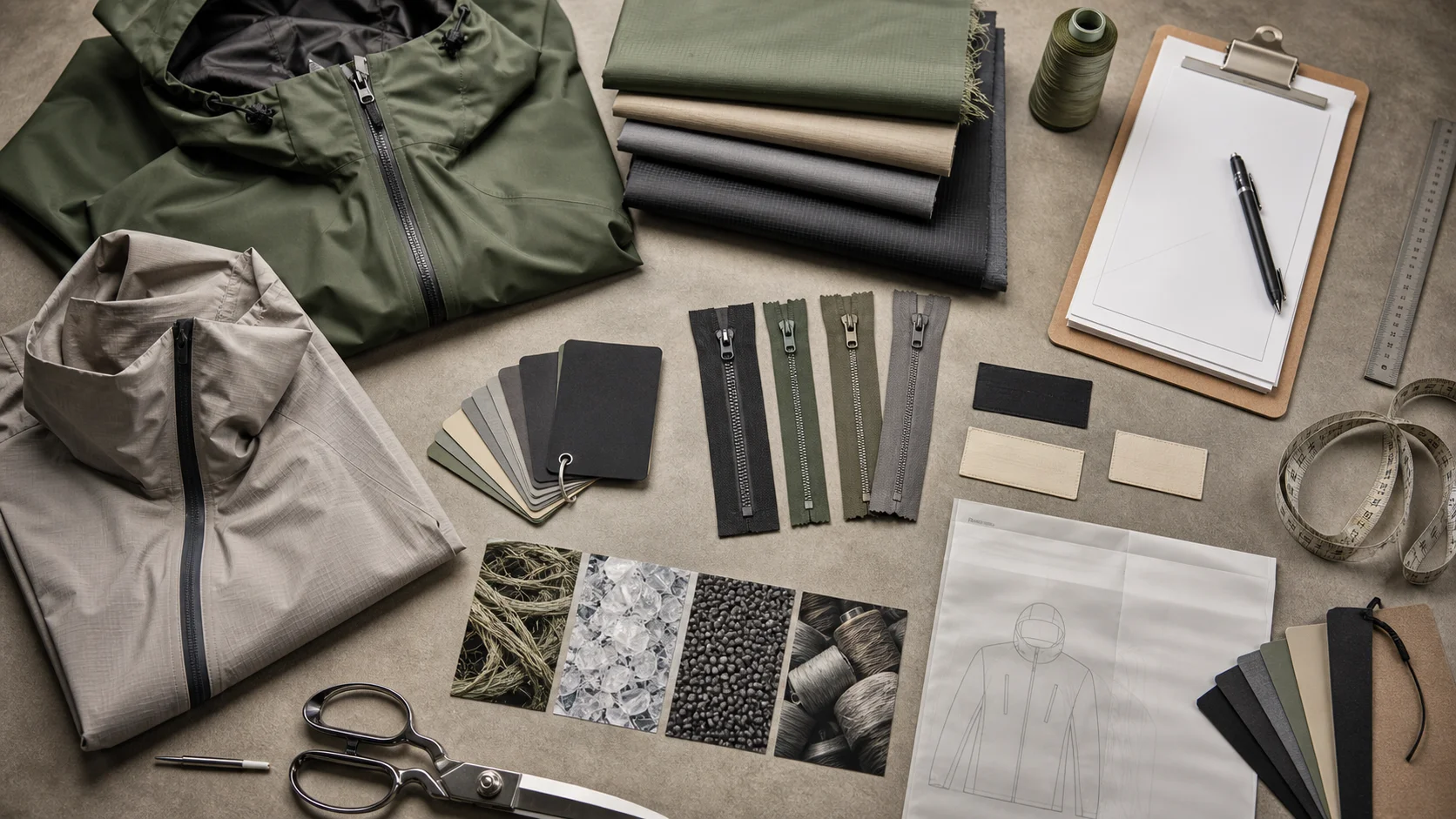
A focused outline for distributor-led private label launches using recycled jackets, covering MOQ planning, trim and labeling decisions, sample stages, costing, compliance, and launch-readiness without drifting into generic supplier advice.
Recycled Jacket MOQ for Distributor Brand Launches - Fabrikn production reference
For distributor brand launches, MOQ is rarely just a factory policy line on a quotation sheet. It is a commercial threshold that determines whether a recycled jacket program is realistic, margin-safe, and operationally manageable. When buyers search for private label MOQ for recycled jackets distributor brand launches, they are usually balancing three pressures at once: brand positioning, inventory risk, and supplier willingness to customize.
In sustainable fashion, this gets more complicated. Recycled outerwear often uses fabrics such as recycled polyester shell, recycled nylon lining, or recycled synthetic insulation. These inputs can come with their own minimums at the mill or trim supplier level. A jacket manufacturer may be willing to cut and sew 200 units, but the shell supplier might require 500 meters per color, and the zipper vendor may price poorly below a certain quantity. That mismatch is where many new launches lose momentum.
Distributor brands need to treat MOQ as a planning variable, not a fixed obstacle. A lower MOQ can help test the market and protect cash flow, but it may increase unit cost and reduce customization options. A higher MOQ can improve price efficiency, support stronger branding, and simplify material sourcing, yet it raises stock exposure if the launch underperforms.
The practical goal is not to chase the lowest possible MOQ. It is to secure a workable MOQ structure that supports product quality, recycled content credibility, and acceptable gross margin. Buyers comparing partners should look beyond the headline number and ask how MOQ is applied across style, color, fabric, and size ratio.
If you are mapping out a launch framework, it helps to review a manufacturer’s broader capabilities and development scope before discussing order size. A good starting point is a service overview such as /services/, where sourcing and production support categories can be evaluated in context.
MOQ, or minimum order quantity, is the smallest order a supplier will accept under a given production setup. In private label outerwear, this figure can apply in several ways, and buyers should clarify each one early.
For distributor launches, confusion usually starts when a supplier quotes one number without explaining the structure behind it. A buyer may hear “300 pieces MOQ” and assume that means 300 units spread across three colors and a full size run. In reality, the supplier may mean 300 units per color, or 300 units only if standard stock fabric is used and private label trims are limited.
This is why private label recycled jacket sourcing should always be broken into separate approval points. Ask whether the MOQ changes if you use stock shell fabric instead of custom-dyed fabric, standard zipper pullers instead of molded branded hardware, or woven main labels without custom retail packaging. Small adjustments can materially reduce the entry threshold for a launch.
Purchasing judgment matters here: a slightly higher MOQ with stable material sourcing is often safer than a very low MOQ built around substitutions, inconsistent trim lots, or vague recycled content claims.
Recycled fabrics add sourcing value, but they also introduce constraints that do not always exist in conventional outerwear. Mills commonly reserve their best pricing and most flexible booking terms for recurring programs. New distributor brands, especially those launching one or two SKUs, tend to face tighter minimums and fewer stock-supported options.
Common recycled jacket materials include:
Each component can affect MOQ differently. The shell fabric has the biggest impact because it drives color, hand feel, water resistance, and visual consistency. If a buyer needs custom color matching, the mill may require a dye lot minimum that pushes the order higher. If a stock color is acceptable, MOQ can drop substantially.
Trims matter too. Waterproof zippers, branded snap buttons, heat-transfer chest logos, and custom silicone badges can all trigger separate minimums. On a recycled puffer jacket, even the insulation vendor may have minimum booking requirements if the fill specification is custom.
There is also a documentation layer. Buyers in sustainable fashion increasingly request recycled claim support, such as transaction certificates or material declarations tied to the supply chain. That is sensible, but it can narrow the vendor pool. Factories that can support recycled traceability paperwork may keep firmer MOQ positions because their compliance workload is heavier and their approved material options are narrower.
MOQ varies by product complexity, fabric source, and level of customization. Still, distributor brands need realistic benchmarks when budgeting. The ranges below are common planning references, not universal rules.
Jacket Type Typical MOQ Range Common Conditions Lightweight recycled windbreaker 200 to 500 units per style Often possible with stock fabric and basic trims Recycled softshell jacket 300 to 600 units per style Depends on bonded fabric availability and color options Recycled padded jacket 300 to 800 units per style Insulation, quilting layout, and lining choices raise complexity Recycled puffer jacket 500 to 1000 units per style Custom shell, baffles, and branded trims often push MOQ upward Technical waterproof recycled jacket 500 to 1200 units per style Taped seams, membrane fabrics, and performance testing increase minimumsColor splits are just as important as style MOQ. A 600-unit order spread across four colors may be harder to place than a 600-unit order in one or two stock-supported colors. Size range also changes efficiency. A standard size breakdown such as S to XXL is easier to manage than an extended range requiring low-quantity edge sizes.
For first launches, many distributor brands get the best result by simplifying one of these variables:
This is usually a better tradeoff than forcing a very low MOQ on a highly customized jacket. When suppliers stretch too far below their comfortable production threshold, consistency risks go up.
Distributor brands should build MOQ strategy around channel reality, not brand ambition alone. A launch aimed at corporate resale, uniforms, promotional distribution, or multi-account wholesale has different order logic than a direct-to-consumer fashion drop.
The strongest launch plans usually start with one core jacket silhouette and one backup variation, not a broad assortment. That approach concentrates buying volume, improves trim alignment, and makes fit approvals easier to control. A distributor can still create a professional line presentation with one hero style in two commercial colors if the product specs are disciplined.
Useful launch questions include:
A cautious sourcing editor’s view is simple: launch narrow, document the specification cleanly, and leave room for repeat orders. Factories tend to support growing programs more seriously than scattered low-volume experiments. If a distributor can present a plausible replenishment path, even modest first orders may be treated more favorably.
Supplier communication quality matters here. Buyers who want practical guidance on feasibility, cost structure, and development sequence should open a direct discussion early through a channel such as /contact-us/. That saves time compared with collecting generic quotes that ignore fabric and trim realities.
MOQ is tied to cost absorption. The supplier is not only selling units; it is trying to cover setup, purchasing, handling, risk, and capacity allocation. Understanding those cost drivers makes negotiation more effective.
Jackets consume more material planning than simple knitwear. Shell, lining, pocketing, insulation, rib, and sometimes contrast panels all affect usage. If the recycled shell requires a minimum meter purchase, unused balance fabric can become dead stock unless the buyer commits to repeat orders.
Articulated sleeves, detachable hoods, storm flaps, seam sealing, internal pockets, and adjustable cuffs add labor steps. Complex styles rarely support ultra-low MOQs efficiently because setup time becomes too expensive relative to unit count.
Main labels, care labels, size labels, hangtags, zipper pullers, snap molds, and packaging can each carry minimums. Custom branding is valuable, but buyers should decide which branded elements matter most commercially. A woven neck label and hangtag usually add more launch value than forcing custom molded hardware on a small run.
Some distributor buyers need colorfastness, water resistance, azo-free confirmation, or restricted substance compliance checks. If testing is needed, the cost per unit is easier to absorb on a larger run. This does not mean testing should be skipped on small launches. It means expectations on price need to stay realistic.
Sampling is where many recycled jacket programs either become clear or become expensive. A disciplined approval sequence reduces mistakes and helps confirm whether the MOQ being offered is actually workable.
A typical sample path includes:
For recycled outerwear, buyers should review these specifications carefully:
Sample approval should not be rushed to hit an arbitrary launch date. If the proto is approved with unresolved issues, those mistakes usually become bulk problems. The most common failures are collar shape imbalance, puckering near zipper installation, off-tone lining substitution, and unexpected stiffness in coated recycled shells.
Direct purchasing call: if a supplier offers a low MOQ but cannot lock sample comments into a clear pre-production approval process, the low MOQ is not the advantage it appears to be.
Lead time for recycled jackets depends on material readiness more than many new buyers expect. The garment sewing window may only be part of the schedule. Fabric booking, trim development, lab dips, sample revisions, and testing can add weeks before bulk production even starts.
A practical planning framework looks like this:
These are planning estimates, not guarantees. Lead times extend when:
Distributor brands launching sustainable outerwear should build extra calendar protection into the first order. The first production cycle usually carries more revision risk than repeats. A repeat order using approved shell, lining, padding, and trims is often much easier to execute.
Quality control in recycled outerwear is not only about obvious sewing defects. Buyers need to watch for inconsistencies that affect both product appearance and sustainability claims.
Recycled fabrics can vary by lot in hand feel, shade, and surface texture. This is not unique to recycled textiles, but it becomes more sensitive when low-quantity runs are booked across multiple small lots. Ask whether the factory plans one lot per color or will need to combine lots.
Water-repellent or coated shells can show unevenness after stitching or pressing if finishing control is weak. That matters on windbreakers and light rain jackets where the face fabric is visually exposed.
Padded jackets and puffers can show cold spots, uneven loft, or shifting fill if quilting and filling controls are inconsistent. Small launches should not assume these risks disappear simply because order volume is lower.
Broken zippers, weak snap setting, peeling transfer logos, and label misplacement are frequent inspection issues. Private label orders often involve custom branding steps, and each added step creates another checkpoint.
Size sticker mistakes, incorrect carton ratios, and mislabeled color names can create avoidable problems for distributors shipping to multiple accounts. Final inspection should cover assortments, barcodes if used, and carton markings.
For many launches, a practical inspection structure includes inline checks during sewing, a pre-final review if timing allows, and a final random inspection before shipment. Buyers should confirm acceptable quality level expectations early rather than after production is finished.
MOQ negotiation works best when the buyer gives the supplier a path to operational efficiency. Asking for a lower number without adjusting the product package usually leads to weak offers or hidden compromises.
Better negotiation options include:
Buyers can also ask whether the supplier supports mixed-size allocation within the style MOQ, or whether one bulk fabric booking can cover future replenishment. That sometimes creates a smarter arrangement than simply forcing a lower unit count.
One more tradeoff deserves attention: low MOQ and aggressive target price rarely coexist with strong quality and custom detail. If price pressure is severe, prioritize the features customers will actually notice. Clean fit, reliable zipper performance, and credible recycled fabric matter more than decorative extras on a first launch.
The right supplier for a recycled jacket launch is not always the one quoting the absolute lowest MOQ. It is the one whose capabilities, material access, and communication style fit the brand’s actual launch plan.
Evaluate suppliers on these points:
It is also worth reviewing company background and operating approach before entering detailed development discussions. A reference page such as /about-us/ helps buyers understand how a sourcing partner presents its production scope and market focus.
For distributor brand launches in sustainable fashion, the strongest sourcing outcomes usually come from disciplined simplification. Choose a commercially solid recycled jacket style, control the material package, limit avoidable custom complexity, and push for transparent MOQ logic. That combination improves the odds of launching with inventory you can sell and quality you can stand behind.
Get a free quote from Fabrikn — your trusted B2B clothing manufacturer with 10+ years of experience. MOQ as low as 200 pieces.
Get a Free Quote →A realistic starting point is often 200 to 500 units for simpler recycled windbreakers or basic jackets using stock-supported materials. More technical or heavily customized recycled jackets may begin around 500 units and can move above 1000 units depending on fabric, trims, and performance requirements.
Recycled puffers usually involve more components, including shell, lining, insulation, quilting construction, and specialized trims. Custom colors and branded hardware can raise material minimums further, so suppliers often require higher volumes to make production efficient.
Yes, in many cases. Stock recycled fabric avoids custom dye minimums and reduces booking risk for the supplier. That is one of the most practical ways to lower MOQ for a launch while keeping the recycled positioning intact.
It can. Custom hangtags, printed polybags, barcode stickers, and branded cartons may each have separate minimums or added setup costs. For first orders, many buyers keep packaging simple and invest more in garment labeling and core product quality.
From development to shipment, a first order can easily take 8 to 16 weeks or more depending on sample revisions, fabric availability, trim approvals, and production capacity. Programs using custom-dyed recycled materials or technical waterproof construction may take longer.
Buyers should confirm approved samples, full measurement specs, fabric and trim details, recycled content documentation requirements, labeling, packaging, inspection standards, and shipment terms. The more precise the pre-production file, the lower the risk of bulk disputes.