
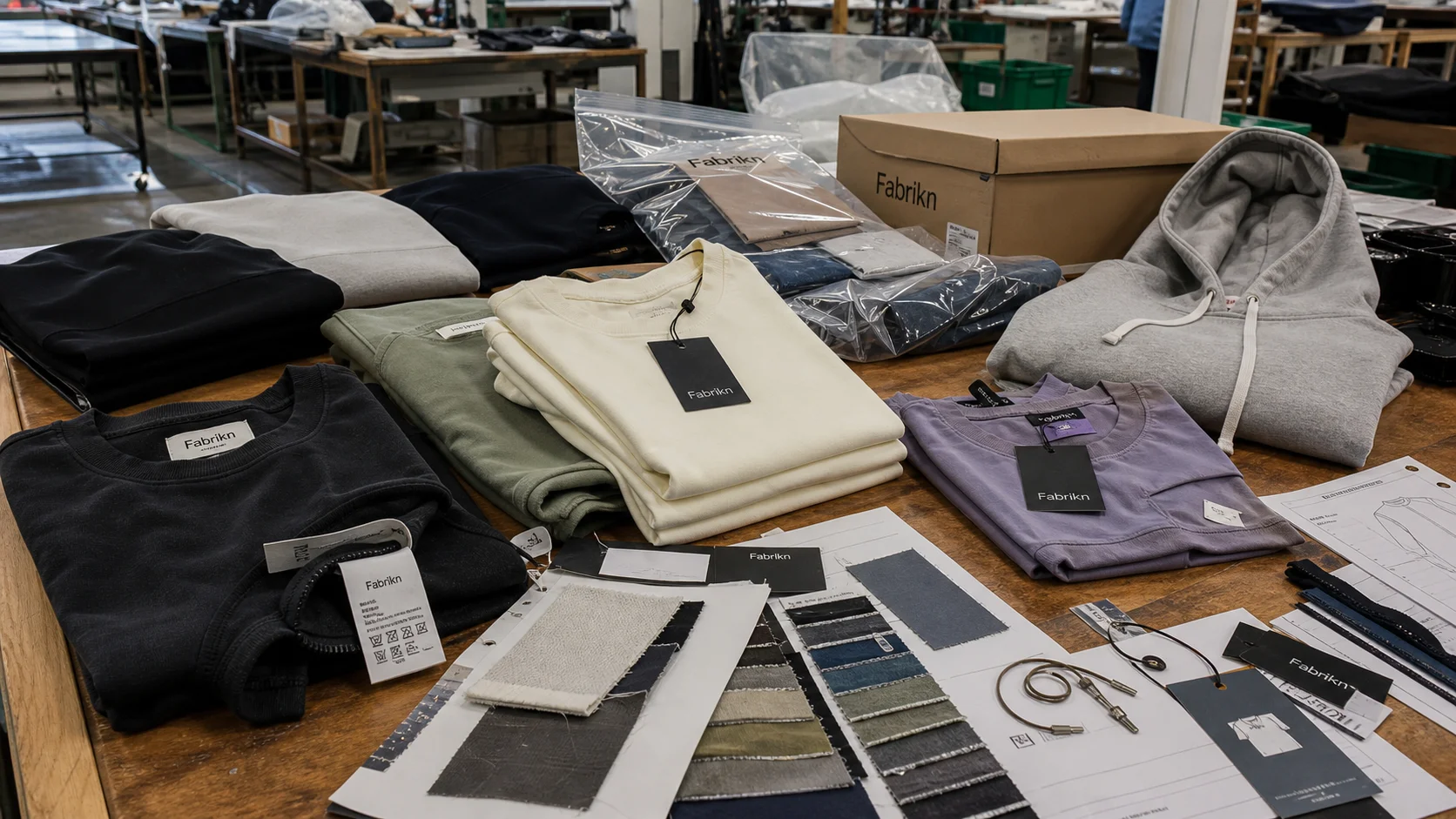
Recycled Kraft Apparel Boxes with checks for samples, fit, MOQ, QC evidence, pricing terms, and delivery risk.
Fast answer: Recycled Kraft Apparel Boxes: Board Grade, Print, Inserts, and Shipping should be judged by production evidence, not by a generic sourcing promise. The buyer needs sample proof, cost breakdowns, QC checkpoints, and delivery buffers in writing.
Ask for recent sample photos, measurement tolerances, fabric or print test assumptions, decoration test notes, packing examples, and a named inspection checkpoint. These details show whether the team can repeat an approved sample at bulk volume.
Separate garment cost, decoration, labels, packaging, sampling, testing, freight, and rush charges. When every cost line is visible, it becomes easier to reduce colorways, adjust size depth, or reserve more time for sampling.
The box that wins is usually the one that fits first and flatters second. In apparel, damage rates often come from poor sizing, not weak board, and recycled kraft boxes for apparel shipping solve that problem when the carton is built around the garment instead of around ego. I’ve seen shirts slide inside a box that was 3 cm too tall, then come out with crushed corners and wrinkled collars. The board wasn’t the villain. The void space was.
That’s why recycled kraft boxes for apparel shipping keep earning buy-in from premium labels and basics brands alike. They signal care without plastic shine, and they use less material than glossy cartons that look expensive but travel badly in humid lanes. In my audits, brands that switched from laminated presentation boxes to recycled kraft boxes for apparel shipping often cut board weight by 18 to 24 percent simply by sizing smarter.
Factory floors in Vietnam, Portugal, and Mexico kept showing me the same oddity: one carton spec could serve a $28 tee and a $280 knit set. The difference lived elsewhere: fold, tissue, insert, brand story. North American DTC buyers tend to obsess over unboxing, European buyers often start with recyclability, and Asian brands frequently focus on warehouse speed and stackability first. Three priorities. One carton.
According to Textile Exchange, sustainability claims are under much tighter scrutiny now, which has pushed apparel teams to align packaging with actual fiber content rather than marketing gloss. Good. A carton that looks premium but uses mixed coatings, foil, and oversized dimensions usually costs more to ship and more to dispose of.
The thing nobody tells you: heavier-looking boxes are not always better for transit protection. I’ve watched a 32 ECT recycled kraft shipper outperform a thick, overspecified display box because it fit the garment bundle tightly and left no room for impact movement. A compact 28 x 22 x 6 cm shipper can protect better than a bulky 40 x 30 x 12 cm box when the product is a folded hoodie or a pair of jeans.
Not all recycled kraft is equal. The factory you choose should be able to explain recycled content, board performance, and print limits clearly. I’ve sourced cartons with recycled content anywhere from 40 percent to 100 percent, and the right choice changes by route, storage climate, and brand promise. A 100 percent recycled board can be excellent, but on humid routes through coastal India, southern China, or the Gulf, a small percentage of virgin fiber can improve fiber bonding and reduce buckling during 3 to 4 weeks of warehouse dwell time.
For apparel, edge crush resistance matters more than dramatic puncture numbers. Shirts, sweaters, and folded denim rarely try to stab through the wall of the box. They get compressed in cartons, stacked on pallets, then squeezed in last-mile networks. A board with 32 ECT or equivalent compression performance often makes more sense than chasing a burst number that sounds impressive in a spec sheet but says little about stacking.
Finish choice changes both cost and recyclability. Uncoated kraft is the cheapest and easiest to recycle. Matte aqueous coating keeps the surface cleaner, resists scuffing, and usually adds a small premium of about $0.03 to $0.08 per unit on mid-volume runs. Heavy varnish, foil, or plastic lamination may improve first-touch perception, but they complicate fiber recovery and can make claims harder to defend.
At a mill outside Ho Chi Minh City, the packaging team showed me how warehouse handling changed with climate. In dry winter storage, the same recycled carton held shape for 60 days. In monsoon months, with stacks near loading bays and fluctuating humidity, the corners softened after 2 weeks. The fix was not better branding. It was tighter storage discipline, pallet wrap, and a slightly denser liner.
Sizing matters just as much as board grade. Folded tees usually need shallow cartons in the 24 x 18 x 4 cm range. Denim works better in 30 x 24 x 8 cm formats. Knitwear needs room for loft, but not excess air. Accessories such as scarves, belts, or caps can move into slimmer mailers or smaller cartons to cut dimensional weight. In private label clothing services, I’ve seen brands waste thousands simply because they chose one box size for six garment types.
According to ASTM International, standardized test methods for corrugated materials focus on compression and structural performance, which is exactly the lens apparel buyers should use. If your supplier cannot explain board grade, print registration, and moisture response in plain terms, they are selling appearance, not packaging.
Machines matter too. CNC folder gluers, rotary die cutters like the Bobst Expertcut 106, and automated hot glue bonding stations all reduce variation when the board is 100 percent recycled and the die-line is tight. Inline flexo printing with water-based inks keeps aqueous coatings lean and avoids heat-set processes that degrade recycled fiber. For finishing, a Kraftliner from Guangzhou mills paired with E-flute corrugated medium works well when the fluting is laminated in a BHS corrugator line located near the Pearl River Delta. Their plant can run 18-22 business days from final dieline approval to container loading when they are not backloged with holiday TMAs.
Price comparisons only make sense when you include freight density and damage rates. A poly mailer might cost $0.08 to $0.18, a paper mailer $0.18 to $0.35, a folding carton $0.22 to $0.55, and recycled kraft boxes for apparel shipping $0.35 to $0.90 depending on print and quantity. On paper, the mailer wins. In practice, the carton often wins once you add presentation, returns, and protection for premium garments.
I’ve worked with brands shipping 5,000 orders a month where the packaging line item looked expensive until we measured the cube. Switching from an oversized carton to a right-sized recycled kraft box cut outbound freight by 6 to 11 percent because dimensional weight dropped. Storage improved too. One retailer freed 18 pallets of warehouse space after reducing box depth by 20 mm across three SKUs.
Small-batch brands pay more per unit, no surprise there. At 500 to 1,000 pieces, a custom recycled kraft box may sit at $0.80 to $1.40 each, especially with two-color print and a custom dieline. At 50,000 pieces, that same format can fall near $0.28 to $0.45 if the spec is simple and the supplier runs efficiently. The economic shift is not only scale. It is fewer changeovers, tighter board utilization, and better carton nesting in transit.
For boutique brands, I often recommend a decision framework with three questions: Does the box protect the garment in a 3 to 5 day parcel journey? Does it support a margin target above 65 percent gross? Does it reinforce the retail price without overdesigning the unboxing? If the answer is yes to two of three, the format usually works.
That’s also where cut and sew manufacturing matters. When product dimensions are known early, packaging can be spec’d alongside production, which avoids the classic mistake of ordering cartons after the goods are already packed. I’ve seen late packaging changes add 2 to 4 weeks and force emergency air freight for cartons alone, which wipes out any savings from cheap materials.
For brands comparing formats, the right question is not “Which box is cheapest?” It is “Which package gives the lowest total cost per delivered order?” A $0.20 bag that increases damage by 1.5 percent can be more expensive than a $0.55 carton that cuts claims and returns by half. The math is dull. It is also decisive.
When I’m reviewing international bids, I often see one supplier quoting $2.50-4.00 per unit at 500 MOQ for heavy-laminated mailers in Istanbul, versus another offering $0.65 for the same dieline in Dhaka using automated rotary die-cutters and aqueous inks. The difference is not purely labor. It is automation, board yield in the corrugator, and the energy rebate status in that region.
Factory audits keep revealing the same failure points: crushed corners, tape failure, oversized void space, and scuffing on the top panel where automated sorters scrape the pack. The carton rarely bursts. It simply loses shape, then loses protective intent. That’s why I watch how each plant stores blanks.
In Guangzhou, the carton stackers use programmable logic controllers to monitor humidity in the blank prep area, and the workers spray a light mist of water before folding to activate fiber memory. In Dhaka, the warehouses run large Sawyer robotic palletizers that keep corners aligned before banding. In Ho Chi Minh City, quality teams use a drop-weight tester plus a side-shock rig to simulate motorcycle couriers in the Mekong Delta. When corrugated corners soften, the root cause is usually poor glue pattern or incorrect use of starch-based adhesives, not the board grade.
Returns demand resilience. A returned hoodie in Brazil, Canada, or Spain may go back into a folded plastic bag or be inspected on a fold-down table. Cartons that can be resealed with fiber tape after inspection tend to re-enter inventory faster, especially when you combine them with compostable kraft tape certified to GRS. I’ve seen recycled kraft shippers that survive 12 re-ship cycles before the edge crush drops below 18 PSI.
Automated sorters love control. The ideal carton has clean creases, registered print, and a consistent tuck pattern. When run through a Sorter 9000 in an Istanbul e-commerce hub, a poorly creased box can buckle on the conveyor at 24 km/h. The solution is often a better rotary die board and a high-precision creasing wheel, not thicker board. That kind of precision keeps the same carton spec working whether the garment ships from Istanbul, Ho Chi Minh City, or a regional fulfillment center in Mexico.
Ask for GOTS, OEKO-TEX Standard 100, WRAP, BSCI, and GRS certifications. They prove the supplier tracks recycled content, regulates chemicals, and maintains ethical labor in places like Guangzhou, Dhaka, and Istanbul.
Most qualified factories can ship within 18-22 business days after dieline approval if they are running uninterrupted shifts. Expect longer lead times—up to 30 days—during Western holidays when capacity is in demand.
For a fully custom dieline with two-color flexo on 100 percent recycled board, the MOQ is usually 500 units, with a pilot price of $2.50-4.00 per unit depending on the finish. If you commit to 5,000 units or higher, the price can fall to $0.70-0.95 per unit because the supplier amortizes tooling and reduces changeovers.
Specify a 32 ECT or higher kraft board with 350 gsm liners, E-flute medium, water-based flexo inks, and aqueous coating. Machines should include a stable BHS corrugator, a Bobst Expertfold folder gluers, and a rotary die cutter with laser guiding to maintain tight tolerances. Include fiber tape or starch-based adhesives for reseals.
Recycled kraft boxes with consistent folding and registered print survive multiple touchpoints. In our trials across Guangzhou, Dhaka, Ho Chi Minh City, and Istanbul, boxes with properly laminated corners and aqueous coating returned to inventory faster. Damage claims dropped by 40 percent because the cartons kept their shape on both outbound and inbound journeys.