
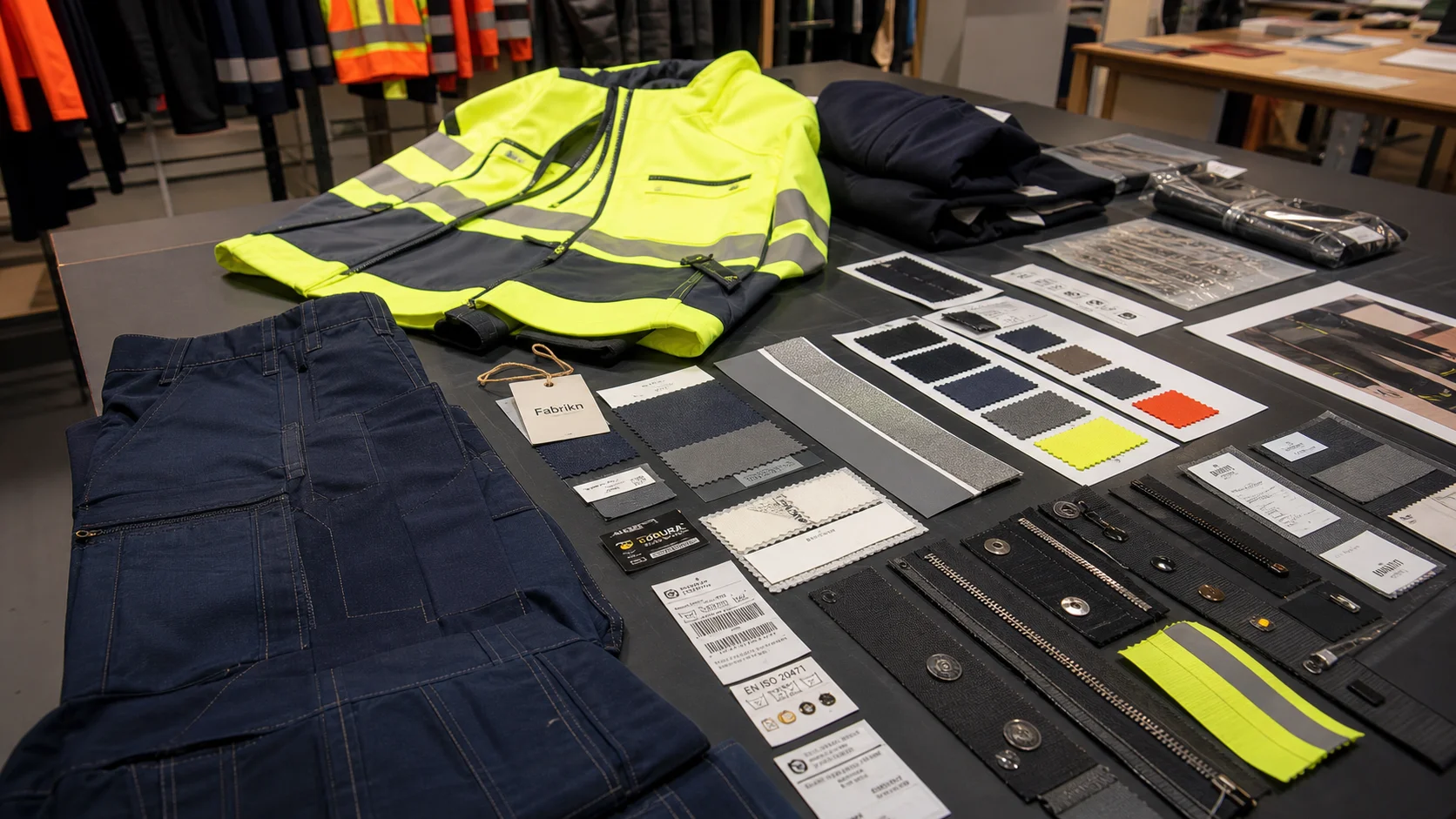
A practical compliance checklist for corporate buyers evaluating recycled polyester safety vests, covering standards, visibility requirements, labeling,...
Corporate uniform buyers looking at recycled poly safety vest compliance need more than a low-price quote and a bright color swatch. The vest has to meet visibility rules, hold up in field use, fit the company’s branding, and still be practical to source in volume. That is where a clear compliance checklist pays for itself. It helps buyers compare suppliers on the same basis, spot weak claims early, and avoid delays caused by failed testing, missing paperwork, or trim that cannot pass inspection.
This guide is written for procurement teams, uniform managers, and sustainability buyers who need a practical way to evaluate recycled polyester safety vests for employee programs. It covers fabric specifications, reflective tape requirements, certification documents, sample approval steps, inspection points, and the tradeoffs that usually show up during development. If you are also coordinating custom decoration or broader uniform production, see Fabrikn’s services page, about us page, and contact us page for a starting point.
Recycled Poly Safety Vest Compliance Checklist - Fabrikn production reference
A recycled poly safety vest can be a smart choice for corporate uniform programs, but “recycled” by itself does not prove compliance or quality. Buyers should verify three things at the same time: the vest’s safety performance, the credibility of the recycled material claim, and the factory’s ability to produce consistent lots.
The most common mistake is treating the vest like a simple promotional item. In reality, a safety vest sits closer to regulated PPE or protective workwear in many programs. That means the buyer has to ask for technical proof, not just a visual sample.
For corporate buyers, the tradeoff is usually between cost, compliance margin, and comfort. A cheaper vest may use lighter fabric and narrower reflective tape, but that can reduce durability and appearance after repeated washing. A heavier vest may last longer and look more professional, yet it can be less comfortable in warm environments.
The exact compliance standard depends on where the vest will be used and how the buyer classifies the garment. Common requirements include high-visibility standards, site-specific safety rules, and sometimes additional rules for public works or transportation environments.
Buyers should not assume one standard applies everywhere. A vest approved for one market may not be accepted in another. The supplier should identify the exact standard, test method, and certification body before production begins.
In practice, the buyer should ask for the test report, not just a certificate. The report should show the tested garment construction, fabric composition, tape specification, and any limitations. If the supplier changes the fabric weight, reflective tape brand, or sewing method after approval, the earlier report may no longer be valid.
A compliant-looking vest is not the same as a compliant vest. If the reflective tape, stitch pattern, or fabric source changes after testing, the buyer should treat the approval as open until the new version is verified.
For a recycled poly safety vest, the fabric spec is one of the most important sections in the purchase order. The buyer should define the recycled content target, the knit or woven structure, and any minimum performance requirements for colorfastness, tear resistance, and shrinkage.
Many sourcing teams use recycled polyester because it supports sustainability goals without forcing a radical change in the garment platform. That said, recycled content can vary from one supplier to another. Some mills offer fully recycled yarns, while others blend recycled and virgin polyester. The buyer should not rely on a broad “eco” claim. The claim needs to be documented.
For many corporate programs, mesh is the most practical option because it reduces heat buildup and supports all-day wear. Solid tricot may look more polished and can sometimes feel sturdier, but it may trap more heat. The better choice depends on the climate, work duration, and whether the vest is meant for temporary visitor use or regular employee wear.
Buyers should also ask about color consistency across dye lots. Safety colors can drift, especially if the recycled feedstock varies. A batch that looks acceptable under warehouse light may appear different in outdoor daylight. If the program uses multiple sizes or staggered reorders, color matching becomes more important than many teams expect.
Reflective tape is the most visible compliance component, but the garment construction around it matters just as much. Poor sewing can distort the tape, reduce reflectivity at the seams, or cause the tape to peel after laundering. The buyer should request clear construction drawings or a detailed tech pack before confirming production.
The closure choice has practical implications. Open-front vests are easier to size across multiple wearers and can be cheaper to make. Zipper-front vests look more finished and stay in place better, yet they may cost more and add lead time. Hook-and-loop closures are common for quick on-and-off use, but the fastening components can wear out faster in high-frequency programs.
Reflective tape should be checked not only for width, but for placement accuracy. If tape is too close to a seam or too narrowly stitched, it may fail washing or fail inspection. Buyers should specify whether a double-row stitch is required and whether any decorative embroidery is allowed near the reflective areas. In many cases, decoration near tape creates unnecessary risk.
Corporate uniform programs usually want logos, department names, or role identifiers. That is reasonable, but branding has to be added in a way that does not compromise the vest’s visibility performance or violate the safety standard.
The safest approach is to define a fixed decoration zone outside the reflective tape area. If the logo is too large, too dark, or too close to the tape, it can interfere with daytime visibility or weaken the perceived contrast. Buyers should treat branding as a controlled specification, not an afterthought.
Screen print and heat transfer are common for flat vest panels. Embroidery can look premium, but it may perforate the fabric and create comfort issues in lightweight mesh. In some cases, print is the safer choice because it adds less bulk and is easier to position away from reflective zones.
If the vest is being purchased for regulated work, ask whether the decoration layout needs to stay fixed across all sizes. A logo that works on medium may crowd the tape on small sizes, which creates avoidable approval problems.
MOQ for recycled poly safety vests varies widely by supplier, fabric source, and whether the garment is a stock base or a fully custom program. For many factories, the practical MOQ may start around 500 to 1,000 pieces per color and style for a custom run, while some suppliers can offer smaller test orders if the vest uses standard materials. Custom recycled yarn, special tape, or unique packaging can increase MOQ quickly.
Sampling usually follows a stepped process. A buyer should expect a lab dip or material reference, then a pre-production sample, then size set approval if the order includes multiple sizes. If the supplier skips steps, the order may move faster at the front end but create more risk later.
Lead time depends on fabric availability, testing requirements, decoration complexity, and order volume. A simple repeat order from approved materials may be relatively quick. A new recycled poly safety vest program with custom tape, certification, and branded decoration can take longer because the factory may need to source recycled yarn, confirm lab testing, and wait for sample sign-off before cutting bulk fabric.
Buyers should also build in time for packaging approval. If the vest is meant for retail-style distribution, polybag labeling and carton marking may need to follow corporate or regulatory requirements. Even simple packaging details can hold up shipment if they are not approved early.
Quality risk in safety vests often shows up in small details that are easy to overlook during buying. The garment may pass an initial visual check but still fail on measurement tolerances, tape alignment, or wash performance.
For corporate buyers, pre-production approval is not enough. A production inline check or final inspection is worth the effort, especially on mixed-size orders. If the vest is going to be washed repeatedly, ask for wash test confirmation on both fabric and decoration. Heat transfers and some printed logos can crack or peel sooner than expected if the base fabric or curing method is not suitable.
Inspection standards should be agreed in advance. Buyers often use a basic AQL framework for finished goods, but they should also specify critical defects. On safety vests, a misplaced reflective tape panel or wrong garment class is more serious than a loose thread. The inspection checklist should reflect that priority.
When evaluating a supplier, the right questions are often more valuable than a polished presentation. The aim is to determine whether the factory understands both sustainability documentation and safety garment construction.
Clear answers matter more than confident answers. If a supplier cannot explain the difference between the approved sample and the bulk production spec, that is a warning sign. The buyer should also watch for vague language around recycled content. A statement such as “eco fabric” is not enough for a corporate procurement file.
Good suppliers should be comfortable sharing technical detail, including fabric weight, tape width, yarn source information where available, and the sampling sequence. If a factory offers broader uniform support or custom product development, it can help simplify sourcing across programs. For a contact point, see Fabrikn contact for project inquiries.
Use the checklist below as a working procurement tool. It can be adapted into a PO attachment, vendor scorecard, or internal approval form.
Checklist Item Buyer Action Pass/Fail Notes Intended use defined Confirm day use, night use, or both Job site and risk level documented Safety standard identified Request applicable standard and test basis Do not accept generic compliance claims Recycled content verified Ask for recycled polyester proof and percentage Certification or supporting documents on file Fabric spec approved Confirm GSM, construction, and color Match sample to bulk fabric reference Reflective tape spec approved Check width, placement, and stitching Exact tape version should be documented Branding layout approved Verify logo size and placement Avoid interference with compliant zones Sample approval completed Approve pre-production sample in writing Keep one signed reference sample if possible MOQ confirmed Align quantities by color and size Watch for hidden MOQ by trim or decoration Lead time confirmed Include fabric, sample, testing, and bulk production Build buffer for approvals and shipping Inspection method set Agree on AQL or critical defect criteria Critical safety defects need zero tolerance Packaging approved Confirm polybag, carton, and label details Check size stickers and carton marks Change control defined Require approval for any material or trim change Retest if relevant specifications changeIn sustainable fashion sourcing, it is easy to focus on recycled content and forget the rest of the garment system. A recycled poly safety vest only succeeds when the sustainability claim is supported by good manufacturing discipline. Recycled fabric that cannot meet visibility standards is not a buying win. A compliant vest that falls apart after a short service life is not a sustainability win either.
The strongest programs are the ones that define measurable requirements. They specify recycled content, safety standard, fabric weight, tape layout, and inspection criteria in one document. That approach gives the supplier fewer chances to guess and gives the buyer fewer surprises.
For many corporate uniform teams, the best purchasing judgment is to accept a slightly higher unit price in exchange for better documentation, more stable lead time, and a lower risk of rejected goods. That is especially true when the vest will be issued in large volumes across multiple departments. A failed batch can be more expensive than a careful order from the start.
A recycled poly safety vest compliance checklist gives corporate uniform buyers a practical framework for sourcing with less risk. It brings together safety standards, recycled material verification, fabric specs, reflective tape details, branding rules, sample approvals, and inspection controls. That combination is what separates a reliable program from a patchy one.
When the checklist is used properly, it helps buyers compare suppliers on real capability, not just on price or marketing language. It also creates a cleaner approval trail for internal stakeholders who need to sign off on sustainable uniform purchases. For companies building broader custom apparel programs, the same sourcing discipline can be applied across visibility gear, workwear, and branded uniforms.
If you are planning a recycled poly safety vest program and need support on specification, sampling, or production coordination, you can review Fabrikn’s services or contact the team to start a sourcing discussion.
Get a free quote from Fabrikn — your trusted B2B clothing manufacturer with 10+ years of experience. MOQ as low as 200 pieces.
Get a Free Quote →It is used to help buyers verify that a recycled polyester safety vest meets the required safety standard, includes acceptable recycled content documentation, and is suitable for corporate uniform use before bulk purchase.
No. Recycled polyester only addresses the material source. The vest still needs the correct visibility construction, reflective tape layout, testing, labeling, and approval for the intended work environment.
Many factories start around 500 to 1,000 pieces per color and style for a custom run, though the exact MOQ depends on fabric availability, tape specification, decoration, and whether the order uses stock or custom materials.
A typical process includes fabric or material reference approval, a pre-production sample, and sometimes a size set or fit approval before bulk production starts. Written sign-off is important.
Common risks include reflective tape misalignment, incorrect fabric shade, weak stitching, sizing variation, decoration too close to the safety tape, and packaging or labeling errors.
Embroidery can work in some cases, but it may add bulk or affect comfort on lightweight mesh. Print or heat transfer is often easier to place away from compliance zones. The best choice depends on the vest construction and the safety standard.
Ask for documentation that identifies the recycled polyester percentage and the method of verification. If possible, request certification or traceability paperwork tied to the approved fabric source.
Retesting should be considered whenever the supplier changes fabric, reflective tape, sewing method, decoration placement, or any other element that could affect compliance or durability.