
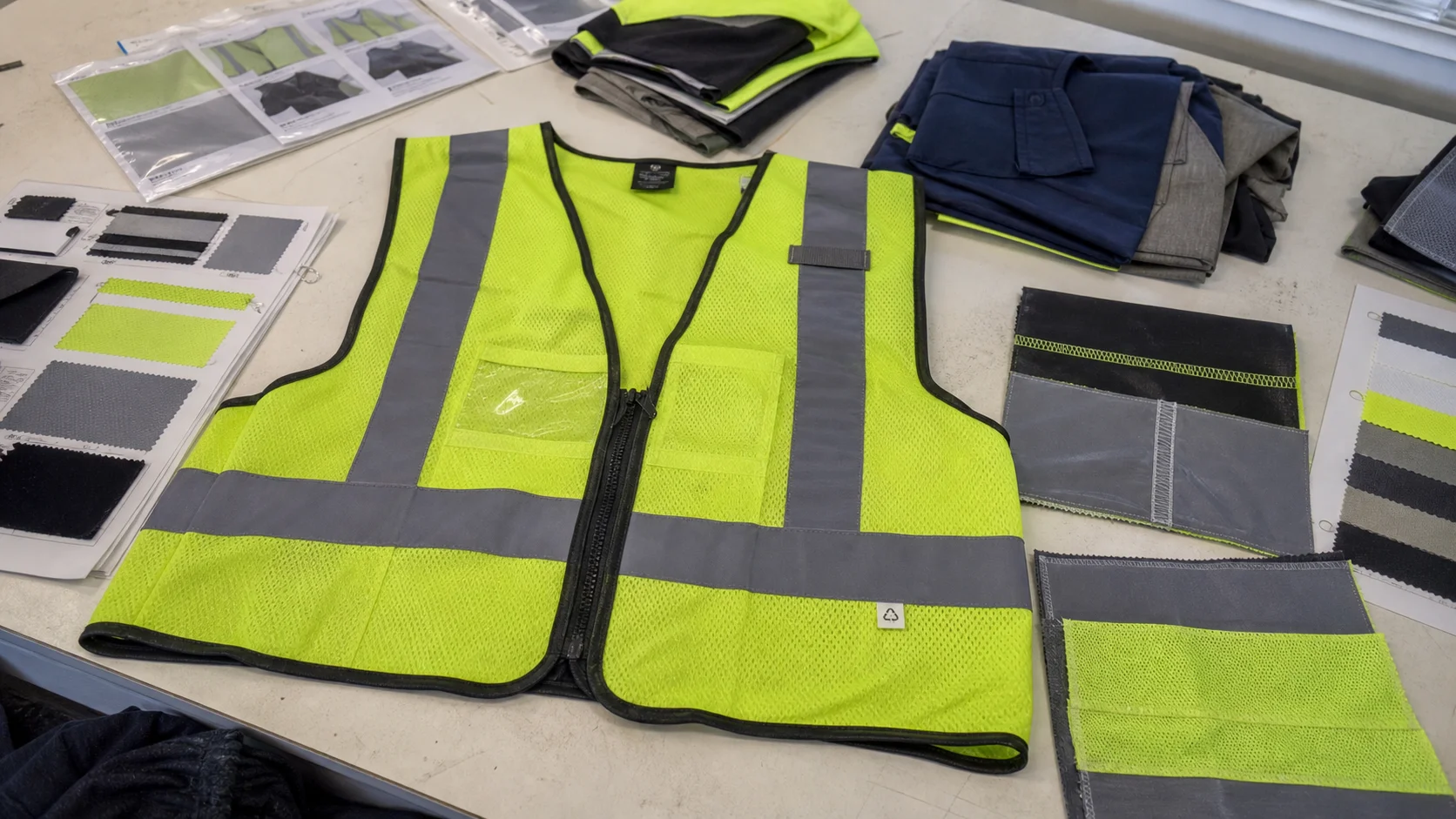
A buyer-focused outline for evaluating seam strength, recycled polyester performance, and compliance risks in safety vests for security contractors.
Recycled Poly Safety Vest Seam Strength Review - Sustainable Fashion manufacturing guide
Security contractors recycled poly safety vest seam strength review is not just a sustainability topic. It is a purchasing risk topic. A vest can use recycled polyester, meet a color requirement, print cleanly with a company logo, and still fail in the field if the side seams, shoulder seams, zipper tape, binding, or reflective tape stitching cannot tolerate daily wear.
For security contractors, the garment is part uniform, part visibility tool, and part brand surface. Guards wear it during parking control, event management, site access, logistics yards, campuses, retail loss prevention support, and night patrol. The vest is often put on and taken off many times per shift. It may be worn over hoodies, jackets, rainwear, or body armor. That movement creates seam stress that is different from a lightweight promotional vest used once at a trade show.
Recycled poly is a practical choice when the buyer wants a lower-impact uniform program without shifting to delicate materials. The main question is not whether recycled polyester can work. It can. The better question is whether the selected fabric, thread, seam type, trims, and factory controls are strong enough for contractor use.
Seam strength is the difference between a vest that looks acceptable on arrival and a vest that survives the contract period. Security teams are hard on uniforms because the garments are used repeatedly, often outdoors, and often by different body types across multiple shifts. A vest may be stretched at the side seam when worn over winter clothing. The shoulder seam may be pulled when the wearer removes the vest quickly. Pockets may sag if radios, access cards, keys, or small notebooks are carried inside.
A weak seam is more than a cosmetic complaint. If a reflective tape seam opens, visibility is reduced. If a zipper seam tears, the vest may no longer sit correctly on the body. If binding frays at the armhole, the garment looks poor and can keep deteriorating. For contractors bidding on public-sector, event, industrial, or facilities work, that matters. The vest must support a professional appearance while keeping replacement costs under control.
Buyers should be cautious with low-cost recycled poly safety vests that are built like disposable promotional items. Recycled content does not automatically indicate durability. In some cases, a supplier uses a reasonable recycled polyester fabric but pairs it with weak thread, narrow seam allowance, poor stitch density, or low-grade hook-and-loop tape. Those choices can undermine the entire garment.
For contractor uniforms, seam strength should be reviewed as a performance requirement, not as a minor finishing detail.
Recycled polyester, often made from post-consumer PET bottles or post-industrial polyester waste, can be suitable for safety vests. It offers the same broad sourcing advantages as conventional polyester: light weight, color stability, fast drying, wrinkle resistance, and compatibility with mesh or woven vest constructions.
The recycled aspect changes the sourcing conversation in three ways. First, buyers need proof of recycled content, such as transaction documents or certification depending on the program. Second, fabric consistency should be checked because recycled yarn inputs can vary by supplier and batch. Third, sustainability claims must be controlled carefully so the buyer does not overstate the environmental benefit.
For a B2B order, the practical requirement is to specify the recycled content clearly. A common commercial range is 50 percent to 100 percent recycled polyester, depending on fabric availability, budget, certification needs, and color requirements. If the vest must meet high-visibility standards, the fabric and reflective materials need to be assessed against the required market standard, not just the buyer’s preferred sustainability language.
Security contractors should avoid vague phrases such as “eco fabric” or “green polyester” on purchase orders. Use measurable terms instead: recycled polyester percentage, fabric weight, mesh or solid construction, color, reflective tape width, seam type, thread type, closure type, pocket configuration, logo method, and packaging requirement. If sustainability is part of a larger uniform program, suppliers such as Fabrikn services can help buyers organize garment development, sampling, and production specifications around clearer commercial requirements.
Most recycled poly safety vests for security contractors fall into one of three construction types: lightweight mesh, solid woven polyester, or a mixed design with mesh panels and solid pockets. Each type has different seam risks.
Vest Type Common Use Main Seam Risk Purchasing Note Recycled polyester mesh Warm weather patrol, events, traffic control support Mesh tearing near seams or reflective tape stitching Specify stable mesh and reinforced high-stress areas Solid recycled polyester woven General security, logistics yards, facilities Side seam strain and zipper tape pulling Better for durability, less breathable than mesh Hybrid mesh and solid panels Contractor uniforms needing pockets and breathability Panel joining seam imbalance Review seam compatibility between different fabricsThe most common failure points are side seams, shoulder seams, armhole binding, hem binding, front closure seams, pocket corners, reflective tape stitch lines, and label attachment points. If the vest includes radio loops, ID badge holders, pen pockets, mic tabs, or clear PVC credential windows, those areas require extra review because they create localized stress.
Security contractors should pay particular attention to sizing. A vest that is too small for the layering environment will be blamed on poor seam strength when the real problem is undersized grading. If guards wear the vest over jackets, the size chart must allow for that. A unisex safety vest with limited grading may work for a volunteer group, but contractor teams usually need broader sizing from small through 3XL, 4XL, or 5XL. Larger sizes need proportional seam and closure strength, not only wider body panels.
A seam strength review starts with fabric because stitches cannot compensate for weak base material. For recycled polyester safety vests, fabric weights commonly range from about 90 gsm to 160 gsm for lightweight mesh and around 120 gsm to 180 gsm for solid woven polyester. Heavier options may be available, but they can reduce comfort and increase cost. The correct choice depends on wearing climate, contract duration, laundering expectations, and the number of pockets or trims attached.
Mesh vests are breathable, but the mesh structure can pull away under stitch tension if the yarn quality or construction is poor. Solid woven recycled polyester usually gives stronger seam holding and better print surfaces, but it may feel warmer. A hybrid vest gives a workable compromise when the buyer needs both ventilation and durable pocket placement.
Binding is often overlooked. It protects raw edges around armholes, neck, front opening, and hem. Low-grade binding can twist, shrink, fray, or separate after laundering. For contractor use, binding should be made from compatible polyester or recycled polyester where available, with adequate width and stable stitching. Narrow binding may look cleaner in a sample photo, but it leaves less room for sewing tolerance in bulk production.
Thread choice also matters. Polyester thread is the normal choice because it has good strength and compatibility with polyester fabric. Recycled polyester thread may be available, but buyers should confirm strength and color consistency before approving it for high-stress seams. If the supplier proposes cotton thread to reduce cost, it is usually a poor match for a safety vest that may face sweat, rain, and repeated washing.
Safety vests are not complex garments compared with jackets or work pants, but seam type still affects performance. The cheapest construction may use simple single-needle stitching with minimal seam allowance. That may pass a visual review and fail after several weeks of use. A stronger specification uses appropriate seam allowance, correct stitch density, reinforcement at stress points, and consistent operator control.
For side seams, a plain lockstitch can be acceptable if the fabric is stable and the seam allowance is not too narrow. A safety stitch or overlocked seam can help control fraying on some fabrics, but it is not automatically stronger if the fabric tears around the stitch line. The buyer should ask for actual seam performance evidence, not just a verbal claim that the seam is “double stitched.”
Shoulder seams deserve close review because vests are often pulled from the shoulder area. A narrow shoulder seam on mesh fabric is risky. Reinforcement tape or improved seam construction may be worth the extra cost for contractor programs. Armhole binding should be smooth, but it must also be secure. Skipped stitches at curves are a common bulk issue when sewing speed is too high.
Reflective tape stitching is another key point. The stitch line can perforate the base fabric, especially on lighter mesh. If the needle size, stitch density, or tape backing is wrong, the reflective tape can pucker, detach, or weaken the fabric around it. More stitches are not always better. Overly dense stitching can create a tear line.
Area Common Construction Risk Recommended Review Side seams Lockstitch or overlock Splitting when worn over layers Check seam allowance, stitch density, and fit grading Shoulders Joined seam with binding or turned edge Pull-out during removal Consider reinforcement for contractor use Reflective tape Two-line stitching Puckering, detachment, fabric perforation Test tape adhesion and stitching balance Pocket corners Single stitch with bartack or reverse stitch Tearing from contents Use bartacks where pockets carry tools or radios Front closure Zipper or hook-and-loop tape Tape seam peeling or zipper seam strain Review closure strength and operator consistencyReflective tape is often the most expensive functional trim on a safety vest. It is also one of the most visible failure points. Contractors may not notice a slightly weak side seam in the carton, but they will notice reflective tape that wrinkles, peels, cracks, or detaches after use.
Buyers should confirm whether the reflective tape is sewn-on, heat-applied, or a combination depending on the design. Sewn-on tape is common and practical, but the stitching must be controlled. Heat-applied tape may provide a cleaner surface, but it depends heavily on fabric compatibility, heat press settings, adhesive quality, and wash conditions. Some recycled polyester fabrics can be sensitive to heat, so testing is important before approving bulk production.
The safety vest may need to satisfy specific visibility standards depending on use. The buyer should define the target standard early, because reflective tape layout, tape width, background fabric color, and garment coverage are not flexible after the pattern is set. A vest intended only as a branded contractor identifier has different requirements from a vest used near moving vehicles, forklifts, loading zones, or road-adjacent work.
A practical tradeoff appears here. Premium reflective tape improves performance and reduces complaints, but it raises unit cost. Cheaper tape can make a bid look attractive and then create returns, replacements, or contract dissatisfaction. For security contractors, the better value is usually a mid-grade or certified tape appropriate to the use case rather than the cheapest tape available.
A good recycled poly safety vest program should not move from quotation directly to bulk production. Sampling is where the buyer catches weak construction before committing to cartons of unusable inventory. The sample path does not need to be excessive, but it should be disciplined.
For seam strength, the pre-production sample is the most important stage. It should use the same recycled polyester fabric, reflective tape, binding, closure, thread, and sewing method intended for production. A beautiful development sample made with substitute trims does not prove bulk reliability.
The buyer can request basic pull checks on side seams, shoulders, pocket corners, zipper tape, and reflective tape stitch lines. For larger programs, lab testing may be justified. Relevant testing can include seam strength, fabric tear strength, colorfastness to washing, dimensional stability, reflective performance after washing, and print durability. The exact test method should be chosen based on the destination market and contract requirements.
Not every order needs a full laboratory test package. A 100-piece internal deployment may only need careful sample review and incoming inspection. A multi-site contractor program with thousands of vests should use stricter testing because the cost of failure is much higher. Buyers can contact a production partner through Fabrikn contact to discuss how sample approval, specification control, and inspection checkpoints may fit a specific order size.
Minimum order quantities vary by supplier, fabric source, trim availability, and customization level. For recycled poly safety vests, typical MOQ ranges may start around 300 to 500 pieces for basic stock-style designs using available fabric and trims. Custom color, certified recycled fabric, private labels, custom reflective layout, special pockets, or broad size ranges can push the MOQ toward 1,000 to 3,000 pieces or more.
If the buyer needs certified recycled material with documentation, MOQ can rise because fabric mills and trim suppliers may have minimum production or dyeing requirements. If the supplier already holds suitable recycled polyester fabric in safety yellow, orange, black, or navy, a lower MOQ may be possible. Buyers should not assume that every color is available at the same price or minimum.
Lead time depends on material readiness. A simple order using stock recycled polyester fabric may need roughly 3 to 6 weeks after sample approval, depending on factory capacity and branding requirements. A custom fabric order, certified recycled content documentation, lab testing, packaging development, or peak-season production can extend the timeline to 8 to 12 weeks or longer. Ocean freight adds more time, while air freight adds cost and may reduce the sustainability benefit of the program.
Order Type Typical MOQ Range Lead-Time Factors Purchasing Judgment Basic recycled poly vest 300 to 500 pieces Stock fabric, simple trims, limited branding Good for pilot programs and small teams Custom contractor vest 500 to 1,500 pieces Custom pockets, logo, size range, reflective layout Best balance for professional security uniforms Certified recycled program 1,000 to 3,000 pieces or more Material documentation, mill MOQ, testing Suitable for ESG-driven uniform rollouts Specialized high-visibility vest Varies by standard and trim Certified tape, test reports, stricter inspection Use when visibility compliance is contract-criticalPricing is affected by recycled content percentage, fabric weight, tape quality, number of pockets, closure type, logo method, labels, packaging, inspection level, and freight. A low quote may exclude certification documents, use non-certified tape, reduce seam allowance, or downgrade pocket reinforcement. Buyers should compare specifications line by line rather than comparing unit price alone.
Bulk inspection should focus on the areas most likely to fail in real use. A visual check is useful but insufficient. Inspectors should examine seam security, skipped stitches, open seams, loose threads, puckered reflective tape, uneven binding, weak pocket corners, zipper function, hook-and-loop alignment, shade variation, size measurements, label accuracy, and packaging count.
For seam strength review, random pull checks can identify obvious weakness. The inspection team should not destroy finished goods without an agreed procedure, but controlled checks on retained samples or selected units can expose poor sewing tension and weak fabric holding. If a seam opens easily under hand pressure, the production lot should not ship without investigation.
Size measurement is part of seam risk. If the chest width is below tolerance, guards will stress side seams during use. If the armhole is too tight, binding will distort and pull. If body length is too short, the vest may ride up and strain the front closure. Accurate measurement tolerances reduce false seam complaints later.
Common inspection defects include inconsistent stitch density, broken threads, uneven tape placement, heat damage near reflective material, frayed mesh edges, misaligned zipper fronts, weak bartacks, poorly secured labels, and dirty or creased packaging. Many of these are preventable if the sealed sample is clear and the factory understands which points are critical.
Recycled polyester safety vests make sense when the contractor wants a more responsible uniform without giving up durability. The fabric can perform well, and the story is easy for procurement teams to understand. The risk is treating sustainability as the only specification. A recycled vest that fails early is not a good environmental or commercial outcome.
The strongest buying approach is to set a clear hierarchy. Safety and visibility requirements come first. Durability and seam strength come next. Recycled content and documentation should be built into the same specification, not handled as a separate marketing request. Branding, packaging, and price should be optimized after the functional requirements are secure.
Security contractors should also consider standardization. Too many vest variations create production complexity and inspection risk. A core vest with approved recycled polyester fabric, validated seam construction, consistent reflective tape, and modular branding options is easier to manage than a different design for every site. If some teams need extra pockets or higher visibility, create controlled variants rather than one-off styles.
The tradeoff is clear. Higher-grade tape, stronger thread, reinforced pocket corners, and better binding cost more at the unit level. They can reduce replacements, complaints, and field failures. For contractors managing large teams, the total cost of ownership usually matters more than the lowest vest price.
Buyers reviewing factory capability should ask direct questions. What recycled polyester is being used? What proof is available? What seam type is used at the side and shoulder? What is the stitch density? What reflective tape is proposed? Has the exact fabric and tape combination been tested after washing? What is the size tolerance? What defects are considered critical during inspection?
Clear answers do not guarantee a perfect order, but vague answers are a warning sign. A reliable supplier should be able to explain material choices, sampling steps, trim alternatives, and production constraints. Background on the type of sourcing support available through the company can be reviewed on the Fabrikn about us page.
A practical contractor-grade vest specification should balance durability, comfort, cost, and documentation. For many security teams, a solid or hybrid recycled polyester vest with reinforced shoulders, stable binding, reliable reflective tape, and functional pockets will outperform an ultra-light mesh vest. Mesh still has a role in hot climates, but it needs careful fabric selection and seam testing.
A strong baseline specification may include recycled polyester fabric in a suitable gsm range, polyester thread, two-line reflective tape stitching, reinforced pocket corners, adequate side seam allowance, durable front closure, and size grading that allows layering. If the vest is used near vehicle movement or industrial equipment, visibility compliance must be confirmed through the appropriate standard rather than assumed from appearance.
The logo method should also be selected carefully. Screen printing, heat transfer, embroidery, woven patches, and reflective logos all have different effects on fabric feel and durability. On mesh, some prints can crack or look uneven. On solid recycled polyester, heat transfer can work well if temperature and pressure are controlled. Embroidery may distort lightweight fabric unless stabilized. For security contractors, clean identification is important, but it should not weaken the vest or interfere with reflective placement.
Packaging can support sustainability goals too. Buyers may request bulk packing, recycled polybags, reduced plastic, paper belly bands, or carton-level sorting by size and site. The best option depends on distribution. If the order must be shipped to many branch locations, individual packing by size and site may reduce handling errors even if it uses more packaging. Sustainability should be weighed against operational waste and misallocation.
A recycled poly safety vest is a sensible sustainable fashion product for security contractors when the specification is built around field use. The buyer should not approve the garment based on recycled content alone. Seam strength, reflective tape attachment, pocket reinforcement, closure durability, and fit grading decide whether the vest will survive daily contractor work.
For small teams, a stock-based recycled polyester vest with careful sample review may be enough. For larger contractor programs, use a pre-production sample, sealed reference sample, fabric and trim documentation, defined inspection checklist, and agreed defect standards. If the vest supports a contract where visibility is safety-critical, verify compliance requirements before placing the order.
The best purchasing decision is usually not the cheapest recycled vest. It is the vest with the right fabric, controlled stitching, reliable reflective trim, practical sizing, and documentation that matches the sustainability claim. That is the version most likely to protect the wearer, protect the contractor’s brand, and reduce replacement waste.
Get a free quote from Fabrikn — your trusted B2B clothing manufacturer with 10+ years of experience. MOQ as low as 200 pieces.
Get a Free Quote →Yes, recycled polyester can be strong enough for security safety vests when the fabric, thread, seam type, and trims are properly specified. The recycled content itself is not the main weakness. Poor mesh quality, narrow seam allowance, weak stitching, and low-grade reflective tape are more common causes of failure.
Typical MOQ ranges may start around 300 to 500 pieces for basic stock-style recycled poly vests. Custom contractor vests often fall around 500 to 1,500 pieces. Certified recycled programs, special colors, custom trims, or extensive size ranges can require 1,000 to 3,000 pieces or more.
Side seams, shoulder seams, armhole binding, pocket corners, front closure seams, and reflective tape stitch lines are common failure areas. Security contractors should review these points during sampling and inspection because they receive the most stress during daily wear.
Mesh is better for breathability in warm environments, but it can be more vulnerable to tearing near stitch lines. Solid recycled polyester usually provides better seam holding and branding surfaces, though it may feel warmer. A hybrid design can be a good compromise when the vest needs pockets, durability, and ventilation.
The buyer should approve a pre-production sample made with bulk fabric, trims, thread, and final construction. Side seams, shoulders, pocket corners, zipper tape, binding, and reflective tape stitching should be reviewed through visual inspection, hand pull checks, and lab testing when the order size or contract risk justifies it.
Washing instructions depend on the fabric, reflective tape, print method, and closure type. Polyester is generally easy to care for, but reflective tape and heat transfers may have specific wash limits. Buyers should confirm wash testing before approving a large uniform program.
The biggest mistake is buying on recycled content and unit price without reviewing construction. A low-cost vest may use weak stitching, poor tape, minimal seam allowance, or unstable mesh. That can lead to early replacement, higher total cost, and a weaker sustainability result.