
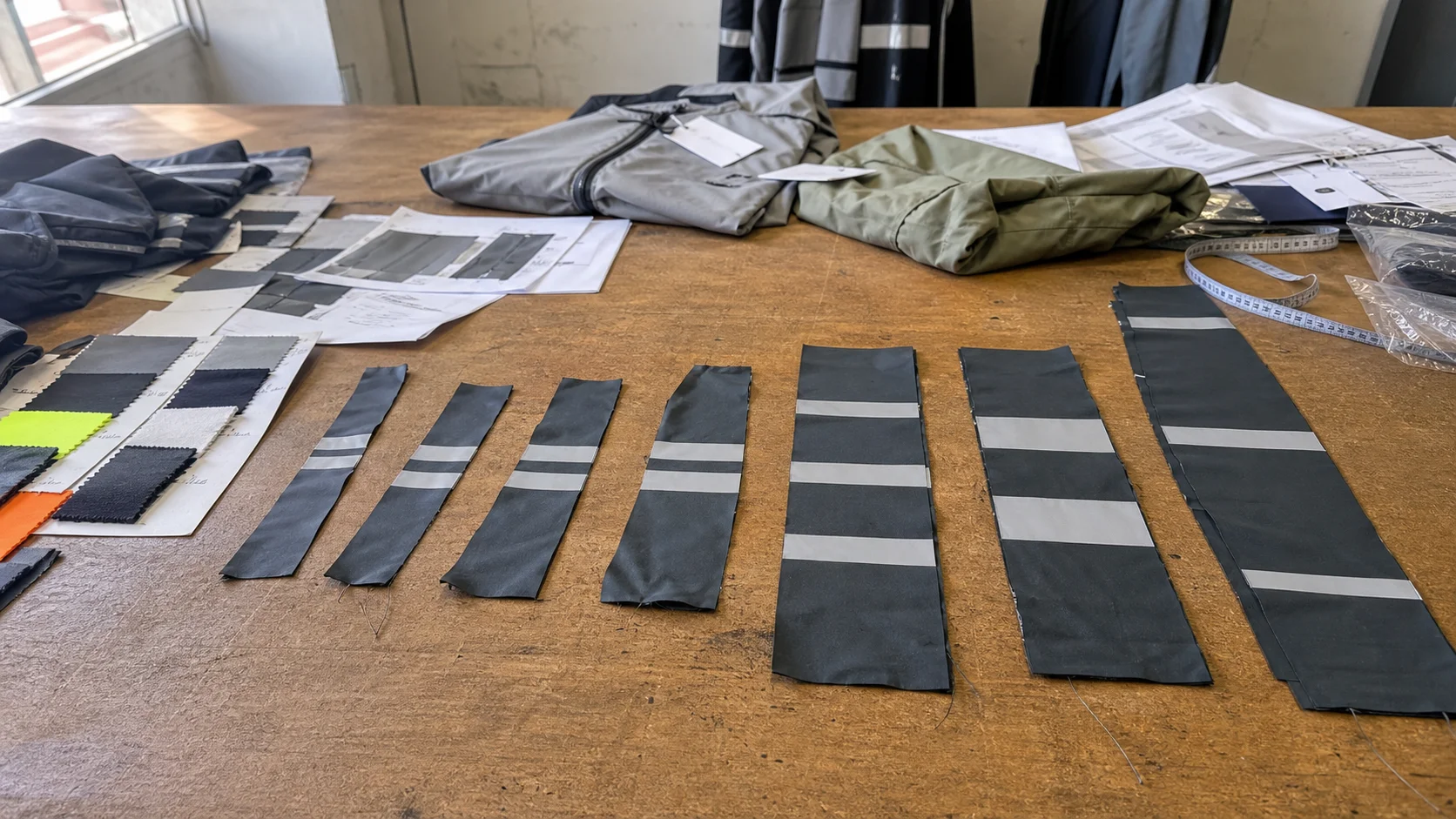
A buyer-focused review of reflective jacket strip size grading, factory production checks, and distributor-ready quality control points for decorated outerwear.
For distributor buyers, reflective jacket strip sourcing is rarely just a matter of price per meter. The real risk sits in grading: whether the factory can hold width tolerances, maintain reflectivity across lots, match color between runs, and keep the strip consistent after cutting, heat transfer, stitching, or washing. A reflective strip that looks acceptable in a small sample can still fail in production when grading rules are loose or poorly documented.
This review looks at reflective jacket strip factory size grading from a practical purchasing angle. It is written for distributor buyers in Decoration & Printing, where trim consistency, compliance, and re-order stability matter as much as visual appearance. If you are sourcing for workwear, safety jackets, outdoor apparel, or promotional outerwear, the grading system behind the strip is one of the first things worth checking.
Reflective Jacket Strip Factory Grading Review - Fabrikn production reference
In jacket production, grading usually refers to how a component is scaled across garment sizes while preserving proportional placement, performance, and appearance. For reflective strips, this can mean the strip width stays fixed, the length changes by size, or both dimensions are adjusted according to a spec sheet. In some product lines, the strip placement also shifts slightly to maintain balance on larger or smaller garments.
A factory grading review should answer a simple question: can the supplier reproduce the same strip spec across the size curve without drifting outside tolerance? For distributor buyers, the answer affects not only fit and appearance but also inventory planning. A strip that is too narrow on larger sizes can look underbuilt. A strip that is too wide on smaller sizes can crowd seams, pockets, logos, or panel lines.
In reflective trim sourcing, “size grading” is not just a pattern issue. It is a repeatability issue across production lots, sizes, and re-orders.
Distributors often work with mixed customer demand. One buyer wants budget workwear, another wants certified safety outerwear, and another wants a branded jacket for seasonal promotion. The supplier may be asked to serve all three with one reflective strip concept, but the grading tolerance cannot be treated casually.
Small errors in strip grading create avoidable problems:
In Decoration & Printing, buyers also need to consider whether reflective strip placement competes with printed logos, transfer graphics, or woven labels. A factory that understands grading from a production standpoint will usually ask for the decoration map before locking the strip layout. That is a good sign. A factory that treats the strip as a simple add-on may be fine for basic promotional wear, but it is usually weaker when the order involves multiple size points and exact placement requirements.
Reflective jacket strips are often supplied in a few practical widths, then cut and placed according to garment size. Typical strip widths in the market are often around 1 cm, 2 cm, 3 cm, 5 cm, or custom engineered widths, depending on the product category and visibility requirement. For general workwear and outerwear, 2 cm to 5 cm is common, though the final choice depends on design, certification target, and garment silhouette.
Grading patterns usually fall into one of three approaches:
For distributor buyers, fixed width with graded length is often the easiest to control. It keeps the reflective performance and visual identity stable. Scaling both width and placement can be useful for premium or technical outerwear, but it demands tighter factory discipline and clearer pattern communication.
When reviewing a supplier, ask for the actual size breakdown rather than a general claim that “all sizes are okay.” A proper grading sheet should show the strip dimension by size, the distance from key points such as center front, hem, shoulder, and side seam, and the tolerances the factory will accept.
Grading Element What to Confirm Buyer Risk if Unclear Strip width Fixed or size-adjusted Appearance drift and compliance mismatch Strip length Per size, per panel, or per set Uneven visual balance Placement Measured from seams and key points Misaligned decoration and fit issues Tolerance Acceptable variation in mm Inspection rejection and rework Attachment method Stitched, heat-transfer, or bonded Durability failure after wash or wearA serious factory review should not stop at looking at a sample jacket. The sample is only proof that one unit can be made correctly. Grading review is about proving the same logic can be repeated across the size set without quality drift.
Ask how the factory constructs the size chart. Does it grade from a base size with a software system, or does it manually adjust pieces? Either method can work, but manual grading should be controlled carefully. Poor manual adjustment often shows up in reflective strip placement first because the eye catches the line immediately.
The factory should be able to show the measurement points used for strip placement. A professional supplier will mark the reference points clearly: edge of placket, shoulder seam, hem, armhole, or waist seam. If the strip layout is not anchored to a stable reference, production variation becomes hard to manage.
Distributor buyers should expect at least three levels of approval when the order is important:
The best time to catch grading mistakes is before bulk production. Once cutting starts, any width or placement change can multiply into a costly correction across sizes.
For reflective strip work, small dimensional errors matter. The supplier should state tolerances in writing. In many trim programs, buyers expect tight control on width and placement, often within a few millimeters, though exact limits depend on product type and price tier. A low-cost factory may offer looser tolerance, but that choice should be deliberate, not accidental.
A good grading review asks one more question: what happens if a strip falls just outside the tolerance? The answer reveals whether the supplier has a disciplined rework process or simply ships what passes visual inspection.
Reflective strips can be applied through sewing, heat transfer, bonding, or integrated manufacturing. Each method has different grading consequences.
For distributor buyers, the practical tradeoff is simple. A neater finish may cost more and require better process control, while a stitched solution may be easier to execute on standard production lines. The right answer depends on the end customer’s use case and price point.
MOQ for reflective jacket strip programs can vary widely by factory, trim type, and decoration method. A practical working range for smaller distributor programs may start around a few hundred pieces per colorway or style, while larger integrated jacket programs may require 1,000 pieces or more for better price efficiency. Some factories will quote lower MOQs for stock strip materials, but custom colors, custom widths, or special compliance requirements usually push the minimum higher.
Sampling lead time also depends on the production route. Stock strip sampling can move quickly, sometimes within several days. Custom reflective film, special backing, or branded placement samples can take longer, especially if the factory must source matching fabric, test adhesive behavior, or adjust the grading layout. If the size set is broad, sample approval can take more than one round.
Lead time in bulk production depends on several dependencies:
Distributor buyers should be cautious with suppliers that promise very short lead times while also offering custom grading and tight tolerances. That combination is possible in some cases, but it usually requires strong planning and stable trim supply.
Reflective strip quality is not controlled by width alone. The base material, coating, adhesive, backing cloth, and stitching method all influence how the strip behaves during grading and production.
Key spec points to request include:
Grading issues often show up when the trim behaves differently from the shell fabric. For example, a stiff reflective tape on a soft jacket can pucker during sewing. A stretchy shell fabric can also cause the strip to wave or twist if the factory does not stabilize the panel before application. In these cases, grading review should include not just measurements, but also garment behavior on the body.
Good grading is invisible when the garment is worn. Bad grading is visible even before the jacket leaves the hanger.
Inspection for reflective jacket strips should include both measurement checks and visual checks. A strip can measure correctly yet still fail because the stitching is crooked, the surface is scratched, or the reflective effect is inconsistent from one batch to another.
Common failure points include:
For distributors, the biggest risk is not always first production. It is re-order drift. A factory may produce one lot correctly, then change trim sourcing or production settings later without updating the buyer. A disciplined supplier keeps the spec frozen, records the approved material code, and flags any substitutions before mass production.
Inspection should also cover packaging. Reflective strips and finished jackets can be damaged by folding pressure, heat, moisture, or surface contamination. A trim that looks perfect in the sewing line can still arrive with visible creasing or marking if packaging is poor.
Not every order needs the same level of grading control. A distributor supplying budget promotional jackets may accept wider tolerance and simpler size scaling if the order is price-sensitive and the customer does not require strict technical performance. A workwear or safety buyer, by contrast, should treat strip grading as a compliance and durability issue, not a cosmetic one.
Here is the practical tradeoff:
If your buyer asks for reflective jacket strips across a broad size range, insist on a size-by-size spec sheet. If the order includes printing or decoration near the strip, review the decoration map before approving the final garment layout. This avoids the common problem of a print that is centered on one size but awkwardly placed on another.
One useful sourcing habit is to compare the sample jacket against the size chart in a flat-lay condition and again on a dress form or fit mannequin. Flat measurements can hide placement issues that become obvious when the jacket is worn. This is especially true for outerwear with curved hems, raglan sleeves, or shaped side panels.
When distributor buyers need consistent reflective strip programs, it helps to work with a supplier that understands both decoration and production control. The right partner should be able to discuss size grading, material options, and application method in the same conversation, not treat them as separate tasks.
If you are comparing options, review the supplier’s capabilities page first: services. For company background and manufacturing focus, see about us. For quote requests, sample questions, or technical file submission, use the contact us page.
What matters most is responsiveness on details. A factory that asks for the size range, strip placement, target use, decoration method, and expected wash performance is usually more reliable than one that offers a quick blanket quote without checking the spec. Buyers should prefer that caution. It is better to spend a little more time in sampling than to discover a grading problem after the bulk order ships.
Reflective jacket strip factory grading review is a sourcing discipline, not a paperwork exercise. For distributor buyers, the important questions are practical: can the supplier hold size consistency, can the strip be placed cleanly across the full size curve, and can the same result be repeated in re-orders? The answer depends on pattern control, tolerance discipline, material consistency, and sample approval quality.
When buying for Decoration & Printing, do not let the visual simplicity of reflective trim hide the complexity underneath. A good strip is one that looks the same across sizes, performs reliably after production, and fits the garment design without conflict. That is the standard worth asking for.
Get a free quote from Fabrikn — your trusted B2B clothing manufacturer with 10+ years of experience. MOQ as low as 200 pieces.
Get a Free Quote →It is the process of adjusting or controlling reflective strip dimensions and placement across different jacket sizes so the design remains balanced, consistent, and manufacturable.
MOQ depends on the strip type, customization level, and factory setup. Small programs may start in the few-hundred-piece range, while custom or technical programs often need 1,000 pieces or more.
Material approval, placement sample, and pre-production sample are the key stages. Each step catches a different type of risk before bulk production begins.
There is no single best method. Sewing is often simpler, heat transfer can look cleaner, and bonded applications may offer a premium finish. The right choice depends on the garment, budget, and durability target.
Width drift, placement errors, adhesion failure, stitching distortion, and re-order inconsistency are the main risks. Packaging damage is also worth checking.
Compare grading sheets, tolerance statements, sample approval discipline, material transparency, and lead-time realism. A factory that answers clearly on those points is usually easier to manage in production.