
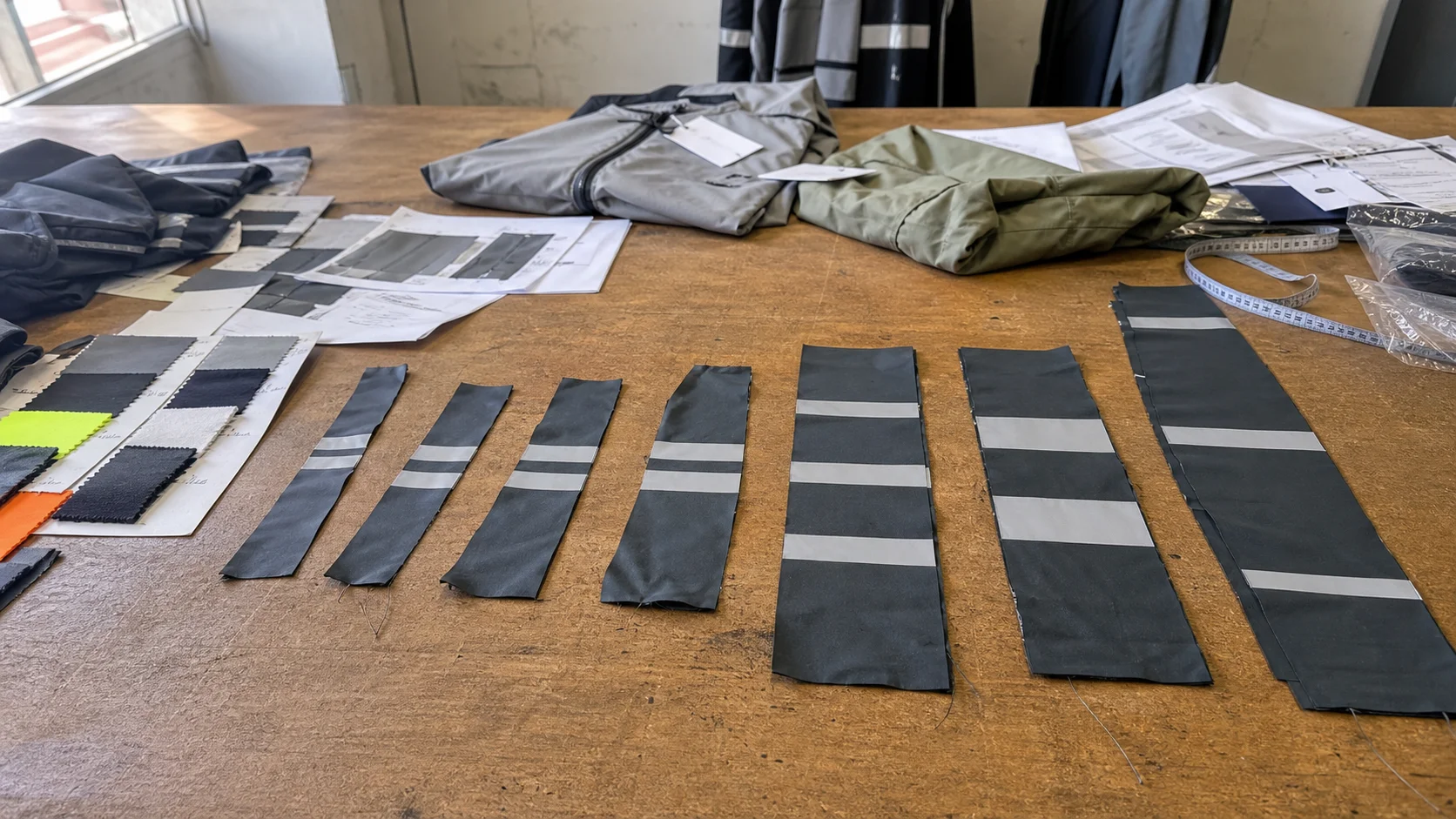
A practical SEO outline for security contractors evaluating reorder risks on reflective jacket strip production, from artwork consistency and placement...
Reordering reflective jacket strips sounds simple until the second or third production run exposes gaps in material matching, adhesive performance, tape width, application method, or compliance paperwork. For security contractors, those details matter. A jacket strip that looks close enough on a sample board can still fail in the field if reflectivity drops, stitching shifts, or the garment no longer matches the original issue standard.
This reorder risk review is written for buyers, sourcing managers, and procurement teams handling reflective jacket strip order reorder risk review for security contractors. The main goal is straightforward: reduce repeat-order surprises before they become delivery delays, uniform inconsistency, or rejected lots. In decoration and printing, reflective trim and strip application sit at the intersection of material sourcing, workmanship, and inspection discipline. That combination deserves a careful review every time you reorder.
Reflective Jacket Strip Reorder Risk Review - Fabrikn production reference
A reorder risk review is a practical check of whether the next production run will match the approved standard from the first order. For reflective jacket strips, that means checking the exact strip type, width, color, retroreflective performance, backing, attachment method, placement, and any required certifications or test reports.
In decoration and printing supply chains, a reorder is not a duplicate by default. Mills change coatings, converters alter adhesive formulations, factories swap stitch patterns, and sub-suppliers replace packaging or release liners. A supplier may still call the item by the same product code even when one or more elements have changed. That is the core risk.
A repeat order is only safe when the buyer controls the specification, the approval route, and the acceptance criteria. Without those three, the order may be “same name, different result.”
For security contractors, consistency matters because reflective strips are part of visibility, identity, and uniform compliance. Mixed batches across crews can create visual inconsistency, and a performance failure can become a safety issue in low-light work environments.
First orders often succeed because everyone pays close attention. Samples are reviewed, production is monitored, and defects are caught early. Reorders can go wrong because the order is treated as routine. That is where risk creeps in.
Reorders also fail when the buyer assumes the factory still has the original patterns, labels, or approved materials on file. That may be true, but it should never be taken for granted. Files get archived, production teams change, and vendors sometimes rely on memory rather than controlled documentation.
The strongest reorder control is a clear spec sheet. For reflective jacket strips, the spec should be detailed enough that another buyer or QC inspector could use it without guessing.
Define the required standard by market or end-use requirement. If the garment must meet a particular visibility standard, state it explicitly. Buyers should not rely on general language such as “good reflective quality.” That phrase is not testable.
Confirm whether the strip is woven, printed, heat-transfer, sewn tape, segmented reflective tape, or a hybrid construction. Some products look similar but behave differently under laundering and abrasion. For repeat orders, the original construction method should be frozen unless a formal change is approved.
Specify the strip width, seam allowance, spacing between stripes, and exact placement on the jacket panel. If the strip sits on the chest, sleeves, back, or hem, include a diagram. Placement errors are common when factories rely on verbal instructions.
If the strip uses adhesive or heat activation, define the backing film, activation temperature, dwell time, and pressure. These details affect bond strength and durability. If it is sewn, specify stitch type, stitch density, and thread type.
State the exact color reference if relevant. Some buyers use silver reflective on navy jackets, while others require fluorescent trim or matte contrast panels. Finish can also influence appearance under flash photography and site lighting.
Security uniforms are often washed regularly. Clarify how many wash cycles are expected and whether the strip must retain reflectivity after laundering, dry cleaning, or high-temperature drying. A strip that looks acceptable on day one may deteriorate quickly if the durability standard is too loose.
Ask for carton labels, lot numbers, and production dates. Traceability matters if one batch later shows premature cracking, peeling, or reflectivity loss. Without lot control, a defect becomes harder to isolate.
MOQ for reflective jacket strips depends on construction, customization level, and whether the strip is purchased as a finished trim component or as part of a decorated garment package. For standard items, the MOQ may be relatively low. For custom printed or specially coated reflective trims, MOQ usually rises.
Order Type Typical MOQ Range Risk Level Buyer Tradeoff Standard reflective tape or strip 100–500 meters or equivalent carton quantity Lower Better flexibility, but watch stock consistency Custom width or color 500–1,000 meters Medium More control over fit, but higher inventory commitment Special performance grade or certified trim 1,000+ meters Higher Compliance confidence, but longer lead times and more cash tied up Garment decoration package with strip application 100–300 garments or equivalent production run Medium to higher Reduced handling for buyer, but more dependency on factory workmanshipLower MOQ can be attractive, especially for pilot programs or new security contract onboarding. The tradeoff is that very small orders may get less favorable pricing and less production attention. Larger reorders tend to improve unit economics, but they also magnify the cost of any spec error.
For buyers managing multiple security sites, a phased reorder strategy is often safer than a large blanket purchase. That approach allows one approved batch to confirm real-world performance before the next volume release.
Sample approval is the most practical way to reduce reorder mistakes. The problem is that many teams approve a sample visually, then skip the rest of the control process.
If available, obtain a retained sample from the first order. Compare it against the current supplier sample under the same lighting conditions. Check reflectivity, edge finish, backing, and attachment consistency.
The pre-production sample should reflect the exact materials and method intended for the reorder. If the supplier proposes any material substitution, the sample must show it before bulk production starts. No bulk approval should be issued based on a similar-looking product without confirmation.
If strip placement is tied to jacket decoration or printed garment branding, request a placement mock-up. Even when the strip itself is unchanged, panel layout can shift during production. That matters when pockets, seam lines, or logo placements interfere with visibility.
For repeat orders, ask whether the original test data still applies. If the source material or supplier lot changed, fresh testing may be necessary. A short wash test can reveal edge lifting, cracking, delamination, or surface haze before bulk shipment.
The approved sample should be documented with photos, measurements, supplier references, and lot numbers. A simple approval note is useful, but a more complete record gives the buyer leverage if the reorder diverges.
Lead time for reflective jacket strips is not determined by one factory calendar alone. It depends on material availability, conversion capacity, test requirements, packaging setup, and shipping route. A reorder can move quickly if all inputs are ready, but one missing item can slow the job materially.
Typical lead time for a standard reorder can fall in the 2 to 6 week range once approvals are complete, but custom or certified trims can take longer. Buyers should be wary of any quote that ignores sample approval time, because the date on the purchase order is not the same as the date the goods are ready to ship.
Inspection on reflective jacket strip orders should focus on appearance, measurement, bonding, and performance. The most common mistakes are simple, but they still cause rejection.
Check strip width, length, spacing, and placement against the approved spec. Small dimensional drift can affect the final look and may also impact compliance if the strip is part of a prescribed visibility layout.
If the strip is sewn, inspect stitch density and thread breakage. If heat-applied, check for edge lift, bubbles, and incomplete bonding. These issues often show up after laundering or flex testing, not immediately on receipt.
Reflective surfaces should be checked for scratches, cloudiness, uneven coating, and dull patches. A strip can pass a quick visual inspection but still underperform under light return conditions.
In larger orders, multiple widths, colors, or garment sizes can get mixed. Strong carton labeling and lot separation reduce this risk. Buyers should ask for clear packing lists and, where necessary, carton photos before shipment.
Missing test reports, unsigned declarations, or expired certificates can delay customs clearance or internal acceptance. This is especially important when the reflective strip is part of a regulated workwear order. Documentation should match the actual production lot, not an earlier batch.
Security contractors buy for consistency across teams, shifts, and sites. That creates a different risk profile from a one-off promotional garment order. The strip is not just decoration. It supports visibility and professional uniformity.
For contractor buyers, there are four practical concerns.
Security buyers should also be careful with “equivalent” substitutions. An equivalent reflective strip may be technically similar but not visually or operationally identical. If a contractor works across multiple facilities, even a subtle change can create confusion in the field and make the uniform program look fragmented.
For security uniform programs, the safest purchase is usually not the cheapest one. It is the one that can be repeated without visible drift.
A good supplier brief reduces reorder risk more effectively than a long email thread. Keep the order file clean and specific.
Include the following:
If the supplier manages both garment decoration and strip application, ask who owns the final QC point. A decoration team may be excellent at applying logos but less experienced with reflective trim handling. The buyer should know where the risk sits before production starts.
For related support on production coordination, buyers can review Fabrikn services, check the company background on about us, or raise a sourcing question through contact us.
Before approving a repeat order, use a short checklist. It is faster than troubleshooting after the goods arrive.
A disciplined reorder process is not overkill. It is the simplest way to protect cost, timeline, and uniform quality.
The real risk in reflective jacket strip reorders is not that the product is complicated. It is that the item looks straightforward, so teams skip control steps. For security contractors, that is a costly assumption. Visibility, durability, and consistent appearance all depend on details that can change quietly between orders.
Buyers should treat every reorder as a controlled purchase, not a routine restock. Lock the specification. Re-approve samples when anything changes. Watch MOQ and lead-time tradeoffs. Keep inspection criteria clear and written. That approach does not eliminate risk, but it does keep the risk manageable.
If the objective is a repeatable uniform program, the supplier relationship should support repeatable outputs. That is where disciplined sourcing makes the difference.
Get a free quote from Fabrikn — your trusted B2B clothing manufacturer with 10+ years of experience. MOQ as low as 200 pieces.
Get a Free Quote →The biggest risk is material drift. A new lot may look similar but perform differently in reflectivity, adhesion, washing, or finish. That is why sample control and written specifications matter.
Typical MOQ can range from 100 to 500 meters for standard strip products and 500 to 1,000 meters or more for custom or certified versions. Finished garment decoration runs may follow garment quantity rather than trim length.
Yes, if the supplier changes material, backing, width, production method, or performance claims. A repeat order should not rely only on old approval files when the actual input may have changed.
Standard repeat orders may take 2 to 6 weeks after approvals, depending on stock, production load, testing, and shipping method. Custom or compliance-heavy orders can take longer.
Check consistency across all uniforms, wash durability, and whether the reflective strip matches the original issue standard. Field appearance and repeatability usually matter as much as the base material itself.
Only if the buyer reviews the technical data, sample, and any compliance impact. Equivalent on paper does not always mean equivalent in appearance or performance.