
A product-focused sourcing review for distributors evaluating reflective jacket strip trim, covering performance specs, attachment methods, compliance...
Reflective Jacket Strip Trim Buying Review for Distributors - Fabrikn production reference
Reflective jacket strip trim is a small component with a large commercial impact. For distributor buyers, it affects garment safety positioning, customer confidence, compliance claims, delivery reliability, and margin protection. A jacket can be well cut and properly sewn, but poor reflective trim immediately weakens the product. It may crack, peel, dull after washing, fray at the edges, or fail customer inspection before the shipment reaches retail or workwear distribution.
This distributor buyers reflective jacket strip trim sourcing review focuses on practical purchasing decisions rather than generic product descriptions. Buyers need to know which trim type suits which jacket category, what specifications should appear on a purchase order, how samples should be approved, and where quality failures normally appear. Reflective strip trim is used across safety jackets, rainwear, winter work jackets, outdoor uniforms, cycling apparel, school outerwear, promotional jackets, and industrial garments. Each category has different durability and compliance expectations.
The first sourcing question is not simply “What is the cheapest reflective tape?” A better question is “What performance level, base fabric, adhesive system, color, width, wash durability, and attachment method does this customer actually need?” Distributor buyers who answer that early usually avoid costly rework. Buyers who source only by width and unit price often discover problems during bulk sewing, finished garment inspection, or post-delivery complaints.
Reflective jacket strip trim sits between decoration and functional safety. It can be treated as a visual design element, but it should not be purchased like ordinary ribbon or printed webbing when the garment carries visibility claims. If a distributor is selling to industrial workwear, logistics, construction, road service, emergency, mining, warehouse, or utilities customers, the buying standard must be more disciplined.
Reflective jacket strip trim generally refers to narrow reflective material applied to a jacket as a stripe, band, piping, panel accent, or segmented transfer. It may be sewn onto the jacket, heat transferred, bonded, laminated, or integrated into a wider decorative tape. The visible reflective effect is usually created by glass beads or microprismatic structures that return light toward the source.
For jacket programs, distributors commonly see the following trim formats:
Not all reflective-looking trims are equal. Some are suitable for promotional jackets that need night-time visibility as a selling point. Others are designed for certified high-visibility garments. Distributor buyers should avoid letting suppliers use vague terms such as “safety tape,” “hi-vis strip,” or “reflective ribbon” without a supporting specification sheet.
Purchasing judgment: if the jacket will be sold with any safety, industrial, or high-visibility claim, request test references, wash performance data, and exact construction details before confirming bulk pricing.
Distributors buy reflective jacket strip trim either as a component for garment production or as part of a finished jacket sourcing package. The sourcing risk changes depending on the final customer. A promotional apparel distributor may prioritize appearance, low MOQ, and quick delivery. A workwear distributor must prioritize compliance, durability, and consistent performance after laundering.
Industrial workwear jackets often require durable reflective trim that can withstand abrasion, repeated washing, and outdoor exposure. Common customers include construction crews, logistics teams, utility workers, roadside service providers, and facility maintenance staff. For this segment, trim failure is not just a cosmetic issue. It can create returns, reputational damage, and compliance disputes.
Outdoor jackets may use reflective trim for visibility during running, cycling, hiking, or commuting. Flexibility, softness, stretch compatibility, and low bulk are important. Segmented heat transfer trim can be attractive here because it moves better with the fabric. The tradeoff is that application conditions and wash testing become more important.
For school outerwear, team jackets, event apparel, and promotional programs, reflective strip trim often functions as decoration. Buyers may accept lower wash durability if the garment has a short usage cycle, but they should still avoid trim that peels or dulls after a few wears. Clear customer communication matters: do not market decorative reflective accents as certified high-visibility protection.
Rain jackets create special challenges. Sewn reflective trim can compromise waterproofing unless seams are properly sealed. Heat transfer trim must bond to coated or laminated fabric without damaging the surface. PVC, PU, TPU, and polyester shell materials behave differently under heat and pressure. Testing on actual shell fabric is necessary before bulk production.
A reliable reflective jacket strip trim purchase specification should include more than width and color. Distributor buyers should build a clear trim sheet that can be used by the supplier, garment factory, inspection team, and customer. This reduces disputes later.
Specification Item Typical Options Buyer Review Point Trim type Sew-on tape, heat transfer film, segmented transfer, piping, woven reflective trim Match attachment method to jacket fabric and end use. Width 10 mm, 15 mm, 20 mm, 25 mm, 50 mm, 75 mm, custom widths 50 mm is common for high-visibility layouts; narrow widths are often decorative. Reflective technology Glass bead, microprismatic, reflective yarn, printed reflective coating Microprismatic can be brighter but may be stiffer; glass bead tape is widely used. Backing material Polyester, TC fabric, knit backing, aramid blend, TPU carrier Backing affects sewing, heat tolerance, softness, and durability. Color Silver, grey, yellow-silver, orange-silver, black reflective, rainbow reflective Fashion colors may have lower reflectivity than standard silver. Wash durability Home wash, industrial wash, dry clean, limited wash cycle claims Ask for cycle count and test method, not only “washable.” Attachment conditions Sewing thread/stitch density or heat press temperature, pressure, time Bulk factories need repeatable instructions to avoid peeling and distortion.For jacket production, common reflective tape widths range from 20 mm to 50 mm. Narrow trim is useful on pocket edges, sleeves, hoods, and decorative seam lines. Wider 50 mm trim is widely used for safety jacket body bands, sleeve bands, and shoulder braces. Some buyers request 75 mm or custom widths for special design layouts, but this can increase MOQ and lead time.
Backing softness should not be ignored. A stiff reflective tape can make lightweight jackets uncomfortable and can create puckering around curved seams. A very soft tape may look better but may not deliver the same abrasion resistance. The correct choice depends on garment weight, shell fabric, lining structure, and the customer’s performance expectation.
Reflective performance is usually measured by retroreflectivity. In practical terms, it describes how much light the trim reflects back toward a light source. For distributors, the main concern is whether the trim supports the claim being made on the jacket. If the jacket is promoted as high-visibility safety apparel, the trim may need to meet standards such as ANSI/ISEA 107, EN ISO 20471, or other market-specific requirements. Requirements vary by country, garment class, layout, background fabric, and reflective material area.
Buyers should avoid making compliance assumptions from appearance alone. Two silver reflective tapes may look similar under warehouse lighting but perform differently under test conditions and after washing. Reflectivity can drop due to poor bead exposure, coating inconsistency, surface contamination, incorrect heat transfer, abrasion, or laundering.
Useful documents to request from suppliers include:
A practical distributor rule is simple: if the customer needs certified safety performance, align the trim, fabric, design layout, and finished garment testing before bulk order. Buying a certified tape does not automatically make the finished jacket compliant. The garment layout, reflective area, background fabric color, and construction must also support the claim.
Reflective jacket strip trim belongs in the Decoration & Printing category because it often carries branding, visual design, and functional visibility at the same time. Distributors may request printed logos on reflective tape, custom color reflective trims, heat transfer reflective graphics, or combined reflective and non-reflective decorative bands.
Printing on reflective material requires caution. Ink coverage can reduce reflectivity. Heavy printed logos may interrupt the reflective surface and weaken compliance area calculations. For decorative programs, this may be acceptable. For safety garments, printed areas should be reviewed carefully and may need to be excluded from reflective performance calculations.
Common branding options include:
When distributors source jackets with both reflective trim and logo decoration, production sequencing matters. Reflective tape may be sewn before lining attachment. Heat transfers may need to be applied before final assembly. Embroidery placed too close to reflective trim can cause puckering or needle damage. Silicone prints, PU prints, and reflective transfers can compete for heat press time and require different temperature settings.
For buyers developing custom decorated jackets, it is worth reviewing service capabilities early. A sourcing partner with decoration and garment production coordination can reduce handoff errors. For reference, buyers can review manufacturing and customization support through Fabrikn services when planning more complex decoration packages.
Supplier selection should reflect the distributor’s sales channel. A low-cost trim vendor may be acceptable for basic promotional jackets if quality expectations are limited and clearly disclosed. A distributor serving safety and industrial customers needs stronger documentation, consistency, and production control.
Key supplier review points include:
Be cautious with suppliers who quote extremely low prices without asking about garment use, wash requirements, compliance claims, or attachment method. That may indicate the supplier is selling generic trim rather than solving the jacket requirement. Price still matters, but an unsuitable trim is expensive once it reaches the sewing line.
Distributor buyers should also decide whether to source trim separately or through a garment manufacturing partner. Separate trim sourcing may reduce component cost and give the distributor more control. It also increases coordination work. The garment factory must receive the trim on time, test it on the shell fabric, and handle defects or shortages. Integrated sourcing through a jacket manufacturer may cost slightly more per garment but can reduce operational friction.
MOQ varies widely by trim type, color, width, and customization. For common silver sew-on reflective tape, typical supplier MOQs may start around 500 to 1,000 meters per width and construction. Stock materials can sometimes be purchased in smaller quantities, especially for sample development or urgent replenishment. Custom colors, custom widths, printed logos, microprismatic constructions, and FR-rated trims usually require higher MOQs.
Trim Category Typical MOQ Range Notes for Distributor Buyers Stock silver sew-on tape 500-1,000 meters Best for fast jacket programs and standard workwear designs. Heat transfer reflective film 300-1,000 meters or equivalent roll quantity Confirm shelf life and application compatibility before buying bulk. Segmented reflective transfer 500-2,000 meters or custom sheet quantity Good comfort, higher application control required. Printed reflective trim 1,000-3,000 meters Artwork, ink testing, and setup charges may apply. Custom color or fashion reflective trim 1,000-5,000 meters Reflectivity may be lower; approve under real light conditions. FR reflective trim 1,000-3,000 meters or higher Require end-use testing and documentation before commercial claims.These ranges are typical market references, not guarantees. Actual MOQ depends on supplier inventory, raw material availability, coating line setup, printing method, and whether the buyer accepts standard packaging. Distributors should calculate trim consumption per garment before negotiating. A jacket with two body bands, two sleeve bands, shoulder braces, and pocket accents can consume much more trim than expected.
Pricing is influenced by reflective technology, backing quality, coating uniformity, compliance testing, wash durability, width, order volume, color, and packaging. Cheaper trim often saves cents per garment but can create dollars of risk if it causes sewing defects or returns. For distributor programs, margin should be evaluated at shipment level, not only trim meter level.
A useful buying practice is to build three trim options into early costing: economy decorative, standard durable, and certified performance. This gives the sales team room to match the customer’s budget without pretending all trims are equivalent.
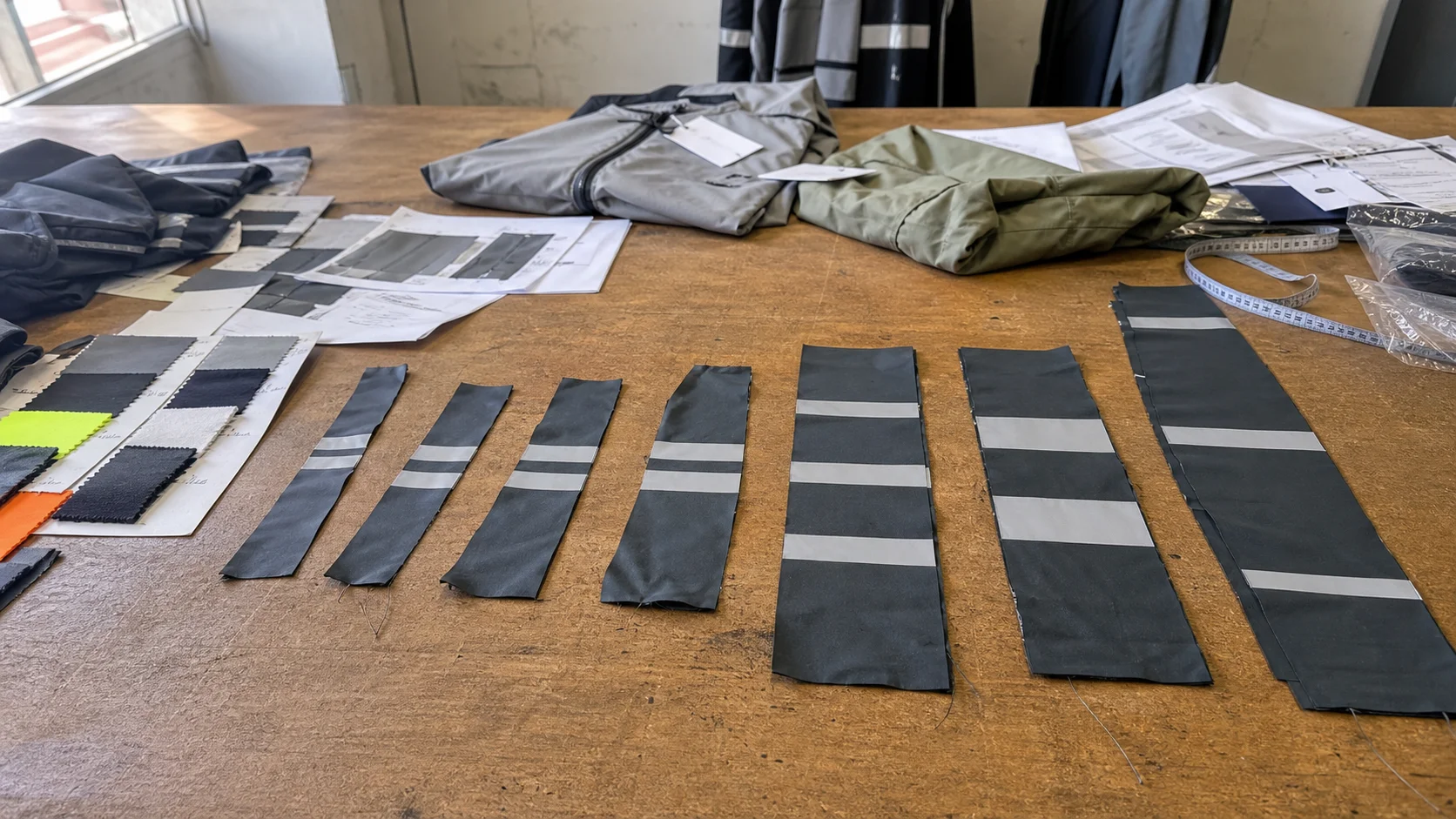
Sampling is where many reflective trim problems should be caught. A photo approval is not enough. Reflective materials change appearance depending on angle, light source, fabric color, stitch tension, and application method. Distributor buyers should require physical samples and application trials before confirming bulk production.
For heat transfer reflective trim, the approval should record press temperature, dwell time, pressure, peel temperature, and fabric face condition after application. Slight changes can affect adhesion. A transfer that looks fine after pressing may lift after laundering if pressure was too low or the fabric coating resisted bonding.
For sew-on tape, inspect stitch margin and needle perforation. Stitching too close to the edge can cause fraying or separation. Stitching through a reflective surface may be acceptable in many designs, but it reduces reflective area and may create weak points. Curved applications, sleeve bands, and pocket edges require extra attention because distortion is common.
If the distributor is comparing multiple jacket makers or trim suppliers, all samples should be tested using the same shell fabric and wash method. Otherwise, comparisons can be misleading. For development support and custom garment planning, buyers may use Fabrikn contact channels to clarify specification requirements before committing to bulk development.
Reflective jacket strip trim lead time depends on whether the material is in stock, whether the width is standard, whether printing or custom coating is required, and whether testing is needed. For stock silver reflective tape, component lead time may be as short as a few days to two weeks, depending on supplier readiness and shipping. Custom trim commonly requires two to six weeks, and specialized performance materials may take longer.
Finished jacket lead time is more complex. Reflective trim must arrive before specific sewing stages. If trim is delayed, the garment factory may not be able to continue assembly. A late trim delivery can block sleeve closing, side seam assembly, lining attachment, seam sealing, or final finishing.
Lead-time dependencies include:
Distributors should avoid confirming short delivery promises before trim status is verified. A jacket factory may have capacity, but the trim supplier may not. The reverse can also happen: trim is ready, but the sewing line is full. For seasonal outerwear, this matters because missing the selling window often damages the order more than a small unit cost increase.
A practical buffer is to approve reflective trim before bulk fabric cutting when possible. At minimum, confirm the trim supplier, exact item number, MOQ, roll quantity, and shipping date before the garment factory finalizes the production schedule.
Reflective trim inspection should occur at component, in-line, and finished garment stages. Waiting until final inspection is risky because reflective trim defects are often sewn into the garment. Rework may require removing stitches, damaging fabric, replacing panels, or scrapping finished jackets.
Inspection should include visual review under normal lighting and directed light. A simple flash photo can reveal obvious inconsistencies, but it is not a substitute for formal retroreflectivity testing when compliance matters. For non-certified decorative jackets, a flash check is still useful because customers often notice reflective unevenness at night.
Buyers should define acceptable tolerances in advance. Examples include width tolerance, placement tolerance from seam lines, allowed roll shade variation, minimum adhesion result after washing, and maximum visible surface defects per garment. Vague “good quality” language is weak protection in a claim situation.
Reflective jacket strip trim sourcing requires balancing cost, compliance, comfort, appearance, and production reliability. The best trim is not always the brightest or the cheapest. It is the trim that matches the garment’s sales promise and survives the production process.
Sew-on tape is often more forgiving for heavy work jackets, padded jackets, and standard safety outerwear. It does not depend on adhesive compatibility with the shell fabric. It can be repaired more easily than a failed transfer. The downside is added stitch lines, possible water leakage, and a stiffer feel.
Heat transfer trim gives a cleaner appearance and can be more comfortable, especially on lightweight or performance jackets. It works well for segmented reflective designs and sleek branding. The tradeoff is application sensitivity. If temperature, pressure, fabric coating, or storage conditions are wrong, peeling can occur.
Glass bead reflective tape is widely used and can offer good flexibility and familiar handling. Microprismatic trim may deliver stronger reflectivity in certain conditions, but it can be stiffer and more expensive. Buyers should compare not only brightness but also garment comfort, washing expectations, and sewing behavior.
Standard silver reflective trim is usually the safest purchasing choice for workwear and safety programs. Fashion reflective colors such as black, rainbow, tonal grey, or iridescent effects can improve design appeal, but they may not provide the same retroreflective value. They are better suited to lifestyle, sportswear, promotional, and design-led outerwear unless test data supports stronger claims.
Low MOQ is attractive for distributors testing a new market. It also creates batch variation risk if repeat orders draw from different stock lots. For ongoing jacket programs, locking a standard trim item and supplier is usually better than chasing the lowest spot-market price each season.
A practical purchasing approach is to segment trim specifications by product tier:
Distributor buyers should also consider after-sales risk. A trim saving of a few cents per meter can be wiped out by one rejected shipment or a repeat customer complaint. In safety-related categories, conservative sourcing is usually the better commercial decision.
Before placing a reflective jacket strip trim order, buyers should confirm the following points in writing:
Distributors sourcing complete jacket programs should align trim decisions with fabric, lining, insulation, zipper, seam sealing, label, and decoration choices. Reflective trim is only one part of the garment, but it often drives the customer’s first impression. A disciplined specification protects both the buyer and the selling channel.
For buyers evaluating manufacturing partners, company background and sourcing model should also be reviewed. General information about business positioning can be checked through Fabrikn about us, while project-specific trim and jacket requirements should be discussed through formal quotation and sampling.
Reflective jacket strip trim is a component where low-price sourcing can quickly become expensive. The main buying risks are poor reflectivity, weak adhesion, batch inconsistency, incorrect compliance assumptions, sewing distortion, wash failure, and late delivery. The main buying controls are clear specifications, physical sample approval, application testing, documentation review, and staged inspection.
For distributors, the strongest sourcing position is to classify each jacket program by end use before requesting quotes. A lifestyle commuter jacket, a promotional event jacket, and a certified roadwork jacket should not use the same buying standard. They may use similar-looking trim, but the required proof, durability, and production control are different.
Choose standard silver sew-on tape when durability, familiarity, and workwear reliability are priorities. Choose heat transfer or segmented reflective trim when comfort, clean styling, and performance aesthetics matter, but only after fabric compatibility testing. Choose custom printed or fashion reflective trim for branding-led products, with honest limits on safety claims. For certified safety garments, do not separate trim purchasing from garment compliance review.
A good distributor buyers reflective jacket strip trim sourcing review should end with one practical conclusion: specify the claim first, then buy the trim. If the customer only needs decoration, keep the program cost-efficient and flexible. If the customer needs protective visibility, pay for verified performance and control the process. That distinction is where margin protection and customer trust are won.
Get a free quote from Fabrikn — your trusted B2B clothing manufacturer with 10+ years of experience. MOQ as low as 200 pieces.
Get a Free Quote →Reflective jacket strip trim is a narrow reflective material applied to jackets as bands, stripes, piping, or transfers. It may be sewn, heat pressed, bonded, or integrated into decorative tape. It is used for visibility, branding, styling, or certified high-visibility garment construction.
Stock silver reflective tape often starts around 500 to 1,000 meters. Custom printed, colored, segmented, or flame-resistant trims may require 1,000 to 5,000 meters depending on the supplier and construction. Smaller sample quantities may be available from stock, but repeat-order consistency should be checked.
No. Silver appearance does not prove compliance. Safety jackets may require trim that meets specific retroreflective standards and is used in an approved garment layout. Buyers should request data sheets, test reports, wash performance information, and finished garment compliance review when safety claims are involved.
Sew-on trim is often safer for heavy-duty work jackets and is less dependent on adhesive compatibility. Heat transfer trim gives a cleaner look and better flexibility, but it requires controlled temperature, pressure, time, and fabric compatibility. The better choice depends on jacket fabric, end use, wash requirement, and design target.
Yes, reflective trim can often be screen printed, heat transferred, or produced with custom graphics. Printing may reduce reflective performance, especially if ink covers a large area. For safety garments, printed areas should be reviewed carefully and may not count fully toward reflective compliance.
Common problems include peeling, cracking, dull reflectivity, shade variation, width inconsistency, edge fraying, sewing puckering, misaligned bands, surface scratches, and poor wash durability. Many of these issues can be caught through component inspection and application testing before bulk garment production.
Buyers should review physical trim samples, apply the trim to actual jacket fabric, check appearance under directed light, run wash or adhesion tests, and approve a pre-production garment. For certified safety programs, formal testing and documentation should be reviewed before bulk approval.
No. Certified tape is only one part of compliance. The finished jacket design, background fabric, reflective area, placement, garment class, and construction must also meet the relevant standard. Buyers should avoid making finished garment claims based only on trim certification.
Stock reflective trim may be available within days to two weeks, depending on supplier inventory and shipping. Custom trim commonly takes two to six weeks or longer if printing, special coating, testing, or material development is required. Finished jacket lead time also depends on when the trim is needed in the sewing process.
A purchase order should include trim type, width, color, backing material, reflectivity requirement, wash durability, attachment method, approved sample reference, roll quantity, MOQ, packaging, delivery date, and inspection criteria. For safety garments, compliance documents and test requirements should also be stated clearly.