
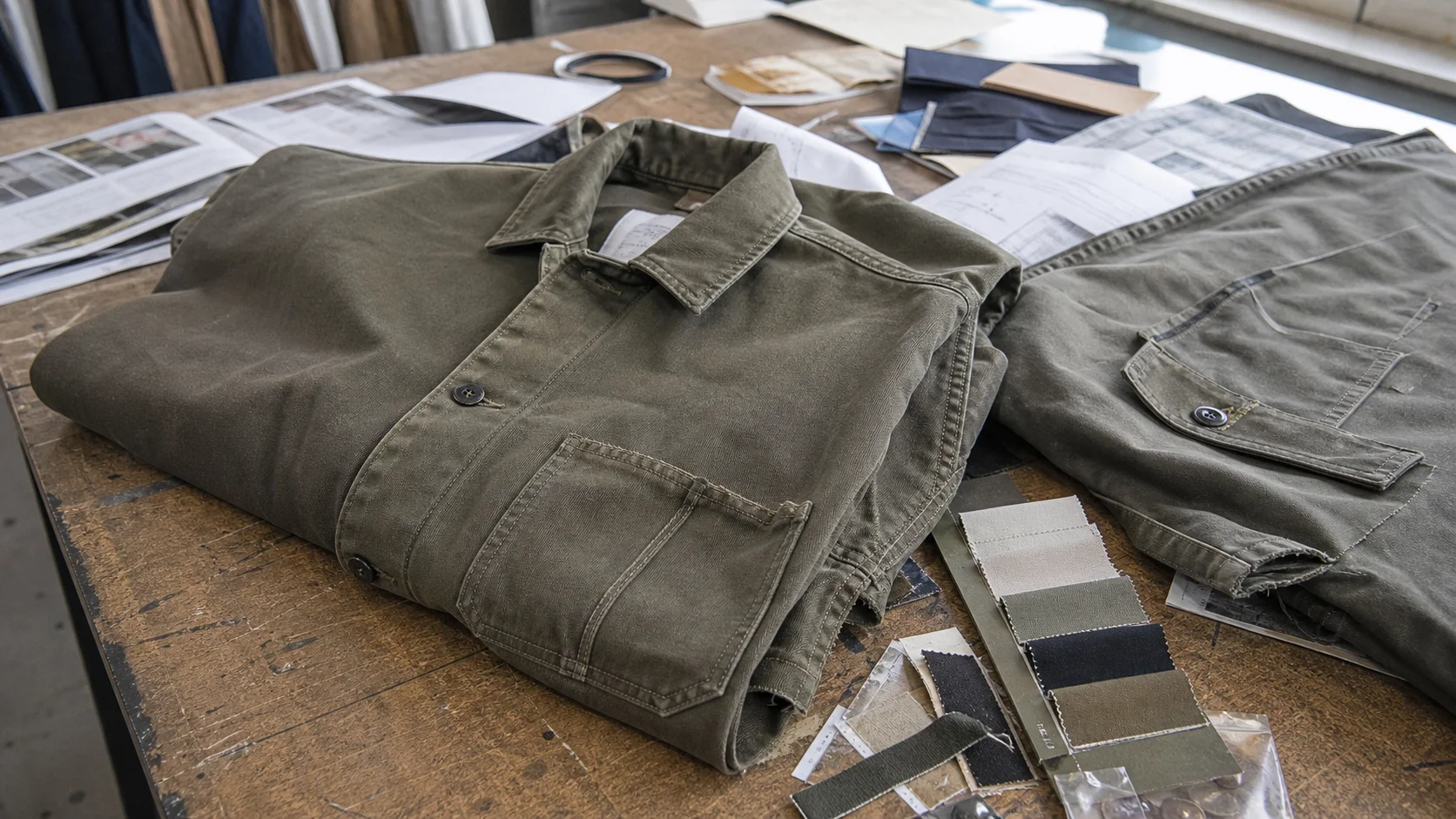
A product-specific scorecard framework gym program buyers can use to evaluate repairable work jacket manufacturers, from fabric durability and modular...
Gym program buyers face a narrower problem than general apparel sourcing. The jacket has to survive daily wear, repeated laundering, sweat exposure, handling by staff, and the kind of abrasion that comes from equipment, benches, lockers, bags, and constant movement. A repairable work jacket is a smarter category than a disposable seasonal style because it keeps replacement costs lower, reduces waste, and gives the program a cleaner long-term uniform standard. The right repairable work jacket manufacturer supplier scorecard for gym program buyers should not only measure price. It should measure whether the jacket can be repaired, reissued, and kept in circulation without looking patched together after the first season.
This scorecard is designed for sourcing teams, merchandising managers, and procurement buyers who need a practical way to compare suppliers. The focus is on durability, repair access, fabric consistency, trim availability, sample approval discipline, and the hidden costs that usually appear after purchase orders are placed. A low unit price can be misleading if the jacket cannot be repaired, if trims are hard to replace, or if the mill cannot hold shade consistency across reorder lots.
Repairable Work Jacket Scorecard for Gym Buyers - Fabrikn production reference
Gym buyers tend to evaluate outerwear through a performance lens, but repairability changes the economics. A jacket that can be repaired cleanly can stay in service longer, which matters when the garment is part of a staff uniform, trainer kit, front-desk outfit, or branded merchandise program. Replacing a jacket because a zipper failed or a cuff wore through is poor value when the rest of the garment is still serviceable.
Repairable design also supports visual consistency. Staff in a gym environment often need to look coordinated. A jacket that can be repaired with original or near-original components preserves the program look better than an item replaced with a different shade or slightly changed trim package. For buyers managing multi-site programs, that consistency matters as much as cost.
The practical advantage is simple: repairable garments let buyers hold a smaller safety stock and reduce rush reorders. The sourcing logic is straightforward. If the jacket is built with accessible seams, standardized hardware, and repeatable fabric construction, the program can extend its lifecycle and reduce waste without compromising appearance.
A useful scorecard should compare suppliers on more than manufacturing capacity. The best vendor for a repairable work jacket manufacturer supplier scorecard for gym program buyers is the one that can prove repeatability. That means the factory understands production consistency, trim continuity, and the realities of post-sale repair.
Use a weighted evaluation that includes technical design, material control, production reliability, and service support. Price should remain a factor, but it should not dominate the decision. A jacket that is 8 percent cheaper at landed cost can become far more expensive if it fails at stress points or cannot be repaired with matching parts.
A scorecard should reward suppliers that can support the jacket over its full life, not just ship the first batch. A factory that can produce a clean bulk order but cannot keep trims available should score below a supplier with slightly higher pricing and stronger material control. For gym programs, the lowest-risk supplier usually wins over the lowest-cost supplier.
Repairability starts at the pattern and spec level. A jacket that is designed for easy service is easier to mend, easier to inspect, and easier to reissue. Buyers should ask for a spec sheet that makes repair practical rather than decorative.
For work jackets used in gym settings, common fabric options include polyester-cotton canvas, cotton-rich twill, nylon blends, and recycled polyester blends with mechanical stretch. The best option depends on the use case. A front-desk or trainer-facing program may prioritize a cleaner surface, lighter weight, and better drape. A back-of-house or maintenance role may need heavier abrasion resistance and more structure.
Typical fabric ranges often fall between 180 gsm and 320 gsm for lighter jackets, and 300 gsm to 450 gsm for workwear-style shells. Heavier is not automatically better. If the jacket is too heavy, staff may stop wearing it indoors. If it is too light, elbows, cuffs, and pocket openings can fail early.
Colorfastness matters. Gym environments include frequent washing, sweat exposure, and contact with cleaning products. Buyers should request wash testing, pilling assessment, and shrinkage data before approving production. If a fabric shows obvious shade migration after repeated wash cycles, repair work will not save the garment visually.
Repairability improves when the garment uses standard seam structures and predictable construction. Straight seams, accessible panels, and reinforced stress points are easier to repair than highly layered decorative builds. A jacket with unnecessary seam complexity can look premium at first glance and become difficult to service later.
Pay attention to seam allowance. Narrow seam allowances leave little room for repair. Buyers should ask for a reasonable allowance that gives technicians room to re-stitch without distorting the garment. Reinforcement at pocket corners, zipper ends, sleeve joins, and hem transitions is worth the added cost because these are the first areas to fail.
Zippers, snaps, buttons, and drawcord hardware are not minor details. If the trim package is proprietary or inconsistent, replacement becomes difficult. Standard coil zippers, known snap systems, and repeatable thread specifications are easier to support across replenishment orders. Buyers should insist on trim codes and approved alternates for continuity.
Thread type and stitch density also matter. A jacket can look clean in sample form and still fail if the thread is too weak for the fabric weight. Ask for thread brand or equivalent, stitch SPI range, and any reinforcement at high-wear points. For many work jackets, a clear specification for bar-tacks and topstitch reinforcements can prevent a large share of early repairs.
Repairable products should carry a useful internal record. That includes style number, color code, fabric composition, and trim references that can be matched months later. Without that documentation, replacements and repairs become guesswork. For a gym program, that usually means extra time, more freight, and a higher chance of mismatch.
A strong supplier process starts with a proper development cycle. Buyers should not award bulk production from a single proto sample and a visual approval. A repairable jacket needs more testing because the design promise is long-term use, not just first-impression appearance.
Typical approval steps should include a fit sample, a material confirmation sample, and a pre-production sample. Some programs may also need a wash-tested unit or a wear trial sample if the jacket will be used heavily by staff. The goal is to catch problems before the purchase order becomes fixed.
Buyers should expect at least one round of sample comments, and in many cases two. Budget time for revisions. A factory that rushes to bulk without resolving fit or repair details is usually sending risk downstream.
For gym buyers, MOQ should be judged against size runs, seasonal drops, and replenishment needs. Typical MOQ ranges can start around 300 to 500 pieces for simpler jacket constructions and may run from 800 to 1,500 pieces or more for custom fabrics, specialized trims, or complex branding. The actual number depends on fabric availability, print or embroidery method, and whether the supplier holds greige stock or must source to order.
Lead times are just as important. A reasonable production schedule might look like 2 to 4 weeks for development, 2 to 4 weeks for material booking, 30 to 60 days for bulk production, and added time for freight. Custom fabric development, lab dips, and special trims can extend the schedule quickly. Buyers should not treat quoted ex-factory dates as guaranteed ship dates unless the supplier is also clear about fabric readiness, lab approvals, and inspection timing.
Lead-time risk often hides in three places. The first is mill booking. The second is accessory sourcing, especially zippers and snaps. The third is pre-production approval lag, where the factory is waiting on comments or revised artwork. A supplier that keeps these dependencies visible is usually more reliable than one that offers a fast promise with no detail behind it.
Inspection for a repairable work jacket should go beyond stitching counts. Buyers should watch for issues that become expensive after the first wash or after field use. Many of these problems are not obvious on a hanger.
A repairable jacket should fail in predictable places, not all at once. If the factory cannot show consistent line control, buyers should expect more returns and more post-shipment complaint handling. Final inspection should include measurement checks, visual review, and spot confirmation of critical trims. For larger programs, third-party inspection can be worth the added cost because it creates an independent check on the bulk lot.
Repair-friendly sourcing should also reduce the need for full replacements. Buyers can build a spare-part or repair allowance into the program. That may include extra zippers, branded pulls, buttons, or labels. Keeping a small reserve of repair components is often cheaper than replacing an entire jacket because one part failed.
Sustainable fashion claims are easy to write and harder to support. Repairability is one of the more credible sustainability levers because it extends garment life in a measurable way. Still, the tradeoff is not always simple. A jacket designed for repair may use heavier fabric, more robust trims, or a more modular build, which can raise unit cost and sometimes increase material weight.
That tradeoff is usually acceptable if the jacket stays in service longer. A lower-cost jacket that fails quickly is not sustainable in a practical sense. Buyers should compare the cost per wear, not just the purchase price. If a repairable jacket lasts twice as long, the higher initial cost may be the better commercial decision.
Buyers should be careful with sustainability claims that depend on unproven assumptions. Repairable design has value when the supplier can support spare trims, repeatable materials, and a repair process that fits the real operating environment.
Programs that care about sustainability should ask for transparency on fiber content, recycled input where relevant, chemical compliance, and packaging reduction. The strongest case is usually made by a product that balances durability, repairability, and controlled supply chain documentation. If a supplier cannot maintain repeat buys with the same fabric and trims, the sustainability story weakens fast.
The right supplier conversation should be specific. Vague assurances are not enough. Use direct questions that force the manufacturer or supplier to show their process.
These questions help separate a reliable partner from a commodity vendor. A good supplier will answer with a process, not a slogan. If the response is only about price and ship date, the long-term risk is probably being hidden.
For buyers who are building a repairable jacket program from scratch, it helps to work through a supplier that can support development, sampling, and production coordination without forcing guesswork at the start. The service model should make it easier to move from concept to approved product while preserving the documentation needed for repeat orders and repair planning.
Start with the services overview at fabrikn.com/services/ to understand the types of sourcing support available. If the program is already defined and the buyer needs a direct discussion about specifications, repairs, or production fit, the contact page at fabrikn.com/contact-us/ is the natural next step. Buyers who want background on the company’s positioning and capabilities can review fabrikn.com/about-us/ before opening a sourcing conversation.
Those links matter because a repairable work jacket program is not a one-off style order. It needs a supplier relationship that can handle approvals, repeat production, and the maintenance logic that comes after the initial shipment. The best outcome is a jacket that stays usable, looks consistent, and does not force a new sourcing cycle every time one component wears out.
A repairable work jacket is a practical choice for gym buyers when the sourcing process is disciplined. The right scorecard should reward construction that can be serviced, fabrics that hold up to laundering and abrasion, trims that can be replaced, and suppliers that document their process well enough to support repeat orders. Price still matters, but the real measure is lifecycle value.
For gym programs, the goal is not only to buy a jacket. The goal is to buy a jacket that can survive the pace of use, be repaired without drama, and remain consistent across size runs and reorder cycles. That is the difference between a short-term purchase and a durable program asset.
Get a free quote from Fabrikn — your trusted B2B clothing manufacturer with 10+ years of experience. MOQ as low as 200 pieces.
Get a Free Quote →A repairable work jacket is a jacket designed so common wear points such as zippers, cuffs, pocket openings, and hems can be fixed without replacing the entire garment. In a gym setting, that matters because the jacket is exposed to frequent wear, washing, and handling.
Many suppliers quote somewhere between 300 and 1,500 pieces depending on fabric, trims, and customization. Simpler styles can sit at the lower end. Custom fabric, special hardware, or branded finishing usually push MOQ higher.
Light to midweight jackets often fall around 180 gsm to 320 gsm, while more rugged workwear shells can reach 300 gsm to 450 gsm. The right weight depends on whether the jacket is meant for indoor staff wear, outdoor transition wear, or heavier-duty work use.
At minimum, buyers should approve fit, fabric handfeel, color, wash performance, and the critical trims. A pre-production sample is strongly recommended for any jacket that needs to be repaired or reordered consistently.
The most common risks are shade variation, weak seams, zipper failure, pocket bag tearing, and shrinkage after washing. These issues often do not show up fully until the product is tested in real use or after laundering.
Repair only works if replacement parts match the original jacket closely enough to preserve function and appearance. If a zipper, snap, or drawcord is discontinued, the repair process becomes more complicated and the product may need full replacement instead.